SUBSCRIBE TO OUR FREE NEWSLETTER
Daily news & progressive opinion—funded by the people, not the corporations—delivered straight to your inbox.
5
#000000
#FFFFFF
To donate by check, phone, or other method, see our More Ways to Give page.
Daily news & progressive opinion—funded by the people, not the corporations—delivered straight to your inbox.
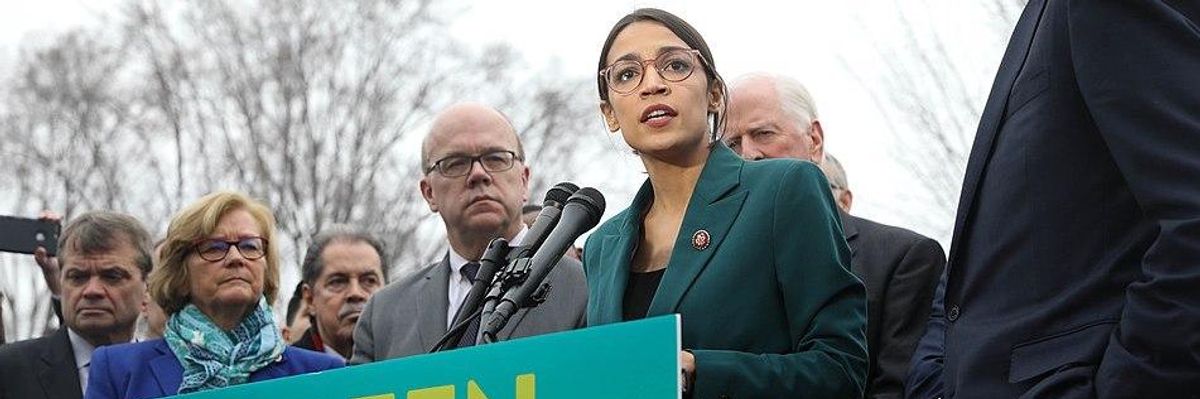
Rep. Alexandria Ocasio-Cortez speaks on the Green New Deal in front of the Capitol Building. (Photo: Senate Democrats Flickr)
Centrist House Democrats continue to argue for incrementalism and bipartisan solutions to address the climate crisis--even as progressives are doubling down on their demand for urgent and visionary action.
A resolution put forward in the House February by Rep. Alexandria Ocasio-Cortez proposes a Green New Deal that would take drastic action over the next decade, but not all members of the caucus are on board for what the global scientific community has said is necessary.
The New Democrat Coalition, a moderate group within the Democratic caucus, announced last week that it would pursue what the group defined as "tangible, achievable" approaches to the climate crisis through "gradual" action.
"We're not going to do 100 percent [renewable energy] over 10 years," the coalition's Rep. Elaine Luria (D-Va.) in an interview with The Hill published on Friday.
The New Democrats have a climate task force in place to develop plans to tackle the crisis, but not to go so far as the "aspirational" ideas of the Green New Deal, said Luria.
"The entire plan of the task force is to find ways to attack this incrementally," Luria said.
The coalition also stressed its commitment to reaching across the aisle to the GOP.
"We are all on the same page going forward and bringing a bipartisan, bicameral discussion," said Rep. Paul Tonko (D-N.Y.).
But incrementalism and bipartisanship aren't the answer, youth climate activist group The Sunrise Movement said in a tweet Thursday responding to attempts by Environmental Protection Agency Administrator Andrew Wheeler--a Republican--to downplay the threat that the climate crisis poses to the country and the world.
"We have roughly 12 years to prevent the worst of climate change -- not 50 years, not 75 years -- we've only got 12," the organization said.
The New York Democrat's proposed resolution would provide a framework for the next decade of climate policy in the House and the idea has proven broadly popular in the country. Increasingly, lawmakers in Congress are being forced to account for their positions on climate change in general and the Green New Deal in particular.
"In D.C., where climate has long been relegated to third-tier status, lawmakers could no longer avoid the issue," wrote TIME's Justin Worland in an essay exploring the evolution of the climate movement in the first three months of the new year.
Climate policy is a hot topic for the 116th Congress due to a number of recent global reports indicating that the scope of the catastrophe is worse than previously understood. That's led the charge for more immediate action from activists who want to see the policies from the Green New Deal implemented as soon as possible.
However, that's easier said than done.
Perhaps there's another solution in the minds of those willing to delay action, Ocasio-Cortez mused on Twitter.
The New York Democrat took a more serious approach to the legislation in an interview Thursday with late night host Seth Myers.
"The resolution of the Green New Deal is the vision of what we need to accomplish in the next ten years," said Ocasio-Cortez.
Watch the full interview:
Dear Common Dreams reader, It’s been nearly 30 years since I co-founded Common Dreams with my late wife, Lina Newhouser. We had the radical notion that journalism should serve the public good, not corporate profits. It was clear to us from the outset what it would take to build such a project. No paid advertisements. No corporate sponsors. No millionaire publisher telling us what to think or do. Many people said we wouldn't last a year, but we proved those doubters wrong. Together with a tremendous team of journalists and dedicated staff, we built an independent media outlet free from the constraints of profits and corporate control. Our mission has always been simple: To inform. To inspire. To ignite change for the common good. Building Common Dreams was not easy. Our survival was never guaranteed. When you take on the most powerful forces—Wall Street greed, fossil fuel industry destruction, Big Tech lobbyists, and uber-rich oligarchs who have spent billions upon billions rigging the economy and democracy in their favor—the only bulwark you have is supporters who believe in your work. But here’s the urgent message from me today. It's never been this bad out there. And it's never been this hard to keep us going. At the very moment Common Dreams is most needed, the threats we face are intensifying. We need your support now more than ever. We don't accept corporate advertising and never will. We don't have a paywall because we don't think people should be blocked from critical news based on their ability to pay. Everything we do is funded by the donations of readers like you. When everyone does the little they can afford, we are strong. But if that support retreats or dries up, so do we. Will you donate now to make sure Common Dreams not only survives but thrives? —Craig Brown, Co-founder |
Centrist House Democrats continue to argue for incrementalism and bipartisan solutions to address the climate crisis--even as progressives are doubling down on their demand for urgent and visionary action.
A resolution put forward in the House February by Rep. Alexandria Ocasio-Cortez proposes a Green New Deal that would take drastic action over the next decade, but not all members of the caucus are on board for what the global scientific community has said is necessary.
The New Democrat Coalition, a moderate group within the Democratic caucus, announced last week that it would pursue what the group defined as "tangible, achievable" approaches to the climate crisis through "gradual" action.
"We're not going to do 100 percent [renewable energy] over 10 years," the coalition's Rep. Elaine Luria (D-Va.) in an interview with The Hill published on Friday.
The New Democrats have a climate task force in place to develop plans to tackle the crisis, but not to go so far as the "aspirational" ideas of the Green New Deal, said Luria.
"The entire plan of the task force is to find ways to attack this incrementally," Luria said.
The coalition also stressed its commitment to reaching across the aisle to the GOP.
"We are all on the same page going forward and bringing a bipartisan, bicameral discussion," said Rep. Paul Tonko (D-N.Y.).
But incrementalism and bipartisanship aren't the answer, youth climate activist group The Sunrise Movement said in a tweet Thursday responding to attempts by Environmental Protection Agency Administrator Andrew Wheeler--a Republican--to downplay the threat that the climate crisis poses to the country and the world.
"We have roughly 12 years to prevent the worst of climate change -- not 50 years, not 75 years -- we've only got 12," the organization said.
The New York Democrat's proposed resolution would provide a framework for the next decade of climate policy in the House and the idea has proven broadly popular in the country. Increasingly, lawmakers in Congress are being forced to account for their positions on climate change in general and the Green New Deal in particular.
"In D.C., where climate has long been relegated to third-tier status, lawmakers could no longer avoid the issue," wrote TIME's Justin Worland in an essay exploring the evolution of the climate movement in the first three months of the new year.
Climate policy is a hot topic for the 116th Congress due to a number of recent global reports indicating that the scope of the catastrophe is worse than previously understood. That's led the charge for more immediate action from activists who want to see the policies from the Green New Deal implemented as soon as possible.
However, that's easier said than done.
Perhaps there's another solution in the minds of those willing to delay action, Ocasio-Cortez mused on Twitter.
The New York Democrat took a more serious approach to the legislation in an interview Thursday with late night host Seth Myers.
"The resolution of the Green New Deal is the vision of what we need to accomplish in the next ten years," said Ocasio-Cortez.
Watch the full interview:
Centrist House Democrats continue to argue for incrementalism and bipartisan solutions to address the climate crisis--even as progressives are doubling down on their demand for urgent and visionary action.
A resolution put forward in the House February by Rep. Alexandria Ocasio-Cortez proposes a Green New Deal that would take drastic action over the next decade, but not all members of the caucus are on board for what the global scientific community has said is necessary.
The New Democrat Coalition, a moderate group within the Democratic caucus, announced last week that it would pursue what the group defined as "tangible, achievable" approaches to the climate crisis through "gradual" action.
"We're not going to do 100 percent [renewable energy] over 10 years," the coalition's Rep. Elaine Luria (D-Va.) in an interview with The Hill published on Friday.
The New Democrats have a climate task force in place to develop plans to tackle the crisis, but not to go so far as the "aspirational" ideas of the Green New Deal, said Luria.
"The entire plan of the task force is to find ways to attack this incrementally," Luria said.
The coalition also stressed its commitment to reaching across the aisle to the GOP.
"We are all on the same page going forward and bringing a bipartisan, bicameral discussion," said Rep. Paul Tonko (D-N.Y.).
But incrementalism and bipartisanship aren't the answer, youth climate activist group The Sunrise Movement said in a tweet Thursday responding to attempts by Environmental Protection Agency Administrator Andrew Wheeler--a Republican--to downplay the threat that the climate crisis poses to the country and the world.
"We have roughly 12 years to prevent the worst of climate change -- not 50 years, not 75 years -- we've only got 12," the organization said.
The New York Democrat's proposed resolution would provide a framework for the next decade of climate policy in the House and the idea has proven broadly popular in the country. Increasingly, lawmakers in Congress are being forced to account for their positions on climate change in general and the Green New Deal in particular.
"In D.C., where climate has long been relegated to third-tier status, lawmakers could no longer avoid the issue," wrote TIME's Justin Worland in an essay exploring the evolution of the climate movement in the first three months of the new year.
Climate policy is a hot topic for the 116th Congress due to a number of recent global reports indicating that the scope of the catastrophe is worse than previously understood. That's led the charge for more immediate action from activists who want to see the policies from the Green New Deal implemented as soon as possible.
However, that's easier said than done.
Perhaps there's another solution in the minds of those willing to delay action, Ocasio-Cortez mused on Twitter.
The New York Democrat took a more serious approach to the legislation in an interview Thursday with late night host Seth Myers.
"The resolution of the Green New Deal is the vision of what we need to accomplish in the next ten years," said Ocasio-Cortez.
Watch the full interview: