SUBSCRIBE TO OUR FREE NEWSLETTER
Daily news & progressive opinion—funded by the people, not the corporations—delivered straight to your inbox.
5
#000000
#FFFFFF
To donate by check, phone, or other method, see our More Ways to Give page.
Daily news & progressive opinion—funded by the people, not the corporations—delivered straight to your inbox.
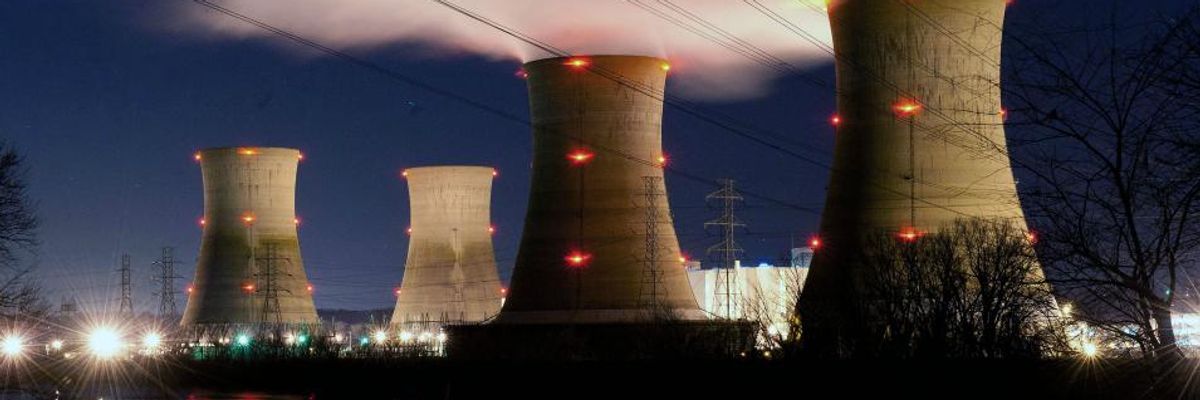
The Three Mile Island Nuclear Plant is seen in the early morning hours March 28, 2011 in Middletown, Pennsylvania. (Photo: Jeff Fusco/Getty Images)
Independent watchdogs are raising alarm about the nuclear power industry's ongoing efforts to convince federal regulators to scale back safety inspections and limit what "lower-level" issues are reported to the public.
The Nuclear Regulatory Commission (NRC)--an agency dominated by President Donald Trump's appointees--is currently reviewing its enforcement policies and is set to put forth recommendations for updating the nationwide rules in June. As part of that process, it sought input from plant operators and industry groups.
In September, one of those groups, the Nuclear Energy Institute (NEI), outlined the industry's wish list in a letter (pdf). Requests include shifting to more "self-assessments," cutting back on public disclosures for problems at plants, and reducing the "burden of radiation-protection and emergency-preparedness inspections."
As The Associated Press reported:
The Trump NRC appointees and industry representatives say changes in oversight are warranted to reflect the industry's overall improved safety records and its financial difficulties, as the operating costs of the country's aging nuclear plants increase and affordable natural gas and solar and wind power gain in the energy market.
But the prospect of the Trump administration's regulation-cutting mission reaching the NRC alarms some independent industry watchdogs, who say the words "nuclear safety" and "deregulation" don't go together.
"For an industry that is increasingly under financial decline," Paul Gunter of the anti-nuclear group Beyond Nuclear told AP, "to take regulatory authority away from the NRC puts us on a collision course... with a nuclear accident."
Geoffrey Fettus, a senior attorney for nuclear issues at the Natural Resources Defense Council, suggested the potential consequences of rolling back nuclear regulations are arguably far greater than the Trump administration's efforts to relax other rules, such as the federal government's Securities Exchange Commission (SEC).
"The deregulatory agenda at SEC is a significant concern as well, but it's not a nuclear power plant," Fettus said.
Worries over how industry lobbying will sway the NRC's forthcoming recommendations follow critiques from experts and activists of a "stripped down" safety rule the agency's five commissioners approved with a 3-2 party-line vote in January.
As journalist Susan Q. Stranahan--who covered the Three Mile Island accident and co-authored Fukushima: The Story of a Nuclear Disaster--explained in an op-ed for the Washington Post on Thursday, "NRC commissioners rejected a recommendation from their own senior staff to require reactor owners to recognize new climate reality and fortify their plants against real-world natural hazards such as flooding and seismic events."
The Democratic commissioners, Jeff Baran and Stephen Burns, strongly objected to the rule. Baran charged that is "nonsensical" to not require nuclear power plants "to be prepared for the actual flooding and earthquake hazards that could occur at their sites," while Burns pointed out that "the accident at Fukushima was a direct result of the operator and regulator failing to take action to account for new scientific knowledge related to natural hazards, especially flooding hazards."
And, as Stranahan noted: "For those keeping tabs, March is nuclear accident month. Three Mile Island occurred 40 years ago; Fukushima Daiichi, eight."
Meanwhile, on Thursday, massive flooding in the Midwest caused a dam to fail in Spencer, Nebraska and led the Nebraska Public Power District (NPPD) to start sandbagging a levee that protects the Cooper Nuclear Station from the Missouri River.
Though NPPD said Friday that "there is no threat to plant employees or to the public," Stephen Schwartz, a senior fellow at the Bulletin of the Atomic Scientists, said in a series of tweets that "it's worth noting that Cooper Nuclear Station uses a General Electric Mark 1 boiling water reactor, identical in design to the 4 reactors that were flooded and subsequently exploded eight years ago this week in Fukushima."
Dear Common Dreams reader, It’s been nearly 30 years since I co-founded Common Dreams with my late wife, Lina Newhouser. We had the radical notion that journalism should serve the public good, not corporate profits. It was clear to us from the outset what it would take to build such a project. No paid advertisements. No corporate sponsors. No millionaire publisher telling us what to think or do. Many people said we wouldn't last a year, but we proved those doubters wrong. Together with a tremendous team of journalists and dedicated staff, we built an independent media outlet free from the constraints of profits and corporate control. Our mission has always been simple: To inform. To inspire. To ignite change for the common good. Building Common Dreams was not easy. Our survival was never guaranteed. When you take on the most powerful forces—Wall Street greed, fossil fuel industry destruction, Big Tech lobbyists, and uber-rich oligarchs who have spent billions upon billions rigging the economy and democracy in their favor—the only bulwark you have is supporters who believe in your work. But here’s the urgent message from me today. It's never been this bad out there. And it's never been this hard to keep us going. At the very moment Common Dreams is most needed, the threats we face are intensifying. We need your support now more than ever. We don't accept corporate advertising and never will. We don't have a paywall because we don't think people should be blocked from critical news based on their ability to pay. Everything we do is funded by the donations of readers like you. When everyone does the little they can afford, we are strong. But if that support retreats or dries up, so do we. Will you donate now to make sure Common Dreams not only survives but thrives? —Craig Brown, Co-founder |
Independent watchdogs are raising alarm about the nuclear power industry's ongoing efforts to convince federal regulators to scale back safety inspections and limit what "lower-level" issues are reported to the public.
The Nuclear Regulatory Commission (NRC)--an agency dominated by President Donald Trump's appointees--is currently reviewing its enforcement policies and is set to put forth recommendations for updating the nationwide rules in June. As part of that process, it sought input from plant operators and industry groups.
In September, one of those groups, the Nuclear Energy Institute (NEI), outlined the industry's wish list in a letter (pdf). Requests include shifting to more "self-assessments," cutting back on public disclosures for problems at plants, and reducing the "burden of radiation-protection and emergency-preparedness inspections."
As The Associated Press reported:
The Trump NRC appointees and industry representatives say changes in oversight are warranted to reflect the industry's overall improved safety records and its financial difficulties, as the operating costs of the country's aging nuclear plants increase and affordable natural gas and solar and wind power gain in the energy market.
But the prospect of the Trump administration's regulation-cutting mission reaching the NRC alarms some independent industry watchdogs, who say the words "nuclear safety" and "deregulation" don't go together.
"For an industry that is increasingly under financial decline," Paul Gunter of the anti-nuclear group Beyond Nuclear told AP, "to take regulatory authority away from the NRC puts us on a collision course... with a nuclear accident."
Geoffrey Fettus, a senior attorney for nuclear issues at the Natural Resources Defense Council, suggested the potential consequences of rolling back nuclear regulations are arguably far greater than the Trump administration's efforts to relax other rules, such as the federal government's Securities Exchange Commission (SEC).
"The deregulatory agenda at SEC is a significant concern as well, but it's not a nuclear power plant," Fettus said.
Worries over how industry lobbying will sway the NRC's forthcoming recommendations follow critiques from experts and activists of a "stripped down" safety rule the agency's five commissioners approved with a 3-2 party-line vote in January.
As journalist Susan Q. Stranahan--who covered the Three Mile Island accident and co-authored Fukushima: The Story of a Nuclear Disaster--explained in an op-ed for the Washington Post on Thursday, "NRC commissioners rejected a recommendation from their own senior staff to require reactor owners to recognize new climate reality and fortify their plants against real-world natural hazards such as flooding and seismic events."
The Democratic commissioners, Jeff Baran and Stephen Burns, strongly objected to the rule. Baran charged that is "nonsensical" to not require nuclear power plants "to be prepared for the actual flooding and earthquake hazards that could occur at their sites," while Burns pointed out that "the accident at Fukushima was a direct result of the operator and regulator failing to take action to account for new scientific knowledge related to natural hazards, especially flooding hazards."
And, as Stranahan noted: "For those keeping tabs, March is nuclear accident month. Three Mile Island occurred 40 years ago; Fukushima Daiichi, eight."
Meanwhile, on Thursday, massive flooding in the Midwest caused a dam to fail in Spencer, Nebraska and led the Nebraska Public Power District (NPPD) to start sandbagging a levee that protects the Cooper Nuclear Station from the Missouri River.
Though NPPD said Friday that "there is no threat to plant employees or to the public," Stephen Schwartz, a senior fellow at the Bulletin of the Atomic Scientists, said in a series of tweets that "it's worth noting that Cooper Nuclear Station uses a General Electric Mark 1 boiling water reactor, identical in design to the 4 reactors that were flooded and subsequently exploded eight years ago this week in Fukushima."
Independent watchdogs are raising alarm about the nuclear power industry's ongoing efforts to convince federal regulators to scale back safety inspections and limit what "lower-level" issues are reported to the public.
The Nuclear Regulatory Commission (NRC)--an agency dominated by President Donald Trump's appointees--is currently reviewing its enforcement policies and is set to put forth recommendations for updating the nationwide rules in June. As part of that process, it sought input from plant operators and industry groups.
In September, one of those groups, the Nuclear Energy Institute (NEI), outlined the industry's wish list in a letter (pdf). Requests include shifting to more "self-assessments," cutting back on public disclosures for problems at plants, and reducing the "burden of radiation-protection and emergency-preparedness inspections."
As The Associated Press reported:
The Trump NRC appointees and industry representatives say changes in oversight are warranted to reflect the industry's overall improved safety records and its financial difficulties, as the operating costs of the country's aging nuclear plants increase and affordable natural gas and solar and wind power gain in the energy market.
But the prospect of the Trump administration's regulation-cutting mission reaching the NRC alarms some independent industry watchdogs, who say the words "nuclear safety" and "deregulation" don't go together.
"For an industry that is increasingly under financial decline," Paul Gunter of the anti-nuclear group Beyond Nuclear told AP, "to take regulatory authority away from the NRC puts us on a collision course... with a nuclear accident."
Geoffrey Fettus, a senior attorney for nuclear issues at the Natural Resources Defense Council, suggested the potential consequences of rolling back nuclear regulations are arguably far greater than the Trump administration's efforts to relax other rules, such as the federal government's Securities Exchange Commission (SEC).
"The deregulatory agenda at SEC is a significant concern as well, but it's not a nuclear power plant," Fettus said.
Worries over how industry lobbying will sway the NRC's forthcoming recommendations follow critiques from experts and activists of a "stripped down" safety rule the agency's five commissioners approved with a 3-2 party-line vote in January.
As journalist Susan Q. Stranahan--who covered the Three Mile Island accident and co-authored Fukushima: The Story of a Nuclear Disaster--explained in an op-ed for the Washington Post on Thursday, "NRC commissioners rejected a recommendation from their own senior staff to require reactor owners to recognize new climate reality and fortify their plants against real-world natural hazards such as flooding and seismic events."
The Democratic commissioners, Jeff Baran and Stephen Burns, strongly objected to the rule. Baran charged that is "nonsensical" to not require nuclear power plants "to be prepared for the actual flooding and earthquake hazards that could occur at their sites," while Burns pointed out that "the accident at Fukushima was a direct result of the operator and regulator failing to take action to account for new scientific knowledge related to natural hazards, especially flooding hazards."
And, as Stranahan noted: "For those keeping tabs, March is nuclear accident month. Three Mile Island occurred 40 years ago; Fukushima Daiichi, eight."
Meanwhile, on Thursday, massive flooding in the Midwest caused a dam to fail in Spencer, Nebraska and led the Nebraska Public Power District (NPPD) to start sandbagging a levee that protects the Cooper Nuclear Station from the Missouri River.
Though NPPD said Friday that "there is no threat to plant employees or to the public," Stephen Schwartz, a senior fellow at the Bulletin of the Atomic Scientists, said in a series of tweets that "it's worth noting that Cooper Nuclear Station uses a General Electric Mark 1 boiling water reactor, identical in design to the 4 reactors that were flooded and subsequently exploded eight years ago this week in Fukushima."