SUBSCRIBE TO OUR FREE NEWSLETTER
Daily news & progressive opinion—funded by the people, not the corporations—delivered straight to your inbox.
5
#000000
#FFFFFF
To donate by check, phone, or other method, see our More Ways to Give page.
Daily news & progressive opinion—funded by the people, not the corporations—delivered straight to your inbox.
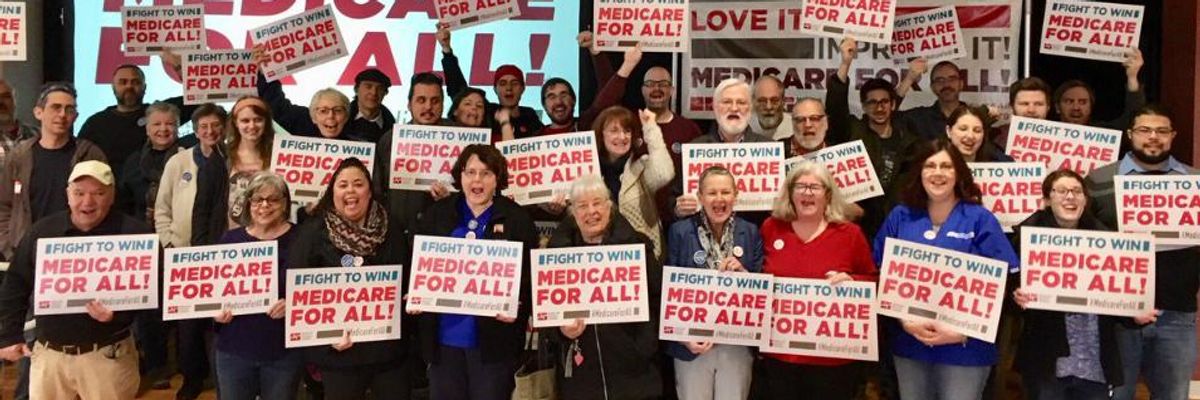
"Count us in!" said National Nurses United (NNU), which has been holding "barnstorms" nationwide to build grassroots momentum for single-payer. (Photo: National Nurses United/Twitter)
In just two weeks, what is being heralded as an "astonishingly strong" plan to create a Medicare for All system in the United States will be introduced in the U.S. House.
With energized grassroots activists, more than 90 congressional co-sponsors, and public opinion all firmly on her side, Rep. Pramila Jayapal (D-Wash.) announced on Wednesday that she plans to introduce her 150-page Medicare for All bill the week after next.
One healthcare justice organizer who has read a detailed overview of the bill said it should now be considered the new "baseline" for national single-payer legislation.
"Thousands of nurses and health care activists who participated in the National Week of Action are fired up and ready to do what it takes to pass the Medicare for All Act of 2019."
--National Nurses United"Medicare for All is the solution our country needs. Long-term care, mental health services, women's reproductive health. All without co-pays or deductibles," declared Jayapal, who sent a letter to her House colleagues this week urging them to sign on to the legislation. "Join me in two weeks and let's make history with the Medicare for All Act."
Speaking to the Washington Post, Jayapal said she expects to introduce her bill with at least 100 original co-sponsors.
"Count us in!" said National Nurses United (NNU), which has been holding "barnstorms" nationwide to build grassroots momentum for single-payer. "Thousands of nurses and healthcare activists who participated in the National Week of Action are fired up and ready to do what it takes to pass the Medicare for All Act of 2019."
In an analysis of Jayapal's legislation and the broader fight for Medicare for All in Splinter on Thursday, single-payer proponent and health policy expert Tim Faust offered strong praise for the Medicare for All Act after reading an overview of the bill.
Noting that he is "generally inclined to distrust the policy gestures of elected officials," Faust wrote that--while not perfect--Jayapal's bill "appears to meet all of the criteria for a proper single-payer plan."
"It includes long-term care with a preference toward home health. It sets guidelines for care but lets doctors overrule them. It is, by all accounts, the first actual robust single-payer bill of the post-[Affordable Care Act] era," he argued. "If you are looking for a bill to call 'Medicare for All,' this is the one. It must not be permitted to be weakened."
"Only Medicare for All will bring down national health spending and guarantee healthcare as a human right for every American."
--Diane Archer, Just Care USA
While Jayapal's bill will be released as nurses and other grassroots activists mobilize in support of Medicare for All across the nation, it will also come as a number of her Democratic colleagues in the House and Senate are pushing ahead with Medicare buy-in plans and other half-measures, which single-payer supporters say would leave the fundamental cruelty and wastefulness of the current for-profit system intact.
After Sen. Sherrod Brown (D-Ohio), Rep. Joe Courtney (D-Conn.), and several other Democrats introduced Medicare buy-in legislation on Wednesday, Just Care USA president Diane Archer labeled such plans "Medicare for Some" and argued they would "not address the unsustainable cost increases keeping our commercial healthcare system from being as fair and effective as Medicare itself or the healthcare systems in place in other developed countries."
"Only Medicare for All will bring down national health spending and guarantee healthcare as a human right for every American," Archer wrote in a piece for Common Dreams on Thursday. "It does so by eliminating the profits, administrative waste and inefficiencies of commercial health insurance and using the collective bargaining leverage of all Americans to negotiate fair rates for doctors, hospitals and prescription drugs."
Faust emphatically agreed with Archer's assessment of the recent proliferation of buy-in bills, warning Americans to "look out" if lawmakers and 2020 presidential candidates "float a 'pragmatic policy solution' or talk about plans named something like 'Medicare Extra As A Service... For You!' (If they're polite, perhaps they will at least say they support 'Medicare for All' before announcing they'd be open to keeping the feet of private insurance companies on our throats)."
"These pathetic programs, which usually revolve around a 'public option,' are what happens when politicians understand the need for a massive change but lack the moral imagination to do anything but genuflect to existing structures," Faust argued. "They are, in reality, corporate bailout packages which do very little for you, but quite a bit for the Aetnas and the Sacklers and the Joe Manchins."
Dear Common Dreams reader, It’s been nearly 30 years since I co-founded Common Dreams with my late wife, Lina Newhouser. We had the radical notion that journalism should serve the public good, not corporate profits. It was clear to us from the outset what it would take to build such a project. No paid advertisements. No corporate sponsors. No millionaire publisher telling us what to think or do. Many people said we wouldn't last a year, but we proved those doubters wrong. Together with a tremendous team of journalists and dedicated staff, we built an independent media outlet free from the constraints of profits and corporate control. Our mission has always been simple: To inform. To inspire. To ignite change for the common good. Building Common Dreams was not easy. Our survival was never guaranteed. When you take on the most powerful forces—Wall Street greed, fossil fuel industry destruction, Big Tech lobbyists, and uber-rich oligarchs who have spent billions upon billions rigging the economy and democracy in their favor—the only bulwark you have is supporters who believe in your work. But here’s the urgent message from me today. It's never been this bad out there. And it's never been this hard to keep us going. At the very moment Common Dreams is most needed, the threats we face are intensifying. We need your support now more than ever. We don't accept corporate advertising and never will. We don't have a paywall because we don't think people should be blocked from critical news based on their ability to pay. Everything we do is funded by the donations of readers like you. When everyone does the little they can afford, we are strong. But if that support retreats or dries up, so do we. Will you donate now to make sure Common Dreams not only survives but thrives? —Craig Brown, Co-founder |
In just two weeks, what is being heralded as an "astonishingly strong" plan to create a Medicare for All system in the United States will be introduced in the U.S. House.
With energized grassroots activists, more than 90 congressional co-sponsors, and public opinion all firmly on her side, Rep. Pramila Jayapal (D-Wash.) announced on Wednesday that she plans to introduce her 150-page Medicare for All bill the week after next.
One healthcare justice organizer who has read a detailed overview of the bill said it should now be considered the new "baseline" for national single-payer legislation.
"Thousands of nurses and health care activists who participated in the National Week of Action are fired up and ready to do what it takes to pass the Medicare for All Act of 2019."
--National Nurses United"Medicare for All is the solution our country needs. Long-term care, mental health services, women's reproductive health. All without co-pays or deductibles," declared Jayapal, who sent a letter to her House colleagues this week urging them to sign on to the legislation. "Join me in two weeks and let's make history with the Medicare for All Act."
Speaking to the Washington Post, Jayapal said she expects to introduce her bill with at least 100 original co-sponsors.
"Count us in!" said National Nurses United (NNU), which has been holding "barnstorms" nationwide to build grassroots momentum for single-payer. "Thousands of nurses and healthcare activists who participated in the National Week of Action are fired up and ready to do what it takes to pass the Medicare for All Act of 2019."
In an analysis of Jayapal's legislation and the broader fight for Medicare for All in Splinter on Thursday, single-payer proponent and health policy expert Tim Faust offered strong praise for the Medicare for All Act after reading an overview of the bill.
Noting that he is "generally inclined to distrust the policy gestures of elected officials," Faust wrote that--while not perfect--Jayapal's bill "appears to meet all of the criteria for a proper single-payer plan."
"It includes long-term care with a preference toward home health. It sets guidelines for care but lets doctors overrule them. It is, by all accounts, the first actual robust single-payer bill of the post-[Affordable Care Act] era," he argued. "If you are looking for a bill to call 'Medicare for All,' this is the one. It must not be permitted to be weakened."
"Only Medicare for All will bring down national health spending and guarantee healthcare as a human right for every American."
--Diane Archer, Just Care USA
While Jayapal's bill will be released as nurses and other grassroots activists mobilize in support of Medicare for All across the nation, it will also come as a number of her Democratic colleagues in the House and Senate are pushing ahead with Medicare buy-in plans and other half-measures, which single-payer supporters say would leave the fundamental cruelty and wastefulness of the current for-profit system intact.
After Sen. Sherrod Brown (D-Ohio), Rep. Joe Courtney (D-Conn.), and several other Democrats introduced Medicare buy-in legislation on Wednesday, Just Care USA president Diane Archer labeled such plans "Medicare for Some" and argued they would "not address the unsustainable cost increases keeping our commercial healthcare system from being as fair and effective as Medicare itself or the healthcare systems in place in other developed countries."
"Only Medicare for All will bring down national health spending and guarantee healthcare as a human right for every American," Archer wrote in a piece for Common Dreams on Thursday. "It does so by eliminating the profits, administrative waste and inefficiencies of commercial health insurance and using the collective bargaining leverage of all Americans to negotiate fair rates for doctors, hospitals and prescription drugs."
Faust emphatically agreed with Archer's assessment of the recent proliferation of buy-in bills, warning Americans to "look out" if lawmakers and 2020 presidential candidates "float a 'pragmatic policy solution' or talk about plans named something like 'Medicare Extra As A Service... For You!' (If they're polite, perhaps they will at least say they support 'Medicare for All' before announcing they'd be open to keeping the feet of private insurance companies on our throats)."
"These pathetic programs, which usually revolve around a 'public option,' are what happens when politicians understand the need for a massive change but lack the moral imagination to do anything but genuflect to existing structures," Faust argued. "They are, in reality, corporate bailout packages which do very little for you, but quite a bit for the Aetnas and the Sacklers and the Joe Manchins."
In just two weeks, what is being heralded as an "astonishingly strong" plan to create a Medicare for All system in the United States will be introduced in the U.S. House.
With energized grassroots activists, more than 90 congressional co-sponsors, and public opinion all firmly on her side, Rep. Pramila Jayapal (D-Wash.) announced on Wednesday that she plans to introduce her 150-page Medicare for All bill the week after next.
One healthcare justice organizer who has read a detailed overview of the bill said it should now be considered the new "baseline" for national single-payer legislation.
"Thousands of nurses and health care activists who participated in the National Week of Action are fired up and ready to do what it takes to pass the Medicare for All Act of 2019."
--National Nurses United"Medicare for All is the solution our country needs. Long-term care, mental health services, women's reproductive health. All without co-pays or deductibles," declared Jayapal, who sent a letter to her House colleagues this week urging them to sign on to the legislation. "Join me in two weeks and let's make history with the Medicare for All Act."
Speaking to the Washington Post, Jayapal said she expects to introduce her bill with at least 100 original co-sponsors.
"Count us in!" said National Nurses United (NNU), which has been holding "barnstorms" nationwide to build grassroots momentum for single-payer. "Thousands of nurses and healthcare activists who participated in the National Week of Action are fired up and ready to do what it takes to pass the Medicare for All Act of 2019."
In an analysis of Jayapal's legislation and the broader fight for Medicare for All in Splinter on Thursday, single-payer proponent and health policy expert Tim Faust offered strong praise for the Medicare for All Act after reading an overview of the bill.
Noting that he is "generally inclined to distrust the policy gestures of elected officials," Faust wrote that--while not perfect--Jayapal's bill "appears to meet all of the criteria for a proper single-payer plan."
"It includes long-term care with a preference toward home health. It sets guidelines for care but lets doctors overrule them. It is, by all accounts, the first actual robust single-payer bill of the post-[Affordable Care Act] era," he argued. "If you are looking for a bill to call 'Medicare for All,' this is the one. It must not be permitted to be weakened."
"Only Medicare for All will bring down national health spending and guarantee healthcare as a human right for every American."
--Diane Archer, Just Care USA
While Jayapal's bill will be released as nurses and other grassroots activists mobilize in support of Medicare for All across the nation, it will also come as a number of her Democratic colleagues in the House and Senate are pushing ahead with Medicare buy-in plans and other half-measures, which single-payer supporters say would leave the fundamental cruelty and wastefulness of the current for-profit system intact.
After Sen. Sherrod Brown (D-Ohio), Rep. Joe Courtney (D-Conn.), and several other Democrats introduced Medicare buy-in legislation on Wednesday, Just Care USA president Diane Archer labeled such plans "Medicare for Some" and argued they would "not address the unsustainable cost increases keeping our commercial healthcare system from being as fair and effective as Medicare itself or the healthcare systems in place in other developed countries."
"Only Medicare for All will bring down national health spending and guarantee healthcare as a human right for every American," Archer wrote in a piece for Common Dreams on Thursday. "It does so by eliminating the profits, administrative waste and inefficiencies of commercial health insurance and using the collective bargaining leverage of all Americans to negotiate fair rates for doctors, hospitals and prescription drugs."
Faust emphatically agreed with Archer's assessment of the recent proliferation of buy-in bills, warning Americans to "look out" if lawmakers and 2020 presidential candidates "float a 'pragmatic policy solution' or talk about plans named something like 'Medicare Extra As A Service... For You!' (If they're polite, perhaps they will at least say they support 'Medicare for All' before announcing they'd be open to keeping the feet of private insurance companies on our throats)."
"These pathetic programs, which usually revolve around a 'public option,' are what happens when politicians understand the need for a massive change but lack the moral imagination to do anything but genuflect to existing structures," Faust argued. "They are, in reality, corporate bailout packages which do very little for you, but quite a bit for the Aetnas and the Sacklers and the Joe Manchins."