

SUBSCRIBE TO OUR FREE NEWSLETTER
Daily news & progressive opinion—funded by the people, not the corporations—delivered straight to your inbox.
5
#000000
#FFFFFF
To donate by check, phone, or other method, see our More Ways to Give page.
Daily news & progressive opinion—funded by the people, not the corporations—delivered straight to your inbox.
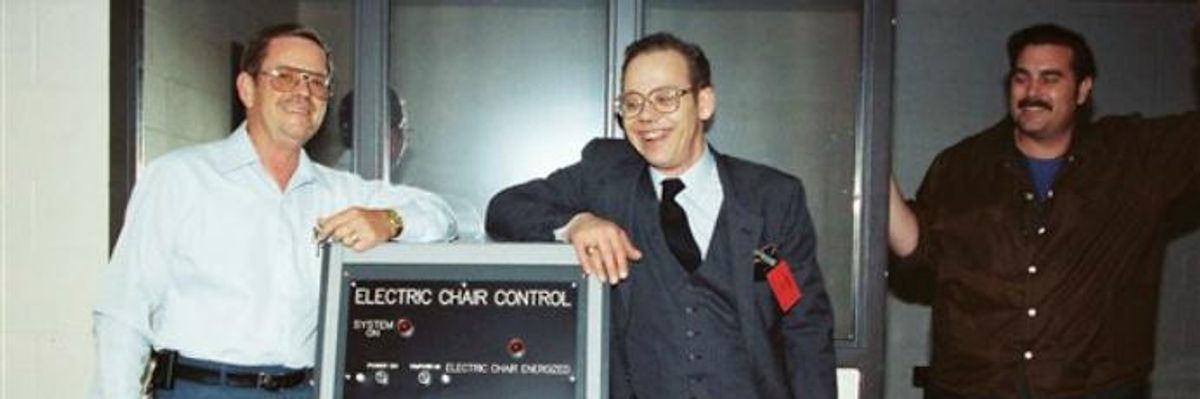
Fred Leuchter, center, stands near the control panel for the electric chair he built. Leuchter says he is afraid the chair will malfunction at an execution scheduled for Nov. 1, 2018, because of later modifications. Tennessee's Republican Gov. Bill Haslam says he is confident it will work. (Photo: Fred Leuchter/AP file)
Tennessee plans to execute by electric chair 63-year-old Edmund Zagorski on Thursday night despite concerns from Fred Leuchter that the device, which he built in 1988 and the state last used in 2007, could fail.
"What I'm worried about now is Tennessee's got an electric chair that's going to hurt someone or cause problems. And it's got my name on it," said Leuchter. "I don't think it's going to be humane."
On Twitter Thursday, anti-death penalty activist Sister Helen Prejean--who advocates for completely abolishing capital punishment in the United States--called Tennessee's plans to use the decades-old chair to kill the inmate "all kinds of wrong."
Zagorski, an inmate at the Riverbend Maximum Security Institution (RMSI) who was convicted of murdering two men in 1984, initially was set to die by lethal injection last month. However, he chose the electric chair as, in the words of one of his lawyers, "the lesser of two evils," because of concerns about the drug cocktail that Tennessee uses for injections.
Citing court documents, CNN reported that Zagorski's attorneys had argued the inmate was forced to make a "terrible choice" between the chair--which, although still "dreadful and grim," would be "relatively fast," causing him "excruciating pain for (likely) 15-30 seconds"--and an injection that could cause him to endure 10 to 18 minutes of "utter terror and agony."
However, Leuchter, a "self-taught execution expert" who also worked on gas chambers, lethal injection machines, and a gallows in at least 27 states, told the Associated Press that he is concerned the chair may fail because of changes that others have made to it. Leuchter has not been allowed to service the device himself as he "is no longer welcome in the prison system," partly because he promoted himself as an engineer despite lacking a degree or license.
Zagorski's planned execution is just the latest to draw attention to the drugs used in state-sanctioned killings. Earlier this year, he was one of 32 death row inmates who sued the state over its controversial three-drug cocktail. As the Tennessean outlined in October, when the Tennessee Supreme Court ruled 4-1 that the state could continue using the formula:
The inmates' legal challenge centered around midazolam, the first of three drugs the state administers during lethal injections. Midazolam is supposed to render inmates unconscious and unable to feel pain, but several experts who testified for the inmates said it doesn't work as intended.
Experts said midazolam sedates inmates but does not stop them from feeling the effects of the other two drugs, vecuronium bromide and potassium chloride. Those drugs make inmates feel like they are burning from the inside and being buried alive, the experts said.
The pain is excruciating enough, they argued, to violate the U.S. Constitution.
Billy Ray Irick, who had been a plaintiff in the case, was executed by lethal injection at RMSI in August. According to Nashville Scene writer Steven Hale, who observed that execution, although Irick was initially unresponsive after the midazolam was administered, he then "jolted and produced what sounded like a cough or a choking noise," and his "face changed to almost purple," before he ultimately was pronounced dead.
Midazolam has been part of multiple botched executions in other states, which has led to heightened controversy and other court battles--including an effort by the pharmaceutical company Alvogen earlier this year to block Nevada from using its drug. Despite claims that use of midazolam is unconstitutional, the U.S. Supreme Court ruled 5-4 in 2015 that states could continue to use the drug to kill condemned prisoners.
Dear Common Dreams reader, It’s been nearly 30 years since I co-founded Common Dreams with my late wife, Lina Newhouser. We had the radical notion that journalism should serve the public good, not corporate profits. It was clear to us from the outset what it would take to build such a project. No paid advertisements. No corporate sponsors. No millionaire publisher telling us what to think or do. Many people said we wouldn't last a year, but we proved those doubters wrong. Together with a tremendous team of journalists and dedicated staff, we built an independent media outlet free from the constraints of profits and corporate control. Our mission has always been simple: To inform. To inspire. To ignite change for the common good. Building Common Dreams was not easy. Our survival was never guaranteed. When you take on the most powerful forces—Wall Street greed, fossil fuel industry destruction, Big Tech lobbyists, and uber-rich oligarchs who have spent billions upon billions rigging the economy and democracy in their favor—the only bulwark you have is supporters who believe in your work. But here’s the urgent message from me today. It's never been this bad out there. And it's never been this hard to keep us going. At the very moment Common Dreams is most needed, the threats we face are intensifying. We need your support now more than ever. We don't accept corporate advertising and never will. We don't have a paywall because we don't think people should be blocked from critical news based on their ability to pay. Everything we do is funded by the donations of readers like you. When everyone does the little they can afford, we are strong. But if that support retreats or dries up, so do we. Will you donate now to make sure Common Dreams not only survives but thrives? —Craig Brown, Co-founder |
Tennessee plans to execute by electric chair 63-year-old Edmund Zagorski on Thursday night despite concerns from Fred Leuchter that the device, which he built in 1988 and the state last used in 2007, could fail.
"What I'm worried about now is Tennessee's got an electric chair that's going to hurt someone or cause problems. And it's got my name on it," said Leuchter. "I don't think it's going to be humane."
On Twitter Thursday, anti-death penalty activist Sister Helen Prejean--who advocates for completely abolishing capital punishment in the United States--called Tennessee's plans to use the decades-old chair to kill the inmate "all kinds of wrong."
Zagorski, an inmate at the Riverbend Maximum Security Institution (RMSI) who was convicted of murdering two men in 1984, initially was set to die by lethal injection last month. However, he chose the electric chair as, in the words of one of his lawyers, "the lesser of two evils," because of concerns about the drug cocktail that Tennessee uses for injections.
Citing court documents, CNN reported that Zagorski's attorneys had argued the inmate was forced to make a "terrible choice" between the chair--which, although still "dreadful and grim," would be "relatively fast," causing him "excruciating pain for (likely) 15-30 seconds"--and an injection that could cause him to endure 10 to 18 minutes of "utter terror and agony."
However, Leuchter, a "self-taught execution expert" who also worked on gas chambers, lethal injection machines, and a gallows in at least 27 states, told the Associated Press that he is concerned the chair may fail because of changes that others have made to it. Leuchter has not been allowed to service the device himself as he "is no longer welcome in the prison system," partly because he promoted himself as an engineer despite lacking a degree or license.
Zagorski's planned execution is just the latest to draw attention to the drugs used in state-sanctioned killings. Earlier this year, he was one of 32 death row inmates who sued the state over its controversial three-drug cocktail. As the Tennessean outlined in October, when the Tennessee Supreme Court ruled 4-1 that the state could continue using the formula:
The inmates' legal challenge centered around midazolam, the first of three drugs the state administers during lethal injections. Midazolam is supposed to render inmates unconscious and unable to feel pain, but several experts who testified for the inmates said it doesn't work as intended.
Experts said midazolam sedates inmates but does not stop them from feeling the effects of the other two drugs, vecuronium bromide and potassium chloride. Those drugs make inmates feel like they are burning from the inside and being buried alive, the experts said.
The pain is excruciating enough, they argued, to violate the U.S. Constitution.
Billy Ray Irick, who had been a plaintiff in the case, was executed by lethal injection at RMSI in August. According to Nashville Scene writer Steven Hale, who observed that execution, although Irick was initially unresponsive after the midazolam was administered, he then "jolted and produced what sounded like a cough or a choking noise," and his "face changed to almost purple," before he ultimately was pronounced dead.
Midazolam has been part of multiple botched executions in other states, which has led to heightened controversy and other court battles--including an effort by the pharmaceutical company Alvogen earlier this year to block Nevada from using its drug. Despite claims that use of midazolam is unconstitutional, the U.S. Supreme Court ruled 5-4 in 2015 that states could continue to use the drug to kill condemned prisoners.
Tennessee plans to execute by electric chair 63-year-old Edmund Zagorski on Thursday night despite concerns from Fred Leuchter that the device, which he built in 1988 and the state last used in 2007, could fail.
"What I'm worried about now is Tennessee's got an electric chair that's going to hurt someone or cause problems. And it's got my name on it," said Leuchter. "I don't think it's going to be humane."
On Twitter Thursday, anti-death penalty activist Sister Helen Prejean--who advocates for completely abolishing capital punishment in the United States--called Tennessee's plans to use the decades-old chair to kill the inmate "all kinds of wrong."
Zagorski, an inmate at the Riverbend Maximum Security Institution (RMSI) who was convicted of murdering two men in 1984, initially was set to die by lethal injection last month. However, he chose the electric chair as, in the words of one of his lawyers, "the lesser of two evils," because of concerns about the drug cocktail that Tennessee uses for injections.
Citing court documents, CNN reported that Zagorski's attorneys had argued the inmate was forced to make a "terrible choice" between the chair--which, although still "dreadful and grim," would be "relatively fast," causing him "excruciating pain for (likely) 15-30 seconds"--and an injection that could cause him to endure 10 to 18 minutes of "utter terror and agony."
However, Leuchter, a "self-taught execution expert" who also worked on gas chambers, lethal injection machines, and a gallows in at least 27 states, told the Associated Press that he is concerned the chair may fail because of changes that others have made to it. Leuchter has not been allowed to service the device himself as he "is no longer welcome in the prison system," partly because he promoted himself as an engineer despite lacking a degree or license.
Zagorski's planned execution is just the latest to draw attention to the drugs used in state-sanctioned killings. Earlier this year, he was one of 32 death row inmates who sued the state over its controversial three-drug cocktail. As the Tennessean outlined in October, when the Tennessee Supreme Court ruled 4-1 that the state could continue using the formula:
The inmates' legal challenge centered around midazolam, the first of three drugs the state administers during lethal injections. Midazolam is supposed to render inmates unconscious and unable to feel pain, but several experts who testified for the inmates said it doesn't work as intended.
Experts said midazolam sedates inmates but does not stop them from feeling the effects of the other two drugs, vecuronium bromide and potassium chloride. Those drugs make inmates feel like they are burning from the inside and being buried alive, the experts said.
The pain is excruciating enough, they argued, to violate the U.S. Constitution.
Billy Ray Irick, who had been a plaintiff in the case, was executed by lethal injection at RMSI in August. According to Nashville Scene writer Steven Hale, who observed that execution, although Irick was initially unresponsive after the midazolam was administered, he then "jolted and produced what sounded like a cough or a choking noise," and his "face changed to almost purple," before he ultimately was pronounced dead.
Midazolam has been part of multiple botched executions in other states, which has led to heightened controversy and other court battles--including an effort by the pharmaceutical company Alvogen earlier this year to block Nevada from using its drug. Despite claims that use of midazolam is unconstitutional, the U.S. Supreme Court ruled 5-4 in 2015 that states could continue to use the drug to kill condemned prisoners.

