SUBSCRIBE TO OUR FREE NEWSLETTER
Daily news & progressive opinion—funded by the people, not the corporations—delivered straight to your inbox.
5
#000000
#FFFFFF
To donate by check, phone, or other method, see our More Ways to Give page.
Daily news & progressive opinion—funded by the people, not the corporations—delivered straight to your inbox.
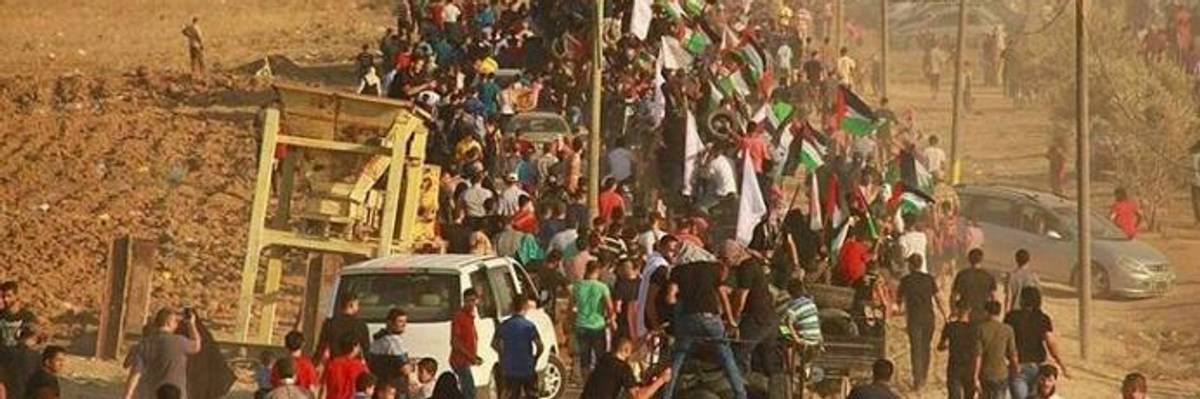
Thousands of Gazans protested the Israeli occupation of Palestinian territories on Friday. (Photo: The IMEU/Twiter)
Israeli soldiers shot and killed seven Gazans, and wounded more than 250 others, during weekly protests against the Israeli occupation of Palestinian territories and the humanitarian crisis in Gaza, according to local health officials.
Based on Palestinian Health Ministry figures, as Reuters noted, that brings the Palestinian death toll to about 200 since the Great Return March began at the Israel-Gaza border fence on March 30.
Politicians, international law experts, and human rights advocates have sharply condemned Israel not only for the decades-long occupation and the blockade that Israel and Egypt have imposed since Hamas took control of Gaza in 2007, but also for authorizing Israeli Defense Forces (IDF) to fire at unarmed protesters.
The Israeli military has not ceased its use of live ammunition and the targeting of demonstrators and bystanders, despite months of international outcry.
The Palestinians shot dead by the IDF on Friday were, according to Haaretz, "Ahmed Ibrahim Zaki El tawil, 27, from the Nuseirat refugee camp in Gaza; Ahmad Ahmad Abdullah Abu Naim, 17, from the Nuseirat refugee camp; Mohammed Abdulhafiz Yusuf Ismail, 29, from the al-Bureij refugee camp; Tamer Iyad Mahmoud Abu Rummaneh, 22, from Rafah; Afifi Mahmoud Atta Afifi, 18, from Gaza City; Abdullah Barham Sulaiman al-Daghmah, 25, from Abasan al-Jadida; and Issam Abbas, 21."
Some 15,000 Palestinians reportedly participated in this week's protest. In response to the demonstration on Friday, Israeli Defense Minister Avigdor Liberman ordered an immediate halt of all fuel deliveries through Israel to the Gaza Strip. Earlier this week, the United Nations had begun overseeing the delivery of Qatari fuel to restart Gaza's only power plant. Gaza's two million residents have been limited to roughly four hours of electricity per day.
Dear Common Dreams reader, It’s been nearly 30 years since I co-founded Common Dreams with my late wife, Lina Newhouser. We had the radical notion that journalism should serve the public good, not corporate profits. It was clear to us from the outset what it would take to build such a project. No paid advertisements. No corporate sponsors. No millionaire publisher telling us what to think or do. Many people said we wouldn't last a year, but we proved those doubters wrong. Together with a tremendous team of journalists and dedicated staff, we built an independent media outlet free from the constraints of profits and corporate control. Our mission has always been simple: To inform. To inspire. To ignite change for the common good. Building Common Dreams was not easy. Our survival was never guaranteed. When you take on the most powerful forces—Wall Street greed, fossil fuel industry destruction, Big Tech lobbyists, and uber-rich oligarchs who have spent billions upon billions rigging the economy and democracy in their favor—the only bulwark you have is supporters who believe in your work. But here’s the urgent message from me today. It's never been this bad out there. And it's never been this hard to keep us going. At the very moment Common Dreams is most needed, the threats we face are intensifying. We need your support now more than ever. We don't accept corporate advertising and never will. We don't have a paywall because we don't think people should be blocked from critical news based on their ability to pay. Everything we do is funded by the donations of readers like you. When everyone does the little they can afford, we are strong. But if that support retreats or dries up, so do we. Will you donate now to make sure Common Dreams not only survives but thrives? —Craig Brown, Co-founder |
Israeli soldiers shot and killed seven Gazans, and wounded more than 250 others, during weekly protests against the Israeli occupation of Palestinian territories and the humanitarian crisis in Gaza, according to local health officials.
Based on Palestinian Health Ministry figures, as Reuters noted, that brings the Palestinian death toll to about 200 since the Great Return March began at the Israel-Gaza border fence on March 30.
Politicians, international law experts, and human rights advocates have sharply condemned Israel not only for the decades-long occupation and the blockade that Israel and Egypt have imposed since Hamas took control of Gaza in 2007, but also for authorizing Israeli Defense Forces (IDF) to fire at unarmed protesters.
The Israeli military has not ceased its use of live ammunition and the targeting of demonstrators and bystanders, despite months of international outcry.
The Palestinians shot dead by the IDF on Friday were, according to Haaretz, "Ahmed Ibrahim Zaki El tawil, 27, from the Nuseirat refugee camp in Gaza; Ahmad Ahmad Abdullah Abu Naim, 17, from the Nuseirat refugee camp; Mohammed Abdulhafiz Yusuf Ismail, 29, from the al-Bureij refugee camp; Tamer Iyad Mahmoud Abu Rummaneh, 22, from Rafah; Afifi Mahmoud Atta Afifi, 18, from Gaza City; Abdullah Barham Sulaiman al-Daghmah, 25, from Abasan al-Jadida; and Issam Abbas, 21."
Some 15,000 Palestinians reportedly participated in this week's protest. In response to the demonstration on Friday, Israeli Defense Minister Avigdor Liberman ordered an immediate halt of all fuel deliveries through Israel to the Gaza Strip. Earlier this week, the United Nations had begun overseeing the delivery of Qatari fuel to restart Gaza's only power plant. Gaza's two million residents have been limited to roughly four hours of electricity per day.
Israeli soldiers shot and killed seven Gazans, and wounded more than 250 others, during weekly protests against the Israeli occupation of Palestinian territories and the humanitarian crisis in Gaza, according to local health officials.
Based on Palestinian Health Ministry figures, as Reuters noted, that brings the Palestinian death toll to about 200 since the Great Return March began at the Israel-Gaza border fence on March 30.
Politicians, international law experts, and human rights advocates have sharply condemned Israel not only for the decades-long occupation and the blockade that Israel and Egypt have imposed since Hamas took control of Gaza in 2007, but also for authorizing Israeli Defense Forces (IDF) to fire at unarmed protesters.
The Israeli military has not ceased its use of live ammunition and the targeting of demonstrators and bystanders, despite months of international outcry.
The Palestinians shot dead by the IDF on Friday were, according to Haaretz, "Ahmed Ibrahim Zaki El tawil, 27, from the Nuseirat refugee camp in Gaza; Ahmad Ahmad Abdullah Abu Naim, 17, from the Nuseirat refugee camp; Mohammed Abdulhafiz Yusuf Ismail, 29, from the al-Bureij refugee camp; Tamer Iyad Mahmoud Abu Rummaneh, 22, from Rafah; Afifi Mahmoud Atta Afifi, 18, from Gaza City; Abdullah Barham Sulaiman al-Daghmah, 25, from Abasan al-Jadida; and Issam Abbas, 21."
Some 15,000 Palestinians reportedly participated in this week's protest. In response to the demonstration on Friday, Israeli Defense Minister Avigdor Liberman ordered an immediate halt of all fuel deliveries through Israel to the Gaza Strip. Earlier this week, the United Nations had begun overseeing the delivery of Qatari fuel to restart Gaza's only power plant. Gaza's two million residents have been limited to roughly four hours of electricity per day.