SUBSCRIBE TO OUR FREE NEWSLETTER
Daily news & progressive opinion—funded by the people, not the corporations—delivered straight to your inbox.
5
#000000
#FFFFFF
To donate by check, phone, or other method, see our More Ways to Give page.
Daily news & progressive opinion—funded by the people, not the corporations—delivered straight to your inbox.
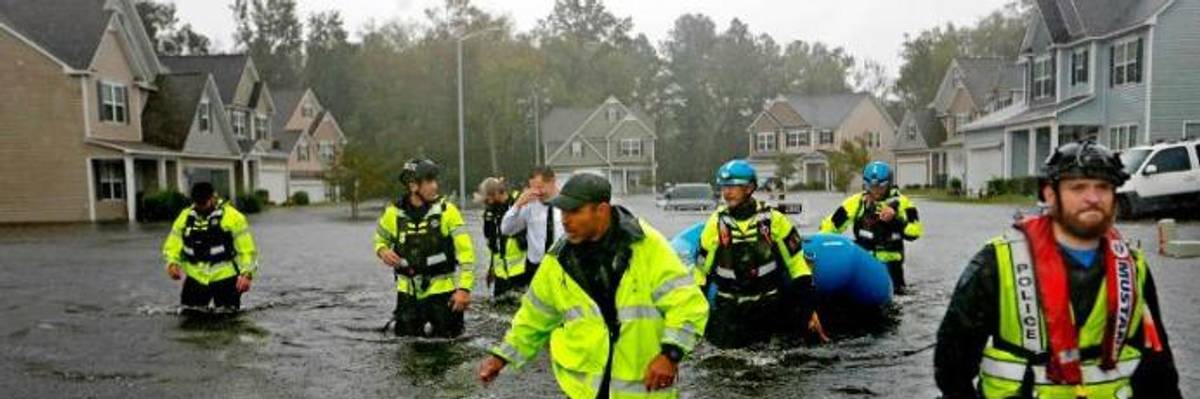
"Catastrophic and historic river flooding will continue for days across portions of the Carolinas," the National Weather Service warned in a Facebook post late Sunday. (Photo: David Goldman/AP)
After tearing through the Carolinas for several days, Hurricane Florence severely damaged tens of thousands of homes, killed over a dozen people, left nearly a million households without power, and unleashed thousands of cubic yards of toxic coal ash--and authorities are warning that the worst flooding from the storm is yet to come.
"For many (most?) places, the worst of Florence's flooding is still on the way," meteorologist Eric Holthaus noted in a tweet on Sunday. "Still expecting record or near-record flooding across a large part of North Carolina in the days to come."
While the National Hurricane Center on Sunday downgraded Florence to a tropical depression, the storm continues to dump heavy rain in North, South Carolina, and southwest Virginia, increasing the risk of landslides and additional damage.
"Catastrophic and historic river flooding will continue for days across portions of the Carolinas," the National Weather Service warned in a Facebook post late Sunday. "Florence is expected to produce heavy and excessive rainfall over the next couple of days. Portions of the Carolinas, mid-Atlantic states, and Southern New England are expected to receive an additional two to five inches of rain...with isolated maximum amounts of eight inches possible."
CNN meteorologist Michael Guy added: "The issue for the Carolinas then becomes the river flooding continuing for the rest of the week. All the rain that fell on the eastern flank of the Appalachians down into central portions of the state has to go somewhere. This water will flow downstream to areas already impacted from flooding rains from Florence. Thus, the rivers will take some time to recede."
Videos and photos posted to social media depicting completely flooded freeways, homes half underwater, and buildings destroyed provide a glimpse of the immense scale of the devastation Florence has wrought across the Carolinas.
"The mammoth amounts of rain observed in southern North Carolina are virtually certain to eclipse anything measured in an East Coast tropical cyclone north of Florida," noted Bob Henson of the Weather Underground.
"The storm has never been more dangerous than it is now," North Carolina's Republican Gov. Roy Cooper said during a press conference on Sunday. "Many rivers are still rising, and are not expected to crest until later today or tomorrow."
Dear Common Dreams reader, It’s been nearly 30 years since I co-founded Common Dreams with my late wife, Lina Newhouser. We had the radical notion that journalism should serve the public good, not corporate profits. It was clear to us from the outset what it would take to build such a project. No paid advertisements. No corporate sponsors. No millionaire publisher telling us what to think or do. Many people said we wouldn't last a year, but we proved those doubters wrong. Together with a tremendous team of journalists and dedicated staff, we built an independent media outlet free from the constraints of profits and corporate control. Our mission has always been simple: To inform. To inspire. To ignite change for the common good. Building Common Dreams was not easy. Our survival was never guaranteed. When you take on the most powerful forces—Wall Street greed, fossil fuel industry destruction, Big Tech lobbyists, and uber-rich oligarchs who have spent billions upon billions rigging the economy and democracy in their favor—the only bulwark you have is supporters who believe in your work. But here’s the urgent message from me today. It's never been this bad out there. And it's never been this hard to keep us going. At the very moment Common Dreams is most needed, the threats we face are intensifying. We need your support now more than ever. We don't accept corporate advertising and never will. We don't have a paywall because we don't think people should be blocked from critical news based on their ability to pay. Everything we do is funded by the donations of readers like you. When everyone does the little they can afford, we are strong. But if that support retreats or dries up, so do we. Will you donate now to make sure Common Dreams not only survives but thrives? —Craig Brown, Co-founder |
After tearing through the Carolinas for several days, Hurricane Florence severely damaged tens of thousands of homes, killed over a dozen people, left nearly a million households without power, and unleashed thousands of cubic yards of toxic coal ash--and authorities are warning that the worst flooding from the storm is yet to come.
"For many (most?) places, the worst of Florence's flooding is still on the way," meteorologist Eric Holthaus noted in a tweet on Sunday. "Still expecting record or near-record flooding across a large part of North Carolina in the days to come."
While the National Hurricane Center on Sunday downgraded Florence to a tropical depression, the storm continues to dump heavy rain in North, South Carolina, and southwest Virginia, increasing the risk of landslides and additional damage.
"Catastrophic and historic river flooding will continue for days across portions of the Carolinas," the National Weather Service warned in a Facebook post late Sunday. "Florence is expected to produce heavy and excessive rainfall over the next couple of days. Portions of the Carolinas, mid-Atlantic states, and Southern New England are expected to receive an additional two to five inches of rain...with isolated maximum amounts of eight inches possible."
CNN meteorologist Michael Guy added: "The issue for the Carolinas then becomes the river flooding continuing for the rest of the week. All the rain that fell on the eastern flank of the Appalachians down into central portions of the state has to go somewhere. This water will flow downstream to areas already impacted from flooding rains from Florence. Thus, the rivers will take some time to recede."
Videos and photos posted to social media depicting completely flooded freeways, homes half underwater, and buildings destroyed provide a glimpse of the immense scale of the devastation Florence has wrought across the Carolinas.
"The mammoth amounts of rain observed in southern North Carolina are virtually certain to eclipse anything measured in an East Coast tropical cyclone north of Florida," noted Bob Henson of the Weather Underground.
"The storm has never been more dangerous than it is now," North Carolina's Republican Gov. Roy Cooper said during a press conference on Sunday. "Many rivers are still rising, and are not expected to crest until later today or tomorrow."
After tearing through the Carolinas for several days, Hurricane Florence severely damaged tens of thousands of homes, killed over a dozen people, left nearly a million households without power, and unleashed thousands of cubic yards of toxic coal ash--and authorities are warning that the worst flooding from the storm is yet to come.
"For many (most?) places, the worst of Florence's flooding is still on the way," meteorologist Eric Holthaus noted in a tweet on Sunday. "Still expecting record or near-record flooding across a large part of North Carolina in the days to come."
While the National Hurricane Center on Sunday downgraded Florence to a tropical depression, the storm continues to dump heavy rain in North, South Carolina, and southwest Virginia, increasing the risk of landslides and additional damage.
"Catastrophic and historic river flooding will continue for days across portions of the Carolinas," the National Weather Service warned in a Facebook post late Sunday. "Florence is expected to produce heavy and excessive rainfall over the next couple of days. Portions of the Carolinas, mid-Atlantic states, and Southern New England are expected to receive an additional two to five inches of rain...with isolated maximum amounts of eight inches possible."
CNN meteorologist Michael Guy added: "The issue for the Carolinas then becomes the river flooding continuing for the rest of the week. All the rain that fell on the eastern flank of the Appalachians down into central portions of the state has to go somewhere. This water will flow downstream to areas already impacted from flooding rains from Florence. Thus, the rivers will take some time to recede."
Videos and photos posted to social media depicting completely flooded freeways, homes half underwater, and buildings destroyed provide a glimpse of the immense scale of the devastation Florence has wrought across the Carolinas.
"The mammoth amounts of rain observed in southern North Carolina are virtually certain to eclipse anything measured in an East Coast tropical cyclone north of Florida," noted Bob Henson of the Weather Underground.
"The storm has never been more dangerous than it is now," North Carolina's Republican Gov. Roy Cooper said during a press conference on Sunday. "Many rivers are still rising, and are not expected to crest until later today or tomorrow."