
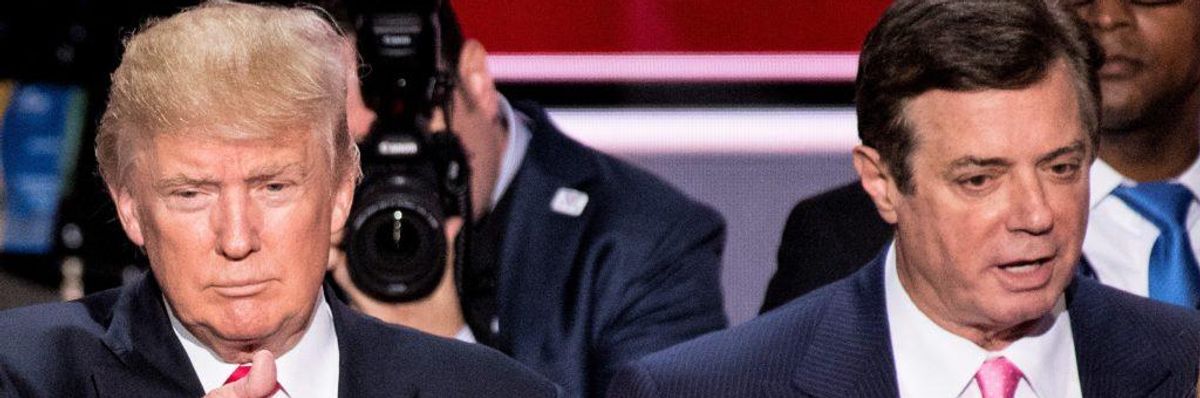
Then candidate Donald Trump standing next to his then campaign chairman Paul Manafort during the 2016 Republican National Convention. On Tuesday, Manafort was found guilty of 8 charges on tax and bank fraud. (Photo: Bill Clark/Getty Images)
After Guilty Verdicts Declared, Senator Warns Trump Any Attempt to Pardon Manafort 'Would Be Gross Abuse of Power'
Sen. Mark Warner (D-Va.), vice chairman of the Senate Intelligence Committee, said that such a move would trigger immediate congressional response
After a jury returned guilty verdicts against Paul Manafort on eight counts stemming from the probe by Special Counsel Robert Mueller on Tuesday afternoon, the immediate question for many was whether the president will take the provocative step of pardoning his former campaign chairman.
According to NBC News, the federal jury in Virginia found Manafort guilty on "eight counts involving bank and tax fraud" though "no verdicts could be reached on the 10 other charges he faced."
To put it mildly, with his former personal attorney Michael Cohen also pleading guilty in a New York court room, it is not a good day for President Trump.
But even as the breaking news of the developments was blinking red on television screens and smartphones nationwide, the question about whether Trump might possibly pardon Manafort was quick to surface.
In the wake of Manafort's guilty verdicts, Sen. Mark Warner (D-Va.), vice chairman of the Senate Intelligence Committee, said that any attempt by Trump to pardon Manafort "would be a gross abuse of power," one that would require immediate congressional response.
As they have previously, progressives groups announced that any move by Trump to undermine the rule of law or thwart the Mueller probe would result in massive street protests:
Just last Friday, Trump told reporters that it was "very sad" what was happening to Manafort, who the president called a "very good person."
A statement issued by legal experts at Citizens for Responsibility and Ethics in Washington (CREW) over the weekend, Trump's exposure will not easily be solved--and could easily by made worse--with his pardon powers. According to CREW, which also published this legal paper on the issue earlier this year, there are serious barriers to trying to pardon Manafort, Cohen, or anyone within his close orbit who find themselves entangled in legal troubles.
"Such a pardon strategy, however tempting it might appear to the president, is fatally flawed," CREW warned. "There are two simple reasons for that. First, receiving a federal pardon will not protect key defendants from exposure to state criminal prosecution (as well as state and federal civil liability). In addition, granting a pardon with corrupt intent or for the purpose of interfering or preventing witness testimony could well expose President Trump to impeachment and personal criminal liability for obstruction of justice or bribery. In other words, pardoning key defendants will only complicate, not resolve, President Trump's legal predicaments."
We are at a crossroads
This country and this world are at a monumental crossroads. In a few short weeks, US voters will have an opportunity to beat back the forces of fascism and confront the billionaires who are rigging the economy, our media system, and our democracy, making it increasingly impossible for ordinary people to get by. We’re not just talking about the election. We’re talking about what must be done once these fascist elements are vanquished from power. We need a bolder set of solutions than what either major party has so far been willing to offer and a working-class movement ready to fight like hell for it. Trump didn't emerge from nowhere. The conditions that fueled MAGA authoritarianism were created by decades of radical neoliberal economic policies and a corrupt political system dominated by corporate interests. They slashed taxes on the super-rich, promising that the benefits would trickle down. They said giveaways to the corporate titans would make life more affordable for the rest of us. It was all bullshit. And when a bitter, betrayed populace searches for someone to blame, right-wing demagogues have little trouble finding scapegoats. People know when they're being lied to, but you won't hear any of this from the corporate media. Only independent journalism—powered and funded by people who believe in building a better world—can deliver truly trustworthy daily news. Our Fall Campaign is underway, and we need your help. To power our newsroom through the rest of the year, we need to raise $125,000 by midnight on October 31. So if you share our vision, please contribute whatever you can to sustain our work. |
After a jury returned guilty verdicts against Paul Manafort on eight counts stemming from the probe by Special Counsel Robert Mueller on Tuesday afternoon, the immediate question for many was whether the president will take the provocative step of pardoning his former campaign chairman.
According to NBC News, the federal jury in Virginia found Manafort guilty on "eight counts involving bank and tax fraud" though "no verdicts could be reached on the 10 other charges he faced."
To put it mildly, with his former personal attorney Michael Cohen also pleading guilty in a New York court room, it is not a good day for President Trump.
But even as the breaking news of the developments was blinking red on television screens and smartphones nationwide, the question about whether Trump might possibly pardon Manafort was quick to surface.
In the wake of Manafort's guilty verdicts, Sen. Mark Warner (D-Va.), vice chairman of the Senate Intelligence Committee, said that any attempt by Trump to pardon Manafort "would be a gross abuse of power," one that would require immediate congressional response.
As they have previously, progressives groups announced that any move by Trump to undermine the rule of law or thwart the Mueller probe would result in massive street protests:
Just last Friday, Trump told reporters that it was "very sad" what was happening to Manafort, who the president called a "very good person."
A statement issued by legal experts at Citizens for Responsibility and Ethics in Washington (CREW) over the weekend, Trump's exposure will not easily be solved--and could easily by made worse--with his pardon powers. According to CREW, which also published this legal paper on the issue earlier this year, there are serious barriers to trying to pardon Manafort, Cohen, or anyone within his close orbit who find themselves entangled in legal troubles.
"Such a pardon strategy, however tempting it might appear to the president, is fatally flawed," CREW warned. "There are two simple reasons for that. First, receiving a federal pardon will not protect key defendants from exposure to state criminal prosecution (as well as state and federal civil liability). In addition, granting a pardon with corrupt intent or for the purpose of interfering or preventing witness testimony could well expose President Trump to impeachment and personal criminal liability for obstruction of justice or bribery. In other words, pardoning key defendants will only complicate, not resolve, President Trump's legal predicaments."
After a jury returned guilty verdicts against Paul Manafort on eight counts stemming from the probe by Special Counsel Robert Mueller on Tuesday afternoon, the immediate question for many was whether the president will take the provocative step of pardoning his former campaign chairman.
According to NBC News, the federal jury in Virginia found Manafort guilty on "eight counts involving bank and tax fraud" though "no verdicts could be reached on the 10 other charges he faced."
To put it mildly, with his former personal attorney Michael Cohen also pleading guilty in a New York court room, it is not a good day for President Trump.
But even as the breaking news of the developments was blinking red on television screens and smartphones nationwide, the question about whether Trump might possibly pardon Manafort was quick to surface.
In the wake of Manafort's guilty verdicts, Sen. Mark Warner (D-Va.), vice chairman of the Senate Intelligence Committee, said that any attempt by Trump to pardon Manafort "would be a gross abuse of power," one that would require immediate congressional response.
As they have previously, progressives groups announced that any move by Trump to undermine the rule of law or thwart the Mueller probe would result in massive street protests:
Just last Friday, Trump told reporters that it was "very sad" what was happening to Manafort, who the president called a "very good person."
A statement issued by legal experts at Citizens for Responsibility and Ethics in Washington (CREW) over the weekend, Trump's exposure will not easily be solved--and could easily by made worse--with his pardon powers. According to CREW, which also published this legal paper on the issue earlier this year, there are serious barriers to trying to pardon Manafort, Cohen, or anyone within his close orbit who find themselves entangled in legal troubles.
"Such a pardon strategy, however tempting it might appear to the president, is fatally flawed," CREW warned. "There are two simple reasons for that. First, receiving a federal pardon will not protect key defendants from exposure to state criminal prosecution (as well as state and federal civil liability). In addition, granting a pardon with corrupt intent or for the purpose of interfering or preventing witness testimony could well expose President Trump to impeachment and personal criminal liability for obstruction of justice or bribery. In other words, pardoning key defendants will only complicate, not resolve, President Trump's legal predicaments."