SUBSCRIBE TO OUR FREE NEWSLETTER
Daily news & progressive opinion—funded by the people, not the corporations—delivered straight to your inbox.
5
#000000
#FFFFFF
To donate by check, phone, or other method, see our More Ways to Give page.
Daily news & progressive opinion—funded by the people, not the corporations—delivered straight to your inbox.
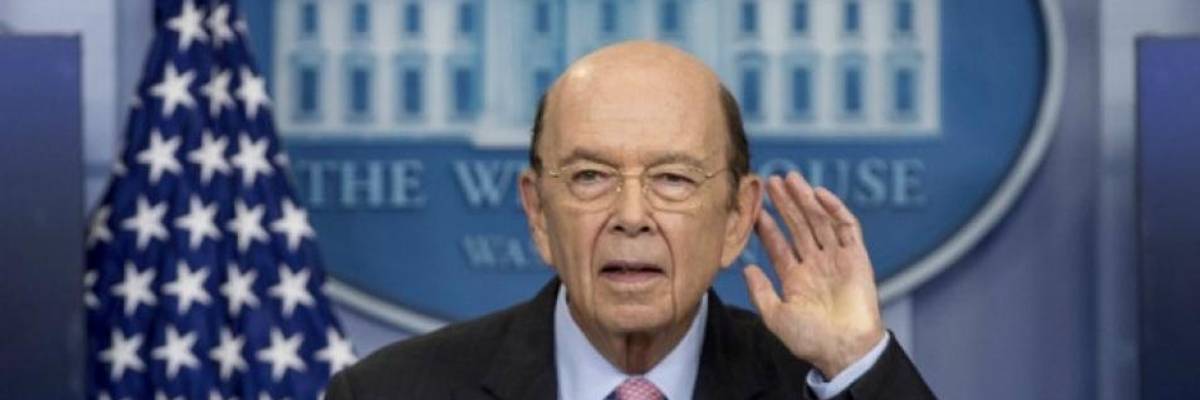
"We conducted a detailed review of public records and found reason to suspect Ross violated the criminal conflict-of-interest law." (Photo: Andrew Harnik/AP)
A nonpartisan watchdog has accused U.S. Commerce Secretary Wilbur Ross of violating conflict-of-interest laws as well as statutes governing false statements and omissions -- and is asking the department's inspector general to investigate.
The 115-page complaint by the Campaign Legal Center cites reporting by the Center for Public Integrity and several other news organizations in calling for an extensive inquiry into Ross' handling of his complex personal holdings while in office.
"We conducted a detailed review of public records and found reason to suspect Ross violated the criminal conflict-of-interest law," Campaign Legal Center Ethics Counsel Delaney Marsco said. "It's imperative that the inspector general get to the bottom of this. There's a lot of smoke, and we need to know if there's fire."
Ross failed to sell multiple financial holdings, including millions of dollars' worth of stock in Invesco Ltd., until months after he was required to do so.
In a statement last month, Ross said he had "made inadvertent errors in completing the divestitures required by my ethics agreement."
Also last month, the Center for Public Integrity reported that Ross' Invesco stock value increased by at least $1.2 million and as much as $6 million between the end of May, when Ross was supposed to divest, and late December, when he actually did.
The Campaign Legal Center complaint notes that in 2017, an Invesco subsidiary headed by Ross until he entered government, acquired an interest in Chinese steel. In April 2017, Ross announced an investigation into whether the U.S. should impose a tariff on steel imports, something the Campaign Legal Center said could have a direct and predictable effect on Ross' financial interests, given his continued ownership of Invesco stock.
The complaint questions Ross' assertion that he believed the stock had been sold.
"Ross may well have had a reason for delaying the divestiture of this stock," the complaint said, citing the Center for Public Integrity's calculations of the stock's increased value.
Commerce Department officials did not immediately return requests for comment.
In July -- responding to the Center for Public Integrity's reporting -- the Commerce Department issued a statement that said: "Nothing regarding Invesco has come before the Secretary. Additionally, Invesco is not regulated by the Commerce Department. Regardless, as the Secretary had been a former employee of Invesco, Invesco was on the list of companies for which he would have been required to recuse himself. It is a mischaracterization to imply that the reason why the shares were not sold was anything other than an inadvertent error and as soon as he discovered the problem, Secretary Ross notified the Commerce Department Ethics officials and promptly sold the shares."
Dear Common Dreams reader, It’s been nearly 30 years since I co-founded Common Dreams with my late wife, Lina Newhouser. We had the radical notion that journalism should serve the public good, not corporate profits. It was clear to us from the outset what it would take to build such a project. No paid advertisements. No corporate sponsors. No millionaire publisher telling us what to think or do. Many people said we wouldn't last a year, but we proved those doubters wrong. Together with a tremendous team of journalists and dedicated staff, we built an independent media outlet free from the constraints of profits and corporate control. Our mission has always been simple: To inform. To inspire. To ignite change for the common good. Building Common Dreams was not easy. Our survival was never guaranteed. When you take on the most powerful forces—Wall Street greed, fossil fuel industry destruction, Big Tech lobbyists, and uber-rich oligarchs who have spent billions upon billions rigging the economy and democracy in their favor—the only bulwark you have is supporters who believe in your work. But here’s the urgent message from me today. It's never been this bad out there. And it's never been this hard to keep us going. At the very moment Common Dreams is most needed, the threats we face are intensifying. We need your support now more than ever. We don't accept corporate advertising and never will. We don't have a paywall because we don't think people should be blocked from critical news based on their ability to pay. Everything we do is funded by the donations of readers like you. When everyone does the little they can afford, we are strong. But if that support retreats or dries up, so do we. Will you donate now to make sure Common Dreams not only survives but thrives? —Craig Brown, Co-founder |
A nonpartisan watchdog has accused U.S. Commerce Secretary Wilbur Ross of violating conflict-of-interest laws as well as statutes governing false statements and omissions -- and is asking the department's inspector general to investigate.
The 115-page complaint by the Campaign Legal Center cites reporting by the Center for Public Integrity and several other news organizations in calling for an extensive inquiry into Ross' handling of his complex personal holdings while in office.
"We conducted a detailed review of public records and found reason to suspect Ross violated the criminal conflict-of-interest law," Campaign Legal Center Ethics Counsel Delaney Marsco said. "It's imperative that the inspector general get to the bottom of this. There's a lot of smoke, and we need to know if there's fire."
Ross failed to sell multiple financial holdings, including millions of dollars' worth of stock in Invesco Ltd., until months after he was required to do so.
In a statement last month, Ross said he had "made inadvertent errors in completing the divestitures required by my ethics agreement."
Also last month, the Center for Public Integrity reported that Ross' Invesco stock value increased by at least $1.2 million and as much as $6 million between the end of May, when Ross was supposed to divest, and late December, when he actually did.
The Campaign Legal Center complaint notes that in 2017, an Invesco subsidiary headed by Ross until he entered government, acquired an interest in Chinese steel. In April 2017, Ross announced an investigation into whether the U.S. should impose a tariff on steel imports, something the Campaign Legal Center said could have a direct and predictable effect on Ross' financial interests, given his continued ownership of Invesco stock.
The complaint questions Ross' assertion that he believed the stock had been sold.
"Ross may well have had a reason for delaying the divestiture of this stock," the complaint said, citing the Center for Public Integrity's calculations of the stock's increased value.
Commerce Department officials did not immediately return requests for comment.
In July -- responding to the Center for Public Integrity's reporting -- the Commerce Department issued a statement that said: "Nothing regarding Invesco has come before the Secretary. Additionally, Invesco is not regulated by the Commerce Department. Regardless, as the Secretary had been a former employee of Invesco, Invesco was on the list of companies for which he would have been required to recuse himself. It is a mischaracterization to imply that the reason why the shares were not sold was anything other than an inadvertent error and as soon as he discovered the problem, Secretary Ross notified the Commerce Department Ethics officials and promptly sold the shares."
A nonpartisan watchdog has accused U.S. Commerce Secretary Wilbur Ross of violating conflict-of-interest laws as well as statutes governing false statements and omissions -- and is asking the department's inspector general to investigate.
The 115-page complaint by the Campaign Legal Center cites reporting by the Center for Public Integrity and several other news organizations in calling for an extensive inquiry into Ross' handling of his complex personal holdings while in office.
"We conducted a detailed review of public records and found reason to suspect Ross violated the criminal conflict-of-interest law," Campaign Legal Center Ethics Counsel Delaney Marsco said. "It's imperative that the inspector general get to the bottom of this. There's a lot of smoke, and we need to know if there's fire."
Ross failed to sell multiple financial holdings, including millions of dollars' worth of stock in Invesco Ltd., until months after he was required to do so.
In a statement last month, Ross said he had "made inadvertent errors in completing the divestitures required by my ethics agreement."
Also last month, the Center for Public Integrity reported that Ross' Invesco stock value increased by at least $1.2 million and as much as $6 million between the end of May, when Ross was supposed to divest, and late December, when he actually did.
The Campaign Legal Center complaint notes that in 2017, an Invesco subsidiary headed by Ross until he entered government, acquired an interest in Chinese steel. In April 2017, Ross announced an investigation into whether the U.S. should impose a tariff on steel imports, something the Campaign Legal Center said could have a direct and predictable effect on Ross' financial interests, given his continued ownership of Invesco stock.
The complaint questions Ross' assertion that he believed the stock had been sold.
"Ross may well have had a reason for delaying the divestiture of this stock," the complaint said, citing the Center for Public Integrity's calculations of the stock's increased value.
Commerce Department officials did not immediately return requests for comment.
In July -- responding to the Center for Public Integrity's reporting -- the Commerce Department issued a statement that said: "Nothing regarding Invesco has come before the Secretary. Additionally, Invesco is not regulated by the Commerce Department. Regardless, as the Secretary had been a former employee of Invesco, Invesco was on the list of companies for which he would have been required to recuse himself. It is a mischaracterization to imply that the reason why the shares were not sold was anything other than an inadvertent error and as soon as he discovered the problem, Secretary Ross notified the Commerce Department Ethics officials and promptly sold the shares."