SUBSCRIBE TO OUR FREE NEWSLETTER
Daily news & progressive opinion—funded by the people, not the corporations—delivered straight to your inbox.
5
#000000
#FFFFFF
To donate by check, phone, or other method, see our More Ways to Give page.
Daily news & progressive opinion—funded by the people, not the corporations—delivered straight to your inbox.
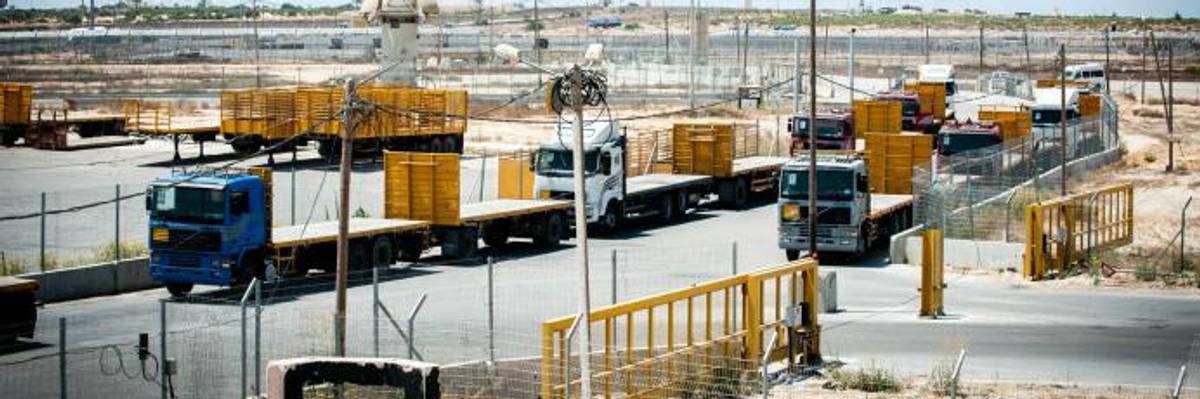
Israel announced on Monday new restrictions for the Kerem Shalom crossing, the main cargo entry point into Gaza. (Photo: David Katz/The Israel Project/Flickr)
In a move condemned by human rights advocates as another of the Israeli government's "genocidal policies of collective punishment" in Gaza, Israel has announced stringent new import rules for the territory's main cargo crossing.
As Israel and Egypt have maintained a naval, aerial, and land blockade of the occupied territory for more than a decade, the Kerem Shalom crossing is how most commercial goods and foreign aid reach Gazans. Under the new restrictions, only food, medicine, and "humanitarian equipment" can come through the entry point.
The rules, Al Jazeera noted, "will also affect Gaza's exports, further straining an already crippled economy brought to its knees by the 12-year blockade."
While the Israeli government claims the closure is aimed at curtailing militant activity in Gaza, human rights advocates such as Omar Shakir, the Israel and Palestine director for Human Rights Watch, condemned the border closure as just the latest example of Israel's "unlawful collective punishment" against the people imprisoned within the Gaza Strip.
Palestinian-American journalist Ali Abunimah said on Twitter that the restrictions are among Israel's "genocidal policies," and emphasized that all other nations which back Israel should be held to account for the consequences of the closure:
The Hamas government in Gaza denounced the move as "a new Israeli crime against humanity."
Israeli Prime Minister Benjamin Netanyahu said Monday that "the Defense Minister and I agree that we will be heavy-handed with the Hamas regime in the Gaza Strip--immediately."
Beyond the import rules, Netanyahu said, "there will be additional steps; I will not go into details." Although he did not divulge whether such steps would include ending the recent expansion of Gaza's fishing zone from six to nine nautical miles, which took effect nearly three months ago, according to Reuters, an Israeli military statement declared the fishing zone would revert to the lower limit.
Though frustrating for Gaza's fisherman, who still struggle within the confines of the expanded zone, the decision was not surprising. While Israel occasionally allows such expansions to boost the Gazan economy, they typically only last for three months. Ahead of that statement, Nizar Ayash, the leader of Gaza's fishermen's union, had told Al Jazeera that members would be taking precautions.
"The latest retaliatory measure by Israel made no mention to the fishing limit in Gaza, but we expect to hear from them on Tuesday," Ayash had said. "The three-month mark is about to end anyway... So we will be back to fishing at only six nautical miles soon."
Dear Common Dreams reader, It’s been nearly 30 years since I co-founded Common Dreams with my late wife, Lina Newhouser. We had the radical notion that journalism should serve the public good, not corporate profits. It was clear to us from the outset what it would take to build such a project. No paid advertisements. No corporate sponsors. No millionaire publisher telling us what to think or do. Many people said we wouldn't last a year, but we proved those doubters wrong. Together with a tremendous team of journalists and dedicated staff, we built an independent media outlet free from the constraints of profits and corporate control. Our mission has always been simple: To inform. To inspire. To ignite change for the common good. Building Common Dreams was not easy. Our survival was never guaranteed. When you take on the most powerful forces—Wall Street greed, fossil fuel industry destruction, Big Tech lobbyists, and uber-rich oligarchs who have spent billions upon billions rigging the economy and democracy in their favor—the only bulwark you have is supporters who believe in your work. But here’s the urgent message from me today. It's never been this bad out there. And it's never been this hard to keep us going. At the very moment Common Dreams is most needed, the threats we face are intensifying. We need your support now more than ever. We don't accept corporate advertising and never will. We don't have a paywall because we don't think people should be blocked from critical news based on their ability to pay. Everything we do is funded by the donations of readers like you. When everyone does the little they can afford, we are strong. But if that support retreats or dries up, so do we. Will you donate now to make sure Common Dreams not only survives but thrives? —Craig Brown, Co-founder |
In a move condemned by human rights advocates as another of the Israeli government's "genocidal policies of collective punishment" in Gaza, Israel has announced stringent new import rules for the territory's main cargo crossing.
As Israel and Egypt have maintained a naval, aerial, and land blockade of the occupied territory for more than a decade, the Kerem Shalom crossing is how most commercial goods and foreign aid reach Gazans. Under the new restrictions, only food, medicine, and "humanitarian equipment" can come through the entry point.
The rules, Al Jazeera noted, "will also affect Gaza's exports, further straining an already crippled economy brought to its knees by the 12-year blockade."
While the Israeli government claims the closure is aimed at curtailing militant activity in Gaza, human rights advocates such as Omar Shakir, the Israel and Palestine director for Human Rights Watch, condemned the border closure as just the latest example of Israel's "unlawful collective punishment" against the people imprisoned within the Gaza Strip.
Palestinian-American journalist Ali Abunimah said on Twitter that the restrictions are among Israel's "genocidal policies," and emphasized that all other nations which back Israel should be held to account for the consequences of the closure:
The Hamas government in Gaza denounced the move as "a new Israeli crime against humanity."
Israeli Prime Minister Benjamin Netanyahu said Monday that "the Defense Minister and I agree that we will be heavy-handed with the Hamas regime in the Gaza Strip--immediately."
Beyond the import rules, Netanyahu said, "there will be additional steps; I will not go into details." Although he did not divulge whether such steps would include ending the recent expansion of Gaza's fishing zone from six to nine nautical miles, which took effect nearly three months ago, according to Reuters, an Israeli military statement declared the fishing zone would revert to the lower limit.
Though frustrating for Gaza's fisherman, who still struggle within the confines of the expanded zone, the decision was not surprising. While Israel occasionally allows such expansions to boost the Gazan economy, they typically only last for three months. Ahead of that statement, Nizar Ayash, the leader of Gaza's fishermen's union, had told Al Jazeera that members would be taking precautions.
"The latest retaliatory measure by Israel made no mention to the fishing limit in Gaza, but we expect to hear from them on Tuesday," Ayash had said. "The three-month mark is about to end anyway... So we will be back to fishing at only six nautical miles soon."
In a move condemned by human rights advocates as another of the Israeli government's "genocidal policies of collective punishment" in Gaza, Israel has announced stringent new import rules for the territory's main cargo crossing.
As Israel and Egypt have maintained a naval, aerial, and land blockade of the occupied territory for more than a decade, the Kerem Shalom crossing is how most commercial goods and foreign aid reach Gazans. Under the new restrictions, only food, medicine, and "humanitarian equipment" can come through the entry point.
The rules, Al Jazeera noted, "will also affect Gaza's exports, further straining an already crippled economy brought to its knees by the 12-year blockade."
While the Israeli government claims the closure is aimed at curtailing militant activity in Gaza, human rights advocates such as Omar Shakir, the Israel and Palestine director for Human Rights Watch, condemned the border closure as just the latest example of Israel's "unlawful collective punishment" against the people imprisoned within the Gaza Strip.
Palestinian-American journalist Ali Abunimah said on Twitter that the restrictions are among Israel's "genocidal policies," and emphasized that all other nations which back Israel should be held to account for the consequences of the closure:
The Hamas government in Gaza denounced the move as "a new Israeli crime against humanity."
Israeli Prime Minister Benjamin Netanyahu said Monday that "the Defense Minister and I agree that we will be heavy-handed with the Hamas regime in the Gaza Strip--immediately."
Beyond the import rules, Netanyahu said, "there will be additional steps; I will not go into details." Although he did not divulge whether such steps would include ending the recent expansion of Gaza's fishing zone from six to nine nautical miles, which took effect nearly three months ago, according to Reuters, an Israeli military statement declared the fishing zone would revert to the lower limit.
Though frustrating for Gaza's fisherman, who still struggle within the confines of the expanded zone, the decision was not surprising. While Israel occasionally allows such expansions to boost the Gazan economy, they typically only last for three months. Ahead of that statement, Nizar Ayash, the leader of Gaza's fishermen's union, had told Al Jazeera that members would be taking precautions.
"The latest retaliatory measure by Israel made no mention to the fishing limit in Gaza, but we expect to hear from them on Tuesday," Ayash had said. "The three-month mark is about to end anyway... So we will be back to fishing at only six nautical miles soon."