

SUBSCRIBE TO OUR FREE NEWSLETTER
Daily news & progressive opinion—funded by the people, not the corporations—delivered straight to your inbox.
5
#000000
#FFFFFF
To donate by check, phone, or other method, see our More Ways to Give page.
Daily news & progressive opinion—funded by the people, not the corporations—delivered straight to your inbox.
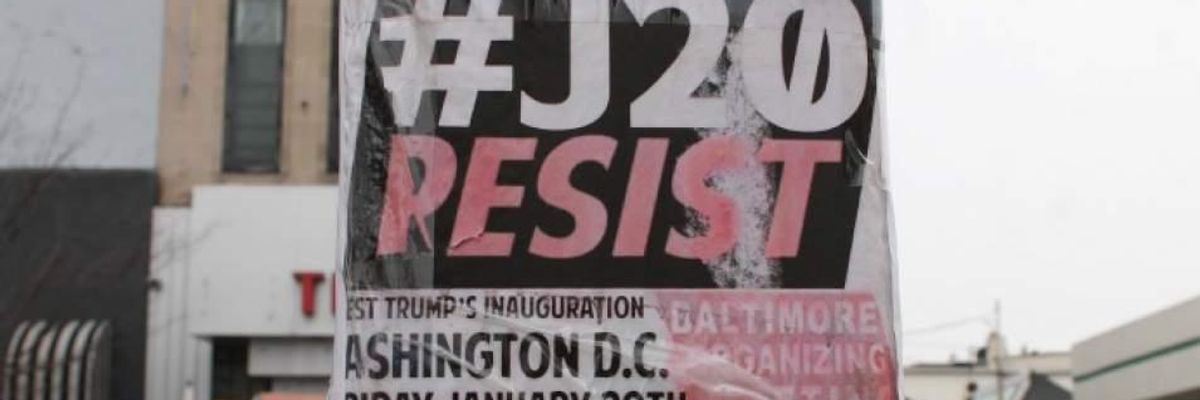
More than 200 people who protested during President Donald Trump's inauguration were rounded up by police and dozens faced felony charges. (Photo: Elvert Barnes/Flickr/cc)
This is a developing story and may be updated...
In a series of victories for civil disobedience rights on Thursday, the U.S. Attorney's Office (USAO) dropped charges and dismissed several cases against people involved with the #DisruptJ20 march during President Donald Trump's inauguration, and a federal judge sanctioned prosecutors for lying about evidence.
As Common Dreams has reported, last year "more than 200 anti-Trump demonstrators, legal observers, and journalists were 'indiscriminately' swept up in mass arrests carried out during inauguration protests."
Although a jury found the first group of protesters not guilty of all charges in December, federal prosecutors have continued pursuing cases against 59 of the rounded-up demonstrators--trying them in groups, seeking to imprison them for decades on felony charges, and relying heavily on recordings by the right-wing activist group Project Veritas.
Following a revelation last week that "prosecutors suppressed potentially exculpatory evidence," known as a Brady violation, it was revealed in an overnight filing by defense attorneys that the government concealed 69 Project Veritas audio and video files and altered other recordings.
In response to the new Brady violations, at a pre-trial hearing on Thursday, Superior Court Judge Robert Morin dismissed conspiracy charges with prejudice--meaning that they cannot be refiled--but dismissed lesser charges without prejudice, meaning the government can still pursue those, according to reporters from the Huffington Post and Unicorn Riot.
The USAO has dropped felony charges against those in the May 29 trial group--the third group of J20 protesters--and all charges against those in the June 4 group.
However, the revelations about prosecutors concealing evidence and Morin's subsequent ruling have not yet impacted the second trial group. During Morin's hearing on Thursday, closing arguments for the May 14 trial group were taking place on another floor of the same courthouse.
Reporters were quick to point out that prosecutors used the same evidence that led to Morin's sanctions to build a case against the May 14 group. If anyone from the second group is found guilty, appeals are expected to cite the new findings.
Dear Common Dreams reader, It’s been nearly 30 years since I co-founded Common Dreams with my late wife, Lina Newhouser. We had the radical notion that journalism should serve the public good, not corporate profits. It was clear to us from the outset what it would take to build such a project. No paid advertisements. No corporate sponsors. No millionaire publisher telling us what to think or do. Many people said we wouldn't last a year, but we proved those doubters wrong. Together with a tremendous team of journalists and dedicated staff, we built an independent media outlet free from the constraints of profits and corporate control. Our mission has always been simple: To inform. To inspire. To ignite change for the common good. Building Common Dreams was not easy. Our survival was never guaranteed. When you take on the most powerful forces—Wall Street greed, fossil fuel industry destruction, Big Tech lobbyists, and uber-rich oligarchs who have spent billions upon billions rigging the economy and democracy in their favor—the only bulwark you have is supporters who believe in your work. But here’s the urgent message from me today. It's never been this bad out there. And it's never been this hard to keep us going. At the very moment Common Dreams is most needed, the threats we face are intensifying. We need your support now more than ever. We don't accept corporate advertising and never will. We don't have a paywall because we don't think people should be blocked from critical news based on their ability to pay. Everything we do is funded by the donations of readers like you. When everyone does the little they can afford, we are strong. But if that support retreats or dries up, so do we. Will you donate now to make sure Common Dreams not only survives but thrives? —Craig Brown, Co-founder |
This is a developing story and may be updated...
In a series of victories for civil disobedience rights on Thursday, the U.S. Attorney's Office (USAO) dropped charges and dismissed several cases against people involved with the #DisruptJ20 march during President Donald Trump's inauguration, and a federal judge sanctioned prosecutors for lying about evidence.
As Common Dreams has reported, last year "more than 200 anti-Trump demonstrators, legal observers, and journalists were 'indiscriminately' swept up in mass arrests carried out during inauguration protests."
Although a jury found the first group of protesters not guilty of all charges in December, federal prosecutors have continued pursuing cases against 59 of the rounded-up demonstrators--trying them in groups, seeking to imprison them for decades on felony charges, and relying heavily on recordings by the right-wing activist group Project Veritas.
Following a revelation last week that "prosecutors suppressed potentially exculpatory evidence," known as a Brady violation, it was revealed in an overnight filing by defense attorneys that the government concealed 69 Project Veritas audio and video files and altered other recordings.
In response to the new Brady violations, at a pre-trial hearing on Thursday, Superior Court Judge Robert Morin dismissed conspiracy charges with prejudice--meaning that they cannot be refiled--but dismissed lesser charges without prejudice, meaning the government can still pursue those, according to reporters from the Huffington Post and Unicorn Riot.
The USAO has dropped felony charges against those in the May 29 trial group--the third group of J20 protesters--and all charges against those in the June 4 group.
However, the revelations about prosecutors concealing evidence and Morin's subsequent ruling have not yet impacted the second trial group. During Morin's hearing on Thursday, closing arguments for the May 14 trial group were taking place on another floor of the same courthouse.
Reporters were quick to point out that prosecutors used the same evidence that led to Morin's sanctions to build a case against the May 14 group. If anyone from the second group is found guilty, appeals are expected to cite the new findings.
This is a developing story and may be updated...
In a series of victories for civil disobedience rights on Thursday, the U.S. Attorney's Office (USAO) dropped charges and dismissed several cases against people involved with the #DisruptJ20 march during President Donald Trump's inauguration, and a federal judge sanctioned prosecutors for lying about evidence.
As Common Dreams has reported, last year "more than 200 anti-Trump demonstrators, legal observers, and journalists were 'indiscriminately' swept up in mass arrests carried out during inauguration protests."
Although a jury found the first group of protesters not guilty of all charges in December, federal prosecutors have continued pursuing cases against 59 of the rounded-up demonstrators--trying them in groups, seeking to imprison them for decades on felony charges, and relying heavily on recordings by the right-wing activist group Project Veritas.
Following a revelation last week that "prosecutors suppressed potentially exculpatory evidence," known as a Brady violation, it was revealed in an overnight filing by defense attorneys that the government concealed 69 Project Veritas audio and video files and altered other recordings.
In response to the new Brady violations, at a pre-trial hearing on Thursday, Superior Court Judge Robert Morin dismissed conspiracy charges with prejudice--meaning that they cannot be refiled--but dismissed lesser charges without prejudice, meaning the government can still pursue those, according to reporters from the Huffington Post and Unicorn Riot.
The USAO has dropped felony charges against those in the May 29 trial group--the third group of J20 protesters--and all charges against those in the June 4 group.
However, the revelations about prosecutors concealing evidence and Morin's subsequent ruling have not yet impacted the second trial group. During Morin's hearing on Thursday, closing arguments for the May 14 trial group were taking place on another floor of the same courthouse.
Reporters were quick to point out that prosecutors used the same evidence that led to Morin's sanctions to build a case against the May 14 group. If anyone from the second group is found guilty, appeals are expected to cite the new findings.

