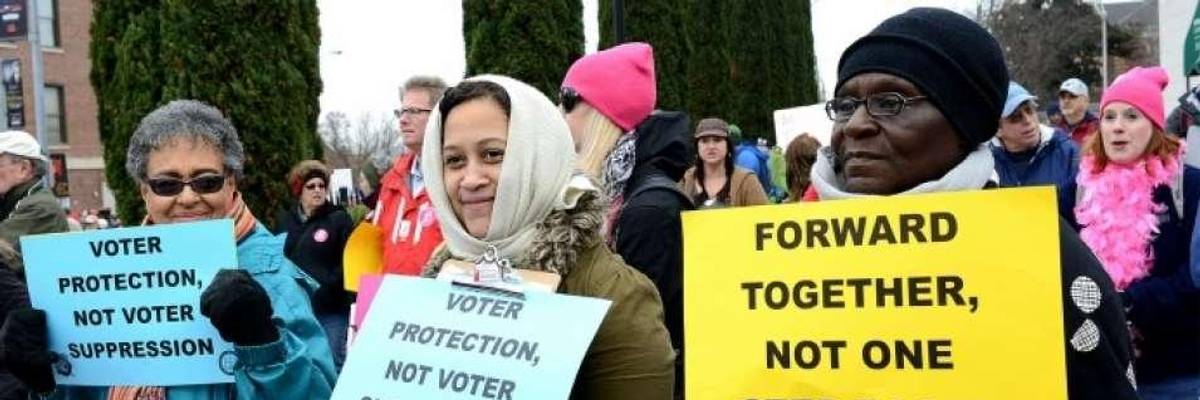
"Rather than seeing what the courts will let them get away with, Texas should be thinking about how to best serve its voters," said Myrna Perez of the Brennan Center. (Photo: Stephen Melkisethian/Flickr/cc)
Upholding Texas Photo ID Law, Federal Appeals Court Deals Blow to Voting Rights
Critics maintain that it "is one of the most discriminatory and restrictive measures of its kind"
In a move that frustrated voting rights advocates, a federal appeals court on Friday ruled that Texas can implement a revisied voter identification law that critics claim is unconstitutionally discriminatory.
"We continue to firmly believe that the Texas photo ID law is one of the most discriminatory and restrictive measures of its kind," Kristen Clarke of the Lawyers' Committee for Civil Rights Under Law, part of the legal team that challenged the measure, said following the court's decision.
In a 2-1 ruling, a 5th U.S. Circuit Court of Appeals panel reversed a district judge's 2017 ruling that Senate Bill 5 unconstitutionally discriminates against black and Latinx voters. The legislation in question is a revised version of Senate Bill 14, which was enacted in 2011 but eventually deemed discriminatory and blocked by federal courts.
S.B. 14 mandated that voters present a government-issued photo ID; S.B. 5 added a provision that required those who lacked such identification to sign an affidavit and present an alternate ID.
"No law should be allowed to stand that is merely built on the back of a plainly discriminatory law," Clarke declared.
In his dissenting opinion, Circuit Judge James Graves wrote (pdf) that "S.B. 5 does not fully remove the burden disproportionately placed on poor and minority voters; it just creates a new and different burden."
However, "even if S.B. 5 were, as Texas and the majority both claim, ostensibly to remove or otherwise lessen the discriminatory impacts of S.B. 14, it still does not change the reason--the discriminatory reason--why the state enacted a voter ID law in the first place," Graves concluded. "A hog in a silk waistcoat is still a hog."
"It is, essentially, the same law," explained ProPublica reporter Jessica Huseman, "and it was a mess."
Sherrilyn Ifill, president of the NAACP's Legal Defense Fund, expressed disappointment with the majority's ruling, but vowed to continue the fight.
"We maintain that no voter should ever be turned away from the polls because of an ID requirement," she said, "and we will continue to aggressively pursue the right to vote wherever it is challenged."
Myrna Perez, deputy director of the Brennan Center's Democracy Program, called on the state's elected officials to better serve their constituents.
Pointing out that "every court that has reviewed Texas' prior voter ID law has found that it would have a discriminatory effect," Perez said, "Rather than seeing what the courts will let them get away with, Texas should be thinking about how to best serve its voters."
Urgent. It's never been this bad.
Dear Common Dreams reader, It’s been nearly 30 years since I co-founded Common Dreams with my late wife, Lina Newhouser. We had the radical notion that journalism should serve the public good, not corporate profits. It was clear to us from the outset what it would take to build such a project. No paid advertisements. No corporate sponsors. No millionaire publisher telling us what to think or do. Many people said we wouldn't last a year, but we proved those doubters wrong. Together with a tremendous team of journalists and dedicated staff, we built an independent media outlet free from the constraints of profits and corporate control. Our mission from the outset was simple. To inform. To inspire. To ignite change for the common good. Building Common Dreams was not easy. Our survival was never guaranteed. When you take on the most powerful forces—Wall Street greed, fossil fuel industry destruction, Big Tech lobbyists, and uber-rich oligarchs who have spent billions upon billions rigging the economy and democracy in their favor—the only bulwark you have is supporters who believe in your work. But here’s the urgent message from me today. It’s never been this bad out there. And it’s never been this hard to keep us going. At the very moment Common Dreams is most needed and doing some of its best and most important work, the threats we face are intensifying. Right now, with just three days to go in our Spring Campaign, we're falling short of our make-or-break goal. When everyone does the little they can afford, we are strong. But if that support retreats or dries up, so do we. Can you make a gift right now to make sure Common Dreams not only survives but thrives? There is no backup plan or rainy day fund. There is only you. —Craig Brown, Co-founder |
In a move that frustrated voting rights advocates, a federal appeals court on Friday ruled that Texas can implement a revisied voter identification law that critics claim is unconstitutionally discriminatory.
"We continue to firmly believe that the Texas photo ID law is one of the most discriminatory and restrictive measures of its kind," Kristen Clarke of the Lawyers' Committee for Civil Rights Under Law, part of the legal team that challenged the measure, said following the court's decision.
In a 2-1 ruling, a 5th U.S. Circuit Court of Appeals panel reversed a district judge's 2017 ruling that Senate Bill 5 unconstitutionally discriminates against black and Latinx voters. The legislation in question is a revised version of Senate Bill 14, which was enacted in 2011 but eventually deemed discriminatory and blocked by federal courts.
S.B. 14 mandated that voters present a government-issued photo ID; S.B. 5 added a provision that required those who lacked such identification to sign an affidavit and present an alternate ID.
"No law should be allowed to stand that is merely built on the back of a plainly discriminatory law," Clarke declared.
In his dissenting opinion, Circuit Judge James Graves wrote (pdf) that "S.B. 5 does not fully remove the burden disproportionately placed on poor and minority voters; it just creates a new and different burden."
However, "even if S.B. 5 were, as Texas and the majority both claim, ostensibly to remove or otherwise lessen the discriminatory impacts of S.B. 14, it still does not change the reason--the discriminatory reason--why the state enacted a voter ID law in the first place," Graves concluded. "A hog in a silk waistcoat is still a hog."
"It is, essentially, the same law," explained ProPublica reporter Jessica Huseman, "and it was a mess."
Sherrilyn Ifill, president of the NAACP's Legal Defense Fund, expressed disappointment with the majority's ruling, but vowed to continue the fight.
"We maintain that no voter should ever be turned away from the polls because of an ID requirement," she said, "and we will continue to aggressively pursue the right to vote wherever it is challenged."
Myrna Perez, deputy director of the Brennan Center's Democracy Program, called on the state's elected officials to better serve their constituents.
Pointing out that "every court that has reviewed Texas' prior voter ID law has found that it would have a discriminatory effect," Perez said, "Rather than seeing what the courts will let them get away with, Texas should be thinking about how to best serve its voters."
In a move that frustrated voting rights advocates, a federal appeals court on Friday ruled that Texas can implement a revisied voter identification law that critics claim is unconstitutionally discriminatory.
"We continue to firmly believe that the Texas photo ID law is one of the most discriminatory and restrictive measures of its kind," Kristen Clarke of the Lawyers' Committee for Civil Rights Under Law, part of the legal team that challenged the measure, said following the court's decision.
In a 2-1 ruling, a 5th U.S. Circuit Court of Appeals panel reversed a district judge's 2017 ruling that Senate Bill 5 unconstitutionally discriminates against black and Latinx voters. The legislation in question is a revised version of Senate Bill 14, which was enacted in 2011 but eventually deemed discriminatory and blocked by federal courts.
S.B. 14 mandated that voters present a government-issued photo ID; S.B. 5 added a provision that required those who lacked such identification to sign an affidavit and present an alternate ID.
"No law should be allowed to stand that is merely built on the back of a plainly discriminatory law," Clarke declared.
In his dissenting opinion, Circuit Judge James Graves wrote (pdf) that "S.B. 5 does not fully remove the burden disproportionately placed on poor and minority voters; it just creates a new and different burden."
However, "even if S.B. 5 were, as Texas and the majority both claim, ostensibly to remove or otherwise lessen the discriminatory impacts of S.B. 14, it still does not change the reason--the discriminatory reason--why the state enacted a voter ID law in the first place," Graves concluded. "A hog in a silk waistcoat is still a hog."
"It is, essentially, the same law," explained ProPublica reporter Jessica Huseman, "and it was a mess."
Sherrilyn Ifill, president of the NAACP's Legal Defense Fund, expressed disappointment with the majority's ruling, but vowed to continue the fight.
"We maintain that no voter should ever be turned away from the polls because of an ID requirement," she said, "and we will continue to aggressively pursue the right to vote wherever it is challenged."
Myrna Perez, deputy director of the Brennan Center's Democracy Program, called on the state's elected officials to better serve their constituents.
Pointing out that "every court that has reviewed Texas' prior voter ID law has found that it would have a discriminatory effect," Perez said, "Rather than seeing what the courts will let them get away with, Texas should be thinking about how to best serve its voters."