SUBSCRIBE TO OUR FREE NEWSLETTER
Daily news & progressive opinion—funded by the people, not the corporations—delivered straight to your inbox.
5
#000000
#FFFFFF
To donate by check, phone, or other method, see our More Ways to Give page.
Daily news & progressive opinion—funded by the people, not the corporations—delivered straight to your inbox.
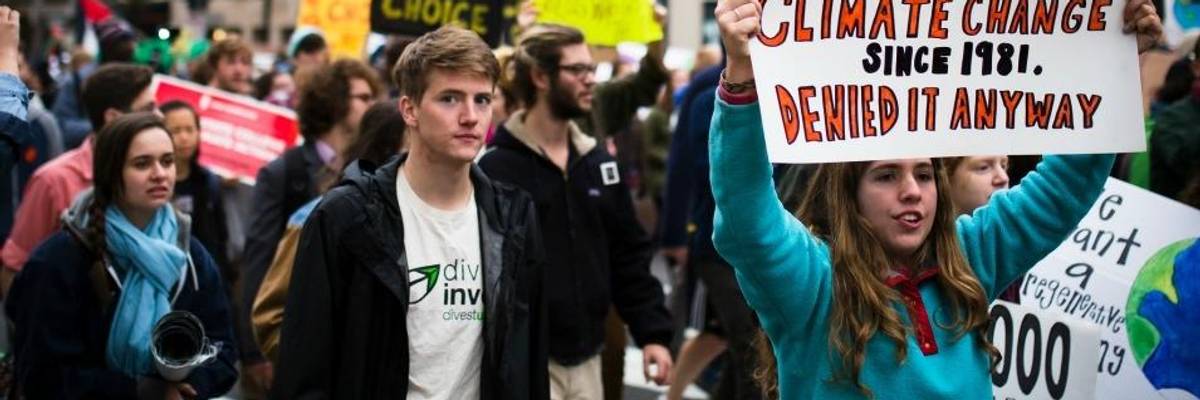
ExxonMobil is targeting lawyers and climate advocates with legal challenges for filing lawsuits against the company. (Photo: Johnny Silvercloud/flickr/cc)
In response to a series of lawsuits aimed at holding the oil giant to account for its climate crimes, ExxonMobil is taking "a bare-knuckle approach rarely seen in legal disputes" by threatening and filing counter suits against those who have sued them.
"Rather than bully communities trying to protect themselves, ExxonMobil should direct its vast resources to help fix the problem--and accept responsibility for the damages their products have caused."
--Peter Frumhoff, Union of Concerned Scientists
ExxonMobil "has targeted at least 30 people and organizations, including the attorneys general of New York and Massachusetts, hitting them with suits, threats of suits, or demands for sworn depositions," based upon claims that "the lawyers, public officials, and environmental activists are 'conspiring' against it in a coordinated legal and public relations campaign," Bloomberg reports.
After a 2015 investigative report by InsideClimate News found that ExxonMobil had "conducted cutting-edge climate research decades ago and then, without revealing all that it had learned, worked at the forefront of climate denial, manufacturing doubt about the scientific consensus that its own scientists had confirmed," attorneys general Eric Schneiderman of New York and Maura Healey of Massachusetts opened investigations into whether the company defrauded investors.
Additionally, New York City as well as eight cities and counties in California have sued ExxonMobil and other fossil fuel companies on the grounds that they have denied and concealed climate science showing the long-term consequences of using oil and gas, and that they should shoulder some of the economic costs generated from the environmental harm their products have caused.
ExxonMobil has named the supposed "coordinated" campaign against them "The La Jolla playbook," inspired by a 2012 meeting of a couple dozen people in La Jolla, California, to explore legal strategies that could be taken to address climate change--a meeting which the company, as Bloomberg notes, is framing "as ground zero for its conspiracy claim."
"It's crazy that people are subpoenaed for attending a meeting," Sharon Eubanks, an attorney who attended the La Jolla event, told Bloomberg. She sees the actions as "a big scare tactic: reframe the debate, use it as a diversionary tactic, and scare the heck out of everybody."
When ExxonMobil made moves indicating potential counter suits in California last month, Peter Frumhoff, chief climate scientist for the Union of Concerned Scientists, declared that its strategy "to intimidate these communities by threatening lawsuits is just another effort to evade accountability for its decades-long campaign to deceive the public about climate science, and block policies that could have limited the climate impacts that California residents are now facing."
"People often try to use litigation to change the cultural conversation. Exxon is positioning itself as a victim rather than a perpetrator."
--Alexandra Lahav, University of Connecticut School of Law
"Rather than bully communities trying to protect themselves," he argued, "ExxonMobil should direct its vast resources to help fix the problem--and accept responsibility for the damages their products have caused."
Alexandra Lahav, a professor at the University of Connecticut School of Law, posed that ExxonMobil's motive could be broader than scaring off future legal challenges or quashing those it's currently facing.
"People often try to use litigation to change the cultural conversation," Lahav noted. "Exxon is positioning itself as a victim rather than a perpetrator."
Dear Common Dreams reader, It’s been nearly 30 years since I co-founded Common Dreams with my late wife, Lina Newhouser. We had the radical notion that journalism should serve the public good, not corporate profits. It was clear to us from the outset what it would take to build such a project. No paid advertisements. No corporate sponsors. No millionaire publisher telling us what to think or do. Many people said we wouldn't last a year, but we proved those doubters wrong. Together with a tremendous team of journalists and dedicated staff, we built an independent media outlet free from the constraints of profits and corporate control. Our mission has always been simple: To inform. To inspire. To ignite change for the common good. Building Common Dreams was not easy. Our survival was never guaranteed. When you take on the most powerful forces—Wall Street greed, fossil fuel industry destruction, Big Tech lobbyists, and uber-rich oligarchs who have spent billions upon billions rigging the economy and democracy in their favor—the only bulwark you have is supporters who believe in your work. But here’s the urgent message from me today. It's never been this bad out there. And it's never been this hard to keep us going. At the very moment Common Dreams is most needed, the threats we face are intensifying. We need your support now more than ever. We don't accept corporate advertising and never will. We don't have a paywall because we don't think people should be blocked from critical news based on their ability to pay. Everything we do is funded by the donations of readers like you. When everyone does the little they can afford, we are strong. But if that support retreats or dries up, so do we. Will you donate now to make sure Common Dreams not only survives but thrives? —Craig Brown, Co-founder |
In response to a series of lawsuits aimed at holding the oil giant to account for its climate crimes, ExxonMobil is taking "a bare-knuckle approach rarely seen in legal disputes" by threatening and filing counter suits against those who have sued them.
"Rather than bully communities trying to protect themselves, ExxonMobil should direct its vast resources to help fix the problem--and accept responsibility for the damages their products have caused."
--Peter Frumhoff, Union of Concerned Scientists
ExxonMobil "has targeted at least 30 people and organizations, including the attorneys general of New York and Massachusetts, hitting them with suits, threats of suits, or demands for sworn depositions," based upon claims that "the lawyers, public officials, and environmental activists are 'conspiring' against it in a coordinated legal and public relations campaign," Bloomberg reports.
After a 2015 investigative report by InsideClimate News found that ExxonMobil had "conducted cutting-edge climate research decades ago and then, without revealing all that it had learned, worked at the forefront of climate denial, manufacturing doubt about the scientific consensus that its own scientists had confirmed," attorneys general Eric Schneiderman of New York and Maura Healey of Massachusetts opened investigations into whether the company defrauded investors.
Additionally, New York City as well as eight cities and counties in California have sued ExxonMobil and other fossil fuel companies on the grounds that they have denied and concealed climate science showing the long-term consequences of using oil and gas, and that they should shoulder some of the economic costs generated from the environmental harm their products have caused.
ExxonMobil has named the supposed "coordinated" campaign against them "The La Jolla playbook," inspired by a 2012 meeting of a couple dozen people in La Jolla, California, to explore legal strategies that could be taken to address climate change--a meeting which the company, as Bloomberg notes, is framing "as ground zero for its conspiracy claim."
"It's crazy that people are subpoenaed for attending a meeting," Sharon Eubanks, an attorney who attended the La Jolla event, told Bloomberg. She sees the actions as "a big scare tactic: reframe the debate, use it as a diversionary tactic, and scare the heck out of everybody."
When ExxonMobil made moves indicating potential counter suits in California last month, Peter Frumhoff, chief climate scientist for the Union of Concerned Scientists, declared that its strategy "to intimidate these communities by threatening lawsuits is just another effort to evade accountability for its decades-long campaign to deceive the public about climate science, and block policies that could have limited the climate impacts that California residents are now facing."
"People often try to use litigation to change the cultural conversation. Exxon is positioning itself as a victim rather than a perpetrator."
--Alexandra Lahav, University of Connecticut School of Law
"Rather than bully communities trying to protect themselves," he argued, "ExxonMobil should direct its vast resources to help fix the problem--and accept responsibility for the damages their products have caused."
Alexandra Lahav, a professor at the University of Connecticut School of Law, posed that ExxonMobil's motive could be broader than scaring off future legal challenges or quashing those it's currently facing.
"People often try to use litigation to change the cultural conversation," Lahav noted. "Exxon is positioning itself as a victim rather than a perpetrator."
In response to a series of lawsuits aimed at holding the oil giant to account for its climate crimes, ExxonMobil is taking "a bare-knuckle approach rarely seen in legal disputes" by threatening and filing counter suits against those who have sued them.
"Rather than bully communities trying to protect themselves, ExxonMobil should direct its vast resources to help fix the problem--and accept responsibility for the damages their products have caused."
--Peter Frumhoff, Union of Concerned Scientists
ExxonMobil "has targeted at least 30 people and organizations, including the attorneys general of New York and Massachusetts, hitting them with suits, threats of suits, or demands for sworn depositions," based upon claims that "the lawyers, public officials, and environmental activists are 'conspiring' against it in a coordinated legal and public relations campaign," Bloomberg reports.
After a 2015 investigative report by InsideClimate News found that ExxonMobil had "conducted cutting-edge climate research decades ago and then, without revealing all that it had learned, worked at the forefront of climate denial, manufacturing doubt about the scientific consensus that its own scientists had confirmed," attorneys general Eric Schneiderman of New York and Maura Healey of Massachusetts opened investigations into whether the company defrauded investors.
Additionally, New York City as well as eight cities and counties in California have sued ExxonMobil and other fossil fuel companies on the grounds that they have denied and concealed climate science showing the long-term consequences of using oil and gas, and that they should shoulder some of the economic costs generated from the environmental harm their products have caused.
ExxonMobil has named the supposed "coordinated" campaign against them "The La Jolla playbook," inspired by a 2012 meeting of a couple dozen people in La Jolla, California, to explore legal strategies that could be taken to address climate change--a meeting which the company, as Bloomberg notes, is framing "as ground zero for its conspiracy claim."
"It's crazy that people are subpoenaed for attending a meeting," Sharon Eubanks, an attorney who attended the La Jolla event, told Bloomberg. She sees the actions as "a big scare tactic: reframe the debate, use it as a diversionary tactic, and scare the heck out of everybody."
When ExxonMobil made moves indicating potential counter suits in California last month, Peter Frumhoff, chief climate scientist for the Union of Concerned Scientists, declared that its strategy "to intimidate these communities by threatening lawsuits is just another effort to evade accountability for its decades-long campaign to deceive the public about climate science, and block policies that could have limited the climate impacts that California residents are now facing."
"People often try to use litigation to change the cultural conversation. Exxon is positioning itself as a victim rather than a perpetrator."
--Alexandra Lahav, University of Connecticut School of Law
"Rather than bully communities trying to protect themselves," he argued, "ExxonMobil should direct its vast resources to help fix the problem--and accept responsibility for the damages their products have caused."
Alexandra Lahav, a professor at the University of Connecticut School of Law, posed that ExxonMobil's motive could be broader than scaring off future legal challenges or quashing those it's currently facing.
"People often try to use litigation to change the cultural conversation," Lahav noted. "Exxon is positioning itself as a victim rather than a perpetrator."