SUBSCRIBE TO OUR FREE NEWSLETTER
Daily news & progressive opinion—funded by the people, not the corporations—delivered straight to your inbox.
5
#000000
#FFFFFF
To donate by check, phone, or other method, see our More Ways to Give page.
Daily news & progressive opinion—funded by the people, not the corporations—delivered straight to your inbox.
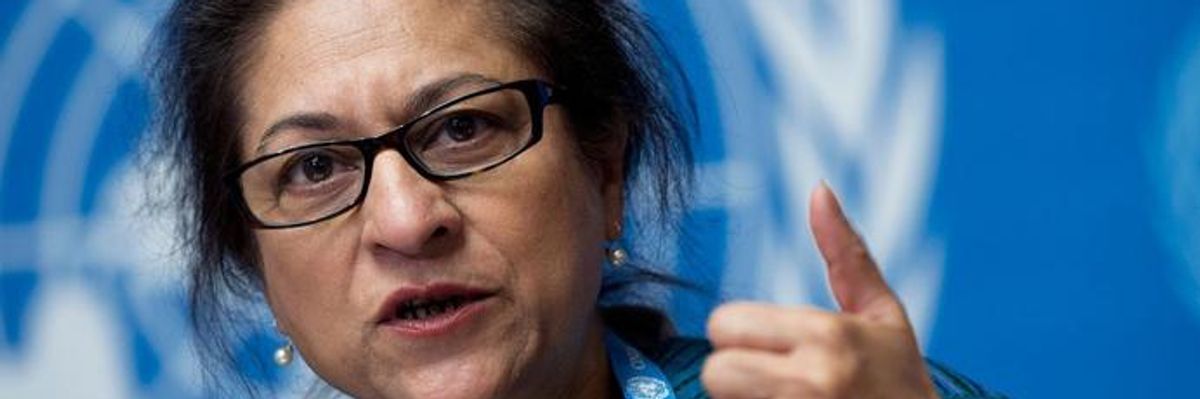
Pakistani human rights advocate Asma Jahangir died Sunday at the age of 66. (Photo: United Nations Human Rights Council/Twitter)
The death of renowned Pakistani human rights advocate Asma Jahangir on Sunday elicited an outpouring of condolences and calls to action, with fellow advocates and political figures from across the globe calling for a wave of renewed energy in fights for freedom, to honor her memory.
"She was always on the front line for progressive voices, even when democracy was under threat."
--Sherry Rehman, friend and Pakistani politician
Jahangir, a lawyer by training, was jailed during the 1980s for her pro-democracy work, served for years as a United Nations special rapporteur, and helped found the Human Rights Commission of Pakistan. She died Sunday, after suffering a heart attack, at the age of 66.
"In Pakistan, she campaigned tirelessly for democracy and free speech, frequently receiving death threats for taking up causes such as criticizing the strict blasphemy laws of the conservative Muslim-majority country," Reuters notes. "She also represented several civil society organizations that were threatened with shutdown as well as families of several 'disappeared' activists over the past few years."
In 2014, Jahangir--along with whistleblower Edward Snowden, climate crusader Bill McKibben, Guardian editor Alan Rusbridge, and Sri Lankan human rights activist Basil Fernando--received The Right Livelihood Award, which is often called the Alternative Nobel Prize.
Both Snowden and McKibben turned to Twitter to express their condolences and remind the world about the causes Jahangir championed:
"She was always on the front line for progressive voices, even when democracy was under threat," Sherry Rehman, an opposition senator in Pakistan's parliament, told Al-Jazeera. "As a close friend, we bickered on issues, but she introduced me to human rights when I was a young journalist.... We are all reeling from shock, the global human rights community is bereft--one of Pakistan's brightest faces is gone."
Her unexpected passing was met with many more expressions of grief, coupled with demands that the global community take more action to improve human rights worldwide:
Amnesty International's South Asia director Omar Waraich called Jahangir "the bravest person I knew:"
The BBC compiled a list outlining several of Jahangir's achievements:
This country and this world are at a monumental crossroads. US voters have an opportunity to beat back the forces of fascism and confront the billionaires who are rigging the economy, our media system, and our democracy, making it increasingly impossible for ordinary people to get by. We’re not just talking about the election. We’re talking about what must be done once these fascist elements are vanquished from power. We need a bolder set of solutions than what either major party has so far been willing to offer and a working-class movement ready to fight like hell for it. Trump didn't emerge from nowhere. The conditions that fueled MAGA authoritarianism were created by decades of radical neoliberal economic policies and a corrupt political system dominated by corporate interests. They slashed taxes on the super-rich, promising that the benefits would trickle down. They said giveaways to the corporate titans would make life more affordable for the rest of us. It was all bullshit. And when a bitter, betrayed populace searches for someone to blame, right-wing demagogues have little trouble finding scapegoats. People know when they're being lied to, but you won't hear any of this from the corporate media. Only independent journalism—powered and funded by people who believe in building a better world—can deliver truly trustworthy daily news. If you share our vision, please contribute whatever you can to sustain our work. |
The death of renowned Pakistani human rights advocate Asma Jahangir on Sunday elicited an outpouring of condolences and calls to action, with fellow advocates and political figures from across the globe calling for a wave of renewed energy in fights for freedom, to honor her memory.
"She was always on the front line for progressive voices, even when democracy was under threat."
--Sherry Rehman, friend and Pakistani politician
Jahangir, a lawyer by training, was jailed during the 1980s for her pro-democracy work, served for years as a United Nations special rapporteur, and helped found the Human Rights Commission of Pakistan. She died Sunday, after suffering a heart attack, at the age of 66.
"In Pakistan, she campaigned tirelessly for democracy and free speech, frequently receiving death threats for taking up causes such as criticizing the strict blasphemy laws of the conservative Muslim-majority country," Reuters notes. "She also represented several civil society organizations that were threatened with shutdown as well as families of several 'disappeared' activists over the past few years."
In 2014, Jahangir--along with whistleblower Edward Snowden, climate crusader Bill McKibben, Guardian editor Alan Rusbridge, and Sri Lankan human rights activist Basil Fernando--received The Right Livelihood Award, which is often called the Alternative Nobel Prize.
Both Snowden and McKibben turned to Twitter to express their condolences and remind the world about the causes Jahangir championed:
"She was always on the front line for progressive voices, even when democracy was under threat," Sherry Rehman, an opposition senator in Pakistan's parliament, told Al-Jazeera. "As a close friend, we bickered on issues, but she introduced me to human rights when I was a young journalist.... We are all reeling from shock, the global human rights community is bereft--one of Pakistan's brightest faces is gone."
Her unexpected passing was met with many more expressions of grief, coupled with demands that the global community take more action to improve human rights worldwide:
Amnesty International's South Asia director Omar Waraich called Jahangir "the bravest person I knew:"
The BBC compiled a list outlining several of Jahangir's achievements: