
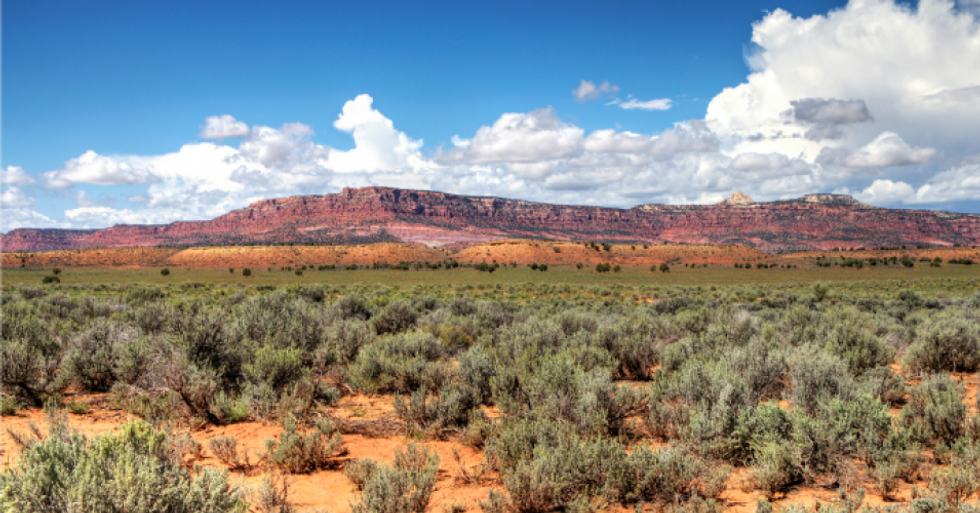
Despite protests from conservationists, local tribe leaders, Democratic lawmakers, and even the United Nations' expert on indigenous rights, at 6am on Friday the Trump administration will allow citizens and companies to start staking claims on sections of the Bears Ears and Grand Staircase-Escalante national monuments in Utah so the new stakeholders can conduct hard rock mining on the formerly protected lands.
"It is outrageous to witness the dismantling of the Bears Ears national monument, in what constitutes a serious attack on indigenous peoples' rights in the United States."
--Victoria Tauli-Corpuz, UN Special Rapporteur
"It is outrageous to witness the dismantling of the Bears Ears national monument, in what constitutes a serious attack on indigenous peoples' rights in the United States," said Victoria Tauli-Corpuz, UN Special Rapporteur on the rights of indigenous peoples.
Tauli-Corpuz noted that the previous administration's decision to create the monument "protected thousands of sacred sites which are central to the preservation of regional Native culture," and warned President Donald Trump's December decision to reduce Bears Ears' area by about 85 percent "exposes thousands of acres of sacred lands and archaeological sites to the threats of desecration, contamination, and permanent destruction."
Critics have turned to social media to denounce the "modern land run."
In response to the attacks on public lands and a proposal from Rep. John Curtis (R-Utah) that purports to give management control of the remaining land to indigenous leaders--who say the measure "is tribal in name only"--a group of Democratic senators has introduced a bill to fight back against Trump and Republicans in Congress:
In spite of widespread opposition, the Trump administration's Bureau of Land Management (BLM) plans to move forward with allowing stakeholders to claim plots of land on Friday, and has determined the process will be governed by the General Mining Law of 1872, which covers mining for metals such as copper, gold, silver, and uranium (but not coal and petroleum).
"The process for staking a claim remains much as it did during the Gold Rush," Reuters reports:
A prospector hammers four poles into the ground corresponding to the four points of a parcel that can be as big as 20 acres, and attaches a written description of the claim onto one of them. A prospector then has 30 days to record the claim at the local BLM office....
The costs of claiming are low: a $212 filing fee, and an annual maintenance fee of $150. Unlike laws governing petroleum extraction, there are no environmental guidelines specific to hard rock mining, and no requirement to pay a royalty. The claims provide prospectors mineral rights but not ownership of the land.
Lauren Pagel, the policy director of the nonprofit Earthworks, criticized the law as outdated, telling Reuters, "It's really the last law still on the books from that Manifest Destiny era encouraging a resources free-for-all."
Despite protests from conservationists, local tribe leaders, Democratic lawmakers, and even the United Nations' expert on indigenous rights, at 6am on Friday the Trump administration will allow citizens and companies to start staking claims on sections of the Bears Ears and Grand Staircase-Escalante national monuments in Utah so the new stakeholders can conduct hard rock mining on the formerly protected lands.
"It is outrageous to witness the dismantling of the Bears Ears national monument, in what constitutes a serious attack on indigenous peoples' rights in the United States."
--Victoria Tauli-Corpuz, UN Special Rapporteur
"It is outrageous to witness the dismantling of the Bears Ears national monument, in what constitutes a serious attack on indigenous peoples' rights in the United States," said Victoria Tauli-Corpuz, UN Special Rapporteur on the rights of indigenous peoples.
Tauli-Corpuz noted that the previous administration's decision to create the monument "protected thousands of sacred sites which are central to the preservation of regional Native culture," and warned President Donald Trump's December decision to reduce Bears Ears' area by about 85 percent "exposes thousands of acres of sacred lands and archaeological sites to the threats of desecration, contamination, and permanent destruction."
Critics have turned to social media to denounce the "modern land run."
In response to the attacks on public lands and a proposal from Rep. John Curtis (R-Utah) that purports to give management control of the remaining land to indigenous leaders--who say the measure "is tribal in name only"--a group of Democratic senators has introduced a bill to fight back against Trump and Republicans in Congress:
In spite of widespread opposition, the Trump administration's Bureau of Land Management (BLM) plans to move forward with allowing stakeholders to claim plots of land on Friday, and has determined the process will be governed by the General Mining Law of 1872, which covers mining for metals such as copper, gold, silver, and uranium (but not coal and petroleum).
"The process for staking a claim remains much as it did during the Gold Rush," Reuters reports:
A prospector hammers four poles into the ground corresponding to the four points of a parcel that can be as big as 20 acres, and attaches a written description of the claim onto one of them. A prospector then has 30 days to record the claim at the local BLM office....
The costs of claiming are low: a $212 filing fee, and an annual maintenance fee of $150. Unlike laws governing petroleum extraction, there are no environmental guidelines specific to hard rock mining, and no requirement to pay a royalty. The claims provide prospectors mineral rights but not ownership of the land.
Lauren Pagel, the policy director of the nonprofit Earthworks, criticized the law as outdated, telling Reuters, "It's really the last law still on the books from that Manifest Destiny era encouraging a resources free-for-all."
Despite protests from conservationists, local tribe leaders, Democratic lawmakers, and even the United Nations' expert on indigenous rights, at 6am on Friday the Trump administration will allow citizens and companies to start staking claims on sections of the Bears Ears and Grand Staircase-Escalante national monuments in Utah so the new stakeholders can conduct hard rock mining on the formerly protected lands.
"It is outrageous to witness the dismantling of the Bears Ears national monument, in what constitutes a serious attack on indigenous peoples' rights in the United States."
--Victoria Tauli-Corpuz, UN Special Rapporteur
"It is outrageous to witness the dismantling of the Bears Ears national monument, in what constitutes a serious attack on indigenous peoples' rights in the United States," said Victoria Tauli-Corpuz, UN Special Rapporteur on the rights of indigenous peoples.
Tauli-Corpuz noted that the previous administration's decision to create the monument "protected thousands of sacred sites which are central to the preservation of regional Native culture," and warned President Donald Trump's December decision to reduce Bears Ears' area by about 85 percent "exposes thousands of acres of sacred lands and archaeological sites to the threats of desecration, contamination, and permanent destruction."
Critics have turned to social media to denounce the "modern land run."
In response to the attacks on public lands and a proposal from Rep. John Curtis (R-Utah) that purports to give management control of the remaining land to indigenous leaders--who say the measure "is tribal in name only"--a group of Democratic senators has introduced a bill to fight back against Trump and Republicans in Congress:
In spite of widespread opposition, the Trump administration's Bureau of Land Management (BLM) plans to move forward with allowing stakeholders to claim plots of land on Friday, and has determined the process will be governed by the General Mining Law of 1872, which covers mining for metals such as copper, gold, silver, and uranium (but not coal and petroleum).
"The process for staking a claim remains much as it did during the Gold Rush," Reuters reports:
A prospector hammers four poles into the ground corresponding to the four points of a parcel that can be as big as 20 acres, and attaches a written description of the claim onto one of them. A prospector then has 30 days to record the claim at the local BLM office....
The costs of claiming are low: a $212 filing fee, and an annual maintenance fee of $150. Unlike laws governing petroleum extraction, there are no environmental guidelines specific to hard rock mining, and no requirement to pay a royalty. The claims provide prospectors mineral rights but not ownership of the land.
Lauren Pagel, the policy director of the nonprofit Earthworks, criticized the law as outdated, telling Reuters, "It's really the last law still on the books from that Manifest Destiny era encouraging a resources free-for-all."