SUBSCRIBE TO OUR FREE NEWSLETTER
Daily news & progressive opinion—funded by the people, not the corporations—delivered straight to your inbox.
5
#000000
#FFFFFF
To donate by check, phone, or other method, see our More Ways to Give page.
Daily news & progressive opinion—funded by the people, not the corporations—delivered straight to your inbox.
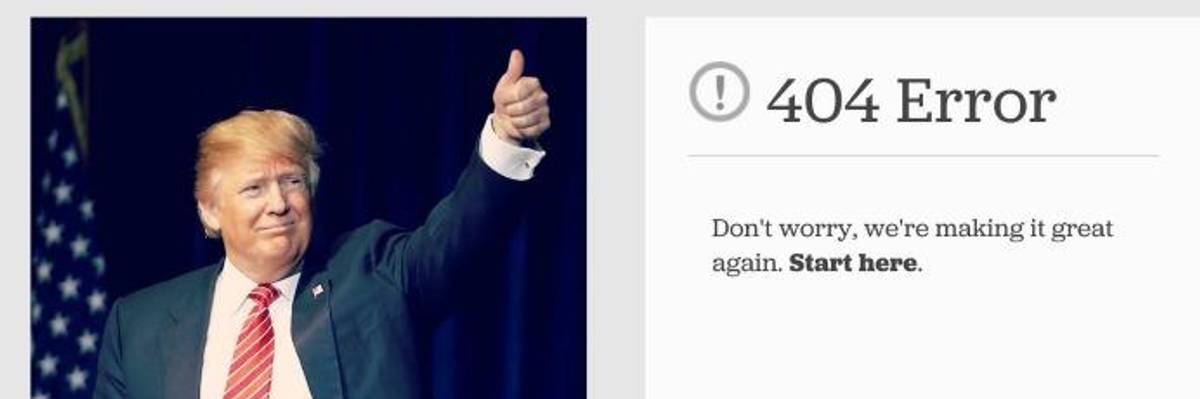
The Republican National Committee's website, which featured President Donald Trump's Fake News Awards, experienced an issue on Wednesday night as the results were set to be revealed. (Photo: Luisa Haynes/@wokeluisa/Twitter)
Highlighting President Donald Trump's general lack of support for the constitutionally guaranteed freedoms of speech and the press, the president's ever-evolving animosity toward the news media culminated in his #FakeNewsAwards, which he doled out on Wednesday night via the internet--as soon as the Republican National Committee's website issue was resolved.
The stunt--the subject of endless jokes--underscored Trump's apparent inability and unwillingness to calmly respond to any and all criticism. Alongside the mockery, journalists and political commenters used the event to remind the public of the growing threats to free speech and press in the age of Trump.
"The purpose of any award is to create an institutionalized way of promoting a certain cause through drawing public attention," observes Ohio State University professor Gleb Tsipursky, warning: "These awards create an institution for Trump's relentless attacks on mainstream media and position Trump as the only voice who gets to determine truthful media."
Other advocates for freedom shared similar observations on Twitter:
After Trump announced his plan to issue Fake News Awards, the Committee to Protect Journalists (CPJ)--which tracks threats to press freedom, including cases of journalists being killed, injured, or imprisoned while on the job--trolled Trump while also highlighting the seriousness of his hostility toward journalists and media organizations by giving out awards to the world's anti-press leaders, and honoring the president with an award for "Overall Achievement in Undermining Global Press Freedom."
Trump's Fake News Awards also provided an opportunity to make note the president's mounting list of misleading or blatantly dishonest statements. "President Trump almost never admits error, even as he has made more than 2,000 false or misleading statements," wrote Glenn Kessler of the Washington Post's "Fact Checker" blog.
However, that's not the case for most recipients of Trump's awards, as Kessler noted: "At least eight of the 'Fake News' winners resulted in corrections, with two reports prompting suspensions or resignations. Two of the winners were simply tweets that were quickly corrected and never resulted in news articles. One was an opinion article in which the author later retracted his prediction."
Dear Common Dreams reader, It’s been nearly 30 years since I co-founded Common Dreams with my late wife, Lina Newhouser. We had the radical notion that journalism should serve the public good, not corporate profits. It was clear to us from the outset what it would take to build such a project. No paid advertisements. No corporate sponsors. No millionaire publisher telling us what to think or do. Many people said we wouldn't last a year, but we proved those doubters wrong. Together with a tremendous team of journalists and dedicated staff, we built an independent media outlet free from the constraints of profits and corporate control. Our mission has always been simple: To inform. To inspire. To ignite change for the common good. Building Common Dreams was not easy. Our survival was never guaranteed. When you take on the most powerful forces—Wall Street greed, fossil fuel industry destruction, Big Tech lobbyists, and uber-rich oligarchs who have spent billions upon billions rigging the economy and democracy in their favor—the only bulwark you have is supporters who believe in your work. But here’s the urgent message from me today. It's never been this bad out there. And it's never been this hard to keep us going. At the very moment Common Dreams is most needed, the threats we face are intensifying. We need your support now more than ever. We don't accept corporate advertising and never will. We don't have a paywall because we don't think people should be blocked from critical news based on their ability to pay. Everything we do is funded by the donations of readers like you. When everyone does the little they can afford, we are strong. But if that support retreats or dries up, so do we. Will you donate now to make sure Common Dreams not only survives but thrives? —Craig Brown, Co-founder |
Highlighting President Donald Trump's general lack of support for the constitutionally guaranteed freedoms of speech and the press, the president's ever-evolving animosity toward the news media culminated in his #FakeNewsAwards, which he doled out on Wednesday night via the internet--as soon as the Republican National Committee's website issue was resolved.
The stunt--the subject of endless jokes--underscored Trump's apparent inability and unwillingness to calmly respond to any and all criticism. Alongside the mockery, journalists and political commenters used the event to remind the public of the growing threats to free speech and press in the age of Trump.
"The purpose of any award is to create an institutionalized way of promoting a certain cause through drawing public attention," observes Ohio State University professor Gleb Tsipursky, warning: "These awards create an institution for Trump's relentless attacks on mainstream media and position Trump as the only voice who gets to determine truthful media."
Other advocates for freedom shared similar observations on Twitter:
After Trump announced his plan to issue Fake News Awards, the Committee to Protect Journalists (CPJ)--which tracks threats to press freedom, including cases of journalists being killed, injured, or imprisoned while on the job--trolled Trump while also highlighting the seriousness of his hostility toward journalists and media organizations by giving out awards to the world's anti-press leaders, and honoring the president with an award for "Overall Achievement in Undermining Global Press Freedom."
Trump's Fake News Awards also provided an opportunity to make note the president's mounting list of misleading or blatantly dishonest statements. "President Trump almost never admits error, even as he has made more than 2,000 false or misleading statements," wrote Glenn Kessler of the Washington Post's "Fact Checker" blog.
However, that's not the case for most recipients of Trump's awards, as Kessler noted: "At least eight of the 'Fake News' winners resulted in corrections, with two reports prompting suspensions or resignations. Two of the winners were simply tweets that were quickly corrected and never resulted in news articles. One was an opinion article in which the author later retracted his prediction."
Highlighting President Donald Trump's general lack of support for the constitutionally guaranteed freedoms of speech and the press, the president's ever-evolving animosity toward the news media culminated in his #FakeNewsAwards, which he doled out on Wednesday night via the internet--as soon as the Republican National Committee's website issue was resolved.
The stunt--the subject of endless jokes--underscored Trump's apparent inability and unwillingness to calmly respond to any and all criticism. Alongside the mockery, journalists and political commenters used the event to remind the public of the growing threats to free speech and press in the age of Trump.
"The purpose of any award is to create an institutionalized way of promoting a certain cause through drawing public attention," observes Ohio State University professor Gleb Tsipursky, warning: "These awards create an institution for Trump's relentless attacks on mainstream media and position Trump as the only voice who gets to determine truthful media."
Other advocates for freedom shared similar observations on Twitter:
After Trump announced his plan to issue Fake News Awards, the Committee to Protect Journalists (CPJ)--which tracks threats to press freedom, including cases of journalists being killed, injured, or imprisoned while on the job--trolled Trump while also highlighting the seriousness of his hostility toward journalists and media organizations by giving out awards to the world's anti-press leaders, and honoring the president with an award for "Overall Achievement in Undermining Global Press Freedom."
Trump's Fake News Awards also provided an opportunity to make note the president's mounting list of misleading or blatantly dishonest statements. "President Trump almost never admits error, even as he has made more than 2,000 false or misleading statements," wrote Glenn Kessler of the Washington Post's "Fact Checker" blog.
However, that's not the case for most recipients of Trump's awards, as Kessler noted: "At least eight of the 'Fake News' winners resulted in corrections, with two reports prompting suspensions or resignations. Two of the winners were simply tweets that were quickly corrected and never resulted in news articles. One was an opinion article in which the author later retracted his prediction."