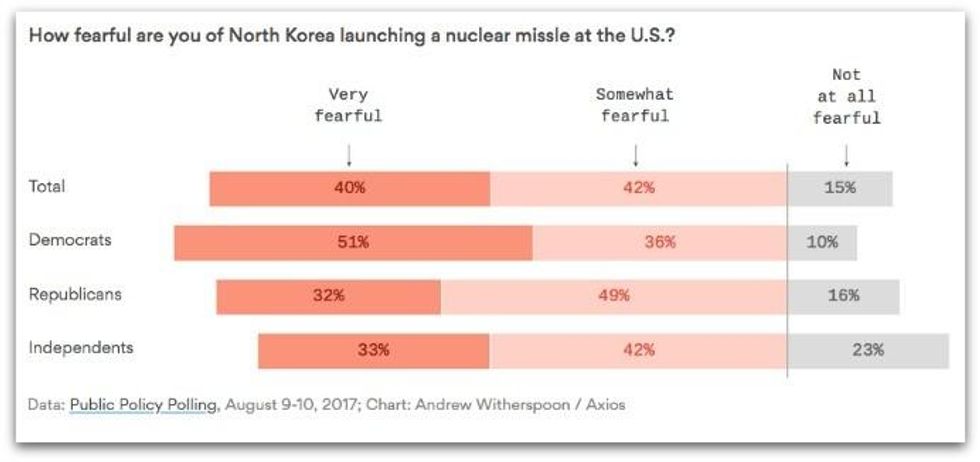
New poll results released Friday, provided exclusively to Axios, show that more than 8 in 10 Americans are fearful of nuclear war breaking out between the United States and North Korea.
And why shouldn't people be afraid? Early Friday morning, the president said the U.S. military is "locked and loaded" regarding North Korea.
Commissioned by Vote Vets, a left-leaning political action group which advocates on behalf of U.S. veterans, the poll shows that Americans are both paying attention to--and increasingly worried about--the tensions stirred by President Donald Trump's bluster and threats towards North Korea and fears that Pyongyang may itself try to launch a nuclear attack.
The new poll arrives after Trump on Thursday said maybe his recent threats to bring down "fire and fury" against North Korea were not "tough" enough and ahead of upcoming (and large-scale) U.S.-South Korean war games which foreign policy analysts warn will only exacerbate tensions.
As reporting on Friday by the Canada Press explains, psychologists say such widespread "public anxiety" can erupt quickly when a figurehead like Trump is making the kind of statements he's made this week:
While the escalating rhetoric may be mere sabre-rattling, psychologists say feeling fearful or anxious about the threat of a nuclear holocaust, or any life-altering catastrophe, is perfectly normal.
"Sometimes we might experience a sense of being in constant danger, especially if we're questioning if there's this threat to life and safety," said Dr. Katy Kamkar, a clinical psychologist at the Centre for Addiction and Mental Health in Toronto.
"And it becomes not only the concern for the safety of self, but then, of course, for the safety of loved ones, the destruction of everything we have established," she said.
Meanwhile on Friday, China appeared to issue a warning to North Korea--via a "semi-official" newspaper editorial--that if it did launch any attack on the U.S., it would effectively be on its own.
While voices for peace and de-escalation continue to call for diplomacy and denounce Trump's "lunatic" behavior, 60+ Democrats on Thursday sent a letter to U.S. Secretary of State Rex Tillerson urging him to facilitate a reduction in the counter-productive provocations and proclamations coming from the White House.
New poll results released Friday, provided exclusively to Axios, show that more than 8 in 10 Americans are fearful of nuclear war breaking out between the United States and North Korea.
And why shouldn't people be afraid? Early Friday morning, the president said the U.S. military is "locked and loaded" regarding North Korea.
Commissioned by Vote Vets, a left-leaning political action group which advocates on behalf of U.S. veterans, the poll shows that Americans are both paying attention to--and increasingly worried about--the tensions stirred by President Donald Trump's bluster and threats towards North Korea and fears that Pyongyang may itself try to launch a nuclear attack.
The new poll arrives after Trump on Thursday said maybe his recent threats to bring down "fire and fury" against North Korea were not "tough" enough and ahead of upcoming (and large-scale) U.S.-South Korean war games which foreign policy analysts warn will only exacerbate tensions.
As reporting on Friday by the Canada Press explains, psychologists say such widespread "public anxiety" can erupt quickly when a figurehead like Trump is making the kind of statements he's made this week:
While the escalating rhetoric may be mere sabre-rattling, psychologists say feeling fearful or anxious about the threat of a nuclear holocaust, or any life-altering catastrophe, is perfectly normal.
"Sometimes we might experience a sense of being in constant danger, especially if we're questioning if there's this threat to life and safety," said Dr. Katy Kamkar, a clinical psychologist at the Centre for Addiction and Mental Health in Toronto.
"And it becomes not only the concern for the safety of self, but then, of course, for the safety of loved ones, the destruction of everything we have established," she said.
Meanwhile on Friday, China appeared to issue a warning to North Korea--via a "semi-official" newspaper editorial--that if it did launch any attack on the U.S., it would effectively be on its own.
While voices for peace and de-escalation continue to call for diplomacy and denounce Trump's "lunatic" behavior, 60+ Democrats on Thursday sent a letter to U.S. Secretary of State Rex Tillerson urging him to facilitate a reduction in the counter-productive provocations and proclamations coming from the White House.
New poll results released Friday, provided exclusively to Axios, show that more than 8 in 10 Americans are fearful of nuclear war breaking out between the United States and North Korea.
And why shouldn't people be afraid? Early Friday morning, the president said the U.S. military is "locked and loaded" regarding North Korea.
Commissioned by Vote Vets, a left-leaning political action group which advocates on behalf of U.S. veterans, the poll shows that Americans are both paying attention to--and increasingly worried about--the tensions stirred by President Donald Trump's bluster and threats towards North Korea and fears that Pyongyang may itself try to launch a nuclear attack.
The new poll arrives after Trump on Thursday said maybe his recent threats to bring down "fire and fury" against North Korea were not "tough" enough and ahead of upcoming (and large-scale) U.S.-South Korean war games which foreign policy analysts warn will only exacerbate tensions.
As reporting on Friday by the Canada Press explains, psychologists say such widespread "public anxiety" can erupt quickly when a figurehead like Trump is making the kind of statements he's made this week:
While the escalating rhetoric may be mere sabre-rattling, psychologists say feeling fearful or anxious about the threat of a nuclear holocaust, or any life-altering catastrophe, is perfectly normal.
"Sometimes we might experience a sense of being in constant danger, especially if we're questioning if there's this threat to life and safety," said Dr. Katy Kamkar, a clinical psychologist at the Centre for Addiction and Mental Health in Toronto.
"And it becomes not only the concern for the safety of self, but then, of course, for the safety of loved ones, the destruction of everything we have established," she said.
Meanwhile on Friday, China appeared to issue a warning to North Korea--via a "semi-official" newspaper editorial--that if it did launch any attack on the U.S., it would effectively be on its own.
While voices for peace and de-escalation continue to call for diplomacy and denounce Trump's "lunatic" behavior, 60+ Democrats on Thursday sent a letter to U.S. Secretary of State Rex Tillerson urging him to facilitate a reduction in the counter-productive provocations and proclamations coming from the White House.