




SUBSCRIBE TO OUR FREE NEWSLETTER
Daily news & progressive opinion—funded by the people, not the corporations—delivered straight to your inbox.
5
#000000
#FFFFFF
To donate by check, phone, or other method, see our More Ways to Give page.
Daily news & progressive opinion—funded by the people, not the corporations—delivered straight to your inbox.
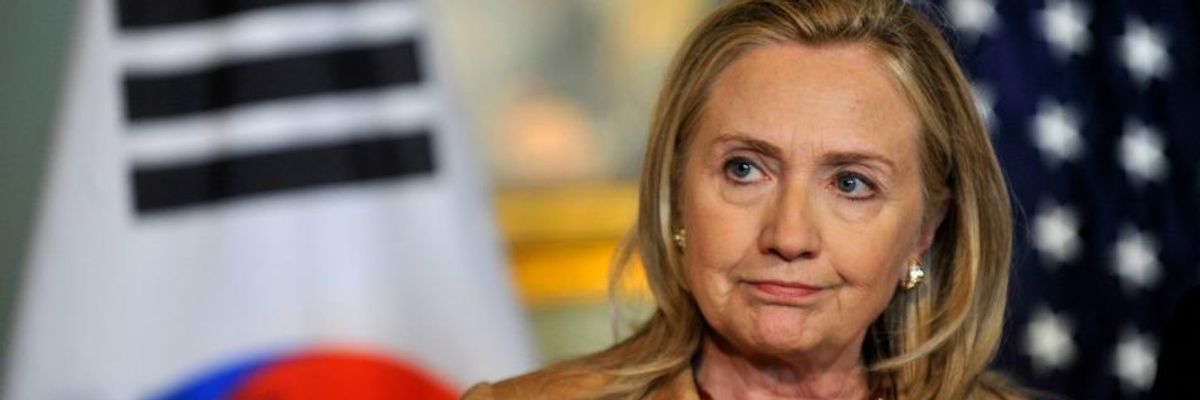
While serving as Sectary of State, none of the former secretary's emails were archived for government records. (Photo: Glenn Fawcet/ Department of Defense)
Former Secretary of State and likely presidential candidate Hillary Clinton for years skirted public disclosure and federal record-keeping laws by using her personal email account while serving her post as the United States' highest ranking ambassador, reports revealed on Tuesday.
According to the New York Times, during Clinton's four-year tenure at the State Department, she never had a government email address nor did her aides take any action to preserve her correspondence on department servers. Under the Federal Records Act, such communications are considered government records and are supposed to be archived "so that congressional committees, historians and members of the news media can find them," the Times reports.
Further, experts said that there is no guarantee of security with personal email accounts.
Jason Baron, an attorney with Drinker Biddle & Reath who served as the director of litigation at the National Archives and Records Administration from 2000-2013 said the exclusive use of private email was unprecedented for such a high-ranking official.
"It is very difficult to conceive of a scenario -- short of nuclear winter -- where an agency would be justified in allowing its cabinet-level head officer to solely use a private email communications channel for the conduct of government business," Baron said. Exceptions to the law exist for certain classified materials and the use of private email is meant to be limited for emergencies.
Clinton spokesperson Nick Merrill defended her use of the personal email account telling the Times she had complied with the "letter and spirit of the rules."
Writing for Firedoglake on Tuesday, columnist Peter Van Buren notes that the "most basic reason this all matters is because it is the law."
Van Buren says that Clinton's decision to use her personal email--which was registered through her own domain, clintonemail.com--was "deliberate, and included an effort to hide what she was doing." Clinton's email actions, Van Buren suggests, will likely come back to haunt the Democratic Party favorite once campaigns for the 2016 Election are underway.
"Clinton as a leader allowed herself to be held to lower standards than that of her own rank and file. This, along with the decision to hide the emails itself and the violations of law, will raise questions about what type of president she might make," Van Buren writes.
According to the Times' reporting, the record breach was only discovered two months ago when, in response to a new State Department effort to comply with federal record-keeping practices, the former Secretary's advisers turned over 55,000 pages of personal emails to the department.
The Times notes that the revelation "echoes longstanding criticisms directed at both the former secretary and her husband, former President Bill Clinton, for a lack of transparency and inclination toward secrecy."
Donald Trump’s attacks on democracy, justice, and a free press are escalating — putting everything we stand for at risk. We believe a better world is possible, but we can’t get there without your support. Common Dreams stands apart. We answer only to you — our readers, activists, and changemakers — not to billionaires or corporations. Our independence allows us to cover the vital stories that others won’t, spotlighting movements for peace, equality, and human rights. Right now, our work faces unprecedented challenges. Misinformation is spreading, journalists are under attack, and financial pressures are mounting. As a reader-supported, nonprofit newsroom, your support is crucial to keep this journalism alive. Whatever you can give — $10, $25, or $100 — helps us stay strong and responsive when the world needs us most. Together, we’ll continue to build the independent, courageous journalism our movement relies on. Thank you for being part of this community. |
Former Secretary of State and likely presidential candidate Hillary Clinton for years skirted public disclosure and federal record-keeping laws by using her personal email account while serving her post as the United States' highest ranking ambassador, reports revealed on Tuesday.
According to the New York Times, during Clinton's four-year tenure at the State Department, she never had a government email address nor did her aides take any action to preserve her correspondence on department servers. Under the Federal Records Act, such communications are considered government records and are supposed to be archived "so that congressional committees, historians and members of the news media can find them," the Times reports.
Further, experts said that there is no guarantee of security with personal email accounts.
Jason Baron, an attorney with Drinker Biddle & Reath who served as the director of litigation at the National Archives and Records Administration from 2000-2013 said the exclusive use of private email was unprecedented for such a high-ranking official.
"It is very difficult to conceive of a scenario -- short of nuclear winter -- where an agency would be justified in allowing its cabinet-level head officer to solely use a private email communications channel for the conduct of government business," Baron said. Exceptions to the law exist for certain classified materials and the use of private email is meant to be limited for emergencies.
Clinton spokesperson Nick Merrill defended her use of the personal email account telling the Times she had complied with the "letter and spirit of the rules."
Writing for Firedoglake on Tuesday, columnist Peter Van Buren notes that the "most basic reason this all matters is because it is the law."
Van Buren says that Clinton's decision to use her personal email--which was registered through her own domain, clintonemail.com--was "deliberate, and included an effort to hide what she was doing." Clinton's email actions, Van Buren suggests, will likely come back to haunt the Democratic Party favorite once campaigns for the 2016 Election are underway.
"Clinton as a leader allowed herself to be held to lower standards than that of her own rank and file. This, along with the decision to hide the emails itself and the violations of law, will raise questions about what type of president she might make," Van Buren writes.
According to the Times' reporting, the record breach was only discovered two months ago when, in response to a new State Department effort to comply with federal record-keeping practices, the former Secretary's advisers turned over 55,000 pages of personal emails to the department.
The Times notes that the revelation "echoes longstanding criticisms directed at both the former secretary and her husband, former President Bill Clinton, for a lack of transparency and inclination toward secrecy."
Former Secretary of State and likely presidential candidate Hillary Clinton for years skirted public disclosure and federal record-keeping laws by using her personal email account while serving her post as the United States' highest ranking ambassador, reports revealed on Tuesday.
According to the New York Times, during Clinton's four-year tenure at the State Department, she never had a government email address nor did her aides take any action to preserve her correspondence on department servers. Under the Federal Records Act, such communications are considered government records and are supposed to be archived "so that congressional committees, historians and members of the news media can find them," the Times reports.
Further, experts said that there is no guarantee of security with personal email accounts.
Jason Baron, an attorney with Drinker Biddle & Reath who served as the director of litigation at the National Archives and Records Administration from 2000-2013 said the exclusive use of private email was unprecedented for such a high-ranking official.
"It is very difficult to conceive of a scenario -- short of nuclear winter -- where an agency would be justified in allowing its cabinet-level head officer to solely use a private email communications channel for the conduct of government business," Baron said. Exceptions to the law exist for certain classified materials and the use of private email is meant to be limited for emergencies.
Clinton spokesperson Nick Merrill defended her use of the personal email account telling the Times she had complied with the "letter and spirit of the rules."
Writing for Firedoglake on Tuesday, columnist Peter Van Buren notes that the "most basic reason this all matters is because it is the law."
Van Buren says that Clinton's decision to use her personal email--which was registered through her own domain, clintonemail.com--was "deliberate, and included an effort to hide what she was doing." Clinton's email actions, Van Buren suggests, will likely come back to haunt the Democratic Party favorite once campaigns for the 2016 Election are underway.
"Clinton as a leader allowed herself to be held to lower standards than that of her own rank and file. This, along with the decision to hide the emails itself and the violations of law, will raise questions about what type of president she might make," Van Buren writes.
According to the Times' reporting, the record breach was only discovered two months ago when, in response to a new State Department effort to comply with federal record-keeping practices, the former Secretary's advisers turned over 55,000 pages of personal emails to the department.
The Times notes that the revelation "echoes longstanding criticisms directed at both the former secretary and her husband, former President Bill Clinton, for a lack of transparency and inclination toward secrecy."