SUBSCRIBE TO OUR FREE NEWSLETTER
Daily news & progressive opinion—funded by the people, not the corporations—delivered straight to your inbox.
5
#000000
#FFFFFF
To donate by check, phone, or other method, see our More Ways to Give page.
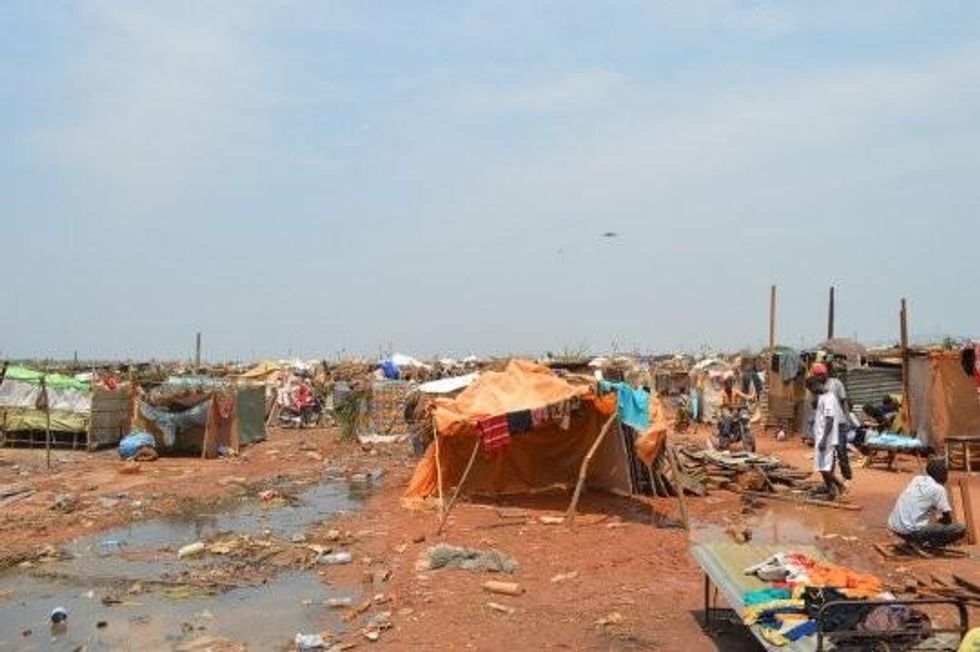
"The human crisis we are witnessing today is unprecedented in the Central African Republic, a country that has been neglected for years," said Dr. Joanne Liu, MSF international president, who recently returned from the country.
Ongoing violence has caused tens of thousands to flee to neighboring countries, thousands have been killed, and those internally displaced face potential brutal attacks--even within hospitals--and minimal shelter with unsafe sanitation levels.
MSF stated that in in some areas humanitarian assistance has been "appalling" or non-existent.
1.3 million people are estimated to be in need of food assisatnce. "As well as forcing people out of the country, violence and insecurity are stopping food from coming in, and people are unable to get enough food for their families. Many of those who have fled the attacks in [the capital of] Bangui were the backbone of the local economy," explained Philippe Conraud, Country Director of Oxfam in CAR.
UN High Commissioner for Human Rights Navi Pillay said Wednesday, "The level of cruelty and disregard for life and dignity is horrifying," and warned that some of the human rights violations taking place may amount to crimes against humanity. Describing what he saw during a visit to Bangui, UN High Commissioner for Refugees Antonio Guterres called it "a humanitarian catastrophe of unspeakable proportions."
"Armed men wearing masks came with machetes and killed everyone in our village, men, women and children," said one woman from the western CAR town of Paoua. "We don't know why," she added.
While many media reports have characterized the violence as a conflict between Muslim Seleka rebels and Christian anti-balaka groups, others have urged a closer look at the historical and broader factors including colonialism, economic security, corporate interests and conflicts that cross national boundaries.
Writer and political analyst Nanjala Nyabola points out that CAR is
home to significant reserves of uranium, the key ingredient in nuclear reactors. As of 2010, 90 percent of the deposits in Bakouma were owned by Uramin, a private corporation in which Areva, the French nuclear giant, is 100 percent shareholder. The impact of this wholly unequal set up is exacerbated by the fact that 75 percent of France's energy is derived from nuclear sources, giving Areva and France significant financial interest in what happens in the CAR.
France has now sent 1,600 troops to the country.
"A mobilization must come now, not in one month, or six months down the line. We see atrocities every day," Liu stated. "This is a massive catastrophe unfolding in full view of international leaders. To not respond is a conscious and deliberate choice to abandon the people of the Central African Republic."
___________________
"The human crisis we are witnessing today is unprecedented in the Central African Republic, a country that has been neglected for years," said Dr. Joanne Liu, MSF international president, who recently returned from the country.
Ongoing violence has caused tens of thousands to flee to neighboring countries, thousands have been killed, and those internally displaced face potential brutal attacks--even within hospitals--and minimal shelter with unsafe sanitation levels.
MSF stated that in in some areas humanitarian assistance has been "appalling" or non-existent.
1.3 million people are estimated to be in need of food assisatnce. "As well as forcing people out of the country, violence and insecurity are stopping food from coming in, and people are unable to get enough food for their families. Many of those who have fled the attacks in [the capital of] Bangui were the backbone of the local economy," explained Philippe Conraud, Country Director of Oxfam in CAR.
UN High Commissioner for Human Rights Navi Pillay said Wednesday, "The level of cruelty and disregard for life and dignity is horrifying," and warned that some of the human rights violations taking place may amount to crimes against humanity. Describing what he saw during a visit to Bangui, UN High Commissioner for Refugees Antonio Guterres called it "a humanitarian catastrophe of unspeakable proportions."
"Armed men wearing masks came with machetes and killed everyone in our village, men, women and children," said one woman from the western CAR town of Paoua. "We don't know why," she added.
While many media reports have characterized the violence as a conflict between Muslim Seleka rebels and Christian anti-balaka groups, others have urged a closer look at the historical and broader factors including colonialism, economic security, corporate interests and conflicts that cross national boundaries.
Writer and political analyst Nanjala Nyabola points out that CAR is
home to significant reserves of uranium, the key ingredient in nuclear reactors. As of 2010, 90 percent of the deposits in Bakouma were owned by Uramin, a private corporation in which Areva, the French nuclear giant, is 100 percent shareholder. The impact of this wholly unequal set up is exacerbated by the fact that 75 percent of France's energy is derived from nuclear sources, giving Areva and France significant financial interest in what happens in the CAR.
France has now sent 1,600 troops to the country.
"A mobilization must come now, not in one month, or six months down the line. We see atrocities every day," Liu stated. "This is a massive catastrophe unfolding in full view of international leaders. To not respond is a conscious and deliberate choice to abandon the people of the Central African Republic."
___________________
"The human crisis we are witnessing today is unprecedented in the Central African Republic, a country that has been neglected for years," said Dr. Joanne Liu, MSF international president, who recently returned from the country.
Ongoing violence has caused tens of thousands to flee to neighboring countries, thousands have been killed, and those internally displaced face potential brutal attacks--even within hospitals--and minimal shelter with unsafe sanitation levels.
MSF stated that in in some areas humanitarian assistance has been "appalling" or non-existent.
1.3 million people are estimated to be in need of food assisatnce. "As well as forcing people out of the country, violence and insecurity are stopping food from coming in, and people are unable to get enough food for their families. Many of those who have fled the attacks in [the capital of] Bangui were the backbone of the local economy," explained Philippe Conraud, Country Director of Oxfam in CAR.
UN High Commissioner for Human Rights Navi Pillay said Wednesday, "The level of cruelty and disregard for life and dignity is horrifying," and warned that some of the human rights violations taking place may amount to crimes against humanity. Describing what he saw during a visit to Bangui, UN High Commissioner for Refugees Antonio Guterres called it "a humanitarian catastrophe of unspeakable proportions."
"Armed men wearing masks came with machetes and killed everyone in our village, men, women and children," said one woman from the western CAR town of Paoua. "We don't know why," she added.
While many media reports have characterized the violence as a conflict between Muslim Seleka rebels and Christian anti-balaka groups, others have urged a closer look at the historical and broader factors including colonialism, economic security, corporate interests and conflicts that cross national boundaries.
Writer and political analyst Nanjala Nyabola points out that CAR is
home to significant reserves of uranium, the key ingredient in nuclear reactors. As of 2010, 90 percent of the deposits in Bakouma were owned by Uramin, a private corporation in which Areva, the French nuclear giant, is 100 percent shareholder. The impact of this wholly unequal set up is exacerbated by the fact that 75 percent of France's energy is derived from nuclear sources, giving Areva and France significant financial interest in what happens in the CAR.
France has now sent 1,600 troops to the country.
"A mobilization must come now, not in one month, or six months down the line. We see atrocities every day," Liu stated. "This is a massive catastrophe unfolding in full view of international leaders. To not respond is a conscious and deliberate choice to abandon the people of the Central African Republic."
___________________