SUBSCRIBE TO OUR FREE NEWSLETTER
Daily news & progressive opinion—funded by the people, not the corporations—delivered straight to your inbox.
5
#000000
#FFFFFF
To donate by check, phone, or other method, see our More Ways to Give page.
Though no injuries were reported, the incident highlights the safety concerns posed by many as the pipeline company awaits a White House decision on whether or not to permit the construction of the Transcanada-operated Keystone XL tar sands pipeline.
A spokesman from Canada's National Energy Board said the line was shut down and was depressurized to contain the fire and that they are working with the federal Transportation Safety Board to determine the cause of the explosion.
Canadian Broadcasting Corp. reported:
The trouble began early Saturday when RCMP responded around 1:05 a.m. to a "loud explosion."
Witnesses who live close to the scene said it was massive. Paul Rawluk lives nearby and drove to the site.
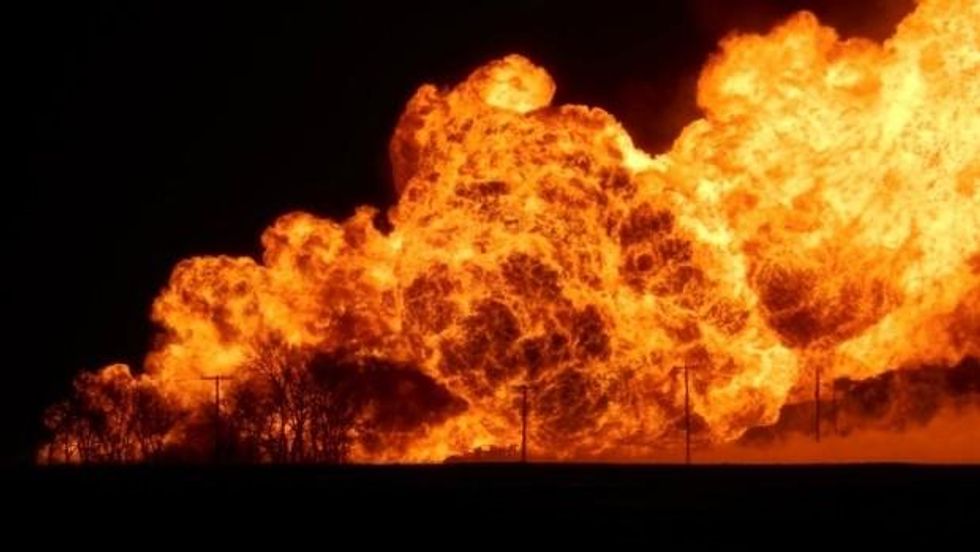
"As we got closer, we could see these massive 200 to 300 metre high flames just shooting out of the ground and it literally sounded like a jet plane," he said. "And that's the thing that really got us, was the sound of it."
He said it was hard to describe the scale.
"Massive, like absolutely massive," he said. "The police were by [Highway] 59 and you could just see little cars out there and you could see in comparison how big the flame was. It was just literally two to 300 metres in the air. And bright, I mean lit up the sky."
About 4,000 residents and other customers may be without natural gas for at least a day, said local utility Manitoba Hydro, as reported by Reuters. Temperatures in the province are well below freezing.
While some argue that increasing incidents of pipeline leaks may provide fodder for increased fossil fuel shipment by rail, as Canadian environmentalist David Suzuki wrote earlier this week, "instead [these accidents] indicate that rapidly increasing oil and gas development and shipping ever greater amounts, by any method, will mean more accidents, spills, environmental damage--even death."
"The answer is to step back from this reckless plunder and consider ways to reduce our fossil fuel use," he adds.
_____________________
Though no injuries were reported, the incident highlights the safety concerns posed by many as the pipeline company awaits a White House decision on whether or not to permit the construction of the Transcanada-operated Keystone XL tar sands pipeline.
A spokesman from Canada's National Energy Board said the line was shut down and was depressurized to contain the fire and that they are working with the federal Transportation Safety Board to determine the cause of the explosion.
Canadian Broadcasting Corp. reported:
The trouble began early Saturday when RCMP responded around 1:05 a.m. to a "loud explosion."
Witnesses who live close to the scene said it was massive. Paul Rawluk lives nearby and drove to the site.
"As we got closer, we could see these massive 200 to 300 metre high flames just shooting out of the ground and it literally sounded like a jet plane," he said. "And that's the thing that really got us, was the sound of it."
He said it was hard to describe the scale.
"Massive, like absolutely massive," he said. "The police were by [Highway] 59 and you could just see little cars out there and you could see in comparison how big the flame was. It was just literally two to 300 metres in the air. And bright, I mean lit up the sky."
About 4,000 residents and other customers may be without natural gas for at least a day, said local utility Manitoba Hydro, as reported by Reuters. Temperatures in the province are well below freezing.
While some argue that increasing incidents of pipeline leaks may provide fodder for increased fossil fuel shipment by rail, as Canadian environmentalist David Suzuki wrote earlier this week, "instead [these accidents] indicate that rapidly increasing oil and gas development and shipping ever greater amounts, by any method, will mean more accidents, spills, environmental damage--even death."
"The answer is to step back from this reckless plunder and consider ways to reduce our fossil fuel use," he adds.
_____________________
Though no injuries were reported, the incident highlights the safety concerns posed by many as the pipeline company awaits a White House decision on whether or not to permit the construction of the Transcanada-operated Keystone XL tar sands pipeline.
A spokesman from Canada's National Energy Board said the line was shut down and was depressurized to contain the fire and that they are working with the federal Transportation Safety Board to determine the cause of the explosion.
Canadian Broadcasting Corp. reported:
The trouble began early Saturday when RCMP responded around 1:05 a.m. to a "loud explosion."
Witnesses who live close to the scene said it was massive. Paul Rawluk lives nearby and drove to the site.
"As we got closer, we could see these massive 200 to 300 metre high flames just shooting out of the ground and it literally sounded like a jet plane," he said. "And that's the thing that really got us, was the sound of it."
He said it was hard to describe the scale.
"Massive, like absolutely massive," he said. "The police were by [Highway] 59 and you could just see little cars out there and you could see in comparison how big the flame was. It was just literally two to 300 metres in the air. And bright, I mean lit up the sky."
About 4,000 residents and other customers may be without natural gas for at least a day, said local utility Manitoba Hydro, as reported by Reuters. Temperatures in the province are well below freezing.
While some argue that increasing incidents of pipeline leaks may provide fodder for increased fossil fuel shipment by rail, as Canadian environmentalist David Suzuki wrote earlier this week, "instead [these accidents] indicate that rapidly increasing oil and gas development and shipping ever greater amounts, by any method, will mean more accidents, spills, environmental damage--even death."
"The answer is to step back from this reckless plunder and consider ways to reduce our fossil fuel use," he adds.
_____________________