SUBSCRIBE TO OUR FREE NEWSLETTER
Daily news & progressive opinion—funded by the people, not the corporations—delivered straight to your inbox.
5
#000000
#FFFFFF
To donate by check, phone, or other method, see our More Ways to Give page.
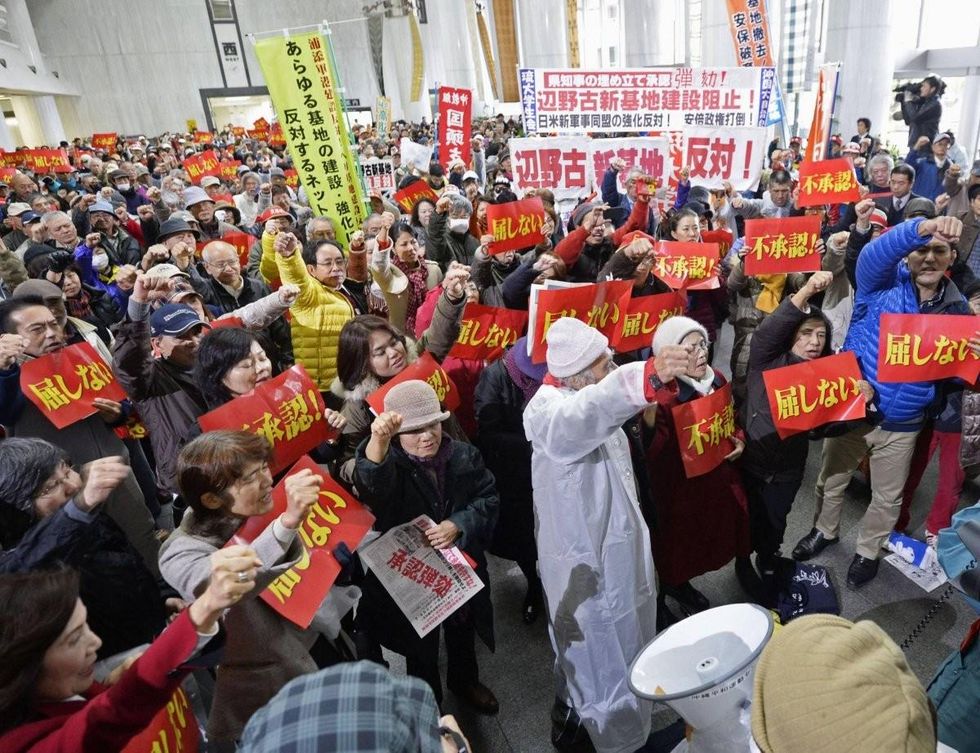
However, instead of ridding the small island of the U.S. military's presence, the base will be replaced by a different location on the east coast of the island in the city of Nago to the ire of thousands of Okinawa residents who took to the streets Friday in protest.
Agence France-Presse reports:
More than 17 years after the two allies agreed to move the U.S. Marines' Futenma Air Station from a densely populated urban area, the local government has finally consented to a landfill that will enable new facilities to be built on the coast.
The agreement will burnish the credentials of Prime Minister Shinzo Abe in the U.S., possibly taking some of the sting out of American criticism of his provocative visit Thursday to a war shrine seen by China and Korea as a symbol of Japanese militarism.
The issue has been deadlocked for years, with huge opposition to any new base among Okinawans fed up with playing host to an outsized share of the U.S. military presence in Japan, and who want it moved off the island altogether.
The move comes in the form of a deal struck between Okinawa's governor Hirokazu Nakaima, who has been a long-time critic of the U.S. base for its placement in the densely populated city of Ginowan, and Japanese Prime Minister Shinzo Abe, who proposed roughly $2.9 billion for the island's economy every year until 2021 in exchange for the replacement base in Nago.
Following the announcement, thousands of protesters surrounded local government offices, holding signs reading: "Never bend."
According to a government spokeswomen, roughly 1,000 protesters stormed the lobby of the building and staged a sit-in.
"Okinawa residents cannot tolerate the base relocation within the prefecture," said protester Akira Oshiro, 53.
Hiroshi Ashitomi, a 67-year-old anti-base activist said: "As an Okinawa resident, I am ashamed of choosing such a governor," referring to Nakaima who has until now criticized the presence of the U.S. military on the island. "He should step down."
Fusako Nakamoto, a 70-year-old resident of Naha, said local people were "treated badly both by the central government and the governor," Adding that now, another base will be "handed down from generation to generation, this time in Nago," the Japan Times reports.
Construction of the new site is scheduled to take place within the next five years.
"What the governor has done is unforgivable," said Yuichi Higa, the head of the assembly in Nago city, where the new base is to be built. "Residents who are opposed will surely resort to the use of force, such as blocking roads to stop this from happening."
_______________________
However, instead of ridding the small island of the U.S. military's presence, the base will be replaced by a different location on the east coast of the island in the city of Nago to the ire of thousands of Okinawa residents who took to the streets Friday in protest.
Agence France-Presse reports:
More than 17 years after the two allies agreed to move the U.S. Marines' Futenma Air Station from a densely populated urban area, the local government has finally consented to a landfill that will enable new facilities to be built on the coast.
The agreement will burnish the credentials of Prime Minister Shinzo Abe in the U.S., possibly taking some of the sting out of American criticism of his provocative visit Thursday to a war shrine seen by China and Korea as a symbol of Japanese militarism.
The issue has been deadlocked for years, with huge opposition to any new base among Okinawans fed up with playing host to an outsized share of the U.S. military presence in Japan, and who want it moved off the island altogether.
The move comes in the form of a deal struck between Okinawa's governor Hirokazu Nakaima, who has been a long-time critic of the U.S. base for its placement in the densely populated city of Ginowan, and Japanese Prime Minister Shinzo Abe, who proposed roughly $2.9 billion for the island's economy every year until 2021 in exchange for the replacement base in Nago.
Following the announcement, thousands of protesters surrounded local government offices, holding signs reading: "Never bend."
According to a government spokeswomen, roughly 1,000 protesters stormed the lobby of the building and staged a sit-in.
"Okinawa residents cannot tolerate the base relocation within the prefecture," said protester Akira Oshiro, 53.
Hiroshi Ashitomi, a 67-year-old anti-base activist said: "As an Okinawa resident, I am ashamed of choosing such a governor," referring to Nakaima who has until now criticized the presence of the U.S. military on the island. "He should step down."
Fusako Nakamoto, a 70-year-old resident of Naha, said local people were "treated badly both by the central government and the governor," Adding that now, another base will be "handed down from generation to generation, this time in Nago," the Japan Times reports.
Construction of the new site is scheduled to take place within the next five years.
"What the governor has done is unforgivable," said Yuichi Higa, the head of the assembly in Nago city, where the new base is to be built. "Residents who are opposed will surely resort to the use of force, such as blocking roads to stop this from happening."
_______________________
However, instead of ridding the small island of the U.S. military's presence, the base will be replaced by a different location on the east coast of the island in the city of Nago to the ire of thousands of Okinawa residents who took to the streets Friday in protest.
Agence France-Presse reports:
More than 17 years after the two allies agreed to move the U.S. Marines' Futenma Air Station from a densely populated urban area, the local government has finally consented to a landfill that will enable new facilities to be built on the coast.
The agreement will burnish the credentials of Prime Minister Shinzo Abe in the U.S., possibly taking some of the sting out of American criticism of his provocative visit Thursday to a war shrine seen by China and Korea as a symbol of Japanese militarism.
The issue has been deadlocked for years, with huge opposition to any new base among Okinawans fed up with playing host to an outsized share of the U.S. military presence in Japan, and who want it moved off the island altogether.
The move comes in the form of a deal struck between Okinawa's governor Hirokazu Nakaima, who has been a long-time critic of the U.S. base for its placement in the densely populated city of Ginowan, and Japanese Prime Minister Shinzo Abe, who proposed roughly $2.9 billion for the island's economy every year until 2021 in exchange for the replacement base in Nago.
Following the announcement, thousands of protesters surrounded local government offices, holding signs reading: "Never bend."
According to a government spokeswomen, roughly 1,000 protesters stormed the lobby of the building and staged a sit-in.
"Okinawa residents cannot tolerate the base relocation within the prefecture," said protester Akira Oshiro, 53.
Hiroshi Ashitomi, a 67-year-old anti-base activist said: "As an Okinawa resident, I am ashamed of choosing such a governor," referring to Nakaima who has until now criticized the presence of the U.S. military on the island. "He should step down."
Fusako Nakamoto, a 70-year-old resident of Naha, said local people were "treated badly both by the central government and the governor," Adding that now, another base will be "handed down from generation to generation, this time in Nago," the Japan Times reports.
Construction of the new site is scheduled to take place within the next five years.
"What the governor has done is unforgivable," said Yuichi Higa, the head of the assembly in Nago city, where the new base is to be built. "Residents who are opposed will surely resort to the use of force, such as blocking roads to stop this from happening."
_______________________