SUBSCRIBE TO OUR FREE NEWSLETTER
Daily news & progressive opinion—funded by the people, not the corporations—delivered straight to your inbox.
5
#000000
#FFFFFF
To donate by check, phone, or other method, see our More Ways to Give page.
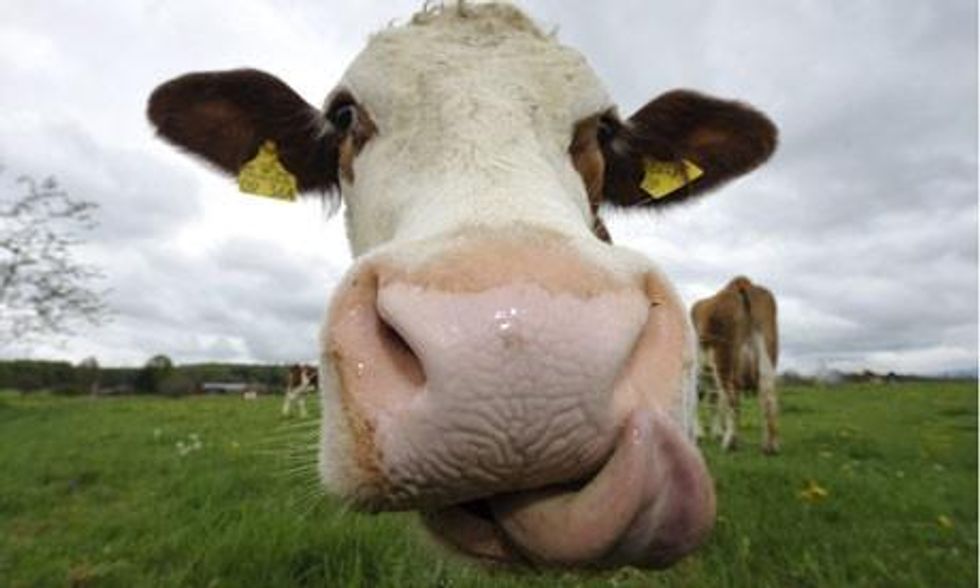
So finds a scientific study, entitled Ruminants, Climate Change and Climate Policy, published Friday in the journal Nature Climate Change.
The report charges that the copious methane emissions produced by ruminants (cattle, sheep, goats, and buffalo), and nitrous oxide produced in the procerss of growing their food, constitute significant, and often overlooked, contributors to climate change.
To rein in these global warming gases, the authors suggest reducing ruminants by slashing meat consumption through regulations and disincentives--including taxes.
"Influencing human behavior is one of the most challenging aspects of any large-scale policy, and it is unlikely that a large-scale dietary change will happen voluntarily without incentives," say the report's authors. "Implementing a tax or emission trading scheme on livestock's greenhouse gas emissions could be an economically sound policy that would modify consumer prices and affect consumption patterns."
While carbon is the most plentiful greenhouse gas, it is not the only one. The study's authors say that the global increase in livestock (50 percent over the past 50 years) leaves a significant 'hoof-print' on global warming--multiple times higher than plant counterparts.
A report summary explains that "greenhouse gas emissions from cattle and sheep production are up to nearly 50 times higher, on the basis of pounds of food produced, than they are from producing protein-rich plant foods such as beans, grains, or soy products."
According to the UN Food and Agriculture Organization, emissions associated with livestock industries account for 14.5 percent of human-caused greenhouse gases.
With 25 percent of the earth's land surface dedicated to grazing, and the planet hosting an 3.6 billion ruminant livestock, cutting this industry's greenhouse gas emissions could help humanity and the earth from going over the climate cliff, report authors argue.
"Because the Earth's climate may be near a tipping point to major climate change, multiple approaches are needed for mitigation," said Pete Smith, co-author of the report and Professor of Soils and Global Change at the University of Aberdeen. "We clearly need to reduce the burning of fossil fuels to cut CO2 emissions. But that addresses only part of the problem. We also need to reduce non-CO2 greenhouse gases to lessen the likelihood of us crossing this climatic threshold."
_____________________
So finds a scientific study, entitled Ruminants, Climate Change and Climate Policy, published Friday in the journal Nature Climate Change.
The report charges that the copious methane emissions produced by ruminants (cattle, sheep, goats, and buffalo), and nitrous oxide produced in the procerss of growing their food, constitute significant, and often overlooked, contributors to climate change.
To rein in these global warming gases, the authors suggest reducing ruminants by slashing meat consumption through regulations and disincentives--including taxes.
"Influencing human behavior is one of the most challenging aspects of any large-scale policy, and it is unlikely that a large-scale dietary change will happen voluntarily without incentives," say the report's authors. "Implementing a tax or emission trading scheme on livestock's greenhouse gas emissions could be an economically sound policy that would modify consumer prices and affect consumption patterns."
While carbon is the most plentiful greenhouse gas, it is not the only one. The study's authors say that the global increase in livestock (50 percent over the past 50 years) leaves a significant 'hoof-print' on global warming--multiple times higher than plant counterparts.
A report summary explains that "greenhouse gas emissions from cattle and sheep production are up to nearly 50 times higher, on the basis of pounds of food produced, than they are from producing protein-rich plant foods such as beans, grains, or soy products."
According to the UN Food and Agriculture Organization, emissions associated with livestock industries account for 14.5 percent of human-caused greenhouse gases.
With 25 percent of the earth's land surface dedicated to grazing, and the planet hosting an 3.6 billion ruminant livestock, cutting this industry's greenhouse gas emissions could help humanity and the earth from going over the climate cliff, report authors argue.
"Because the Earth's climate may be near a tipping point to major climate change, multiple approaches are needed for mitigation," said Pete Smith, co-author of the report and Professor of Soils and Global Change at the University of Aberdeen. "We clearly need to reduce the burning of fossil fuels to cut CO2 emissions. But that addresses only part of the problem. We also need to reduce non-CO2 greenhouse gases to lessen the likelihood of us crossing this climatic threshold."
_____________________
So finds a scientific study, entitled Ruminants, Climate Change and Climate Policy, published Friday in the journal Nature Climate Change.
The report charges that the copious methane emissions produced by ruminants (cattle, sheep, goats, and buffalo), and nitrous oxide produced in the procerss of growing their food, constitute significant, and often overlooked, contributors to climate change.
To rein in these global warming gases, the authors suggest reducing ruminants by slashing meat consumption through regulations and disincentives--including taxes.
"Influencing human behavior is one of the most challenging aspects of any large-scale policy, and it is unlikely that a large-scale dietary change will happen voluntarily without incentives," say the report's authors. "Implementing a tax or emission trading scheme on livestock's greenhouse gas emissions could be an economically sound policy that would modify consumer prices and affect consumption patterns."
While carbon is the most plentiful greenhouse gas, it is not the only one. The study's authors say that the global increase in livestock (50 percent over the past 50 years) leaves a significant 'hoof-print' on global warming--multiple times higher than plant counterparts.
A report summary explains that "greenhouse gas emissions from cattle and sheep production are up to nearly 50 times higher, on the basis of pounds of food produced, than they are from producing protein-rich plant foods such as beans, grains, or soy products."
According to the UN Food and Agriculture Organization, emissions associated with livestock industries account for 14.5 percent of human-caused greenhouse gases.
With 25 percent of the earth's land surface dedicated to grazing, and the planet hosting an 3.6 billion ruminant livestock, cutting this industry's greenhouse gas emissions could help humanity and the earth from going over the climate cliff, report authors argue.
"Because the Earth's climate may be near a tipping point to major climate change, multiple approaches are needed for mitigation," said Pete Smith, co-author of the report and Professor of Soils and Global Change at the University of Aberdeen. "We clearly need to reduce the burning of fossil fuels to cut CO2 emissions. But that addresses only part of the problem. We also need to reduce non-CO2 greenhouse gases to lessen the likelihood of us crossing this climatic threshold."
_____________________