SUBSCRIBE TO OUR FREE NEWSLETTER
Daily news & progressive opinion—funded by the people, not the corporations—delivered straight to your inbox.
5
#000000
#FFFFFF
To donate by check, phone, or other method, see our More Ways to Give page.
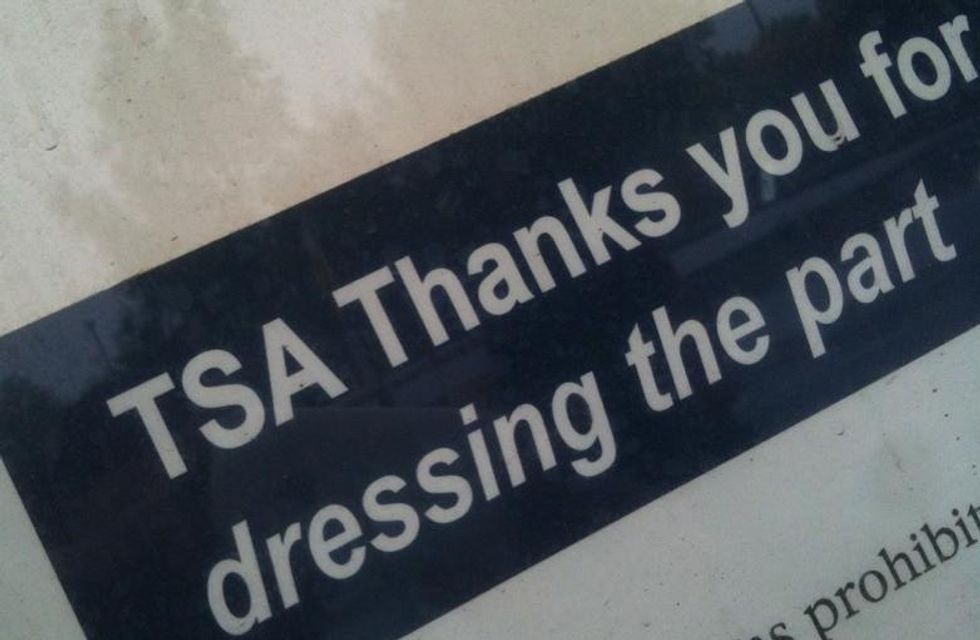
If so, you might want to watch where you travel, how long you stay there, and make extra sure you don't otherwise draw the suspicion of the Department of Homeland Security or the screening agents at the Transportation Security Administration.
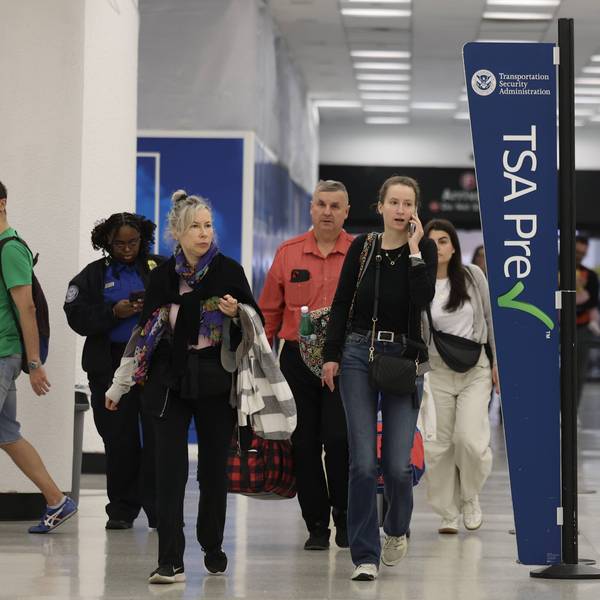
According to new reporting Tuesday by the New York Times, the TSA is now performing more extensive pre-arrival screening of US airline passengers "by searching a wide array of government and private databases that can include records like car registrations and employment information" in order to determine which travelers should be targeted for higher scrutiny or physical screenings. And though the program has been underway, according to the Times, plans are underway to expand its possible scope and implementation.
As one government official familiar with the program, but unwilling to be identified, told the newspaper, "the main goal of the program was to identify low-risk travelers for lighter screening at airport security checkpoints, adapting methods similar to those used to flag suspicious people entering the United States."
The Times reports:
It is unclear precisely what information the agency is relying upon to make these risk assessments, given the extensive range of records it can access, including tax identification number, past travel itineraries, property records, physical characteristics, and law enforcement or intelligence information.
The measures go beyond the background check the government has conducted for years, called Secure Flight, in which a passenger's name, gender and date of birth are compared with terrorist watch lists. Now, the search includes using a traveler's passport number, which is already used to screen people at the border, and other identifiers to access a system of databases maintained by the Department of Homeland Security.
Civil liberty advocates contacted by the newspaper were alarmed by the revelations.
"The average person doesn't understand how much intelligence-driven matching is going on and how this could be accessed for other purposes," Khaliah Barnes, a lawyer with the Electronic Privacy Information Center, told the Times. "There's no meaningful oversight, transparency or accountability."
And those critical of the already burdensome and ill-conceived TSA airport screening process were quick to point out what they consider the absurdity of the entire process. As Juli Weiner, writing for Vanity Fair, quipped:
Can we all agree that the one and only problem with airport security is that it does not begin sooner? Invasive new measures are being taken to ensure that passengers can experience the joys of the Transportation Security Administration right from the non-privacy of their own homes.
However, given the onslaught in recent months of news regarding the U.S. government's alarming levels of domestic surveillance--mostly based on NSA documents leaked by whistleblower Edward Snowden--the TSA, now shown to be sorting the traveling public into various categories of suspicion, might increasingly be the butt of less jokes, and instead, the target of more ire.
_______________________________________________
If so, you might want to watch where you travel, how long you stay there, and make extra sure you don't otherwise draw the suspicion of the Department of Homeland Security or the screening agents at the Transportation Security Administration.
According to new reporting Tuesday by the New York Times, the TSA is now performing more extensive pre-arrival screening of US airline passengers "by searching a wide array of government and private databases that can include records like car registrations and employment information" in order to determine which travelers should be targeted for higher scrutiny or physical screenings. And though the program has been underway, according to the Times, plans are underway to expand its possible scope and implementation.
As one government official familiar with the program, but unwilling to be identified, told the newspaper, "the main goal of the program was to identify low-risk travelers for lighter screening at airport security checkpoints, adapting methods similar to those used to flag suspicious people entering the United States."
The Times reports:
It is unclear precisely what information the agency is relying upon to make these risk assessments, given the extensive range of records it can access, including tax identification number, past travel itineraries, property records, physical characteristics, and law enforcement or intelligence information.
The measures go beyond the background check the government has conducted for years, called Secure Flight, in which a passenger's name, gender and date of birth are compared with terrorist watch lists. Now, the search includes using a traveler's passport number, which is already used to screen people at the border, and other identifiers to access a system of databases maintained by the Department of Homeland Security.
Civil liberty advocates contacted by the newspaper were alarmed by the revelations.
"The average person doesn't understand how much intelligence-driven matching is going on and how this could be accessed for other purposes," Khaliah Barnes, a lawyer with the Electronic Privacy Information Center, told the Times. "There's no meaningful oversight, transparency or accountability."
And those critical of the already burdensome and ill-conceived TSA airport screening process were quick to point out what they consider the absurdity of the entire process. As Juli Weiner, writing for Vanity Fair, quipped:
Can we all agree that the one and only problem with airport security is that it does not begin sooner? Invasive new measures are being taken to ensure that passengers can experience the joys of the Transportation Security Administration right from the non-privacy of their own homes.
However, given the onslaught in recent months of news regarding the U.S. government's alarming levels of domestic surveillance--mostly based on NSA documents leaked by whistleblower Edward Snowden--the TSA, now shown to be sorting the traveling public into various categories of suspicion, might increasingly be the butt of less jokes, and instead, the target of more ire.
_______________________________________________
If so, you might want to watch where you travel, how long you stay there, and make extra sure you don't otherwise draw the suspicion of the Department of Homeland Security or the screening agents at the Transportation Security Administration.
According to new reporting Tuesday by the New York Times, the TSA is now performing more extensive pre-arrival screening of US airline passengers "by searching a wide array of government and private databases that can include records like car registrations and employment information" in order to determine which travelers should be targeted for higher scrutiny or physical screenings. And though the program has been underway, according to the Times, plans are underway to expand its possible scope and implementation.
As one government official familiar with the program, but unwilling to be identified, told the newspaper, "the main goal of the program was to identify low-risk travelers for lighter screening at airport security checkpoints, adapting methods similar to those used to flag suspicious people entering the United States."
The Times reports:
It is unclear precisely what information the agency is relying upon to make these risk assessments, given the extensive range of records it can access, including tax identification number, past travel itineraries, property records, physical characteristics, and law enforcement or intelligence information.
The measures go beyond the background check the government has conducted for years, called Secure Flight, in which a passenger's name, gender and date of birth are compared with terrorist watch lists. Now, the search includes using a traveler's passport number, which is already used to screen people at the border, and other identifiers to access a system of databases maintained by the Department of Homeland Security.
Civil liberty advocates contacted by the newspaper were alarmed by the revelations.
"The average person doesn't understand how much intelligence-driven matching is going on and how this could be accessed for other purposes," Khaliah Barnes, a lawyer with the Electronic Privacy Information Center, told the Times. "There's no meaningful oversight, transparency or accountability."
And those critical of the already burdensome and ill-conceived TSA airport screening process were quick to point out what they consider the absurdity of the entire process. As Juli Weiner, writing for Vanity Fair, quipped:
Can we all agree that the one and only problem with airport security is that it does not begin sooner? Invasive new measures are being taken to ensure that passengers can experience the joys of the Transportation Security Administration right from the non-privacy of their own homes.
However, given the onslaught in recent months of news regarding the U.S. government's alarming levels of domestic surveillance--mostly based on NSA documents leaked by whistleblower Edward Snowden--the TSA, now shown to be sorting the traveling public into various categories of suspicion, might increasingly be the butt of less jokes, and instead, the target of more ire.
_______________________________________________