SUBSCRIBE TO OUR FREE NEWSLETTER
Daily news & progressive opinion—funded by the people, not the corporations—delivered straight to your inbox.
5
#000000
#FFFFFF
To donate by check, phone, or other method, see our More Ways to Give page.
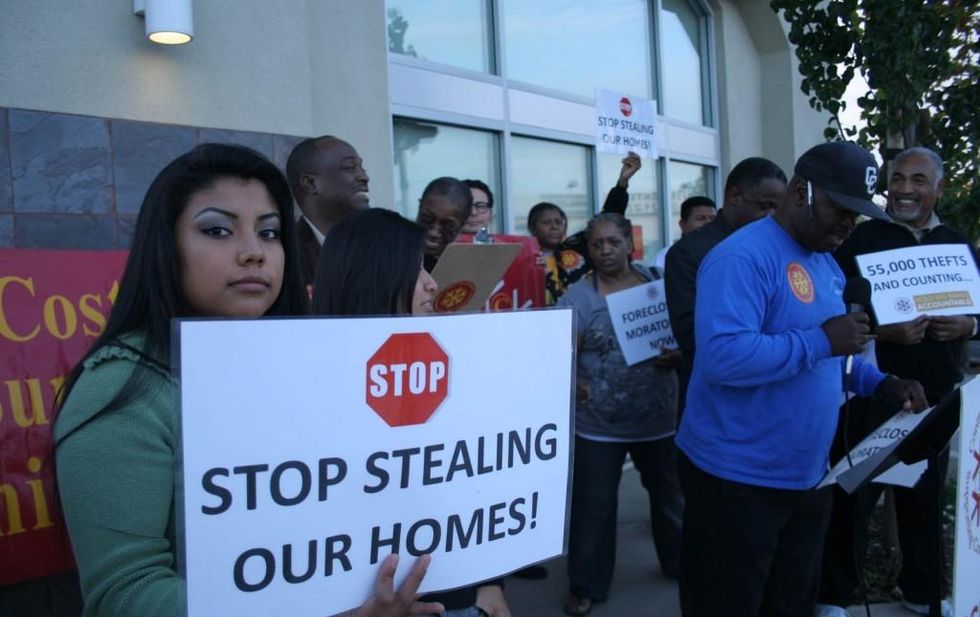
Bucking the threat of lawsuits from large banks and other financial interests, approval of the measure is a victory for the city's progressive-minded Green Party Mayor Gayle McLaughlin, not to mention the city residents struggling with homes that lost a majority of their value in the wake of the financial collapse of 2008.
According to Reuters:
Richmond can now invoke eminent domain if trusts for more than 620 delinquent and performing "underwater" mortgages reject offers made by the city to buy the loans at deep discount pegged to their properties' current appraised prices to refinance them and reduce their principal.
A mortgage is under water when its unpaid balance is greater than its property's market value.
MRP has failed to get similar plans approved by local governments elsewhere - most recently in North Las Vegas, Nevada and earlier this year in San Bernardino County in Southern California - as the mortgage industry and local real estate businesses rallied against them.
Though the city council's approval will come as a positive step by housing and economic justice advocates in California and elsewhere, the legal challenges will likely be intense. As Reuters continues:
...the Federal Housing Finance Agency recently said it would press Fannie Mae and Freddie Mac to limit or cease its business where such proposals get approved, effectively closing off most mortgage financing there.
Investors holding the mortgages targeted by Richmond [...] have sued through trustees Wells Fargo & Co and Deutsche Bank AG in U.S. District Court to block the plan, which they say relies on them swallowing losses. The two sides square off in court in person for the first time on Thursday.
However, the fight is one that many upset about the way the housing crisis has been addressed by both state and federal authorities seem willing to have. As Common Dreams previously reported:
Big banks have been slammed for their damaging mortgage loan policies that target poor and working class people and communities of color with high risk loans, policies that have had a profound impact on Richmond, which has large latino, African American, and low-income communities.
Eminent domain laws also have a painful history in Richmond, but housing justice advocates are hopeful about this new twist on the seizure law.
"For years we have seen cases where eminent domain was used in a harmful way, and it really hurts low-income communities of color," David Sharples, local director for Contra Costa Alliance of Californians for Community Empowerment, told Common Dreams. "People here in Richmond talk about when they built the big 580 Freeway, and people had their houses taken and were displaced."
"But we see this as a way eminent domain is finally being used to help keep families in their homes," he added. "It is finally a way for it to be used in a good way."
__________________________________
Bucking the threat of lawsuits from large banks and other financial interests, approval of the measure is a victory for the city's progressive-minded Green Party Mayor Gayle McLaughlin, not to mention the city residents struggling with homes that lost a majority of their value in the wake of the financial collapse of 2008.
According to Reuters:
Richmond can now invoke eminent domain if trusts for more than 620 delinquent and performing "underwater" mortgages reject offers made by the city to buy the loans at deep discount pegged to their properties' current appraised prices to refinance them and reduce their principal.
A mortgage is under water when its unpaid balance is greater than its property's market value.
MRP has failed to get similar plans approved by local governments elsewhere - most recently in North Las Vegas, Nevada and earlier this year in San Bernardino County in Southern California - as the mortgage industry and local real estate businesses rallied against them.
Though the city council's approval will come as a positive step by housing and economic justice advocates in California and elsewhere, the legal challenges will likely be intense. As Reuters continues:
...the Federal Housing Finance Agency recently said it would press Fannie Mae and Freddie Mac to limit or cease its business where such proposals get approved, effectively closing off most mortgage financing there.
Investors holding the mortgages targeted by Richmond [...] have sued through trustees Wells Fargo & Co and Deutsche Bank AG in U.S. District Court to block the plan, which they say relies on them swallowing losses. The two sides square off in court in person for the first time on Thursday.
However, the fight is one that many upset about the way the housing crisis has been addressed by both state and federal authorities seem willing to have. As Common Dreams previously reported:
Big banks have been slammed for their damaging mortgage loan policies that target poor and working class people and communities of color with high risk loans, policies that have had a profound impact on Richmond, which has large latino, African American, and low-income communities.
Eminent domain laws also have a painful history in Richmond, but housing justice advocates are hopeful about this new twist on the seizure law.
"For years we have seen cases where eminent domain was used in a harmful way, and it really hurts low-income communities of color," David Sharples, local director for Contra Costa Alliance of Californians for Community Empowerment, told Common Dreams. "People here in Richmond talk about when they built the big 580 Freeway, and people had their houses taken and were displaced."
"But we see this as a way eminent domain is finally being used to help keep families in their homes," he added. "It is finally a way for it to be used in a good way."
__________________________________
Bucking the threat of lawsuits from large banks and other financial interests, approval of the measure is a victory for the city's progressive-minded Green Party Mayor Gayle McLaughlin, not to mention the city residents struggling with homes that lost a majority of their value in the wake of the financial collapse of 2008.
According to Reuters:
Richmond can now invoke eminent domain if trusts for more than 620 delinquent and performing "underwater" mortgages reject offers made by the city to buy the loans at deep discount pegged to their properties' current appraised prices to refinance them and reduce their principal.
A mortgage is under water when its unpaid balance is greater than its property's market value.
MRP has failed to get similar plans approved by local governments elsewhere - most recently in North Las Vegas, Nevada and earlier this year in San Bernardino County in Southern California - as the mortgage industry and local real estate businesses rallied against them.
Though the city council's approval will come as a positive step by housing and economic justice advocates in California and elsewhere, the legal challenges will likely be intense. As Reuters continues:
...the Federal Housing Finance Agency recently said it would press Fannie Mae and Freddie Mac to limit or cease its business where such proposals get approved, effectively closing off most mortgage financing there.
Investors holding the mortgages targeted by Richmond [...] have sued through trustees Wells Fargo & Co and Deutsche Bank AG in U.S. District Court to block the plan, which they say relies on them swallowing losses. The two sides square off in court in person for the first time on Thursday.
However, the fight is one that many upset about the way the housing crisis has been addressed by both state and federal authorities seem willing to have. As Common Dreams previously reported:
Big banks have been slammed for their damaging mortgage loan policies that target poor and working class people and communities of color with high risk loans, policies that have had a profound impact on Richmond, which has large latino, African American, and low-income communities.
Eminent domain laws also have a painful history in Richmond, but housing justice advocates are hopeful about this new twist on the seizure law.
"For years we have seen cases where eminent domain was used in a harmful way, and it really hurts low-income communities of color," David Sharples, local director for Contra Costa Alliance of Californians for Community Empowerment, told Common Dreams. "People here in Richmond talk about when they built the big 580 Freeway, and people had their houses taken and were displaced."
"But we see this as a way eminent domain is finally being used to help keep families in their homes," he added. "It is finally a way for it to be used in a good way."
__________________________________