

"Actions violating medical ethics, taken on behalf of the government, devalue medical ethics for all physicians," write Dr. George Annas, Dr. Sondra Crosby and Dr. Leonard Glantz in a commentary published Wednesday in the New England Journal of Medicine.
In their statement, the senior medical professors from Boston University make the case that the prison's medical staff have a moral duty to boycott the treatment, which many in the international community have denounced as a form of torture.
"Guantanamo officials have consistently sought to medicalize hunger strikes by asserting that protestors are 'suicidal' and must be force-fed to prevent self-harm and 'save lives,'" they write. "Hunger strikers are not attempting to commit suicide. Rather, they are willing to risk death if their demands are not met. Their goal is not to die but to have perceived injustices addressed."
Over 100 of the 166 individuals detained at Guantanamo are taking part in the hunger strike which was initiated in February due to mistreatment by prison officials and has since spiraled into a larger demonstration against the inhumanity of indefinite detention.
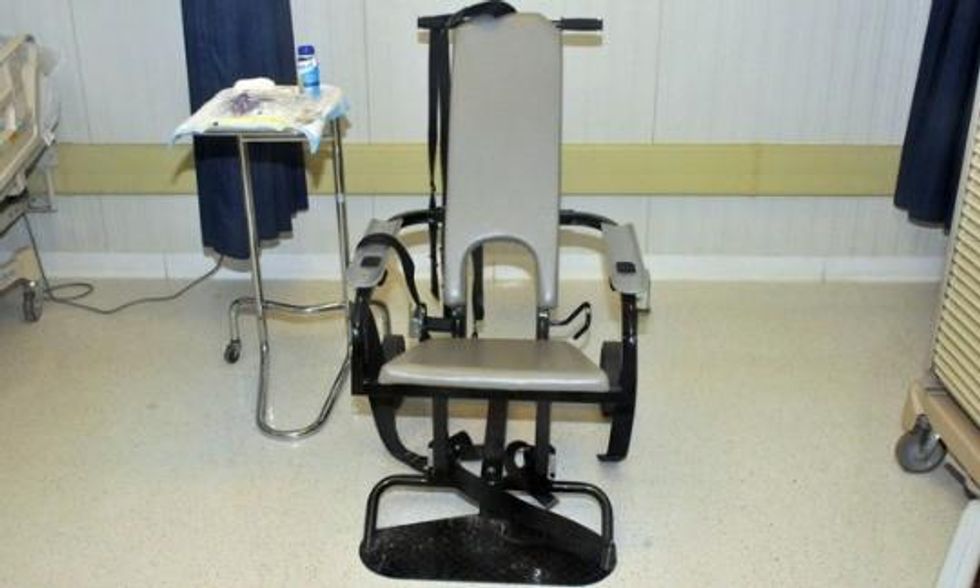
Recent reports estimate that over forty of those participating prisoners are being force-fed by military personnel. The practice has been ongoing despite comments made by President Obama in his May 23 speech on terrorism when he said, "Look at our current situation, where we are force-feeding detainees who are[...]on a hunger strike [...] Is this who we are?[...] Is that the America we want to leave our children? Our sense of justice is stronger than that."
Described by one detainee as being like a "razor blade [going] down through your nose and into your throat," the three physicians declare that any medical personnel participating in such an act is simply serving as a "weapon for maintaining prison order."
They continue:
Physicians at Guantanamo cannot permit the military to use them and their medical skills for political purposes and still comply with their ethical obligations. Force-feeding a competent person is not the practice of medicine; it is aggravated assault. Using a physician to assault prisoners no more changes the nature of the act than using physicians to "monitor" torture makes torture a medical procedure. Military physicians are no more entitled to betray medical ethics than military lawyers are to betray the Constitution or military chaplains are to betray their religion.
Describing Guantanamo as a "legal black hole," the physicians call on their colleagues to "take constructive political action" and use their influence to petition the Department of Defense to abandon the practice.
"Guantanamo is not just going to fade away, and neither is the stain on medical ethics it represents," they conclude.
_____________________
"Actions violating medical ethics, taken on behalf of the government, devalue medical ethics for all physicians," write Dr. George Annas, Dr. Sondra Crosby and Dr. Leonard Glantz in a commentary published Wednesday in the New England Journal of Medicine.
In their statement, the senior medical professors from Boston University make the case that the prison's medical staff have a moral duty to boycott the treatment, which many in the international community have denounced as a form of torture.
"Guantanamo officials have consistently sought to medicalize hunger strikes by asserting that protestors are 'suicidal' and must be force-fed to prevent self-harm and 'save lives,'" they write. "Hunger strikers are not attempting to commit suicide. Rather, they are willing to risk death if their demands are not met. Their goal is not to die but to have perceived injustices addressed."
Over 100 of the 166 individuals detained at Guantanamo are taking part in the hunger strike which was initiated in February due to mistreatment by prison officials and has since spiraled into a larger demonstration against the inhumanity of indefinite detention.
Recent reports estimate that over forty of those participating prisoners are being force-fed by military personnel. The practice has been ongoing despite comments made by President Obama in his May 23 speech on terrorism when he said, "Look at our current situation, where we are force-feeding detainees who are[...]on a hunger strike [...] Is this who we are?[...] Is that the America we want to leave our children? Our sense of justice is stronger than that."
Described by one detainee as being like a "razor blade [going] down through your nose and into your throat," the three physicians declare that any medical personnel participating in such an act is simply serving as a "weapon for maintaining prison order."
They continue:
Physicians at Guantanamo cannot permit the military to use them and their medical skills for political purposes and still comply with their ethical obligations. Force-feeding a competent person is not the practice of medicine; it is aggravated assault. Using a physician to assault prisoners no more changes the nature of the act than using physicians to "monitor" torture makes torture a medical procedure. Military physicians are no more entitled to betray medical ethics than military lawyers are to betray the Constitution or military chaplains are to betray their religion.
Describing Guantanamo as a "legal black hole," the physicians call on their colleagues to "take constructive political action" and use their influence to petition the Department of Defense to abandon the practice.
"Guantanamo is not just going to fade away, and neither is the stain on medical ethics it represents," they conclude.
_____________________
"Actions violating medical ethics, taken on behalf of the government, devalue medical ethics for all physicians," write Dr. George Annas, Dr. Sondra Crosby and Dr. Leonard Glantz in a commentary published Wednesday in the New England Journal of Medicine.
In their statement, the senior medical professors from Boston University make the case that the prison's medical staff have a moral duty to boycott the treatment, which many in the international community have denounced as a form of torture.
"Guantanamo officials have consistently sought to medicalize hunger strikes by asserting that protestors are 'suicidal' and must be force-fed to prevent self-harm and 'save lives,'" they write. "Hunger strikers are not attempting to commit suicide. Rather, they are willing to risk death if their demands are not met. Their goal is not to die but to have perceived injustices addressed."
Over 100 of the 166 individuals detained at Guantanamo are taking part in the hunger strike which was initiated in February due to mistreatment by prison officials and has since spiraled into a larger demonstration against the inhumanity of indefinite detention.
Recent reports estimate that over forty of those participating prisoners are being force-fed by military personnel. The practice has been ongoing despite comments made by President Obama in his May 23 speech on terrorism when he said, "Look at our current situation, where we are force-feeding detainees who are[...]on a hunger strike [...] Is this who we are?[...] Is that the America we want to leave our children? Our sense of justice is stronger than that."
Described by one detainee as being like a "razor blade [going] down through your nose and into your throat," the three physicians declare that any medical personnel participating in such an act is simply serving as a "weapon for maintaining prison order."
They continue:
Physicians at Guantanamo cannot permit the military to use them and their medical skills for political purposes and still comply with their ethical obligations. Force-feeding a competent person is not the practice of medicine; it is aggravated assault. Using a physician to assault prisoners no more changes the nature of the act than using physicians to "monitor" torture makes torture a medical procedure. Military physicians are no more entitled to betray medical ethics than military lawyers are to betray the Constitution or military chaplains are to betray their religion.
Describing Guantanamo as a "legal black hole," the physicians call on their colleagues to "take constructive political action" and use their influence to petition the Department of Defense to abandon the practice.
"Guantanamo is not just going to fade away, and neither is the stain on medical ethics it represents," they conclude.
_____________________