
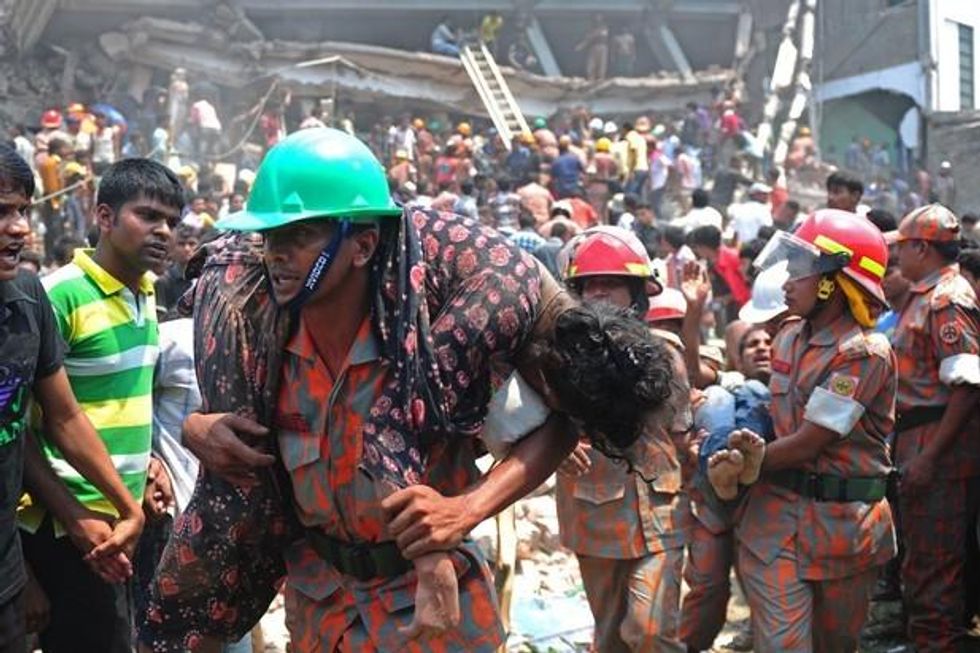
Mohammad Asaduzzaman, head of the area's police station, said factory owners from the building, who produce clothing for western brands, ignored a warning not to allow their workers into the building after a crack was detected in the building's structure on Tuesday.
"It is dreadful that leading brands and governments continue to allow garment workers to die or suffer terrible disabling injuries in unsafe factories making clothes for Western nations' shoppers," Laia Blanch of the U.K. anti-poverty charity War on Want said in a statement.
Commenting on the inevitable ties to western retailers in the disaster, Naomi Klein recently tweeted: "More industrial mass murder disguised as development".
Sam Maher, of Labour Behind the Label, said: "It's unbelievable that brands still refuse to sign a binding agreement with unions and labour groups to stop these unsafe working conditions from existing. Tragedy after tragedy shows that corporate-controlled monitoring has failed to protect workers' lives."
Workers said they hesitated to go to work Wednesday, the Associated Press reports, "because the building had developed such severe cracks the previous day that it had been reported on local news channels."
Abdur Rahim, who worked on the fifth floor, told AP that a factory manager said the cracks were not a problem, so they went inside.
"We started working. After about an hour or so the building collapsed suddenly," he said.
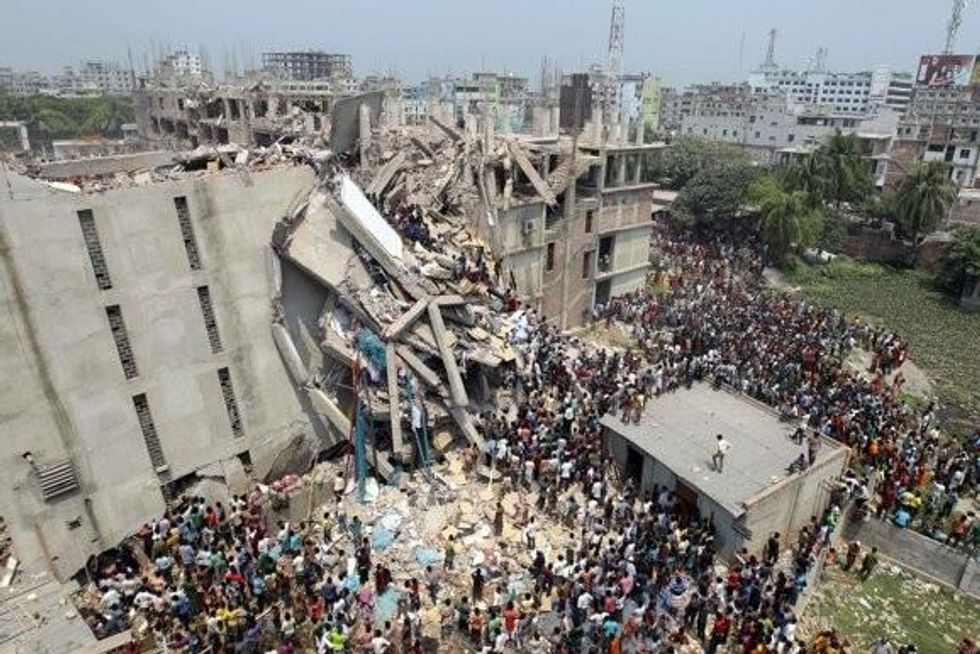
One fireman told Reuters that roughly 2,000 people were in the eight-story building in the outskirts of Dhaka, Bangladesh, when the upper floors gave way, crushing all that was below. Rescue efforts are still under way with hundreds of people still trapped in the rubble.
Five garment factories were housed in the building. One of the employees from the building, Muhammad Anisur, told Reuters that his firm had been sub-contracted to supply Wal-Mart Stores Inc, and Europe's C&A in the past, but did not say who the factory was producing for currently.
Wal-Mart did not immediately respond to requests for comment, Reuters reports.
Among the factory owners in the building were Phantom Apparels Ltd., New Wave Style Ltd., New Wave Bottoms Ltd. and New Wave Brothers Ltd. garment factories, companies that make clothing for a number of brands including Benetton, The Children's Place and Dress Barn.
Other brands will likely be implicated but workers told AP that "they didn't know what specific clothing brands were being produced in the building because labels are attached after the products are finished."
The collapse is the latest in a series of factory disasters in Bangladesh tied to western brands including a massive blaze which broke out in the Tazreen factory in November, killing 112 workers. Clothes made for Disney, Wal-Mart and other western labels were found at that factory.
A report released Tuesday by the AFL-CIO reveals a culture in which western retail companies routinely feign concern for the safety of factories they subcontract with. In reality, according to the report, factory safety auditing programs, used by international corporations to monitor working conditions in their supply chains, are a "facade," which appease corporate needs at the expense of factory workers.
"Not only has it helped keep wages low and working conditions poor," the report's foreword states of the auditing industry, "it has provided public relations cover for producers whose disregard for health and safety has cost hundreds of lives." It determines the "central failing" of such audits to be "short and cursory visits to factories and no proper discussion with workers."
Read the report here.
Watch Al Jazeera's coverage of the building collapse below:
_______________________
Mohammad Asaduzzaman, head of the area's police station, said factory owners from the building, who produce clothing for western brands, ignored a warning not to allow their workers into the building after a crack was detected in the building's structure on Tuesday.
"It is dreadful that leading brands and governments continue to allow garment workers to die or suffer terrible disabling injuries in unsafe factories making clothes for Western nations' shoppers," Laia Blanch of the U.K. anti-poverty charity War on Want said in a statement.
Commenting on the inevitable ties to western retailers in the disaster, Naomi Klein recently tweeted: "More industrial mass murder disguised as development".
Sam Maher, of Labour Behind the Label, said: "It's unbelievable that brands still refuse to sign a binding agreement with unions and labour groups to stop these unsafe working conditions from existing. Tragedy after tragedy shows that corporate-controlled monitoring has failed to protect workers' lives."
Workers said they hesitated to go to work Wednesday, the Associated Press reports, "because the building had developed such severe cracks the previous day that it had been reported on local news channels."
Abdur Rahim, who worked on the fifth floor, told AP that a factory manager said the cracks were not a problem, so they went inside.
"We started working. After about an hour or so the building collapsed suddenly," he said.
One fireman told Reuters that roughly 2,000 people were in the eight-story building in the outskirts of Dhaka, Bangladesh, when the upper floors gave way, crushing all that was below. Rescue efforts are still under way with hundreds of people still trapped in the rubble.
Five garment factories were housed in the building. One of the employees from the building, Muhammad Anisur, told Reuters that his firm had been sub-contracted to supply Wal-Mart Stores Inc, and Europe's C&A in the past, but did not say who the factory was producing for currently.
Wal-Mart did not immediately respond to requests for comment, Reuters reports.
Among the factory owners in the building were Phantom Apparels Ltd., New Wave Style Ltd., New Wave Bottoms Ltd. and New Wave Brothers Ltd. garment factories, companies that make clothing for a number of brands including Benetton, The Children's Place and Dress Barn.
Other brands will likely be implicated but workers told AP that "they didn't know what specific clothing brands were being produced in the building because labels are attached after the products are finished."
The collapse is the latest in a series of factory disasters in Bangladesh tied to western brands including a massive blaze which broke out in the Tazreen factory in November, killing 112 workers. Clothes made for Disney, Wal-Mart and other western labels were found at that factory.
A report released Tuesday by the AFL-CIO reveals a culture in which western retail companies routinely feign concern for the safety of factories they subcontract with. In reality, according to the report, factory safety auditing programs, used by international corporations to monitor working conditions in their supply chains, are a "facade," which appease corporate needs at the expense of factory workers.
"Not only has it helped keep wages low and working conditions poor," the report's foreword states of the auditing industry, "it has provided public relations cover for producers whose disregard for health and safety has cost hundreds of lives." It determines the "central failing" of such audits to be "short and cursory visits to factories and no proper discussion with workers."
Read the report here.
Watch Al Jazeera's coverage of the building collapse below:
_______________________
Mohammad Asaduzzaman, head of the area's police station, said factory owners from the building, who produce clothing for western brands, ignored a warning not to allow their workers into the building after a crack was detected in the building's structure on Tuesday.
"It is dreadful that leading brands and governments continue to allow garment workers to die or suffer terrible disabling injuries in unsafe factories making clothes for Western nations' shoppers," Laia Blanch of the U.K. anti-poverty charity War on Want said in a statement.
Commenting on the inevitable ties to western retailers in the disaster, Naomi Klein recently tweeted: "More industrial mass murder disguised as development".
Sam Maher, of Labour Behind the Label, said: "It's unbelievable that brands still refuse to sign a binding agreement with unions and labour groups to stop these unsafe working conditions from existing. Tragedy after tragedy shows that corporate-controlled monitoring has failed to protect workers' lives."
Workers said they hesitated to go to work Wednesday, the Associated Press reports, "because the building had developed such severe cracks the previous day that it had been reported on local news channels."
Abdur Rahim, who worked on the fifth floor, told AP that a factory manager said the cracks were not a problem, so they went inside.
"We started working. After about an hour or so the building collapsed suddenly," he said.
One fireman told Reuters that roughly 2,000 people were in the eight-story building in the outskirts of Dhaka, Bangladesh, when the upper floors gave way, crushing all that was below. Rescue efforts are still under way with hundreds of people still trapped in the rubble.
Five garment factories were housed in the building. One of the employees from the building, Muhammad Anisur, told Reuters that his firm had been sub-contracted to supply Wal-Mart Stores Inc, and Europe's C&A in the past, but did not say who the factory was producing for currently.
Wal-Mart did not immediately respond to requests for comment, Reuters reports.
Among the factory owners in the building were Phantom Apparels Ltd., New Wave Style Ltd., New Wave Bottoms Ltd. and New Wave Brothers Ltd. garment factories, companies that make clothing for a number of brands including Benetton, The Children's Place and Dress Barn.
Other brands will likely be implicated but workers told AP that "they didn't know what specific clothing brands were being produced in the building because labels are attached after the products are finished."
The collapse is the latest in a series of factory disasters in Bangladesh tied to western brands including a massive blaze which broke out in the Tazreen factory in November, killing 112 workers. Clothes made for Disney, Wal-Mart and other western labels were found at that factory.
A report released Tuesday by the AFL-CIO reveals a culture in which western retail companies routinely feign concern for the safety of factories they subcontract with. In reality, according to the report, factory safety auditing programs, used by international corporations to monitor working conditions in their supply chains, are a "facade," which appease corporate needs at the expense of factory workers.
"Not only has it helped keep wages low and working conditions poor," the report's foreword states of the auditing industry, "it has provided public relations cover for producers whose disregard for health and safety has cost hundreds of lives." It determines the "central failing" of such audits to be "short and cursory visits to factories and no proper discussion with workers."
Read the report here.
Watch Al Jazeera's coverage of the building collapse below:
_______________________