
A Sunday tar sands protest in Burlington, Vermont turned violent when riot police shot protesters with pepper spray and rubber bullets.
Hundreds of activists demonstrating against a proposed tar sands oil pipeline that would extend across northern New England gathered at the Burlington Hilton where the 36th annual conference of New England Governors and Eastern Canadian Premiers was being held.
Protesters created a "human oil spill" over the possibility that tar sands oil from western Canada might be shipped across Vermont, New Hampshire and Maine.
"It's clear the governors and premiers are meeting to talk about trade policy, energy and infrastructure," said Avery Pittman, spokeswoman for the protest groups. "They're definitely prioritizing profits and money-making over the needs of the people or the impact these proposals will have on us."
The main protest ended at 3:45 P.M.
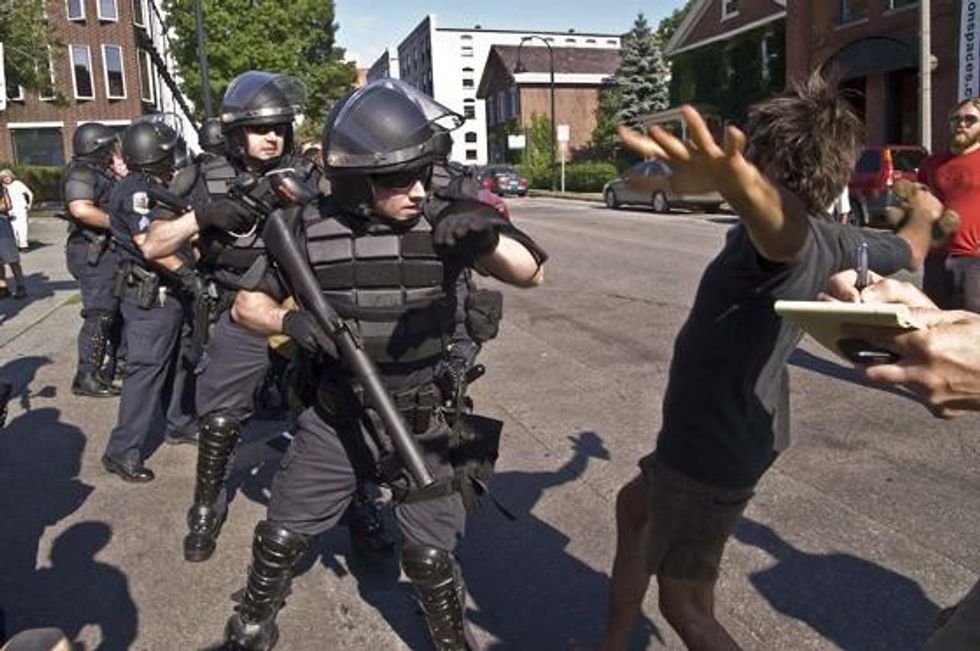
Just before 5 P.M., a smaller group of demonstrators attempted to block buses transporting the conference attendees to dinner, prompting police dressed in riot gear to open fire on the crowd.
Protesters were fired upon, police said, "to protect officers from those in the crowd who were moving toward them."
Burlington Mayor Miro Weinberger released a statement late Sunday. He praised the "laudable environmental goals" of the marchers and said this about the police action:
"The Burlington police had the responsibility of ensuring the free movement of approximately 200 conference attendees from around the region and world. The police took extensive steps to clear a safe path for the buses without conflict and, when their repeated verbal warnings were ignored, they resolved the situation without serious injury to demonstrators or themselves."
During the earlier, peaceful portion of the demonstration, environmental writer and activist Bill McKibben, the founder of 350.org, told the crowd this is "a hinge moment in human history."
He pointed to crop devastation this year across the center of the country from drought and about meager monsoons this year in India, and said that while he had begun a quarter of a century ago to write about potential environmental collapse, "There is nothing abstract about any of this," he said.
Global temperatures have risen just one degree, McKibben said, calling this year's weather just "early signs of global warning."
* * *
* * *
* * *
# # #
A Sunday tar sands protest in Burlington, Vermont turned violent when riot police shot protesters with pepper spray and rubber bullets.
Hundreds of activists demonstrating against a proposed tar sands oil pipeline that would extend across northern New England gathered at the Burlington Hilton where the 36th annual conference of New England Governors and Eastern Canadian Premiers was being held.
Protesters created a "human oil spill" over the possibility that tar sands oil from western Canada might be shipped across Vermont, New Hampshire and Maine.
"It's clear the governors and premiers are meeting to talk about trade policy, energy and infrastructure," said Avery Pittman, spokeswoman for the protest groups. "They're definitely prioritizing profits and money-making over the needs of the people or the impact these proposals will have on us."
The main protest ended at 3:45 P.M.
Just before 5 P.M., a smaller group of demonstrators attempted to block buses transporting the conference attendees to dinner, prompting police dressed in riot gear to open fire on the crowd.
Protesters were fired upon, police said, "to protect officers from those in the crowd who were moving toward them."
Burlington Mayor Miro Weinberger released a statement late Sunday. He praised the "laudable environmental goals" of the marchers and said this about the police action:
"The Burlington police had the responsibility of ensuring the free movement of approximately 200 conference attendees from around the region and world. The police took extensive steps to clear a safe path for the buses without conflict and, when their repeated verbal warnings were ignored, they resolved the situation without serious injury to demonstrators or themselves."
During the earlier, peaceful portion of the demonstration, environmental writer and activist Bill McKibben, the founder of 350.org, told the crowd this is "a hinge moment in human history."
He pointed to crop devastation this year across the center of the country from drought and about meager monsoons this year in India, and said that while he had begun a quarter of a century ago to write about potential environmental collapse, "There is nothing abstract about any of this," he said.
Global temperatures have risen just one degree, McKibben said, calling this year's weather just "early signs of global warning."
* * *
* * *
* * *
# # #
A Sunday tar sands protest in Burlington, Vermont turned violent when riot police shot protesters with pepper spray and rubber bullets.
Hundreds of activists demonstrating against a proposed tar sands oil pipeline that would extend across northern New England gathered at the Burlington Hilton where the 36th annual conference of New England Governors and Eastern Canadian Premiers was being held.
Protesters created a "human oil spill" over the possibility that tar sands oil from western Canada might be shipped across Vermont, New Hampshire and Maine.
"It's clear the governors and premiers are meeting to talk about trade policy, energy and infrastructure," said Avery Pittman, spokeswoman for the protest groups. "They're definitely prioritizing profits and money-making over the needs of the people or the impact these proposals will have on us."
The main protest ended at 3:45 P.M.
Just before 5 P.M., a smaller group of demonstrators attempted to block buses transporting the conference attendees to dinner, prompting police dressed in riot gear to open fire on the crowd.
Protesters were fired upon, police said, "to protect officers from those in the crowd who were moving toward them."
Burlington Mayor Miro Weinberger released a statement late Sunday. He praised the "laudable environmental goals" of the marchers and said this about the police action:
"The Burlington police had the responsibility of ensuring the free movement of approximately 200 conference attendees from around the region and world. The police took extensive steps to clear a safe path for the buses without conflict and, when their repeated verbal warnings were ignored, they resolved the situation without serious injury to demonstrators or themselves."
During the earlier, peaceful portion of the demonstration, environmental writer and activist Bill McKibben, the founder of 350.org, told the crowd this is "a hinge moment in human history."
He pointed to crop devastation this year across the center of the country from drought and about meager monsoons this year in India, and said that while he had begun a quarter of a century ago to write about potential environmental collapse, "There is nothing abstract about any of this," he said.
Global temperatures have risen just one degree, McKibben said, calling this year's weather just "early signs of global warning."
* * *
* * *
* * *
# # #