SUBSCRIBE TO OUR FREE NEWSLETTER
Daily news & progressive opinion—funded by the people, not the corporations—delivered straight to your inbox.
5
#000000
#FFFFFF
To donate by check, phone, or other method, see our More Ways to Give page.
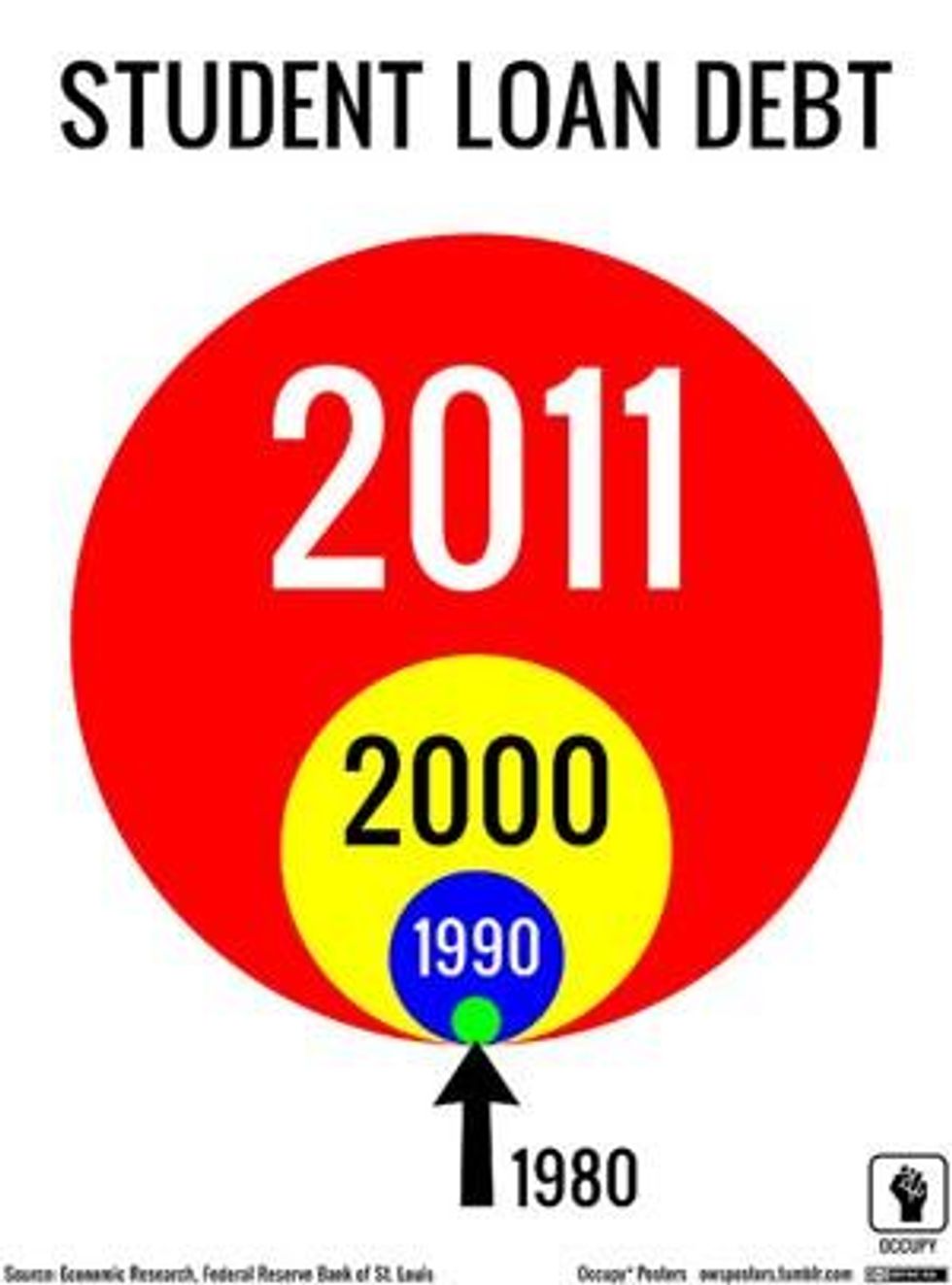
The amount of student borrowing crossed the $100 billion threshold for the first time in 2010 and total outstanding loans exceeded $1 trillion for the first time in 2011, according to a new report.
The report titled, The Student Loan "Debt Bomb": America's Next Mortgage-Style Economic Crisis? (pdf), was published the National Association of Consumer Bankruptcy Attorneys (NACBA), and paints a frightening economic picture of the world created by skyrocketing tuitions and high interest rates in a job market that continues to offer few jobs to graduates.
"How big is the danger to the US economy?" the report asks. Most worrisome to those on the ground during the 'mortgage crisis' that sent the world economy into a tailspin in 2008, is that the atmosphere and metrics around the student debt crisis feels much the same.
"As with the mortgage foreclosure crisis, the staggering amounts owed on student loans also will have repercussions for the broader economy," reads the report. "Just as the housing bubble created a mortgage debt "overhang" that absorbs the income of consumers and renders them unable to afford to engage in the consumer spending that sustains a growing economy, so too are student loans beginning to have the same effect, which will be a drag on the economy for the foreseeable future." And continues:
Most Americans see a college degree as the single most important factor for financial success and a place in the middle class. Post-secondary education and training have become essential not only to the individuals hoping to enter or remain in the middle class, but to the nation as a whole. It is widely believed that we need a well-educated workforce to create new opportunities in the United State and to remain competitive internationally.
But, as family incomes, available grant aid, and state investments in higher education have failed to keep pace with college costs, students and families increasingly are turning to student loans to help bridge the college affordability gap. [...]Americans now owe more on student loans than on credit cards, according to the Federal Reserve Bank of New York, the U.S. Department of Education and others. And, because there are fewer people with student loans than there are credit card holders, the debt burden on the individual borrower is considerably higher.
And Jon Christian, writing at Campus Progress, notes:
Part of the problem, according to the report, is that students are taking on increasing debt for degrees that are not particularly lucrative. And any number of traumatic events can results in students missing a payment, according to the researchers, which sets students up to spiral from delinquency to default.
Students aren't the only demographic caught up in the crisis, according to the report: Parents who took on debt for their children, many of them near retirement age, are going to suffer as well.
The Collegians' Stephen Keheler reports on student efforts to fight back against the rising burden of student debt:
[Earlier this week], thousands of students converged on the Capitol lawn in Sacramento to protest tuition raises and demand that state representatives increase funding for schools. They also protested the growing levels of student debt.
"That was one of our demands--complete forgiveness of student loans," Asami, who was one of the leaders, said. "I have friends that are getting their bachelor's degree now and they have 30 to 50 thousand dollars of student loans, so they are scared. They don't know how they are going to pay and so they just keep deferring payments."
A borrower can defer payments, but interest keeps building up and the debt just gets higher. Student debt has grown from 3 percent in 2000 to 7.5 percent in 2012. This means that recently graduating students aren't able to buy big-ticket items that would help the general economy to recover.
"I can't get a new car anytime soon and mine is not running very well now," said Thompson.
Furthermore, graduates with a massive debt burden find themselves forced to narrow their job-search options. Many do not take entry-level positions in their fields of study because the pay would be too low to service their debts.
The protests in Sacramento are just part of growing movement by students to do something about the problem. At 2011's Sundance Film Festival, "Default: The Student Loan Documentary," was shown and then aired on PBS last November. The film humanizes the loan crisis, following several graduates in their struggles to pay back their loans.
In addition, a petition has been started at Studentloanjustice.org to return bankruptcy protection to all student loans.
Here's a clip from the film:
Default: the Student Loan Doc (Trailer)(old) from Default: the Student Loan Docume on Vimeo.
###
The amount of student borrowing crossed the $100 billion threshold for the first time in 2010 and total outstanding loans exceeded $1 trillion for the first time in 2011, according to a new report.
The report titled, The Student Loan "Debt Bomb": America's Next Mortgage-Style Economic Crisis? (pdf), was published the National Association of Consumer Bankruptcy Attorneys (NACBA), and paints a frightening economic picture of the world created by skyrocketing tuitions and high interest rates in a job market that continues to offer few jobs to graduates.
"How big is the danger to the US economy?" the report asks. Most worrisome to those on the ground during the 'mortgage crisis' that sent the world economy into a tailspin in 2008, is that the atmosphere and metrics around the student debt crisis feels much the same.
"As with the mortgage foreclosure crisis, the staggering amounts owed on student loans also will have repercussions for the broader economy," reads the report. "Just as the housing bubble created a mortgage debt "overhang" that absorbs the income of consumers and renders them unable to afford to engage in the consumer spending that sustains a growing economy, so too are student loans beginning to have the same effect, which will be a drag on the economy for the foreseeable future." And continues:
Most Americans see a college degree as the single most important factor for financial success and a place in the middle class. Post-secondary education and training have become essential not only to the individuals hoping to enter or remain in the middle class, but to the nation as a whole. It is widely believed that we need a well-educated workforce to create new opportunities in the United State and to remain competitive internationally.
But, as family incomes, available grant aid, and state investments in higher education have failed to keep pace with college costs, students and families increasingly are turning to student loans to help bridge the college affordability gap. [...]Americans now owe more on student loans than on credit cards, according to the Federal Reserve Bank of New York, the U.S. Department of Education and others. And, because there are fewer people with student loans than there are credit card holders, the debt burden on the individual borrower is considerably higher.
And Jon Christian, writing at Campus Progress, notes:
Part of the problem, according to the report, is that students are taking on increasing debt for degrees that are not particularly lucrative. And any number of traumatic events can results in students missing a payment, according to the researchers, which sets students up to spiral from delinquency to default.
Students aren't the only demographic caught up in the crisis, according to the report: Parents who took on debt for their children, many of them near retirement age, are going to suffer as well.
The Collegians' Stephen Keheler reports on student efforts to fight back against the rising burden of student debt:
[Earlier this week], thousands of students converged on the Capitol lawn in Sacramento to protest tuition raises and demand that state representatives increase funding for schools. They also protested the growing levels of student debt.
"That was one of our demands--complete forgiveness of student loans," Asami, who was one of the leaders, said. "I have friends that are getting their bachelor's degree now and they have 30 to 50 thousand dollars of student loans, so they are scared. They don't know how they are going to pay and so they just keep deferring payments."
A borrower can defer payments, but interest keeps building up and the debt just gets higher. Student debt has grown from 3 percent in 2000 to 7.5 percent in 2012. This means that recently graduating students aren't able to buy big-ticket items that would help the general economy to recover.
"I can't get a new car anytime soon and mine is not running very well now," said Thompson.
Furthermore, graduates with a massive debt burden find themselves forced to narrow their job-search options. Many do not take entry-level positions in their fields of study because the pay would be too low to service their debts.
The protests in Sacramento are just part of growing movement by students to do something about the problem. At 2011's Sundance Film Festival, "Default: The Student Loan Documentary," was shown and then aired on PBS last November. The film humanizes the loan crisis, following several graduates in their struggles to pay back their loans.
In addition, a petition has been started at Studentloanjustice.org to return bankruptcy protection to all student loans.
Here's a clip from the film:
Default: the Student Loan Doc (Trailer)(old) from Default: the Student Loan Docume on Vimeo.
###
The amount of student borrowing crossed the $100 billion threshold for the first time in 2010 and total outstanding loans exceeded $1 trillion for the first time in 2011, according to a new report.
The report titled, The Student Loan "Debt Bomb": America's Next Mortgage-Style Economic Crisis? (pdf), was published the National Association of Consumer Bankruptcy Attorneys (NACBA), and paints a frightening economic picture of the world created by skyrocketing tuitions and high interest rates in a job market that continues to offer few jobs to graduates.
"How big is the danger to the US economy?" the report asks. Most worrisome to those on the ground during the 'mortgage crisis' that sent the world economy into a tailspin in 2008, is that the atmosphere and metrics around the student debt crisis feels much the same.
"As with the mortgage foreclosure crisis, the staggering amounts owed on student loans also will have repercussions for the broader economy," reads the report. "Just as the housing bubble created a mortgage debt "overhang" that absorbs the income of consumers and renders them unable to afford to engage in the consumer spending that sustains a growing economy, so too are student loans beginning to have the same effect, which will be a drag on the economy for the foreseeable future." And continues:
Most Americans see a college degree as the single most important factor for financial success and a place in the middle class. Post-secondary education and training have become essential not only to the individuals hoping to enter or remain in the middle class, but to the nation as a whole. It is widely believed that we need a well-educated workforce to create new opportunities in the United State and to remain competitive internationally.
But, as family incomes, available grant aid, and state investments in higher education have failed to keep pace with college costs, students and families increasingly are turning to student loans to help bridge the college affordability gap. [...]Americans now owe more on student loans than on credit cards, according to the Federal Reserve Bank of New York, the U.S. Department of Education and others. And, because there are fewer people with student loans than there are credit card holders, the debt burden on the individual borrower is considerably higher.
And Jon Christian, writing at Campus Progress, notes:
Part of the problem, according to the report, is that students are taking on increasing debt for degrees that are not particularly lucrative. And any number of traumatic events can results in students missing a payment, according to the researchers, which sets students up to spiral from delinquency to default.
Students aren't the only demographic caught up in the crisis, according to the report: Parents who took on debt for their children, many of them near retirement age, are going to suffer as well.
The Collegians' Stephen Keheler reports on student efforts to fight back against the rising burden of student debt:
[Earlier this week], thousands of students converged on the Capitol lawn in Sacramento to protest tuition raises and demand that state representatives increase funding for schools. They also protested the growing levels of student debt.
"That was one of our demands--complete forgiveness of student loans," Asami, who was one of the leaders, said. "I have friends that are getting their bachelor's degree now and they have 30 to 50 thousand dollars of student loans, so they are scared. They don't know how they are going to pay and so they just keep deferring payments."
A borrower can defer payments, but interest keeps building up and the debt just gets higher. Student debt has grown from 3 percent in 2000 to 7.5 percent in 2012. This means that recently graduating students aren't able to buy big-ticket items that would help the general economy to recover.
"I can't get a new car anytime soon and mine is not running very well now," said Thompson.
Furthermore, graduates with a massive debt burden find themselves forced to narrow their job-search options. Many do not take entry-level positions in their fields of study because the pay would be too low to service their debts.
The protests in Sacramento are just part of growing movement by students to do something about the problem. At 2011's Sundance Film Festival, "Default: The Student Loan Documentary," was shown and then aired on PBS last November. The film humanizes the loan crisis, following several graduates in their struggles to pay back their loans.
In addition, a petition has been started at Studentloanjustice.org to return bankruptcy protection to all student loans.
Here's a clip from the film:
Default: the Student Loan Doc (Trailer)(old) from Default: the Student Loan Docume on Vimeo.
###