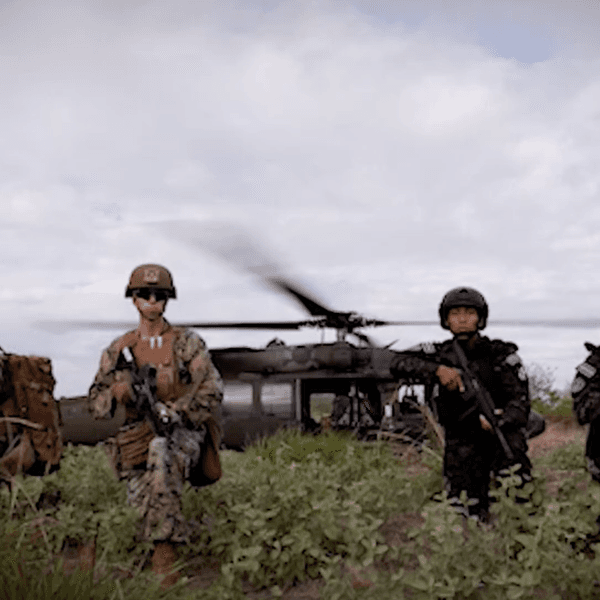

In Cauca, Colombia is still at war. You find trenches in every corner, tanks, Blackhawk helicopters and lots of soldiers. Fighting takes place here almost every day and people have gotten used to it. More than that, they are certain that on election day there will be attacks.
But in spite of all that military presence we managed to find the left-wing Farc rebels, who are still fighting the Colombian government. We drove to the city of Toribio in the middle of the mountains and that's when we saw them. They were getting ready to attack the military. They were carrying RPG's and AK-47. They were coming out from the mountains, from the sewage canals, from everywhere. They said that a fight with the military was coming.
Later on, we saw them again. They set up a checkpoint on the road. Hundreds of vehicles were stranded for hours. Commander Duber was the man in charge - he gave us an exclusive interview on the eve of Colombia's presidential elections.
"Our main enemy is president Uribe and the armed forces. We want to tell people that we are still alive, we are still strong. There are elections in Colombia. People can vote for whom the want. But we will continue fighting. The ideology of the Farc is to win or die, that's what Che Guevara said," Duber told us.
Since president Alvaro Uribe took office he has battled against the left-wing rebel - who are South America's oldest guerrilla organization. He has pushed them away from the main cities, but in Cauca the fighting is still ongoing.
"Presidente Uribe offers money [and] cars to those guerrillas who turn themselves in. Those who sell themselves are not guerrillas. They should give that money to those who are still starving in this country. We don't need it."
Commander Duber joined the organisation when he was 16 years old. He said he is proud to have survived the presidency of Alvaro Uribe.
"A new Colombia is a place where the poor have jobs, social equality, free healthcare, free education. Not like now; there is no equality here. There is no health, no education for the poor - only for the rich," he said.
The government accuses the Farc of drug trafficking. In fact, some of the areas where the Coca leaf is grown are controlled by them.
"People here help us, we receive help from neighbouring countries. You don't see the Farc on a small plane taking cocaine to the US. We are not the problem. Illegal crops are the only way farmers have to feed themselves. The government offers them no alternative."
Duber said the Farc is not trying to influence people to vote for any candidate in the election. For the Farc, all of the candidates are the same. But the group did send a message to Juan Manuel Santos, who could become on Sunday Colombia's next president.
"[If] Juan Manuel Santos wants to continue the war, then we are ready to fight. If there are conditions for peace talks then we could sit down and talk. But it's difficult. Santos has killed lots of innocent people while trying to kill us."
When the interview was over, the Farc opened up the check point and went up into the mountains. They seemed ready for another fight.

correspondent, reports from across Latin America.
In Cauca, Colombia is still at war. You find trenches in every corner, tanks, Blackhawk helicopters and lots of soldiers. Fighting takes place here almost every day and people have gotten used to it. More than that, they are certain that on election day there will be attacks.
But in spite of all that military presence we managed to find the left-wing Farc rebels, who are still fighting the Colombian government. We drove to the city of Toribio in the middle of the mountains and that's when we saw them. They were getting ready to attack the military. They were carrying RPG's and AK-47. They were coming out from the mountains, from the sewage canals, from everywhere. They said that a fight with the military was coming.
Later on, we saw them again. They set up a checkpoint on the road. Hundreds of vehicles were stranded for hours. Commander Duber was the man in charge - he gave us an exclusive interview on the eve of Colombia's presidential elections.
"Our main enemy is president Uribe and the armed forces. We want to tell people that we are still alive, we are still strong. There are elections in Colombia. People can vote for whom the want. But we will continue fighting. The ideology of the Farc is to win or die, that's what Che Guevara said," Duber told us.
Since president Alvaro Uribe took office he has battled against the left-wing rebel - who are South America's oldest guerrilla organization. He has pushed them away from the main cities, but in Cauca the fighting is still ongoing.
"Presidente Uribe offers money [and] cars to those guerrillas who turn themselves in. Those who sell themselves are not guerrillas. They should give that money to those who are still starving in this country. We don't need it."
Commander Duber joined the organisation when he was 16 years old. He said he is proud to have survived the presidency of Alvaro Uribe.
"A new Colombia is a place where the poor have jobs, social equality, free healthcare, free education. Not like now; there is no equality here. There is no health, no education for the poor - only for the rich," he said.
The government accuses the Farc of drug trafficking. In fact, some of the areas where the Coca leaf is grown are controlled by them.
"People here help us, we receive help from neighbouring countries. You don't see the Farc on a small plane taking cocaine to the US. We are not the problem. Illegal crops are the only way farmers have to feed themselves. The government offers them no alternative."
Duber said the Farc is not trying to influence people to vote for any candidate in the election. For the Farc, all of the candidates are the same. But the group did send a message to Juan Manuel Santos, who could become on Sunday Colombia's next president.
"[If] Juan Manuel Santos wants to continue the war, then we are ready to fight. If there are conditions for peace talks then we could sit down and talk. But it's difficult. Santos has killed lots of innocent people while trying to kill us."
When the interview was over, the Farc opened up the check point and went up into the mountains. They seemed ready for another fight.
correspondent, reports from across Latin America.
In Cauca, Colombia is still at war. You find trenches in every corner, tanks, Blackhawk helicopters and lots of soldiers. Fighting takes place here almost every day and people have gotten used to it. More than that, they are certain that on election day there will be attacks.
But in spite of all that military presence we managed to find the left-wing Farc rebels, who are still fighting the Colombian government. We drove to the city of Toribio in the middle of the mountains and that's when we saw them. They were getting ready to attack the military. They were carrying RPG's and AK-47. They were coming out from the mountains, from the sewage canals, from everywhere. They said that a fight with the military was coming.
Later on, we saw them again. They set up a checkpoint on the road. Hundreds of vehicles were stranded for hours. Commander Duber was the man in charge - he gave us an exclusive interview on the eve of Colombia's presidential elections.
"Our main enemy is president Uribe and the armed forces. We want to tell people that we are still alive, we are still strong. There are elections in Colombia. People can vote for whom the want. But we will continue fighting. The ideology of the Farc is to win or die, that's what Che Guevara said," Duber told us.
Since president Alvaro Uribe took office he has battled against the left-wing rebel - who are South America's oldest guerrilla organization. He has pushed them away from the main cities, but in Cauca the fighting is still ongoing.
"Presidente Uribe offers money [and] cars to those guerrillas who turn themselves in. Those who sell themselves are not guerrillas. They should give that money to those who are still starving in this country. We don't need it."
Commander Duber joined the organisation when he was 16 years old. He said he is proud to have survived the presidency of Alvaro Uribe.
"A new Colombia is a place where the poor have jobs, social equality, free healthcare, free education. Not like now; there is no equality here. There is no health, no education for the poor - only for the rich," he said.
The government accuses the Farc of drug trafficking. In fact, some of the areas where the Coca leaf is grown are controlled by them.
"People here help us, we receive help from neighbouring countries. You don't see the Farc on a small plane taking cocaine to the US. We are not the problem. Illegal crops are the only way farmers have to feed themselves. The government offers them no alternative."
Duber said the Farc is not trying to influence people to vote for any candidate in the election. For the Farc, all of the candidates are the same. But the group did send a message to Juan Manuel Santos, who could become on Sunday Colombia's next president.
"[If] Juan Manuel Santos wants to continue the war, then we are ready to fight. If there are conditions for peace talks then we could sit down and talk. But it's difficult. Santos has killed lots of innocent people while trying to kill us."
When the interview was over, the Farc opened up the check point and went up into the mountains. They seemed ready for another fight.
correspondent, reports from across Latin America.