SUBSCRIBE TO OUR FREE NEWSLETTER
Daily news & progressive opinion—funded by the people, not the corporations—delivered straight to your inbox.
5
#000000
#FFFFFF
To donate by check, phone, or other method, see our More Ways to Give page.
Daily news & progressive opinion—funded by the people, not the corporations—delivered straight to your inbox.
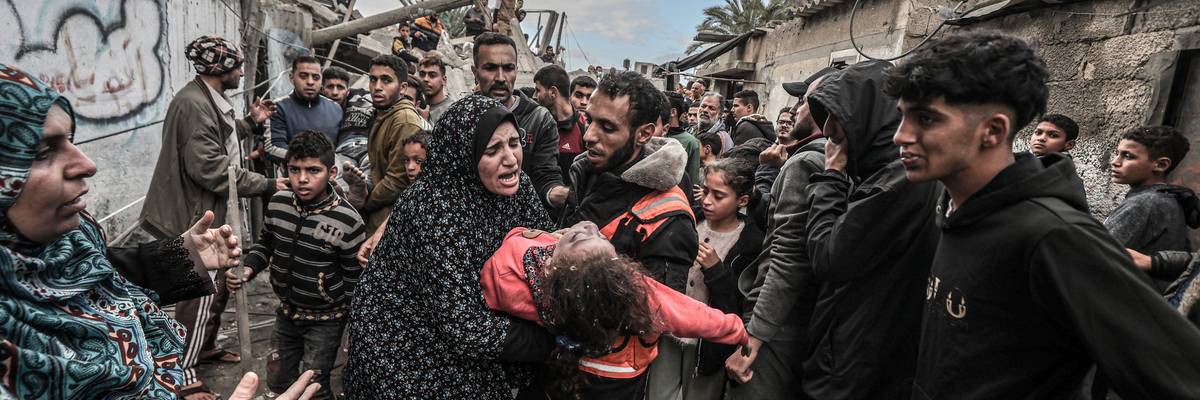
Gazan mother mourns her daughter killed in an Israeli air strike in Deir Al Bala
Cruelty upon cruelty: Today is Mother's Day in Gaza, and across the Arab world. Still the slaughter, the wounding, trauma, hunger go on. Israel has killed over 12,000 Palestinian children, with many thousands more injured or orphaned ; each day, 37 more mothers are killed. Those who survive battle to keep their children alive, and mourn those they've lost. "The children are always ours," said James Baldwin. But in Gaza, says one mother, "Today, like all mothers, I feel broken."
This year, the Mother's Day marked each March 21 is, for Gazans, a bloody travesty. The numbers still numb: More than 31,988 people have been killed in the ongoing) Israeli assault; another 74,188 have been injured, including over 32,800 children and 25,000 women, and 25,000 children have lost one or both parents. The Palestine Red Crescent Society estimates this Mother's Day would have been commemorated by 37 mothers killed; it was also marked by Israeli forces denying 28 Palestinian detained mothers from seeing their children. To date, Israel's "there-are-no-innocents" air campaign has dropped over 29,000 bombs, many of them 2,000-pound munitions that maim or kill within a quarter mile - often in so-called "safe zones" or "safe corridors" where Israel has told Gazans to go. Meanwhile, their relentless blockade has left at least half the population at imminent risk of famine; in recent weeks, at least several dozen children have starved to death.
When children are present in a time of genocide, writes pediatrician Sabreen Akhter, they are always the most afflicted. and the most in need of protection. When children are in a place that is bombed, they die more often than adults due to their smaller bodies and organs: "When you bomb a place with children in it, your primary intention is to kill all the children first." When they're in a place lacking sustenance, they die more quickly: "When you cut off water and food to a population with children, your primary intention is to starve all the children first." When they're without housing and exposed to the elements, they are more traumatized, and die more rapidly. A U.N panel said Thursday Israel appears "calculated to bring about the physical destruction of Palestinian children." At least, urges Al-Jazeera, "Know their names." Last month, they compiled perhaps half the names of the young dead known to them when the total was 11,500; even then, it takes over seven minutes to scroll through.
Palestinian children killed in Israeli attacks in Gaza | Al Jazeera Newsfeedwww.youtube.com
For mothers who survive, their daily mission is to keep alive the children who remain to them. A 29-year-old mother of three whose husband was killed in a recent "flour massacre" - while trying to feed his children - struggles to feed her five-month-old, because her breasts have almost no milk from lack of food and "deep sadness": "The baby keeps crying all day and night." A 49-year-old mother hasn't seen her only son, Ahmed, 16, since he rushed to the nearby scene of an Israeli air strike in October; she believes he was killed but has been unable to find or retrieve his body from the rubble. Nada Abu Aita, a 32-year-old "mother missing her mother" - who fled to Rafah - gave birth to her first son a month before the war and is fighting to "keep him alive, or stay alive for him." "I sometimes look into (his) eyes and I want to apologize for bringing him into this life," she says. "I am afraid I will lose him, and I am afraid I will be killed because he would be left alone."
And Alaa el-Qatrawi, a 33-year-old, PhD-educated poet and teacher, lost all four of her children in December. Separated from her husband, she saw them only part-time and last heard from them trapped amidst fighting when they called to beg, "Mama, get us out of here" - which she tried, but failed to do. Much later, her brother-in-law found their bodies. Lovingly, she names them: "Yamen, eight years old. The twins Orchid and Kanan, six years old. And Carmel, three years old.” She speaks of them in the present tense: "They're beautiful...They're so smart and funny...Kenan loves fruit...I would put some next to him when he sleeps (for) when he wakes up." She had been trying to arrange to move her children to Dubai "for a better future"; she'd bought Orchid "a princess dress" for summer, "and now summer will come and Orchid isn't here to wear it." In earlier wars, she'd written prose or poetry; in this one, she can't. "What can a grieving mother say about her children?" she asks. No words.
Dear Common Dreams reader, It’s been nearly 30 years since I co-founded Common Dreams with my late wife, Lina Newhouser. We had the radical notion that journalism should serve the public good, not corporate profits. It was clear to us from the outset what it would take to build such a project. No paid advertisements. No corporate sponsors. No millionaire publisher telling us what to think or do. Many people said we wouldn't last a year, but we proved those doubters wrong. Together with a tremendous team of journalists and dedicated staff, we built an independent media outlet free from the constraints of profits and corporate control. Our mission has always been simple: To inform. To inspire. To ignite change for the common good. Building Common Dreams was not easy. Our survival was never guaranteed. When you take on the most powerful forces—Wall Street greed, fossil fuel industry destruction, Big Tech lobbyists, and uber-rich oligarchs who have spent billions upon billions rigging the economy and democracy in their favor—the only bulwark you have is supporters who believe in your work. But here’s the urgent message from me today. It's never been this bad out there. And it's never been this hard to keep us going. At the very moment Common Dreams is most needed, the threats we face are intensifying. We need your support now more than ever. We don't accept corporate advertising and never will. We don't have a paywall because we don't think people should be blocked from critical news based on their ability to pay. Everything we do is funded by the donations of readers like you. When everyone does the little they can afford, we are strong. But if that support retreats or dries up, so do we. Will you donate now to make sure Common Dreams not only survives but thrives? —Craig Brown, Co-founder |
Cruelty upon cruelty: Today is Mother's Day in Gaza, and across the Arab world. Still the slaughter, the wounding, trauma, hunger go on. Israel has killed over 12,000 Palestinian children, with many thousands more injured or orphaned ; each day, 37 more mothers are killed. Those who survive battle to keep their children alive, and mourn those they've lost. "The children are always ours," said James Baldwin. But in Gaza, says one mother, "Today, like all mothers, I feel broken."
This year, the Mother's Day marked each March 21 is, for Gazans, a bloody travesty. The numbers still numb: More than 31,988 people have been killed in the ongoing) Israeli assault; another 74,188 have been injured, including over 32,800 children and 25,000 women, and 25,000 children have lost one or both parents. The Palestine Red Crescent Society estimates this Mother's Day would have been commemorated by 37 mothers killed; it was also marked by Israeli forces denying 28 Palestinian detained mothers from seeing their children. To date, Israel's "there-are-no-innocents" air campaign has dropped over 29,000 bombs, many of them 2,000-pound munitions that maim or kill within a quarter mile - often in so-called "safe zones" or "safe corridors" where Israel has told Gazans to go. Meanwhile, their relentless blockade has left at least half the population at imminent risk of famine; in recent weeks, at least several dozen children have starved to death.
When children are present in a time of genocide, writes pediatrician Sabreen Akhter, they are always the most afflicted. and the most in need of protection. When children are in a place that is bombed, they die more often than adults due to their smaller bodies and organs: "When you bomb a place with children in it, your primary intention is to kill all the children first." When they're in a place lacking sustenance, they die more quickly: "When you cut off water and food to a population with children, your primary intention is to starve all the children first." When they're without housing and exposed to the elements, they are more traumatized, and die more rapidly. A U.N panel said Thursday Israel appears "calculated to bring about the physical destruction of Palestinian children." At least, urges Al-Jazeera, "Know their names." Last month, they compiled perhaps half the names of the young dead known to them when the total was 11,500; even then, it takes over seven minutes to scroll through.
Palestinian children killed in Israeli attacks in Gaza | Al Jazeera Newsfeedwww.youtube.com
For mothers who survive, their daily mission is to keep alive the children who remain to them. A 29-year-old mother of three whose husband was killed in a recent "flour massacre" - while trying to feed his children - struggles to feed her five-month-old, because her breasts have almost no milk from lack of food and "deep sadness": "The baby keeps crying all day and night." A 49-year-old mother hasn't seen her only son, Ahmed, 16, since he rushed to the nearby scene of an Israeli air strike in October; she believes he was killed but has been unable to find or retrieve his body from the rubble. Nada Abu Aita, a 32-year-old "mother missing her mother" - who fled to Rafah - gave birth to her first son a month before the war and is fighting to "keep him alive, or stay alive for him." "I sometimes look into (his) eyes and I want to apologize for bringing him into this life," she says. "I am afraid I will lose him, and I am afraid I will be killed because he would be left alone."
And Alaa el-Qatrawi, a 33-year-old, PhD-educated poet and teacher, lost all four of her children in December. Separated from her husband, she saw them only part-time and last heard from them trapped amidst fighting when they called to beg, "Mama, get us out of here" - which she tried, but failed to do. Much later, her brother-in-law found their bodies. Lovingly, she names them: "Yamen, eight years old. The twins Orchid and Kanan, six years old. And Carmel, three years old.” She speaks of them in the present tense: "They're beautiful...They're so smart and funny...Kenan loves fruit...I would put some next to him when he sleeps (for) when he wakes up." She had been trying to arrange to move her children to Dubai "for a better future"; she'd bought Orchid "a princess dress" for summer, "and now summer will come and Orchid isn't here to wear it." In earlier wars, she'd written prose or poetry; in this one, she can't. "What can a grieving mother say about her children?" she asks. No words.
Cruelty upon cruelty: Today is Mother's Day in Gaza, and across the Arab world. Still the slaughter, the wounding, trauma, hunger go on. Israel has killed over 12,000 Palestinian children, with many thousands more injured or orphaned ; each day, 37 more mothers are killed. Those who survive battle to keep their children alive, and mourn those they've lost. "The children are always ours," said James Baldwin. But in Gaza, says one mother, "Today, like all mothers, I feel broken."
This year, the Mother's Day marked each March 21 is, for Gazans, a bloody travesty. The numbers still numb: More than 31,988 people have been killed in the ongoing) Israeli assault; another 74,188 have been injured, including over 32,800 children and 25,000 women, and 25,000 children have lost one or both parents. The Palestine Red Crescent Society estimates this Mother's Day would have been commemorated by 37 mothers killed; it was also marked by Israeli forces denying 28 Palestinian detained mothers from seeing their children. To date, Israel's "there-are-no-innocents" air campaign has dropped over 29,000 bombs, many of them 2,000-pound munitions that maim or kill within a quarter mile - often in so-called "safe zones" or "safe corridors" where Israel has told Gazans to go. Meanwhile, their relentless blockade has left at least half the population at imminent risk of famine; in recent weeks, at least several dozen children have starved to death.
When children are present in a time of genocide, writes pediatrician Sabreen Akhter, they are always the most afflicted. and the most in need of protection. When children are in a place that is bombed, they die more often than adults due to their smaller bodies and organs: "When you bomb a place with children in it, your primary intention is to kill all the children first." When they're in a place lacking sustenance, they die more quickly: "When you cut off water and food to a population with children, your primary intention is to starve all the children first." When they're without housing and exposed to the elements, they are more traumatized, and die more rapidly. A U.N panel said Thursday Israel appears "calculated to bring about the physical destruction of Palestinian children." At least, urges Al-Jazeera, "Know their names." Last month, they compiled perhaps half the names of the young dead known to them when the total was 11,500; even then, it takes over seven minutes to scroll through.
Palestinian children killed in Israeli attacks in Gaza | Al Jazeera Newsfeedwww.youtube.com
For mothers who survive, their daily mission is to keep alive the children who remain to them. A 29-year-old mother of three whose husband was killed in a recent "flour massacre" - while trying to feed his children - struggles to feed her five-month-old, because her breasts have almost no milk from lack of food and "deep sadness": "The baby keeps crying all day and night." A 49-year-old mother hasn't seen her only son, Ahmed, 16, since he rushed to the nearby scene of an Israeli air strike in October; she believes he was killed but has been unable to find or retrieve his body from the rubble. Nada Abu Aita, a 32-year-old "mother missing her mother" - who fled to Rafah - gave birth to her first son a month before the war and is fighting to "keep him alive, or stay alive for him." "I sometimes look into (his) eyes and I want to apologize for bringing him into this life," she says. "I am afraid I will lose him, and I am afraid I will be killed because he would be left alone."
And Alaa el-Qatrawi, a 33-year-old, PhD-educated poet and teacher, lost all four of her children in December. Separated from her husband, she saw them only part-time and last heard from them trapped amidst fighting when they called to beg, "Mama, get us out of here" - which she tried, but failed to do. Much later, her brother-in-law found their bodies. Lovingly, she names them: "Yamen, eight years old. The twins Orchid and Kanan, six years old. And Carmel, three years old.” She speaks of them in the present tense: "They're beautiful...They're so smart and funny...Kenan loves fruit...I would put some next to him when he sleeps (for) when he wakes up." She had been trying to arrange to move her children to Dubai "for a better future"; she'd bought Orchid "a princess dress" for summer, "and now summer will come and Orchid isn't here to wear it." In earlier wars, she'd written prose or poetry; in this one, she can't. "What can a grieving mother say about her children?" she asks. No words.