

SUBSCRIBE TO OUR FREE NEWSLETTER
Daily news & progressive opinion—funded by the people, not the corporations—delivered straight to your inbox.
5
#000000
#FFFFFF
To donate by check, phone, or other method, see our More Ways to Give page.
Daily news & progressive opinion—funded by the people, not the corporations—delivered straight to your inbox.
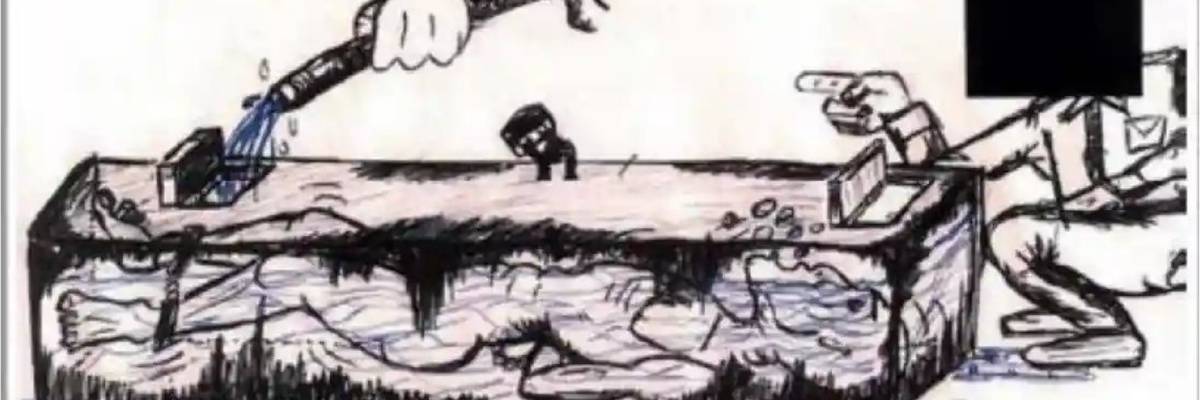
Abu Zubaydah drawing shows one of multiple ways he was waterboarded
The searing images, by "the poster child for America's torture program," stun. "Like clockwork," Abu Zubaydah was ceaselessly beaten, rectal-fed, hung by his hands, slammed into walls and waterboarded 83 times during Darth Cheney's grisly, senseless "enhanced interrogation techniques." In newly released drawings, Zubaydah documents his abuse during 21 years at Guantánamo. Still there, he's "the forever prisoner" - not for what he did (he was never charged) but for what was done to him.
Now 52, the Saudi-born Zubaydah moved to the West Bank in occupied Palestine as a teenager, and was captured in Pakistan by CIA, FBI, and Pakistani agents in 2002. Shot multiple times, he was successively renditioned to CIA "black sites" in Pakistan, Poland, Thailand, Afghanistan, Lithuania and Northern Africa before being sent to Guantánamo in September 2006. There, he was used as "a human guinea pig," the first victim of George Bush's "21st-century medieval torture program" against terror suspects. The US initially claimed he was a top al-Qaeda operative, but was later forced to concede he wasn't even a member of the group. "Everybody agrees, they tortured the wrong guy," says his lawyer. "They went ahead anyway so they could get permission to torture other people." After years of savagery, roughly 120 victims and at least 26 detainee deaths at the hands of torturers at Asadadad, Bagram, Gardez, Abu Ghraib, Basra, Mosul, Tikrit, Bucca, CIA officials admitted they'd gained no new intelligence from the carnage. Zubaydah and his painfully detailed, precisely damning drawings, says attorney Mark Denbeaux, "are the ultimate repudiation of the failure and abuses of torture."
They are also one of the few surviving records of a sordid post-9/11 chapter of history the CIA and FBI have long labored to keep hidden - and that current aspiring despot Ron DeSantis, sometimes laughingly complicit in it, has denied. Though the CIA made videotapes of Zubaydah's torture, they later destroyed them in violation of a court order; meanwhile, a 6,700-page report by a 2014 Senate intelligence committee remains secret. In the absence of any full accounting of a human rights disaster that violated both international laws and our government's own minimal guidelines, Zubaydah's drawings represent a singularly chilling look at this "long-festering...collective national wound." They saw new light this week when The Guardian published American Torturers: FBI and CIA Abuses at Dark Sites and Guantánamo, a report based on 40 sketches and Zubaydah's notes on them, compiled by Denbeaux, a law professor at Seton Hall University, a UC San Francisco psychiatry professor, and Seton Hall law students. "Silence and darkness" have kept Zubaydah imprisoned, argues Denbeaux; if the report's release, coupled with a new UN avowal that Zubaydah's ongoing detention is a crime against humanity, his "iconic self-portraits (of torture) will have done their job."
Many of the portraits of his degradation between 2002 and 2006 are so meticulously rendered that Zubaydah often blacked out the faces of his torturers to protect their identities, and presumably himself. He depicts grotesque violence, sexual and religious humiliation, psychological terror, all accompanied by plain-spoken descriptions. "This drawing shows threatening the detainee with rape," he writes of forced "rectal feedings" by guards wielding thick batons. They "drop the prisoner on the ground, and hold him in a way to sodomize him"; they use "dirty, sexual words," they "start the disgrace," they "use their hands or some sticks around the anus." He draws himself chained naked before a female interrogator: He is "sitting on the chair for weeks...Naked. Very hungry. Shivering from cold...He cannot cover his genitalia...They pour freezing buckets of water over him." He describes prolonged use of multiple torture techniques he calls "the Vortex" of pain, stress, hunger and cold: Hitting with a stick in cold temperatures till the prisoner passes out, waking him up, starting on another method for an hour, pass out, wake up, more for the next hour, "until they finish all their methods."
There is no respite, no break. He is regularly "walled," thrown head-first against a concrete wall; beaten on his face and back; jammed into a tiny "dog box" for days; shackled for weeks; deprived of sleep; exposed to constant light and noise; threatened with desecration of the Qur’an; hung by his hands; forced into stress positions; denied use of a toilet to wallow in his own shit and piss. He is waterboarded 83 times; variations include being confined in a coffin-size crate that inexorably fills with water as he tries to keep his nose above it, leaving him terrified of drowning long afterward. The guards open the locked door of his cell when they bring a power drill into the next cell "so I could hear the shouting, begging and crying in horror of the brother receiving the torture threat. Did they drill the brother's head? Did they drill his stomach or foot or rear end?...All these questions kept going through my mind for days until another day when they come back (with) the drill. The same sounds of horror come back...Is he the same brother? Didn't he die? Or is this another brother? Who is the second one? And who will be the third one? Will it be me?" It will not be us; it was just being done in our name. Don't look away.
Dear Common Dreams reader, It’s been nearly 30 years since I co-founded Common Dreams with my late wife, Lina Newhouser. We had the radical notion that journalism should serve the public good, not corporate profits. It was clear to us from the outset what it would take to build such a project. No paid advertisements. No corporate sponsors. No millionaire publisher telling us what to think or do. Many people said we wouldn't last a year, but we proved those doubters wrong. Together with a tremendous team of journalists and dedicated staff, we built an independent media outlet free from the constraints of profits and corporate control. Our mission has always been simple: To inform. To inspire. To ignite change for the common good. Building Common Dreams was not easy. Our survival was never guaranteed. When you take on the most powerful forces—Wall Street greed, fossil fuel industry destruction, Big Tech lobbyists, and uber-rich oligarchs who have spent billions upon billions rigging the economy and democracy in their favor—the only bulwark you have is supporters who believe in your work. But here’s the urgent message from me today. It's never been this bad out there. And it's never been this hard to keep us going. At the very moment Common Dreams is most needed, the threats we face are intensifying. We need your support now more than ever. We don't accept corporate advertising and never will. We don't have a paywall because we don't think people should be blocked from critical news based on their ability to pay. Everything we do is funded by the donations of readers like you. When everyone does the little they can afford, we are strong. But if that support retreats or dries up, so do we. Will you donate now to make sure Common Dreams not only survives but thrives? —Craig Brown, Co-founder |
The searing images, by "the poster child for America's torture program," stun. "Like clockwork," Abu Zubaydah was ceaselessly beaten, rectal-fed, hung by his hands, slammed into walls and waterboarded 83 times during Darth Cheney's grisly, senseless "enhanced interrogation techniques." In newly released drawings, Zubaydah documents his abuse during 21 years at Guantánamo. Still there, he's "the forever prisoner" - not for what he did (he was never charged) but for what was done to him.
Now 52, the Saudi-born Zubaydah moved to the West Bank in occupied Palestine as a teenager, and was captured in Pakistan by CIA, FBI, and Pakistani agents in 2002. Shot multiple times, he was successively renditioned to CIA "black sites" in Pakistan, Poland, Thailand, Afghanistan, Lithuania and Northern Africa before being sent to Guantánamo in September 2006. There, he was used as "a human guinea pig," the first victim of George Bush's "21st-century medieval torture program" against terror suspects. The US initially claimed he was a top al-Qaeda operative, but was later forced to concede he wasn't even a member of the group. "Everybody agrees, they tortured the wrong guy," says his lawyer. "They went ahead anyway so they could get permission to torture other people." After years of savagery, roughly 120 victims and at least 26 detainee deaths at the hands of torturers at Asadadad, Bagram, Gardez, Abu Ghraib, Basra, Mosul, Tikrit, Bucca, CIA officials admitted they'd gained no new intelligence from the carnage. Zubaydah and his painfully detailed, precisely damning drawings, says attorney Mark Denbeaux, "are the ultimate repudiation of the failure and abuses of torture."
They are also one of the few surviving records of a sordid post-9/11 chapter of history the CIA and FBI have long labored to keep hidden - and that current aspiring despot Ron DeSantis, sometimes laughingly complicit in it, has denied. Though the CIA made videotapes of Zubaydah's torture, they later destroyed them in violation of a court order; meanwhile, a 6,700-page report by a 2014 Senate intelligence committee remains secret. In the absence of any full accounting of a human rights disaster that violated both international laws and our government's own minimal guidelines, Zubaydah's drawings represent a singularly chilling look at this "long-festering...collective national wound." They saw new light this week when The Guardian published American Torturers: FBI and CIA Abuses at Dark Sites and Guantánamo, a report based on 40 sketches and Zubaydah's notes on them, compiled by Denbeaux, a law professor at Seton Hall University, a UC San Francisco psychiatry professor, and Seton Hall law students. "Silence and darkness" have kept Zubaydah imprisoned, argues Denbeaux; if the report's release, coupled with a new UN avowal that Zubaydah's ongoing detention is a crime against humanity, his "iconic self-portraits (of torture) will have done their job."
Many of the portraits of his degradation between 2002 and 2006 are so meticulously rendered that Zubaydah often blacked out the faces of his torturers to protect their identities, and presumably himself. He depicts grotesque violence, sexual and religious humiliation, psychological terror, all accompanied by plain-spoken descriptions. "This drawing shows threatening the detainee with rape," he writes of forced "rectal feedings" by guards wielding thick batons. They "drop the prisoner on the ground, and hold him in a way to sodomize him"; they use "dirty, sexual words," they "start the disgrace," they "use their hands or some sticks around the anus." He draws himself chained naked before a female interrogator: He is "sitting on the chair for weeks...Naked. Very hungry. Shivering from cold...He cannot cover his genitalia...They pour freezing buckets of water over him." He describes prolonged use of multiple torture techniques he calls "the Vortex" of pain, stress, hunger and cold: Hitting with a stick in cold temperatures till the prisoner passes out, waking him up, starting on another method for an hour, pass out, wake up, more for the next hour, "until they finish all their methods."
There is no respite, no break. He is regularly "walled," thrown head-first against a concrete wall; beaten on his face and back; jammed into a tiny "dog box" for days; shackled for weeks; deprived of sleep; exposed to constant light and noise; threatened with desecration of the Qur’an; hung by his hands; forced into stress positions; denied use of a toilet to wallow in his own shit and piss. He is waterboarded 83 times; variations include being confined in a coffin-size crate that inexorably fills with water as he tries to keep his nose above it, leaving him terrified of drowning long afterward. The guards open the locked door of his cell when they bring a power drill into the next cell "so I could hear the shouting, begging and crying in horror of the brother receiving the torture threat. Did they drill the brother's head? Did they drill his stomach or foot or rear end?...All these questions kept going through my mind for days until another day when they come back (with) the drill. The same sounds of horror come back...Is he the same brother? Didn't he die? Or is this another brother? Who is the second one? And who will be the third one? Will it be me?" It will not be us; it was just being done in our name. Don't look away.
The searing images, by "the poster child for America's torture program," stun. "Like clockwork," Abu Zubaydah was ceaselessly beaten, rectal-fed, hung by his hands, slammed into walls and waterboarded 83 times during Darth Cheney's grisly, senseless "enhanced interrogation techniques." In newly released drawings, Zubaydah documents his abuse during 21 years at Guantánamo. Still there, he's "the forever prisoner" - not for what he did (he was never charged) but for what was done to him.
Now 52, the Saudi-born Zubaydah moved to the West Bank in occupied Palestine as a teenager, and was captured in Pakistan by CIA, FBI, and Pakistani agents in 2002. Shot multiple times, he was successively renditioned to CIA "black sites" in Pakistan, Poland, Thailand, Afghanistan, Lithuania and Northern Africa before being sent to Guantánamo in September 2006. There, he was used as "a human guinea pig," the first victim of George Bush's "21st-century medieval torture program" against terror suspects. The US initially claimed he was a top al-Qaeda operative, but was later forced to concede he wasn't even a member of the group. "Everybody agrees, they tortured the wrong guy," says his lawyer. "They went ahead anyway so they could get permission to torture other people." After years of savagery, roughly 120 victims and at least 26 detainee deaths at the hands of torturers at Asadadad, Bagram, Gardez, Abu Ghraib, Basra, Mosul, Tikrit, Bucca, CIA officials admitted they'd gained no new intelligence from the carnage. Zubaydah and his painfully detailed, precisely damning drawings, says attorney Mark Denbeaux, "are the ultimate repudiation of the failure and abuses of torture."
They are also one of the few surviving records of a sordid post-9/11 chapter of history the CIA and FBI have long labored to keep hidden - and that current aspiring despot Ron DeSantis, sometimes laughingly complicit in it, has denied. Though the CIA made videotapes of Zubaydah's torture, they later destroyed them in violation of a court order; meanwhile, a 6,700-page report by a 2014 Senate intelligence committee remains secret. In the absence of any full accounting of a human rights disaster that violated both international laws and our government's own minimal guidelines, Zubaydah's drawings represent a singularly chilling look at this "long-festering...collective national wound." They saw new light this week when The Guardian published American Torturers: FBI and CIA Abuses at Dark Sites and Guantánamo, a report based on 40 sketches and Zubaydah's notes on them, compiled by Denbeaux, a law professor at Seton Hall University, a UC San Francisco psychiatry professor, and Seton Hall law students. "Silence and darkness" have kept Zubaydah imprisoned, argues Denbeaux; if the report's release, coupled with a new UN avowal that Zubaydah's ongoing detention is a crime against humanity, his "iconic self-portraits (of torture) will have done their job."
Many of the portraits of his degradation between 2002 and 2006 are so meticulously rendered that Zubaydah often blacked out the faces of his torturers to protect their identities, and presumably himself. He depicts grotesque violence, sexual and religious humiliation, psychological terror, all accompanied by plain-spoken descriptions. "This drawing shows threatening the detainee with rape," he writes of forced "rectal feedings" by guards wielding thick batons. They "drop the prisoner on the ground, and hold him in a way to sodomize him"; they use "dirty, sexual words," they "start the disgrace," they "use their hands or some sticks around the anus." He draws himself chained naked before a female interrogator: He is "sitting on the chair for weeks...Naked. Very hungry. Shivering from cold...He cannot cover his genitalia...They pour freezing buckets of water over him." He describes prolonged use of multiple torture techniques he calls "the Vortex" of pain, stress, hunger and cold: Hitting with a stick in cold temperatures till the prisoner passes out, waking him up, starting on another method for an hour, pass out, wake up, more for the next hour, "until they finish all their methods."
There is no respite, no break. He is regularly "walled," thrown head-first against a concrete wall; beaten on his face and back; jammed into a tiny "dog box" for days; shackled for weeks; deprived of sleep; exposed to constant light and noise; threatened with desecration of the Qur’an; hung by his hands; forced into stress positions; denied use of a toilet to wallow in his own shit and piss. He is waterboarded 83 times; variations include being confined in a coffin-size crate that inexorably fills with water as he tries to keep his nose above it, leaving him terrified of drowning long afterward. The guards open the locked door of his cell when they bring a power drill into the next cell "so I could hear the shouting, begging and crying in horror of the brother receiving the torture threat. Did they drill the brother's head? Did they drill his stomach or foot or rear end?...All these questions kept going through my mind for days until another day when they come back (with) the drill. The same sounds of horror come back...Is he the same brother? Didn't he die? Or is this another brother? Who is the second one? And who will be the third one? Will it be me?" It will not be us; it was just being done in our name. Don't look away.
