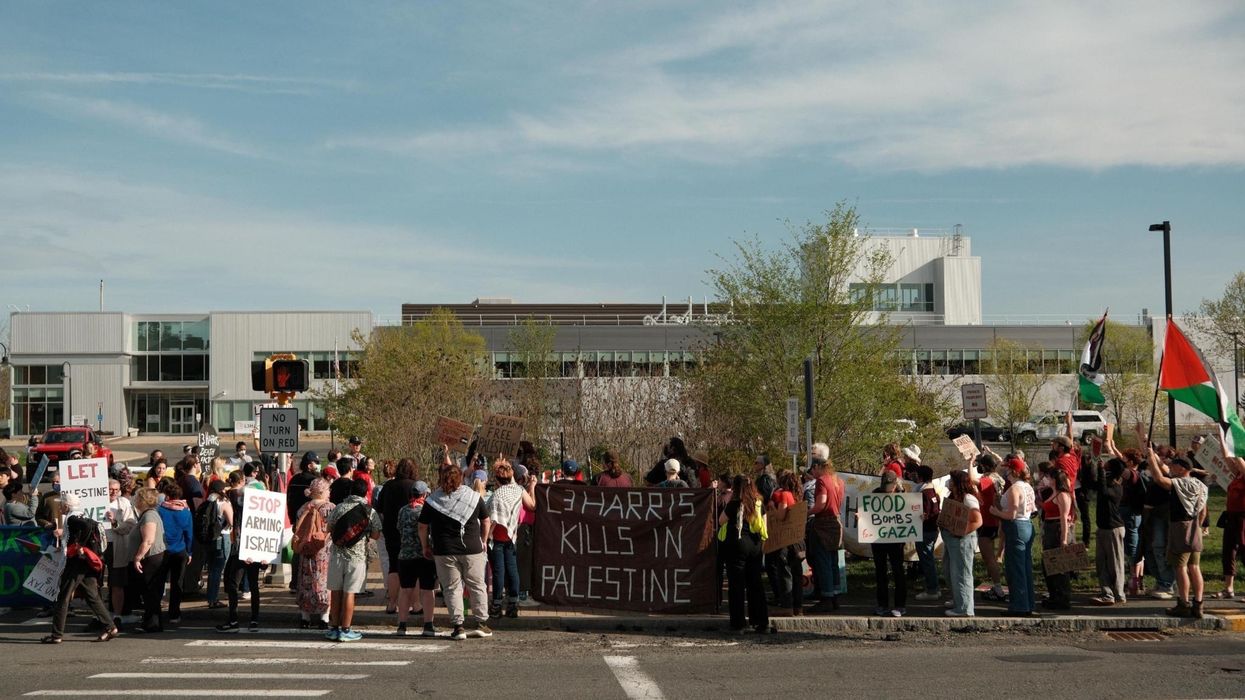
Last week we had seven protesters, and now we shatter that record-breaking turnout with an array of colorful people who number at least four times that many (maybe more)—some wear grim reaper getups, and others are masked, hooded, cloaked, or simply covered over with rain gear and warm coats on a rare, cold, rainy day momentarily punctuating a month of drought and oppressive heat. But these people (organized by Demilitarize Western Mass with a number of individual participants from Jewish Voice for Peace)—however many we have—now block the entrance with their bodies. They have stretched a yellow ribbon labeled, "crime scene" across the road. The crime itself, represented explicitly with a line of faux bloodstained body bags, each the size of an infant, might ordinarily be lost—crimes against humanity depend on the oblivious indifference of participants who work within the lower layers of homicidal supply chains. We stir the faint embers of conscience, the hypothetical internal torment of L3 workers, but we perform primarily to arouse the sleeping giant of Northampton, a city whose moral resolve has been largely illusory.
The L3Harris website might easily be seen as a parody of so-called "woke" culture. One page solicits job applications with a picture of a Black man with a child on his back. Workers at L3Harris have access to "employee resource groups" organized around diverse ethnic, religious, and racial identities. The human imagination would seemingly explode with flabbergasted disbelief at how far absurdity can be stretched—corporations have created cultures with such limitless credulity that George Orwell himself would now scream into the void. At L3Harris you can join "MENA"—a company association for people with Middle Eastern or North African descent who build sensors to guide bombs to the chosen Gazan addresses (schools, hospitals and apartments). I don't see any employees who appear to be Middle Eastern or North African at our Northampton outpost of the death industry. L3 also has an employee resource group called "PRIDE" for its LGBTQ workers. I suspect that we witness a time lag between the old jargon that characterized former US President Joe Biden's style, and the new language of current President Donald Trump's white supremacy. Both Biden and Trump align around L3Harris and massive bombing of civilians. Even the worst crimes against humanity require the balm of cultural trends. Who but god itself could conceivably imagine the roiling thoughts of L3 workers whose cars have been stymied by the accusing souls of dead babies suddenly lined up on the pavement of their employee parking lot entrance.
Ralph Nader sets the Gazan death toll at 400,000 currently—we futilely attempt to replicate the scope of suffering with theatrical props. A stretch of white cloth streaked with more red paint lies across the entire L3Harris driveway entrance, and beside that, puddles of somewhat pinkish liquid glisten in the light mist that falls.
One woman with a bullhorn leads chants: "Hey, ho! L3Harris has got to go! From Palestine to Mexico, L3Harris has got to go!" I team up with a woman in a black raincoat holding my end of a sign that reads, "L3 your boss Chris Kubacik makes $19.8 million a year supplying weapons to Israel." Another companion placard has a photograph of CEO Kubacik blandly smiling to reveal a couple of vampire teeth with a drop of blood oozing at each point. This is all wonderful—any spark of life, whimsy, or celebration these days has an aura of abrupt surprise, as if a spaceship has descended from the void of interstellar darkness and unloaded a cargo of atrophied torsos and oversized heads.
Is L3Harris, the epicenter of Northampton, the only part of Northampton that truly matters, the dusky shadow of ourselves that we paper over with slogans? Our civil disobedience acts out a theatrical production with a skeleton cast. Only the protesters, the police, a reporter for the local progressive newspaper (The Shoestring), the L3 employees, and a few passing cars are here to play their parts. The two most important roles—the 30,000 Northampton residents and the Northampton elected city officials—are not here. The guidance systems that align bombs with anatomies take shape behind the ordinary walls of a local workplace in a town that thinks of itself as a beacon of universal tolerance. An ocean of blood resolves into a moral trickle. From time to time, activists have assembled at the entrance of L3Harris, but not yet with sustained resolve. We have barely imagined an endgame for resistance, but clearly, we need to release Northampton from the bondage of neoliberal somnolence.
History will possibly link Northampton and L3Harris in the manner that we link Los Alamos, New Mexico and the atomic bombs that destroyed Hiroshima and Nagasaki. People live quietly in Los Alamos too—people who drink coffee and catch their breath, people who look at basketball scores, work as grocery baggers or nuclear physicists, but we forget the normal things that go on at Los Alamos as we may one day forget about Smith College, The Iron Horse Music Hall, or The David Ruggles Center that commemorates the role that Northampton played as a stop on the Underground Railroad.
My comparison between Northampton and Los Alamos might raise eyebrows, as I hope it will. Los Alamos, as a township, had no historical existence at all and rather coalesced around the top secret Manhattan Project begun in 1943. The township officially emerged only after Hiroshima and Nagasaki were blown to smithereens—the fruits of Los Alamos. Northampton, on the other hand, has a rich history as one of the birthplaces of the US mental health industry, and as the home of such morally uncompromising religious zealots as Jonathan Edwards and Sylvester Graham. In 1805, 15,000 Northampton residents gathered to celebrate the hanging of two Irish immigrants condemned by a kangaroo court that required no evidence. A few decades later our town became a major stop on the Underground Railroad. Northampton continues to flutter mysteriously in the political breezes. L3Harris did not build Northampton from scratch, but arrived quietly as an afterthought. Most of us don't even know that it is there, manufacturing death and selling lethal components around the globe.
The Manhattan Project was kept secret by design and centered in Los Alamos because of its remote proximity to nowhere. In our times the military-industrial complex no longer needs to conceal its intent. Our secrets are not secrets at all, but, rather, we share a repressed understanding that—whatever tiny measure of agency the masses might possess—war is none of our business. The balance of control has made ordinary people into particles of sediment carried passively downstream by the momentum of corporate aspirations and the Orwellian gifts of politicians and media. But Northampton likes to sometimes think of itself as a world apart.
Can we really do the impossible and evict a major component of the US military-industrial complex with the tools of civil disobedience and local elections?
There might be 30-35 of us here, and now the cops have arrived looking uncertain, but peeved. A line of L3 employees' vehicles wait to turn into the blocked driveway. The biggest, most muscular cop recognizes me with a smile—we both workout at Planet Fitness and I wave to my fitness comrade. Some L3 employees have parked at the mental health facility across the street and cross our picket line like so many strike breakers. A young man in his early 20s wears a particularly fierce scowl. Most armaments employees self-consciously avoid eye contact with us. The moral fault lines of the US seldom become as explicit as they now are.
The civil disobedience ends with a whimper. A couple of particularly nasty, loud-voiced cops intimidate us, and we take down the yellow tape, remove the bloody babies in body bags, and move aside while fire hoses wash away the blood of Gaza. As a piece of counter-theater, the cops grab two women from Jewish Voice for Peace and shove them roughly into cruisers. My imagination runs wild. The police are an appendage of the city, its mayor, and city council members. This protest is the tip of the iceberg—what would an event like this look like if the police were constrained by a socialist mayor—our version of Zohran Mamdani? Can Northampton—the so-called most progressive city in America—live up to the 3.5% rule. The 3.5% rule generally refers to the needed percentage of people nationally willing to engage in sustained civil disobedience in order to bring about the collapse of an oppressive regime, or a drastic shift in policy. The 3.5% rule may not be entirely applicable to town politics, but still, I wonder what would happen if Northampton elected a Zohran Mamdani sort of mayor and mobilized civil disobedience with a thousand protesters blocking the entrance to L3Harris' parking lot?
Speaking of Planet Fitness, I note that L3Harris and "The Planet" pay the town similar property taxes despite the enormously unequal revenues recorded by each business. Bomb guiding systems and periscopes for nuclear subs bring in some 40 times the national revenue generated by free weights and treadmills. Northampton politicians gave L3Harris over a decade of tax breaks—these town authorities justified this because L3Harris provided local jobs. But the act of pandering to corporate giants has not solved Northampton's financial struggles. The schools wrestle with financial shortfalls every year, and this has led to cuts and layoffs. Rents have become impossible for working people; the streets, rutted and pock marked with neglect, swallow tires and bust axels. Last winter a snow storm and brutal freeze made streets almost impassable for two weeks, but, more than any other issue, the underfunded schools have inspired an unprecedented political movement featuring younger candidates vying to unseat the centrist town council incumbents that have been faithful to Mayor Gina-Louise Sciarra. Some identify as democratic socialists, including 24-year-old Will O'Dwyer, whose campaign website lists a number of laudable policy intentions including:
Oppose further tax breaks and subsidies for L3Harris and support the removal of the company and its operations from Northampton.
Niko Letendre-Cahillane is another young democratic socialist running for a councilor seat in my ward one district. His campaign website lists the following proposal:
Recognize that Northampton is part of a wider global community, and will push for divestment from weapons manufacturers and harmful and extractive businesses, while supporting the Boycott, Divestment, and Sanctions movement to end apartheid in Palestine.
Letendre-Cahillane specifically named the removal of L3Harris from Northampton as a critical campaign goal in a recent public debate.
Luke Rotello, running for a council seat in Northampton ward five, states on his website that he "will seek ways to remove war profiteers from our city." He also specifically named L3Harris as the target for removal in public debates.
The incumbent from ward three, Quaverly Rothenberg, has hosted several activists in her office for months now who wish to brainstorm strategies to remove L3 from Northampton.
I have been told by more experienced observers of local politics that it is possible to have councilors from all seven of Northampton's wards, and two at-large councilors who will all work to remove L3Harris from Northampton.
Current Northampton Mayor Gina-Louise Sciarra stated in a debate on August, 26—I am paraphrasing—that she is not happy with L3Harris being in Northampton, but there isn't anything the town can do about it. This is rather par for the course for this mayor who has failed to prevent the loss of critical school staff, and who has blatantly soft-pedaled her pitch to get the local Smith College (with their multibillion-dollar endowment) to increase the college's piddling PILOT (payments in lieu of taxes) to make up for the shortfall. Sciarra calls herself an "unapologetic progressive." In Northampton every politician to the left of Donald Trump claims to be progressive. Phrases like "social justice," "human rights," and "standing up for working families" fly out of their mouths like spittle pouring from the mouth of a rabid dog.
Sciarra's strongest opponent in the upcoming mayoral election preliminaries, Dan Breindel, calls Sciarra a Republican. Nobody paying attention would mistake Sciarra for a "progressive" given her stingy refusal to apply ample resources to the critically underfunded schools and her penchant for austerity combined with gaudy, gentrifying downtown projects. The population who send their children to public schools is much poorer than the overall voting public. Northampton has the most unequal distribution of wealth in Western Massachusetts. Politicians like Mayor Sciarra can piss all over the rights of poor constituents and appeal to a substantial base of retirees and moneyed residents who can afford to send their kids to nearby Williston—a private school. And Sciarra is a dead weight upon the aspiration to force L3Harris to leave town. Mayoral candidate, Dan Breindel, on the other hand, wrote this in an email to me:
On a personal level, I am extremely anti-war, so please rest assured my aim is to rid the world of the military-industrial complex, starting with this town. 100%. Not only are they (L3Harris) here in our backyard making money off murder, when they considered leaving a few years back the city effectively gave them one of our most beautiful plots of land, which they in turn restrict all public access to. So there's nothing good about having them here and it's frankly baffling they've been here as long as they have seemingly without any real government opposition.
The sudden emergence of candidates for every single local office, who are eager to remove L3Harris from the city, reframes our weekly protests and actions at L3Harris from a futile gesture to a burgeoning movement. I had previously been discouraged by our lack of numbers, but even small protests have meaning. Some of my fellow anti-war protesters are barely aware that their struggle to evict L3Harris now has a resounding echo in the effort to overthrow the neoliberal, corporate-friendly mayor and city council. What role will a truly progressive mayor and council have in growing and energizing our protests? I fantasize about taking on the role of liaison between young socialist candidates and mostly older anti-L3Harris protesters. I also think about being arrested. My time has come to cross that threshold.
Can we really do the impossible and evict a major component of the US military-industrial complex with the tools of civil disobedience and local elections? Our efforts have escalated on many fronts—notably, Mathew Hoey, who once collaborated with Noam Chomsky to bring attention to the US nuclear expansion into South Korea, has written a superb op-ed for the local Hampshire Gazette. Hoey details how L3Harris' proximity endangers the local community which may become a "counterforce" nuclear target. It simply astonishes me that local people in our fascist times have the energy and imagination to undertake a seemingly impossible quest. It now seems less impossible than it did mere months ago.