

SUBSCRIBE TO OUR FREE NEWSLETTER
Daily news & progressive opinion—funded by the people, not the corporations—delivered straight to your inbox.
5
#000000
#FFFFFF
To donate by check, phone, or other method, see our More Ways to Give page.
Daily news & progressive opinion—funded by the people, not the corporations—delivered straight to your inbox.
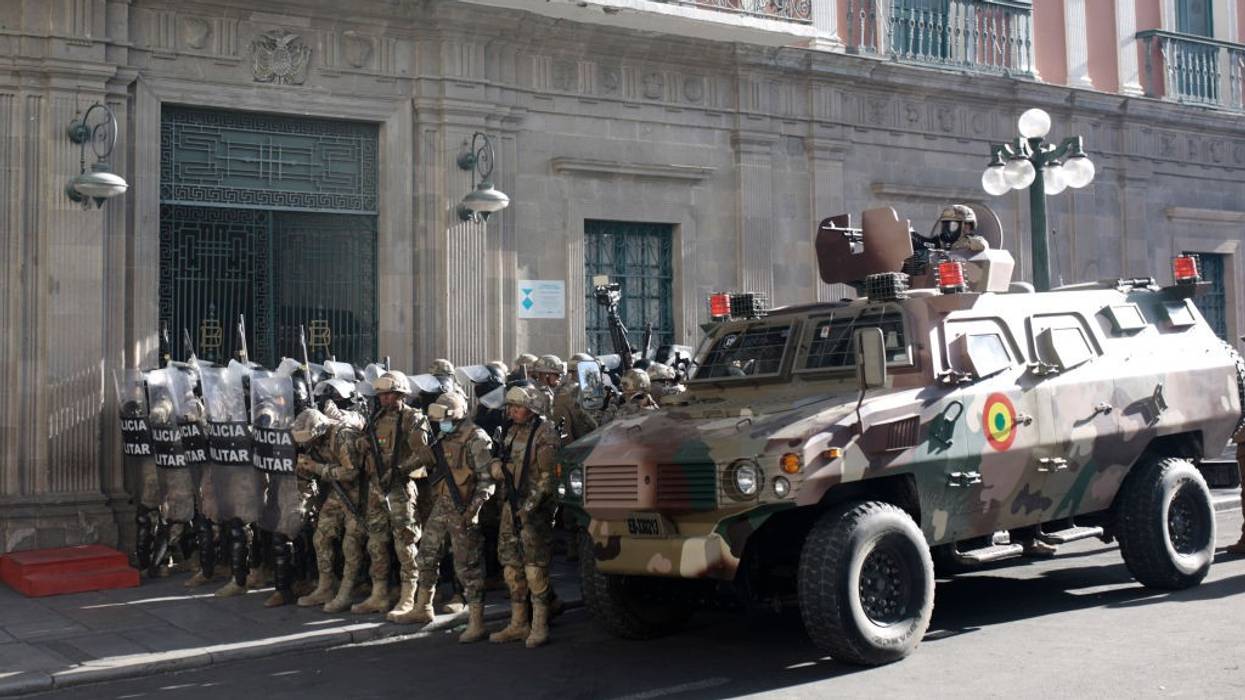
Leftists and political leaders around the world slammed the coup effort as Bolivia's trade union federation called for an emergency mass mobilization and a general strike.
This is a developing story… Please check back for possible updates...
Bolivian President Luis Arce replaced top military leaders on Wednesday in response to an attempted coup d'état in which troops took over Plaza Murillo in La Paz and rammed an armored vehicle into the doors of the presidential palace so soldiers could storm the building.
"We denounce irregular mobilizations of some units of the Bolivian army," Arce, a member of the Movement for Socialism (MAS) party,
said on social media. "Democracy must be respected."
As
The Associated Press reported:
In a video of Arce surrounded by ministers in the palace, he said: "The country is facing an attempted coup d'état. Here we are, firm in Casa Grande, to confront any coup attempt. We need the Bolivian people to organize."
Arce confronted the general commander of the army—Juan José Zúñiga, who appeared to be leading the rebellion—in the palace hallway, as shown on video on Bolivian television. "I am your captain, and I order you to withdraw your soldiers, and I will not allow this insubordination," Arce said.
Zúñiga told local media that "the three chiefs of the armed forces have come to express our dismay. There will be a new Cabinet of ministers, surely things will change, but our country cannot continue like this any longer."
Sharing his demands, Zúñiga said, "Stop destroying, stop impoverishing our country, stop humiliating our army."
The general claimed that the air force, army, and navy were "mobilized" and "the police force is also with us."
Meanwhile, "Arce swore in three new leaders of the armed forces," according to Buenos Aires Herald managing editor Amy Booth. "At the ceremony, army Commander in Chief Wilson Sánchez ordered the forces back to their barracks and at the moment they seem to be listening."
Despite the rift between former Bolivian President Evo Morales, who remains head of MAS, and Arce, who was his finance minister, Bolivia's ex-leader also spoke out against the military action on Wednesday, declaring that "the coup d'état is brewing."
"At this time, personnel from the armed forces and tanks are deployed in Plaza Murillo," Morales said. "They called an emergency meeting at the army general staff in Miraflores at 3:00 pm in combat uniforms. Call on the social movements of the countryside and the city to defend democracy."
After the change in military leaders, Morales—who has denounced his own 2019 ouster as a coup—demanded that "a criminal process" targeting "Zúñiga and his accomplices" begin immediately.
Wednesday evening, Bolivia's attorney general ordered "all legal actions that correspond to the initiation of the criminal investigation against Gen. Juan José Zúñiga and all other participants in the events that occurred," according to Kawsachun News.
The Bolivian Workers' Center (COB), the South American country's trade union federation, had "called for an emergency mass mobilization and a general strike in response to the ongoing coup attempt," Progressive International highlighted on social media.
Progressive International also urged "international attention to these grave violations of Bolivian democracy."
Condemnation of the coup attempt and expressions of solidarity with those opposing it were shared around the world.
"We condemn the attempted coup in Bolivia and send our solidarity to President Luis Arce and his democratically elected government," declared the Peace & Justice Project, founded by Jeremy Corbyn, a member of the U.K. Parliament who used to lead the Labour Party.
European Commission President Ursula von der Leyen said that "I firmly condemn the attempts to overthrow the democratically elected government of Bolivia. The European Union stands by democracies. We express our strong support for the constitutional order and rule of law in Bolivia."
U.S. Congresswoman Ilhan Omar (D-Minn.) emphasized that she is "standing in solidarity with the Bolivian people as they fight to preserve their democracy," and "the coup attempt must be unequivocally condemned."
The Democratic Socialists of America's International Committee wrote on social media that "we extend our solidarity to the Bolivian people during this imminent emergency."
Morales said later Wednesday that "we appreciate all the expressions of solidarity and support for Bolivian democracy expressed by presidents, political and social leaders of the world. We are convinced that democracy is the only way to resolve any difference and that institutions and the rule of law must be respected. We reiterate the call for all those involved in this riot to be arrested and tried."
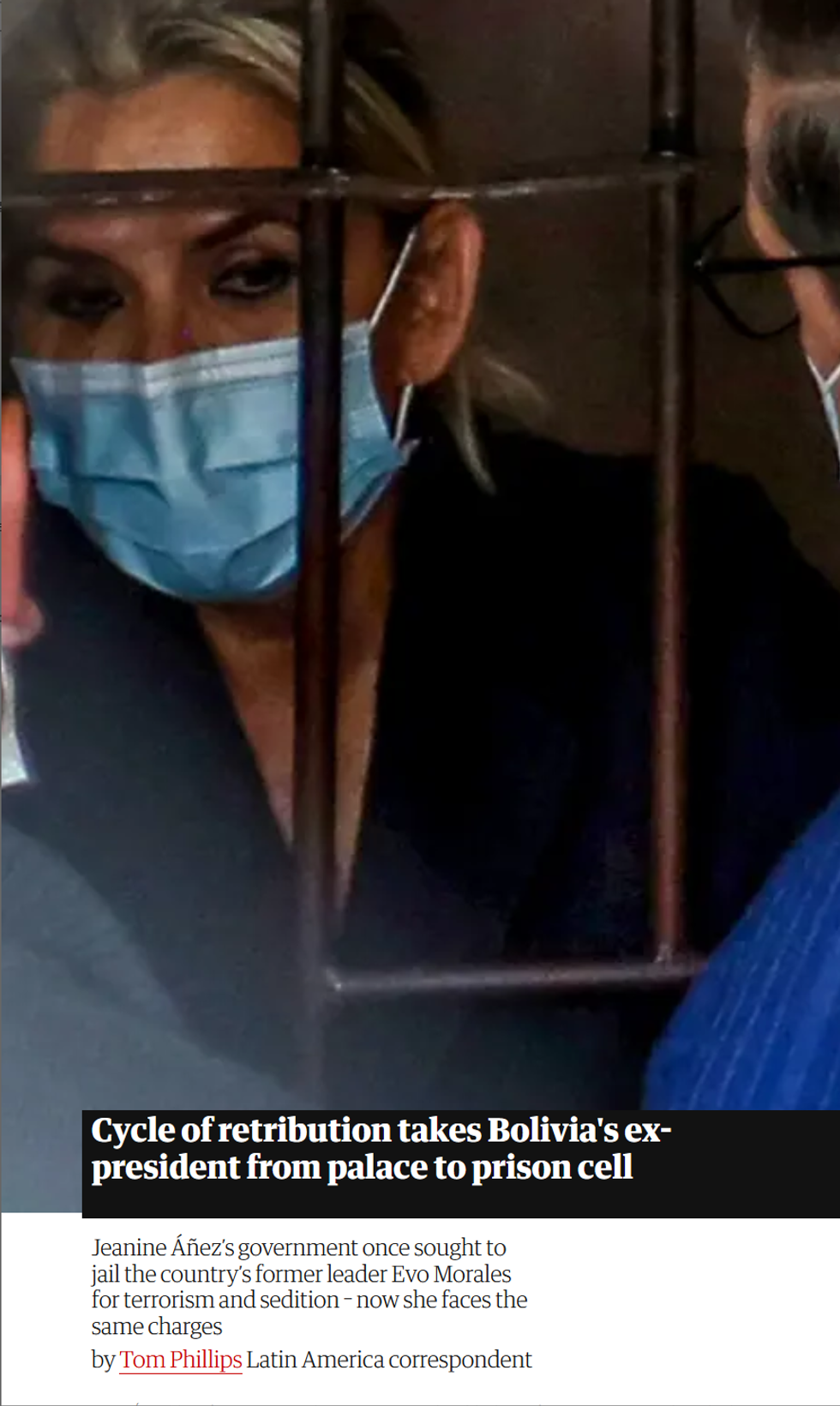
One can imagine an editor of the London-based Guardian (3/17/21) shaking her head sadly as she typed the headline: "Cycle of Retribution Takes Bolivia's Ex-President From Palace to Prison Cell." The subhead told readers, "Jeanine Anez's government once sought to jail the country's former leader Evo Morales for terrorism and sedition--now she faces the same charges."
The Guardian article by Tom Phillips wants us to lament an alleged incapacity of Bolivian governments to stop persecuting opponents once they take office. We are told that Anez's government did it, and that now the government of President Luis Arce (elected in a landslide win on October 18, 2020) is also doing it.
The article's premise is a lie, and the liberal Guardian has hardly been the only outlet spreading it, with help from Jose Miguel Vivanco, Americas director of Human Rights Watch (HRW), whom Philips quoted. A team effort between Western media and NGOs like HRW often reinforces the views of the US government (FAIR.org, 8/23/18, 8/31/18, 5/31/2o, 11/3/18).
Anez was a US-backed dictator installed after a military coup sent democratically elected President Evo Morales fleeing Bolivia for his life on November 10, 2019. Once in power, Anez immediately promised security forces legal immunity as they massacred dozens of protesters. She is now charged with terrorism (in addition to sedition and criminal conspiracy) over her attempt to keep power by terrorizing the public. Her arrest is good news to people who support democracy and human rights.
But now, as when the coup took place in 2019, the most obvious conclusions are evaded when they are incompatible with US foreign policy (FAIR.org, 11/11/19). It should surprise nobody that US officials have made statements depicting her arrest as political persecution.
In downgrading the coup that installed Anez to a mere allegation made against Anez, Reuters (3/13/21), the Financial Times (3/13/21), the Washington Post (3/13/21), CNN (3/15/21) and Canada's National Post (3/13/21) have all run articles quoting HRW's Vivanco criticizing her arrest. CNN quoted him:
The arrest warrants against Anez and her ministers do not contain any evidence that they have committed the crime of "terrorism." For this reason, they generate well-founded doubts that it is a process based on political motives.
The Washington Post article, whose headline alleged a "crackdown on opposition," used a shorter version of the same quote from Vivanco.
While all the articles described the coup as an allegation, CNN stands out for getting the most ridiculous with its denialism:
Then-head of the Bolivian Armed Forces, Cmdr. Williams Kaliman, asked Morales to step down to restore stability and peace; Morales acquiesced on November 10 "for the good of Bolivia."
But political allies maintain he was removed from power as part of a coup orchestrated by conservatives, including Anez.
Did Kaliman need to be filmed putting a gun directly to Morales' head for CNN to admit it was a coup?
Adding to the disinformation loop from his own platform on Twitter, Vivanco spread an Americas Quarterly op-ed by Raul Penaranda (3/16/21) that denounced the arrest of Anez. Penaranda once said that Bolivia's democracy was "saved" the day Morales was overthrown, and his recent op-ed depicts the November 2019 coup as a legal transfer of power.
In 2019, the military publicly "urged" Morales to resign, as both the military and police made clear they would not protect him from violent right-wing protesters, some of whom ransacked his house. Anez, a right-wing senator whose party received only 4% of the national vote in the 2019 legislative elections, had the presidential sash placed on her by military men, while lawmakers from Evo Morales' party (Movimineto al Socialismo, or MAS), the majority in the legislature, were absent: some in hiding, others refusing to attend without guarantees of their safety and their families'.
Ignoring all that, the Guardian article by Tom Philips refers to "claims the former senator [Anez] was involved in plotting the right-wing coup that Bolivia's current government claims brought her to power." (My emphasis.) Editors are usually big fans of concision. The highlighted words should have been deleted. An added benefit would have been accuracy.
Of course, it's easier to deny that Anez was involved in plotting the coup that put her in power (hardly a stretch) if you do not even accept that a coup took place. Reuters placed scare quotes around the word "coup" in headlines about Anez's arrest: "Bolivian Ex-President Anez Begins Four-Month Detention Over 'Coup' Allegations" (3/16/21); " Bolivian Ex-President Anez Begins Jail Term as Rights Groups Slam 'Coup' Probe" (3/14/21).
Reuters (3/14/21) and CNN (3/15/21) also uncritically reported the thoroughly debunked pretext for the coup. CNN reported, "Though an international audit would later find the results the 2019 election could not be validated because of 'serious irregularities,' [Morales] declared himself the winner, prompting massive protests around the country." (The "international audit" is the OAS's widely debunked report.) Reuters simply stated that the Organization of America States (OAS) "was an official monitor of the 2019 election and had found it fraudulent."
The coup was incited by transparently dishonest claims repeatedly made by OAS monitors about the presidential election won by Morales on October 20, 2019. Three days after the election, they claimed there was a "drastic," "inexplicable" and "hard to explain" increase in Morales' lead in the vote count (FAIR.org, 12/17/19).
The Washington, DC-based Center for Economic and Policy Research immediately pointed out that this was utter nonsense. But in the crucial months following Morales' ouster, outlets like Reuters constantly shielded the OAS from devastating criticism. Eventually, expert criticism of the OAS continually mounted and disrupted the media silence. Details from the election results in 2020, in which Evo Morales' party triumphed by an even greater margin than in 2019, further exposed OAS dishonesty.
Like Reuters, the widely quoted Jose Miguel Vivanco of HRW spread fraud claims when it mattered most in 2019. The day after the election won by Morales, Vivanco tweeted in Spanish that "everything indicates that [Evo Morales] intends to steal the election." As late as December 2019, HRW executive director Ken Roth was also promoting OAS claims without the slightest trace of scepticism. Months into the murderous illegitimate rule of Anez, Vivanco explicitly referred to Bolivia as a "democracy." He did so in a Spanish-language interview with BrujulaDigital (5/15/20), an outlet edited by Raul Penaranda, the coup supporter whose Americas Quarterly op-ed Vivanco recently promoted on Twitter. Meanwhile, on Twitter, Vivanco constantly refers to the governments of President Nicolas Maduro in Venezuela, and President Daniel Ortega in Nicaragua-two democratically elected presidents the US government wants overthrown-as "dictaduras" (dictatorships).
The New York Times editorial board openly supported the coup that ousted Morales in 2019:
The forced ouster of an elected leader is by definition a setback to democracy, and so a moment of risk. But when a leader resorts to brazenly abusing the power and institutions put in his care by the electorate, as President Evo Morales did in Bolivia, it is he who sheds his legitimacy, and forcing him out often becomes the only remaining option. That is what the Bolivians have done, and what remains is to hope that Mr. Morales goes peacefully into exile in Mexico and to help Bolivia restore its wounded democracy.
So predictably enough, a Times article (3/12/21) about the recent Anez arrest referred vaguely to the utterly debunked OAS fraud claims ("a contested vote count") and took the same kind of dishonest stance as HRW and other Western media by equating a US-backed dictatorship to a democratically elected government whose ouster the US supported: "Both Mr. Morales and Ms. Anez used the judiciary to go after their critics."
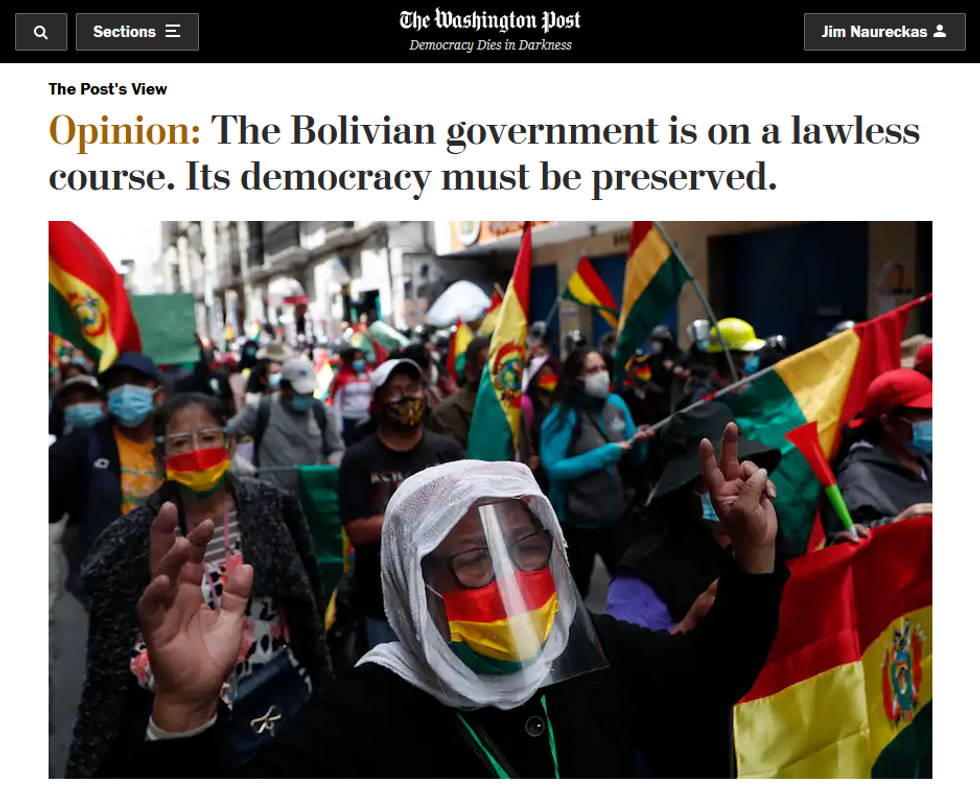
The Washington Post editorial board (3/18/21) came out with a wild defense of Anez, headlined: "The Bolivian Government Is on a Lawless Course. Its Democracy Must Be Preserved." Most ominously, the editorial said, "The Biden administration should lead a regional effort to preserve democratic stability in this long-suffering country, lest crisis turn into catastrophe." Informed people may laugh at this for a few seconds-until they remember that Bolivia's people could eventually face lethal US sanctions for daring to hold murderers to account. Left unchallenged, that's the catastrophe that propaganda like this could bring about.
Brutal dictators supported by Washington have no reason to doubt that establishment journalists and big NGOs will try very hard to keep them out of jail. Removing the threat of US -backed coups from the world will involve a constant struggle against Western media and the sources they present to us as reliable.

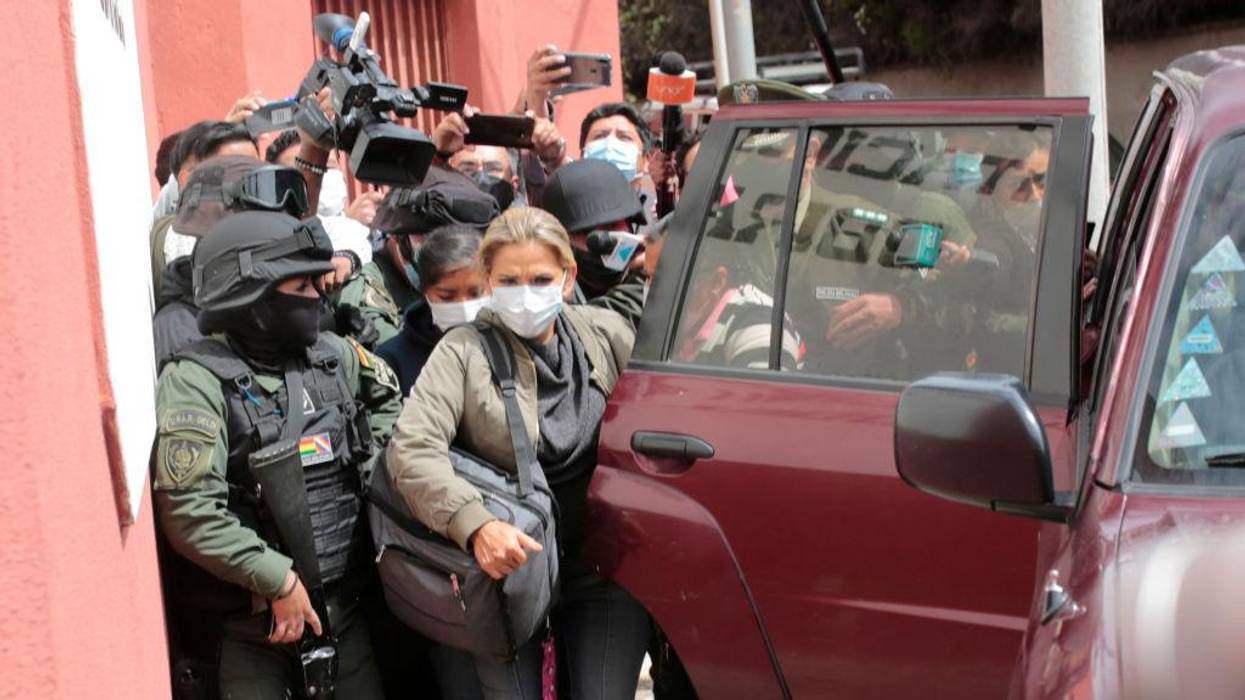
Far-right Bolivian politician Jeanine Anez was arrested Saturday on charges of terrorism and sedition for her role in the 2019 military coup that ousted former President Evo Morales and ushered in a brutal regime that violently repressed largely Indigenous pro-democracy protesters.
In November of 2019--days after Morales was forced by the nation's military to resign and flee the country over bogus claims of election fraud--Anez declared herself the interim president of Bolivia in violation of the country's constitution. The Trump administration, then in power in the U.S., applauded the military coup as it drew global condemnation.
What followed was a wave of deadly attacks by the Bolivian police and military against demonstrators who took to the streets to denounce the subversion of democracy and the illegitimate removal of the nation's first Indigenous leader.
But last October, as Common Dreams reported, Morales' Movement for Socialism (MAS) party--now headed by Luis Arce--prevailed in the country's closely-watched presidential election after the contest was twice postponed by the coup regime. Anez dropped out of the race in September after polling showed her in fourth place; her ally, Luis Camacho, ultimately came in third in the presidential election.
Early Saturday morning, Bolivian minister of government Carlos Eduardo del Castillo tweeted that Anez has "been apprehended and is currently in the hands of the police" after a warrant was issued for her arrest. Anez claimed she is a victim of "political persecution."
The Friday announcement of the warrant for Anez's arrest came after warrants were also issued for the former head of the armed forces and police, according to the Associated Press.
In a tweet Saturday morning, Morales declared that "the authors and accomplices of the dictatorship that looted the economy and attacked life and democracy in Bolivia" must "be investigated and punished."

While Democratic and Republican lawmakers, political pundits, and angered U.S. citizens of all stripes rightly condemned Wednesday's violent coup attempt by a pro-Trump mob in the nation's capital, at least one foreign government offered its sympathy to the victims of the assault while also pointing out that U.S.-backed efforts to subvert democracy abroad are all too common.
In the wake of the day's deadly mayhem at the U.S. Capitol building, the Venezuelan government issued a public statement expressing "concern with the acts of violence that are taking [place] in the city of Washington, D.C."
" Venezuela condemns the political polarization and the spiral of violence that only reflects the deep crisis that the political and social system of the United States is currently going through," the statement continues. "With this unfortunate episode, the United States is suffering the same thing that it has generated in other countries with its policies of aggression."
Juan Guaido, Venezuela's right-wing opposition figure who in 2019 oversaw a failed U.S.-backed coup attempt after the reelection of Venezuelan President Nicolas Maduro, became a flashpoint for commentators eager to shed light on the hypocrisy of U.S. lawmakers from both major parties who gave Guaido a standing ovation when the self-anointed leader was erroneously described by President Donald Trump during his 2020 State of the Union address as the "true and legitimate president of Venezuela."
Alluding to a viral photo of a Trump supporter triumphantly raising his fist in the U.S. Senate Chamber during Wednesday's anti-democratic insurrection, journalist Max Blumenthal of The Grayzone News said, "Imagine if a foreign power recognized this guy as president and you'll know how Venezuelans feel."
The Grayzone's Anya Parampil noted that Maduro opponent Carlos Vecchio "was welcomed in D.C. as Juan Guaido's ambassador," not long after "encouraging violence and attacks on government buildings in Venezuela."
The main difference between the Venezuelan opposition that has tried to violently overthrow Maduro since he was reelected and the so-called #StopTheSteal rioters who stormed the U.S. Capitol on Wednesday in an attempt to strip President-elect Joe Biden of his legitimate victory, Parampil added, is that corporate media "recognizes the danger in these actions when they're taking place in their own capital."
Others also drew links between the efforts of the pro-Trump mob and Washington's anti-Maduro forces, sardonically suggesting that some of Wednesday's actions may have been inspired by Guaido.
Critics lambasted Guaido for having the audacity to denounce Wednesday's attack on democracy in D.C., reminding the "self-proclaimed puppet" of Washington of the similarities between his unsuccessful, anti-democratic power grab in Venezuela and the chaotic events that unfolded in the U.S. on Wednesday.
Like Guaido, right-wing pundit Yascha Mounk also deemed it appropriate to opine on the coup attempt in D.C., denouncing "groups of armed nihilists attempt[ing] to destroy federal buildings that are key to the maintenance of the rule of law."
The only problem, journalist Ollie Vargas pointed out, is that when "this exact set of events (fascist mobs seizing public institutions) took place in Bolivia," Mounk celebrated the military coup that replaced then-president Evo Morales with a brutal right-wing regime, calling it--in true Orwellian fashion--a victory for democracy.
In an interview with teleSUR, political analyst Arnold August explained that while Wednesday's terrible events are relatively unprecedented in the U.S., "unfortunately, these scenes are not unprecedented when it comes to U.S. foreign policy."
"The chickens have come home to roost," August said. "It is not unprecedented in U.S. foreign policy to carry out coups far more violent than the one that is going on in Washington, D.C. at the moment." He listed several recent examples of countries, including Paraguay, Brazil, Venezuela, and Bolivia, whose leaders were overthrown after pursuing policies that run counter to the interests of the U.S. ruling class.
August suggested that U.S. lawmakers disturbed by the attempt of pro-Trump forces to undermine the democratic process in this nation should not support regime change "elsewhere in the world."
Officials in the Maduro administration concluded their statement by saying that "Venezuela hopes that soon the violence will cease and the American people can finally open a new path towards stability and peace."
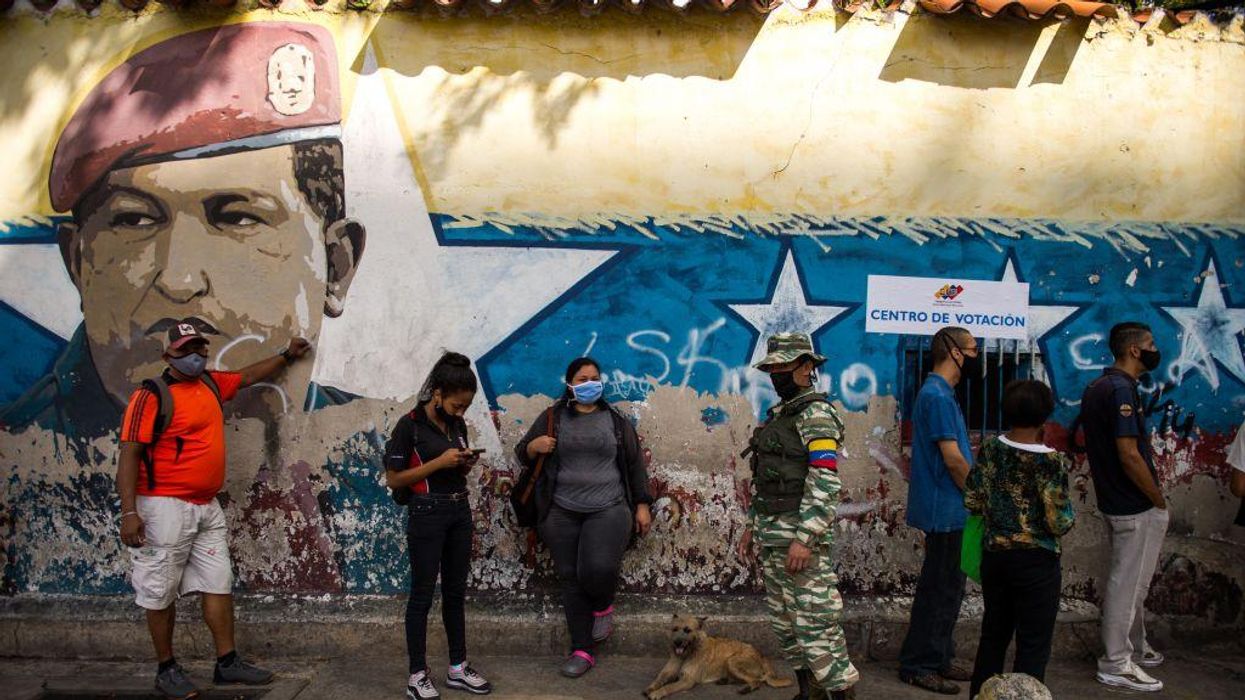
Originally published in Fire Time Newspaper, Volume 14, Issue 9-12 www.firethistime.net
The people of Venezuela have dealt another decisive blow against U.S. domination in Latin America. On December 6, 2020, more than 6.2 million Venezuelans voted for a new National Assembly in what was Venezuela's 25th election in the 21 years since the Bolivarian revolution began. Despite being under massive pressure from the U.S.-led war on Venezuela and the Covid-19 pandemic, the people of Venezuela went to the polls and delivered the National Assembly back into the service of the Bolivarian revolution.
As reported by the National Electoral Council, the United Socialist Party of Venezuela (PSUV), which is the political party of the revolutionary government of Venezuela, won 69% of the votes -- and 253 out of 277 seats in the assembly. The opposition party Accion Democratica, who received 7% of the votes and 11 seats followed in second place far behind. In total, there were 107 political parties represented in the election by more than 14,000 candidates. 98 of these political parties identify themselves as members of Venezuela's opposition, meaning that they do not support the government of President Nicolas Maduro. Sectors of Venezuela's pro-U.S., violent opposition, including the so called "interim President," of Venezuela Juan Guaido, boycotted the election.
Contrary to what has been reported in mainstream capitalist media, the international and national election observers confirmed that the December 6, 2020 National Assembly election was democratic, free and fair. Over 1500 international election observers witnessed the December 6 election. This included the Council of Latin American Electoral Experts and several former heads of state including Evo Morales of Bolivia, Rafael Correa of Ecuador, and Jose Luis Rodriguez Zapatero of Spain.
SURES, non-governmental human rights organization was appointed by the National Electoral Council (a branch of Venezuela's government that oversees elections), as the National electoral observers. As SURES states in their final report, "it is necessary to conclude that the people who participated in the electoral process exercised their human right to vote universally, freely, informed, secretly, without any coercion and under conditions of equality."
The International Observation Committee has also presented their findings, which included, "an increased citizen confidence in political organizations and candidates," as reported by Venezuela Analysis.
It is not surprising, however, that none of this information graced the pages of the Washington Post, the New York Times, any major Canadian media, or the major Television networks in the U.S. and Canada. The United States government and their allies, bent on maintaining their supremacy in Latin America, declared the Dec 6 elections in Venezuela "illegitimate," before they even began.
Question: "Democracy for Whom?" the U.S., and Venezuela Elections
Voter turnout was 31%, which is a victory considering the exceedingly difficult conditions imposed on Venezuela by the pandemic as well as U.S. led war, sanctions, and sabotage.
In their Bulletin No. 231, released following the elections, the PSUV correctly noted that for the U.S. government at their allies, "It would not be enough for 100% of the voters registered in the Permanent Electoral Registry to vote... because the legitimacy is not questioned in the legal arena, it is raised eminently in the political one. Their plan is to destroy the revolution, fragment the country and distribute it among the imperialist transnational corporations to recolonize the continent, and they will not cease their perverse plans against Venezuela and its revolutionary and Bolivarian government."
Venezuela's National Assembly elections were called by the government based on the 5-year election cycle established by the Constitution. Knowing this, the United States government, and their allies, including the government of Canada did not waste any time in their campaign of sabotage and interference in Venezuela's democratic process. In addition to the economic and financial blockade, threats of war and attempted invasions, military exercises funding the violent pro-U.S. opposition, and other such attacks, the U.S. government and their allies launched a targeted campaign meant to deter people in Venezuela from voting.
In March 2020 right-wing counterrevolutionaries calling themselves the "Venezuelan Patriotic Front" burned down a warehouse containing 50,000 electronic voting machines. This attack was reminiscent of other attacks on voting machines and equipment carried out by the violent U.S.- backed opposition between 2014-2017.
The Lima Group -- a collection of right-wing governments in Latin America spear-headed by the government of Canada, released a statement in October announcing that they, "Renew their support of President Juan Guaido and the National Assembly as legitimate and democratically elected authorities and highlight their evident will and commitment to contribute to the democratic transition, led by Venezuelans themselves, as the only way to achieve institutional, economic and social reconstruction in Venezuela." Far from original, this statement continues to parrot the Democratic Transition Framework for Venezuela, released in March by the U.S. State Department. Wherein, the United States government openly offers to provide the people of Venezuela relief from the economic war in exchange for the overthrow of President Maduro.
The day before the election, the Virtual Embassy of the United States in Venezuela (the verified account name includes the word "virtual" because the U.S. does not have an Embassy in Venezuela) sent a tweet advising people in Venezuela how to report allegations of fraud and encouraging people in Venezuela not to vote.
On top of this arrogant interference, people in Venezuela also went to the polls under the stress of the U.S. blockade of Venezuela. This illegal and inhumane policy is being wielded against the people of Venezuela as a form of collective punishment for choosing to break free from U.S. domination.
The United States, Canada, the European Union, and Switzerland have all imposed sanctions aiming to coerce the people of Venezuela into overthrowing the democratically elected government of President Maduro and reverse the gains of the Bolivarian revolutionary process.
Beginning with President Obama in 2015, when Venezuela was declared a, "threat to U.S. national security," the U.S. government has unleashed a brutal regime of sanctions against Venezuela through Congressional laws, Executive Orders, and 300 administrative measures. These sanctions make it virtually impossible for Venezuela to conduct typical business transactions, cutting Venezuela off from food, medicines, and numerous other basic goods, machinery and technology. They have also enabled the theft of billions of dollars from Venezuela. This includes funds which have been frozen in bank accounts throughout the United States and Europe, and exceptions have not been made for those being transferred for the payment of lifesaving medicines.
The Center for Economic Policy Research (CEPR) has estimated that these sanctions on Venezuela killed 40,000 people between 2017-2018 alone. Since that time, the strangle-hold of the United States on the Venezuelan economy has grown tighter.
On December 6, people of Venezuela mobilized for the election and cast their votes knowing that the sanctions and war against Venezuela would continue, and perhaps even worsen. However, they also did so knowing the importance of defending their sovereignty and self-determination by once again defying the orders coming from Washington DC.
Viva Bolivia! Viva Venezuela! Failure of US and Imperialist Intervention in Latin America
On October 18, 2020, the people of Bolivia secured a resounding victory against a violent U.S.-backed coup d'etat that removed President Evo Morales almost one year earlier. On this day, the heroic people of Bolivia elected Luis Arce and David Choquehuanca of the Movement to Socialism (MAS) as the President and Vice President of the Plurinational State of Bolivia.
This great victory was due to the courageous resistance of the people of Bolivia. By electing a progressive leftist government, the mainly poor Indigenous Bolivians who believed in the revolutionary ideals and leadership of MAS and Evo Morales reversed the tremendous effort of the United States to destroy the progressive process in Bolivia. Without the heroic resistance of Bolivia's oppressed people and working class to rightwing coup government and their resistance to imperialism, this victory would not have been possible.
The successful continuity of two decades of Venezuelan Bolivarian revolutionary process has turned Venezuela into the backbone of the Latin American anti-imperialist and revolutionary movement.
However, it should also not be forgotten that the continuation of the Bolivarian revolution, its dynamic and its impact was also a driving factor of keeping the anti-imperialist movement strong and resilient in Bolivia. The resistance of the Bolivarian revolutionary people of Venezuela to U.S. domination maintains and nourishes the anti-imperialist spirit in Bolivia and Latin America. In this sense, it is like a resonating core of resistance and defense against U.S. aggression. The successful continuity of two decades of Venezuelan Bolivarian revolutionary process has turned Venezuela into the backbone of the Latin American anti-imperialist and revolutionary movement.
We have seen how, over the last few years, the United States and their right-wing allies have consolidated some of their forces in Latin America, for example with the election of Bolsonaro in Brazil in 2018. However, the victory in Bolivia has reminded poor, working and oppressed people around the world that this reactionary backlash was just a pause. The progressive and revolutionary movement in Latin America has continued, and even with a partial set-back the United States and their imperialist allies cannot win.
Throughout Latin America, poor masses, the working class and young people are rising--in response to the deepening crisis imposed upon them by U.S. imperialist domination and neo-Liberal governments.Over the past two years, the landscape is shifting, and one can observe how people are moving to the left in South America -- Argentina, Chile, Peru, Ecuador, and Colombia.
It is also significant that since the beginning of the Bolivarian revolutionary process until today, the United States has failed to isolate Venezuela from the rest of the world. Despite the inhuman and criminal unilateral sanctions imposed on them, Venezuela continues to have economic and cooperative relationships with other developing countries, especially those that have also been targeted by the U.S. government. This too, demonstrates to the rest of poor, working and oppressed people in Latin America that there is a possibility for continued development without relying on the United States, the World Bank, and International Monetary Fund (IMF).
Although the severe impact of the U.S. economic war on Venezuela cannot be completely mitigated, there are several examples of the ways that the government of Venezuela has lessened the impact on the people of Venezuela.
For example, the Russian Vaccine Sputnik V is undergoing phase 3 trials in Venezuela today. Venezuela has received more than 274 tons of medicines, medical supplies and medical equipment from China to assist in their struggle against the pandemic. Venezuela and Cuba have also continued to expand their cooperation, especially through the presence of Cuban doctors in Venezuela that have contributed to the development of Venezuela's free and universal healthcare system.
Since May 2020, Iran has also been sending tankers of gasoline to relieve the severe shortages in Venezuela brought on by U.S. sanctions aimed at destroying Venezuela's oil industry. Ten tankers are currently on their way to Venezuela, following three that arrived in October.
In this way, the people of Venezuela and the Bolivarian revolutionary government are breaking the economic sanctions by expanding friendship with other nations, especially those that are also facing severe U.S. sanctions themselves. They learned many good lessons from the example of revolutionary Cuba. With the belief and practice of revolutionary internationalism and cooperation with oppressed nations and countries, revolutionary socialist Cuba set an example for a successful anti-imperialist struggle. For whomever is interested in fighting Yankee imperialism, the example of the people of Cuba, Venezuela and the Bolivarian revolutionary process shows that this is possible, that there is an alternative to staying under the domination and pressure of the United States.
Build the Movement in Solidarity with Venezuela Today and Tomorrow
The blow that the people of Venezuela have dealt to the domination of the United States and their imperialist allies in Latin America also gives a boost to those fighting against the war at home. Poor, working and oppressed people within the "belly of the beast," are in a better position to fight for their rights when the beast is wounded. On February 19, 2019 the Foreign Minister of Venezuela Jorge Arreaza tweeted, "The time and resources that these imperialist gentlemen spend on Bolivarian Venezuela can only mean one thing: like 200 years ago, today we are also at the geopolitical epicenter of the multipolar world in the making #HandsOffVenezuela"
Anti-imperialists and fighters for liberation must have a sense for the accuracy of Arreaza's analysis. However, it is also good that we take this further, that we understand Venezuela not just as epicentre, but also the critical point for the anti-imperialist movement in Latin America. The success and progress of the whole anti-imperialist, anti-Yankee domination movement in Latin America is dependent on the resistance of the people of Venezuela. The continuation of the Bolivarian revolutionary process is the necessity for the road to freedom in Latin America.
Thus, defending Venezuela is a central task for anti-imperialists and anyone who believes that a better and just world is not only necessary, but possible. We must see with clarity that standing for Venezuela's sovereignty and self-determination is not a question of defending progressive causes, the left or socialists. Let's not get distracted. The continuity of the Bolivarian revolutionary process is the critical point for revolution and counter-revolution in Latin America and it is directly related to defending a new movement of working and oppressed people in Latin America. Anyone who believes that defeating imperialism in Latin America is an essential task will support Venezuela.
There is no doubt that the new U.S. Biden Administration understands this just as well as President Trump's. When the new Venezuelan National Assembly takes office on January 5, 2020 -- they will cement the victory of the December 6 elections and begin to further the Bolivarian revolutionary process.
As people living in the United States and Canada, and around the world, we must also take on a new responsibility--and redouble our efforts to end the U.S. blockade and war on Venezuela!
In the words of Comandante Hugo Chavez "Let the dogs of the empire bark, that's their job; ours is to battle to achieve the true liberation of our people."
This article was distributed by the Independent Media Institute, and published by Raw Story and AlterNet on December 21, 2020.
In recent weeks, Donald Trump has been ridiculed, slathered with contempt, and repeatedly branded a "liar," as well as an existential threat to democracy in the United States, by the biggest media outlets in the country. This is in response to his attempts to reverse the results of the US presidential election, and claiming -- without evidence -- that it was stolen. He still clings to these allegations, but he will be leaving the White House on January 20th.
But just over a year ago, a similar effort was launched in Bolivia, and it actually prevailed. The country's democratically elected president, Evo Morales, was toppled three weeks after the October 20 vote, before his term was finished. He left the country after the military "asked" him to resign.
The similarities are remarkable. Leaders of the Bolivian opposition indicated before the votes were counted, as Trump did, that they would not accept the result if they lost. Like Trump, they had no evidence for their allegations of fraud when the votes were counted. And as with Trump, the falseness of their charges was obvious from day one.
Some readers may question the relevance of the comparison with a developing country whose democratic institutions have a shorter history, and are in important ways weaker than those in the US government. But the Bolivian right would not have succeeded, where Trump has failed, if not for another important difference: the Bolivian right had powerful help from outside the country in pulling off their coup.
Not surprisingly some of this help came from the Trump administration, which stated the day after the coup that "Morales's departure preserves democracy and paves the way for the Bolivian people to have their voices heard."
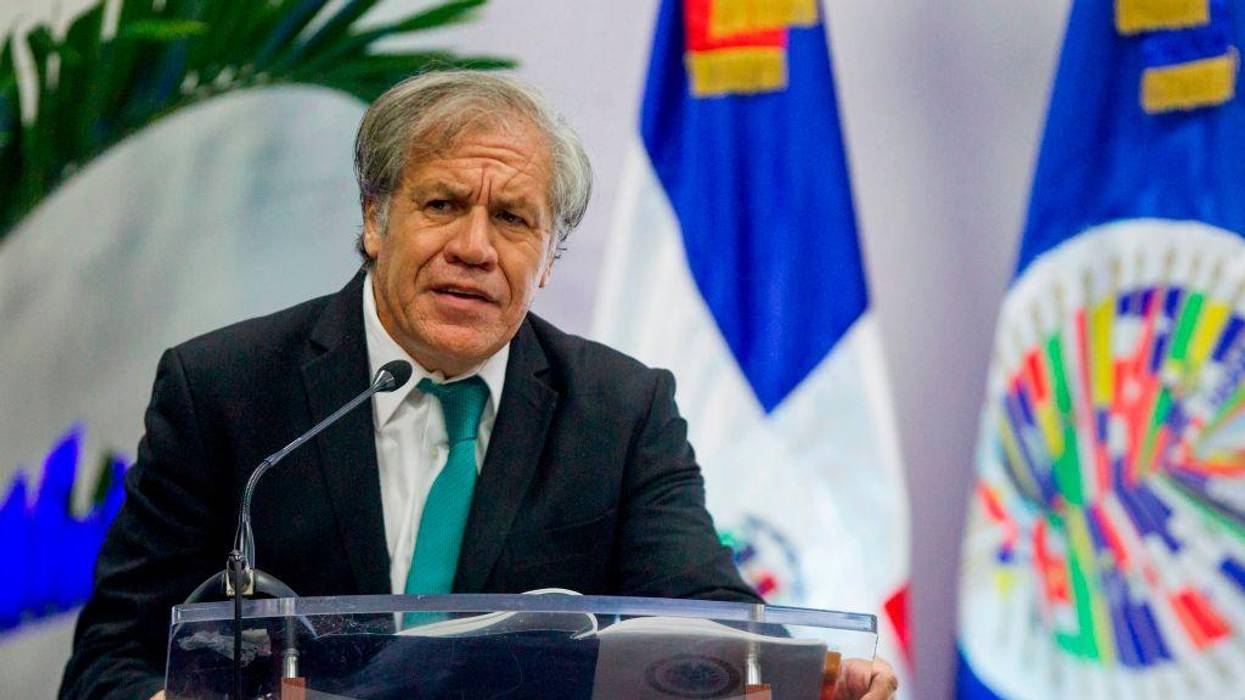
Even more important help came from the Organization of American States (OAS), which, not coincidentally, gets 60 percent of its funding from the United States. The OAS also currently has a leader, Luis Almagro, who at the time of Bolivia's election needed the support of Trump and his allied right-wing governments in the Americas in order to be reelected as the head of the organization. The OAS issued a statement the day after the election, expressing "deep concern and surprise at the drastic and hard-to-explain change in the trend of the preliminary results."
This allegation turned out to be "false," as the New York Times would later report; but as the Times noted, this false allegation "changed the South American nation's history." It changed history because it served as the political foundation for the military coup on November 10, 2019.
Another similarity: remember when Trump and his Republican allies were saying that the Democrats were "stealing" the election here because the later, mostly mail-in votes were coming in overwhelmingly from Democrats? Of course this was false; the truth was simply that more Democrats than Republicans were voting by mail.
Like the effort of Trump in the United States -- as seen in the recent Republican attempt to throw out hundreds of thousands of votes from Detroit, Michigan, where nearly 80 percent of residents are Black -- the assault on democracy in Bolivia is also tied to systemic racism.
The OAS allegation in Bolivia was the same: for various reasons -- including geography -- votes in the pro-Morales areas came in later than those for the opposing candidates. This was obvious from the day after the election by simply looking at the areas where the earlier and later votes were coming from; the data was all on the web. That's why 133 economists and statisticians from various countries -- the majority from the United States -- signed a letter demanding that the OAS retract its false statements.
That's why four members of the US Congress asked the OAS if they ever considered the possibility -- which amazingly was not mentioned in three more OAS reports--that the later-reporting precincts were politically different from the earlier ones.
It's been a year, and the OAS still hasn't answered.
In October, the de facto government, which took power after last year's coup, held elections, after postponing them twice. Luis Arce, Evo Morales's economy minister for 13 years, won by a margin of more than 26 percentage points.
But the people killed by the post-coup government, including at least 22 people killed in two massacres committed by security forces, cannot be brought back to life. The victims were all Indigenous.
Like the effort of Trump in the United States -- as seen in the recent Republican attempt to throw out hundreds of thousands of votes from Detroit, Michigan, where nearly 80 percent of residents are Black -- the assault on democracy in Bolivia is also tied to systemic racism.
Evo Morales is the first Indigenous president in a country with the largest percent of Indigenous population in the Americas, who have overwhelmingly supported him and his party; the leaders of the coup are infused with white supremacists and seek to restore the dominance of the mostly white elite who ruled the country before Morales was first elected in 2005.
US Representatives Jan Schakowsky and Jesus "Chuy" Garcia, both of Chicago, have called for Congress to investigate the role of the OAS in Bolivia following the 2019 election.
This is vitally important, because the coup, and the violence and political repression that followed, might never have happened without the OAS's pivotal role. Perhaps most importantly, the OAS had an enormous impact on the international and domestic media, with many journalists mistakenly believing that the OAS Electoral Observation Mission was impartial, and that therefore their allegations were true.
But the Bolivian coup is not the first time that the OAS has abused its authority as an electoral observer, in order to support a US-backed effort to topple a democratically elected government. This happened in Haiti between 2000 and 2004. And also in Haiti, the OAS did something in 2011 that perhaps no election observers had ever done: they reversed the results of a first-round presidential election, without even a recount or a statistical analysis.
The OAS and its leadership must be held accountable, or these crimes will keep happening.

Evo Morales was welcomed back to Bolivia on Monday morning, surrounded by the thunderous cheers of thousands of supporters who took part in a joyous celebration filled with music.
Morales' return comes one year after the former president of the Latin American country was forced into exile by a violent far-right regime that was installed via a military coup, which was facilitated by unsubstantiated claims of electoral fraud made by the U.S.-dominated Organization of American States (OAS) and condoned by corporate media outlets.
It also comes one day after Bolivian President Luis Arce, Morales' ally in the Movement for Socialism (MAS) party, was inaugurated following his election last month, considered a repudiation of authoritarianism and imperialism.
Massive crowds gathered in Villazon, a southern town that borders La Quiaca, Argentina, to greet Morales upon his return to Bolivia from the neighboring country, where the popular leftist leader had spent most of the past twelve months as a political refugee.
"Today is an important day in my life. Returning to my homeland, which I love so much, fills me with joy," Morales tweeted early Monday morning, prior to crossing the border with Argentinian President Alberto Fernandez.
Morales was not the only person who was ecstatic about his homecoming. Journalist Ollie Vargas shared a video on social media of Bolivians dancing in Villazon on Sunday night in anticipation of Morales' return.
On Monday morning, thousands of Bolivians gathered to welcome Morales back to the country.
Moments before Morales' return, Camila Escalante, a reporter with teleSUR English, called it a "historic day for the people of Bolivia and our continent." Morales, she noted, will "be received by the very social movements who defeated the coup and restored democracy."
Kawsachun News captured the scene as Morales crossed the border.
"I am very grateful to the Bolivian people for receiving me with such affection," Morales tweeted soon after his return.
According to teleSUR English, Morales, accompanied by Fernandez, will embark on a tour of Bolivia this week and is scheduled to arrive in the city of Cochabamba on Wednesday.

Less than a year after the United States and the U.S.-backed Organization of American States (OAS) supported a violent military coup to overthrow the government of Bolivia, the Bolivian people have reelected the Movement for Socialism (MAS) and restored it to power.
In the long history of U.S.-backed "regime changes" in countries around the world, rarely have a people and a country so firmly and democratically repudiated U.S. efforts to dictate how they will be governed. Post-coup interim president Jeanine Anez has reportedly requested 350 U.S. visas for herself and others who may face prosecution in Bolivia for their roles in the coup.
The narrative of a rigged election in 2019 that the U.S. and the OAS peddled to support the coup in Bolivia has been thoroughly debunked. MAS's support is mainly from indigenous Bolivians in the countryside, so it takes longer for their ballots to be collected and counted than those of the better-off city dwellers who support MAS's right-wing, neoliberal opponents.
As the votes come in from rural areas, there is a swing to MAS in the vote count. By pretending that this predictable and normal pattern in Bolivia's election results was evidence of election fraud in 2019, the OAS bears responsibility for unleashing a wave of violence against indigenous MAS supporters that, in the end, has only delegitimized the OAS itself.
It is instructive that the failed U.S.-backed coup in Bolivia has led to a more democratic outcome than U.S. regime change operations that succeeded in removing a government from power. Domestic debates over U.S. foreign policy routinely presume that the U.S. has the right, or even an obligation, to deploy an arsenal of military, economic and political weapons to force political change in countries that resist its imperial dictates.
In practice, this means either full-scale war (as in Iraq and Afghanistan), a coup d'etat (as in Haiti in 2004, Honduras in 2009 and Ukraine in 2014), covert and proxy wars (as in Somalia, Libya, Syria and Yemen) or punitive economic sanctions (as against Cuba, Iran and Venezuela) - all of which violate the sovereignty of the targeted countries and are therefore illegal under international law.
No matter which instrument of regime change the U.S. has deployed, these U.S. interventions have not made life better for the people of any of those countries, nor countless others in the past. William Blum's brilliant 1995 book, Killing Hope: U.S. Military and CIA Interventions Since World War II, catalogues 55 U.S. regime change operations in 50 years between 1945 and 1995. As Blum's detailed accounts make clear, most of these operations involved U.S. efforts to remove popularly elected governments from power, as in Bolivia, and often replaced them with U.S.-backed dictatorships: like the Shah of Iran; Mobutu in the Congo; Suharto in Indonesia; and General Pinochet in Chile.
Even when the targeted government is a violent, repressive one, U.S. intervention usually leads to even greater violence. Nineteen years after removing the Taliban government in Afghanistan, the United States has dropped 80,000 bombs and missiles on Afghan fighters and civilians, conducted tens of thousands of "kill or capture" night raids, and the war has killed hundreds of thousands of Afghans.
In December 2019, the Washington Post published a trove of Pentagon documents revealing that none of this violence is based on a real strategy to bring peace or stability to Afghanistan - it's all just a brutal kind of "muddling along," as U.S. General McChrystal put it. Now the U.S.-backed Afghan government is finally in peace talks with the Taliban on a political power-sharing plan to bring an end to this "endless" war, because only a political solution can provide Afghanistan and its people with the viable, peaceful future that decades of war have denied them.
In Libya, it has been nine years since the U.S. and its NATO and Arab monarchist allies launched a proxy war backed by a covert invasion and NATO bombing campaign that led to the horrific sodomy and assassination of Libya's long time anti-colonial leader, Muammar Gaddafi. That plunged Libya into chaos and civil war between the various proxy forces that the U.S. and its allies armed, trained and worked with to overthrow Gaddafi.
A parliamentary inquiry in the U.K. found that, "a limited intervention to protect civilians drifted into an opportunist policy of regime change by military means," which led to "political and economic collapse, inter-militia and inter-tribal warfare, humanitarian and migrant crises, widespread human rights violations, the spread of Gaddafi regime weapons across the region and the growth of Isil [Islamic State] in north Africa."
The various Libyan warring factions are now engaged in peace talks aimed at a permanent ceasefire and, according to the UN envoy "holding national elections in the shortest possible timeframe to restore Libya's sovereignty"--the very sovereignty that the NATO intervention destroyed.
Senator Bernie Sanders' foreign policy adviser Matthew Duss has called for the next U.S. administration to conduct a comprehensive review of the post-9/11 "War on Terror," so that we can finally turn the page on this bloody chapter in our history.
Duss wants an independent commission to judge these two decades of war based on "the standards of international humanitarian law that the United States helped to establish after World War II," which are spelled out in the UN Charter and the Geneva Conventions. He hopes that this review will "stimulate vigorous public debate about the conditions and legal authorities under which the United States uses military violence."
Such a review is overdue and badly needed, but it must confront the reality that, from its very beginning, the "War on Terror" was designed to provide cover for a massive escalation of U.S. "regime change" operations against a diverse range of countries, most of which were governed by secular governments that had nothing to do with the rise of Al Qaeda or the crimes of September 11th.
Notes taken by senior policy official Stephen Cambone from a meeting in the still damaged and smoking Pentagon on the afternoon of September 11, 2001 summarized Secretary of Defense Rumsfeld's orders to get "...best info fast. Judge whether good enough hit S.H. [Saddam Hussein] at same time - not only UBL [Osama Bin Laden]... Go massive. Sweep it all up. Things related and not."
At the cost of horrific military violence and mass casualties, the resulting global reign of terror has installed quasi-governments in countries around the world that have proved more corrupt, less legitimate and less able to protect their territory and their people than the governments that U.S. actions removed. Instead of consolidating and expanding U.S. imperial power as intended, these illegal and destructive uses of military, diplomatic and financial coercion have had the opposite effect, leaving the U.S. ever more isolated and impotent in an evolving multipolar world.
Today, the U.S., China and the European Union are roughly equal in the size of their economies and international trade, but even their combined activity accounts for less than half of global economic activity and external trade. No single imperial power economically dominates today's world as overconfident American leaders hoped to do at the end of the Cold War, nor is it divided by a binary struggle between rival empires as during the Cold War. This is the multipolar world we are already living in, not one that may emerge at some point in the future.
This multipolar world has been moving forward, forging new agreements on our most critical common problems, from nuclear and conventional weapons to the climate crisis to the rights of women and children. The United States' systematic violations of international law and rejection of multilateral treaties have made it an outlier and a problem, certainly not a leader, as American politicians claim.
Joe Biden talks about restoring American international leadership if he is elected, but that will be easier said than done. The American empire rose to international leadership by harnessing its economic and military power to a rules-based international order in the first half of the 20th century, culminating in the post-World War II rules of international law. But the United States has gradually deteriorated through the Cold War and post-Cold War triumphalism to a flailing, decadent empire that now threatens the world with a doctrine of "might makes right" and "my way or the highway."
When Barack Obama was elected in 2008, much of the world still saw Bush, Cheney and the "War on Terror" as exceptional, rather than a new normal in American policy. Obama won the Nobel Peace Prize based on a few speeches and the world's desperate hopes for a "peace president." But eight years of Obama, Biden, Terror Tuesdays and Kill Lists followed by four years of Trump, Pence, children in cages and the New Cold War with China have confirmed the world's worst fears that the dark side of American imperialism seen under Bush and Cheney was no aberration.
Amid America's botched regime changes and lost wars, the most concrete evidence of its seemingly unshakeable commitment to aggression and militarism is that the U.S. Military-Industrial Complex is still outspending the ten next largest military powers in the world combined, clearly out of all proportion to America's legitimate defense needs.
So the concrete things we must do if we want peace are to stop bombing and sanctioning our neighbors and trying to overthrow their governments; to withdraw most American troops and close military bases around the world; and to reduce our armed forces and our military budget to what we really need to defend our country, not to wage illegal wars of aggression half-way round the world.
For the sake of people around the world who are building mass movements to overthrow repressive regimes and struggling to construct new models of governing that are not replications of failed neoliberal regimes, we must stop our government--no matter who is in the White House--from trying to impose its will.
Bolivia's triumph over U.S.-backed regime change is an affirmation of the emerging people-power of our new multipolar world, and the struggle to move the U.S. to a post-imperial future is in the interest of the American people as well. As the late Venezuela leader Hugo Chavez once told a visiting U.S. delegation, "If we work together with oppressed people inside the United States to overcome the empire, we will not only be liberating ourselves, but also the people of Martin Luther King."
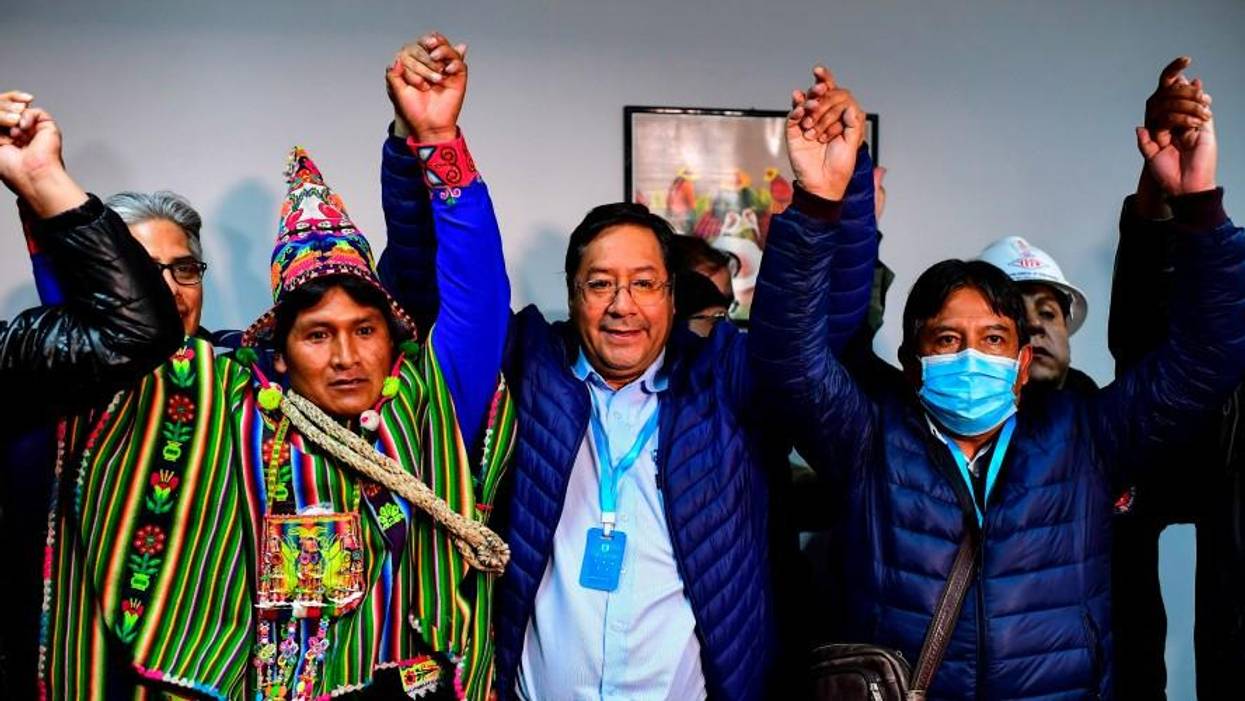
Bolivia's Movement Towards Socialism (MAS) party won a decisive victory in the country's presidential elections on Sunday, with its candidate Luis Arce apparently winning by a large enough margin to avoid a runoff, likely achieving an absolute majority. The leading opposing candidate, neoliberal Carlos Mesa, and the right-wing unelected President Jeanine Anez congratulated Arce on his victory.
Some in US corporate media, however, failed to describe what was really going on in the country.
When the Wall Street Journal (10/19/20) reported on the MAS victory, for example, it kept to the usual line (FAIR.org, 11/11/19, 11/18/20) about the previously elected president from MAS, Evo Morales, having been "driven from power" in November 2019 after "an election that observers said was marred by irregularities"--avoiding referring directly to Morales' military overthrow as a "coup." Instead, the Journal wrote that "Bolivians rose up against Mr. Morales" after he "had grown increasingly authoritarian" and already "ruled" for 14 years.
First off, to say that Morales "ruled" in his country is about as accurate as saying that Barack Obama "ruled" the United States from 2009-17. Until Morales' ouster, Bolivia was (and hopefully will again be) a functioning democracy. Trying to paint democratically elected leaders as dictatorial autocrats is a time-honored US tradition going back at least as far as Jacobo Arbenz in Guatemala, removed in a CIA-backed invasion in 1954.
The "irregularities" mentioned are a reference to an analysis by the Organization of American States (OAS), an institution that gets 60% of its budget from the United States. Its analysis, released immediately after the election, expressed "deep concern" about a "hard-to-explain change in the trend of the preliminary results." Their analysis was immediately challenged by the Center for Economic and Policy Research (CEPR), a progressive DC-based think tank, which noted that the OAS provided "absolutely no evidence--no statistics, numbers or facts of any kind"--to support its conclusions. (See CounterSpin, 7/31/20.) The study was later fully debunked, as reported by both the Washington Post (2/27/20), which wrote that "the OAS's statistical analysis and conclusions would appear deeply flawed," and the New York Times (6/7/20), which came to similar conclusions (FAIR.org, 3/5/20, 7/8/20). The Wall Street Journal neglected to mention any of this in its reporting.
To say that "Bolivians rose up" against Morales is true only in the narrow technical sense that the coup leaders that forced the president's removal were from Bolivia. In fact, the situation was far more complicated. After a month-long delay in the vote count, the OAS statement and right-wing protests against the president, military leaders forced Morales to step down from office and flee the country. Morales eventually took refuge in Argentina, barred from returning to Bolivia due to terrorism charges that Human Rights Watch describes as "politically motivated."
Jeanine Anez, a member of a far-right party that won just 4% during elections, declared herself the interim president, violently repressing those who protested the move (FAIR.org, 12/13/19). The US State Department supported Anez's ascension. At the time, the Wall Street Journal (11/11/19) described these incidents as "a democratic breakout."
Anez then began to sell off public resources and take out massive international loans on behalf of the nation. Over the next year, her government delayed elections three times (FAIR.org, 8/6/20) until an unprecedented general strike forced the government to agree to an election. Despite all of this, the Journal and other outlets described the coup regime benignly as a "caretaker government."
The Associated Press (10/18/20) ran a story reprinted by the Washington Post (10/18/20) that had many of the same omissions as the Wall Street Journal piece, describing the coup against Morales as a "resignation" followed by a "self-exile," and ignoring US support.
The New York Times (10/19/20) published a piece that was more sympathetic to Morales and his party, but still contained several critical omissions. The Times cited MAS's popular support as well as its success in reducing Bolivia's poverty. Their piece cited Morales describing his ouster and the violence that followed as a
"coup," and did not dispute it.
However, in describing his departure from the country, the Times neglected to mention that Morales was under threat of arrest. After reading that Morales merely "fled the country," a reader may assume that it was more voluntary than it was. The Times also failed to mention the election's repeated delays and the general strike that finally brought it into existence.
The Washington Post (10/18/20) did a better job capturing the situation, describing how the right wing "drove the left from power" last year. They wrote that Morales' supporters called it a coup, but placed "coup" in quotation marks and linked to a Post piece (11/11/19) headlined "After Morales Resignation, a Question for Bolivia: Was This the Democratic Will or a Coup?" The Post's post-election piece reported on the many delays as well as the US support for Anez.
The next day, the Post (10/20/20) published a piece that said "Bolivia's democracy...has delivered Morales's movement back to power," and noted positively that "Arce's victory adds to the sense of momentum behind socialist or left-leaning politics elsewhere in the region."
It may seem surprising that so much reporting on Bolivia still ignores facts that are critical to understanding the situation there, but US media have a long history of reporting on Latin America that does more to please the State Department than to inform readers.
Imagine the following nightmare: The United States faces a close vote in the presidential election. Trump claims voter fraud and seeks backing from the nation's military, who then stage a coup to keep him in power.
Farfetched? The Trump Administration already did it in Bolivia last year.
"If the far right in Bolivia is more democratic than Trump," Field says, "we're in deep trouble."
In October 2019, officials in Washington, D.C., orchestrated phony claims of election fraud by Bolivia's socialist government. The military forced the winner, President Evo Morales, to flee the country. It then installed an ultra-right regime that carried out civilian massacres and arrested opponents on trumped up charges.
But the people of Bolivia never accepted the coup regime and on October 18 voted overwhelmingly to elect Luis Arce Catacora of the leftist Movement Towards Socialism (MAS), the party founded by Morales. Arce easily surpassed conservative, former president Carlos Mesa and far-right candidate Luis Fernando Camacho.
Thomas Field, associate professor Global Security and Intelligence at Arizona's Embry-Riddle Aeronautical University, tells me the United States can learn from Bolivia's 2019 election. The coup leaders claimed fraud based on a preliminary count and rejected the final count that included late reports from rural areas.
"You have to wait until all the votes are counted," he says. "Late votes matter."
In Bolivia, opposition parties accepted the 2020 election results, even the ultra-right wingers. Trump, however, has refused to agree to a peaceful transfer of power if he loses.
"If the far right in Bolivia is more democratic than Trump," Field says, "we're in deep trouble."
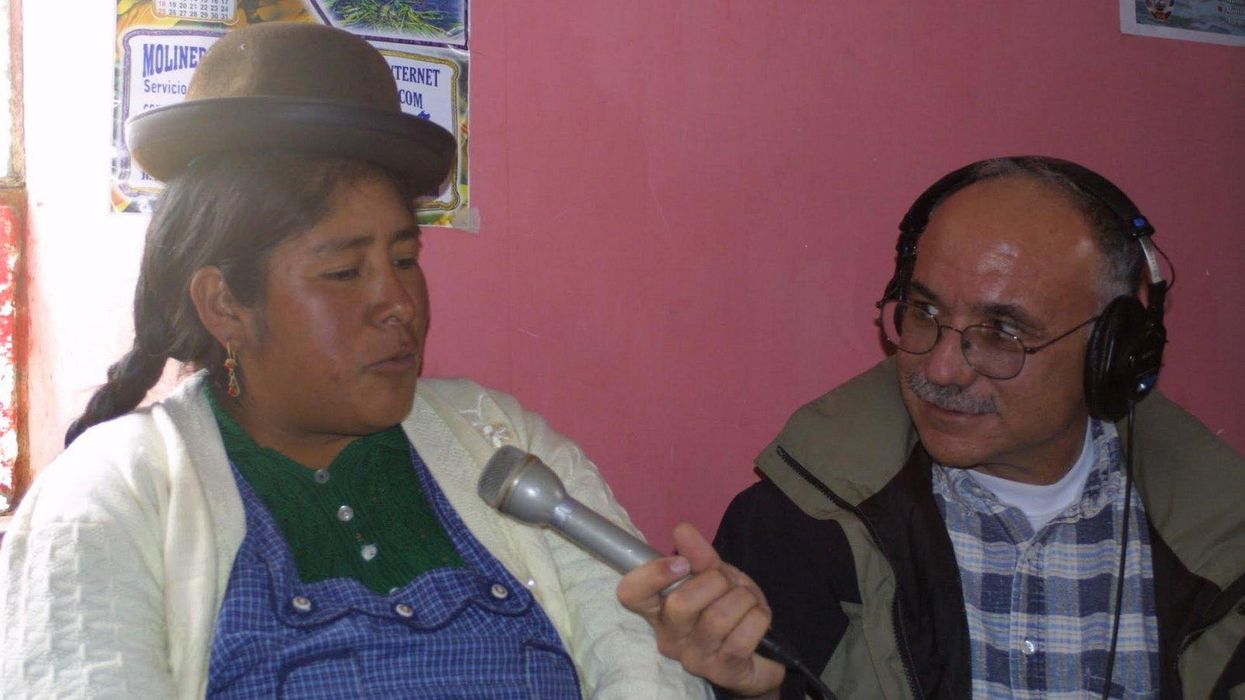
During a 2008 trip to Bolivia on assignment for NPR's Latino USA, I covered attempts by right-wingers to oust Morales through a referendum. But he defeated the effort and was later reelected president three times.
In October 2019, Morales ran for a fourth term. The official vote count showed he beat his closest opponent by just over 10 percent. In response, the Organization of American States (OAS) insisted that a major discrepancy between the preliminary quick count and the final tally showed Morales couldn't have won. The opposition claimed fraud.
The military backed street demonstrations in middle- and upper-class neighborhoods, and forced Morales to resign. He fled the country and took exile in Argentina.
But the OAS attack on the elections quickly fell apart. As two election specialists wrote in The Washington Post, "the statistical evidence does not support the claim of fraud in Bolivia's October [2019] election."
Jake Johnston, a senior research associate at the Center for Economic and Policy Research in Washington, D.C., wrote an eighty-five-page analysis of the 2019 elections.
"The OAS grossly misrepresented the facts," he tells me in an interview. The organization manipulated the data in order to reach "a political conclusion aimed at justifying the removal of a democratically elected president."
According to the Los Angeles Times, U.S. Ambassador to the OAS Carlos Trujillo played a key role in "steering" the OAS "to report widespread fraud and pushed the Trump Administration to support the ouster of Morales."
The ruling elite in Washington, D.C., has long opposed the socialist policies of Bolivia for economic and geopolitical reasons. The MAS government established close relations with Cuba, Venezuela, and other leftist governments in Latin America. Bolivia is rich in natural gas and contains 70 percent of the world's lithium, a key mineral used in electric car batteries.
MAS sought to break the traditional model of foreign corporations extracting minerals and shipping them abroad. Morales wanted to generate jobs by manufacturing lithium batteries and started a pilot project to make electric cars.
The new government faces serious problems when it comes into office next month. The country is reeling from an international recession, low commodity prices and a spreading coronavirus pandemic.
After the coup, however, the regime wanted to return to the old extractive model and wooed Elon Musk, founder of the Tesla electric car company. Musk publicly supported the coup.
In a twitter exchange, Musk wrote, "We will coup whoever we want! Deal with it."
MAS, which was first elected in 2006, produced impressive economic gains. Extreme poverty dropped from 36 to 17 percent. The socialists introduced a universal old age pension program and cut unemployment by 50 percent.
Bolivia went from being the second-poorest country in South America to a lower-middle tier country, according to an analysis by the World Bank.
For the first time in Bolivia's history, the country's Indigenous people saw significant economic improvements and steps towards political empowerment. In 2009, a new constitution provided rights for the country's thirty-six Indigenous groups, including equal status for their judicial systems and government courts.
International election observers agreed that the October 18 vote was free and fair. All of the ballots were counted in public, according to Leonardo Flores, an official election observer and member of the U.S.-based group Code Pink. And the vote tally was posted publicly at all precincts, allowing for a quick count of the ballots.
"These elections are much more transparent than in the United States," he tells me in a phone interview from the capital city of La Paz, Bolivia.
As of press time, Arce was ahead with 52 percent of the vote, a twenty-point lead over his closest rival, Carlos Mesa.
MAS won the election, according to Bolivia expert Field, by mobilizing its strong, traditional base and picking up support from those disgusted with the coup regime.
The coup leaders carried out brutal massacres against the opposition when they came to power in 2019, and gave security forces immunity from prosecution.
"It will go down in history as one of the most brutal regimes in decades," Field says.
Flores adds, "This was very much a vote against fascism and a vote for socialism."
Flores notes that MAS is not a traditional political party because it works closely with grassroots unions, peasant associations, and neighborhood groups--all of which promise to keep pressure on the new MAS government to maintain progressive policies.
Flores describes a recent meeting in which members of the Women's Alliance criticized what they considered the demobilization of the social movements prior to the coup. Leftist street demonstrations had largely stopped during the Morales presidency, the women said, but, as one activist put it, "We will be willing to go to the streets now."
MAS will have to revamp the institutions that provided unemployment, welfare, and pensions.
President Arce promises to re-nationalize key industries as a means of raising government funds. "We need public companies and also solid tax revenues to guarantee all the social programs we have," he said in April.
Meanwhile, Flores hopes people in the United States learn the lessons of Bolivia.
If Trump tries to stay in power despite losing the election, Flores says, "Lawsuits and speeches by Democratic Party leaders" won't be enough. "You have to organize and take to the streets."