SUBSCRIBE TO OUR FREE NEWSLETTER
Daily news & progressive opinion—funded by the people, not the corporations—delivered straight to your inbox.
5
#000000
#FFFFFF
To donate by check, phone, or other method, see our More Ways to Give page.

Extreme winds of up to 135 miles per hour and torrential rain had weakened as the storm headed inland into Sunday morning.
As the storm passes, news agencies are reporting up to 17 deaths so far but that number may climb, officials said, as rescue and clean up efforts continue.
Comparisons to the storm's strength and size are being made with Cyclone Orissa that left at least 10,000 people dead in India in 1999. The difference, state officials are say, lies in the evacuation of nearly 1 million people, including more than 870,000 in Orissa and more than 100,000 in neighboring Andhra Pradesh, this time around.
Reuters reports:
At least 873,000 people in Odisha and adjacent Andhra Pradesh spent the night in shelters, some of which had been built after a 1999 storm killed 10,000 in the same area. Others sought safety in schools or temples, in an exercise disaster management officials called one of India's largest evacuations.
"We saved lives by putting them in shelters in time," said Odisha's special relief commissioner, J.K. Mohapatra. [...]
Winds slowed to 90 kph (56 mph) early on Sunday and rain eased. But large swathes of Odisha, including its capital, Bhubaneswar, were without electricity for a second day after the storm tore down power cables. Officials said it was too early to assess damage accurately.
Soldiers and rescue workers in helicopters, boats and trucks fanned out across the two states, but officials sounded confident that a major disaster had been avoided.
Associated Press reports:
Mass evacuations spared India the widespread deaths many had feared from a powerful cyclone that roared ashore over the weekend, officials said Sunday, as the country sorted through the wreckage of flooded towns, tangled power lines and tens of thousands of destroyed thatch homes.
Cyclone Phailin, the strongest storm to hit India in more than a decade, destroyed hundreds of millions of dollars' worth of crops, but more than 20 hours after it made landfall in Orissa state on the country's east coast, authorities said they knew of only 17 fatalities.
The final death toll is expected to climb further as officials reach areas of the cyclone-battered coast that remain isolated by downed communication links and blocked roads, but the evacuation of nearly 1 million people appeared to have saved many lives.
"Damage to property is extensive," said Amitabh Thakur, the top police officer in the Orissa district worst-hit by the cyclone. "But few lives have been lost," he said, crediting the mass evacuations. [...]
For days before the storm hit, officials had been stockpiling emergency food supplies and setting up hundreds of shelters. The Indian military put some forces on alert, with trucks, planes and helicopters at the ready for relief operations.
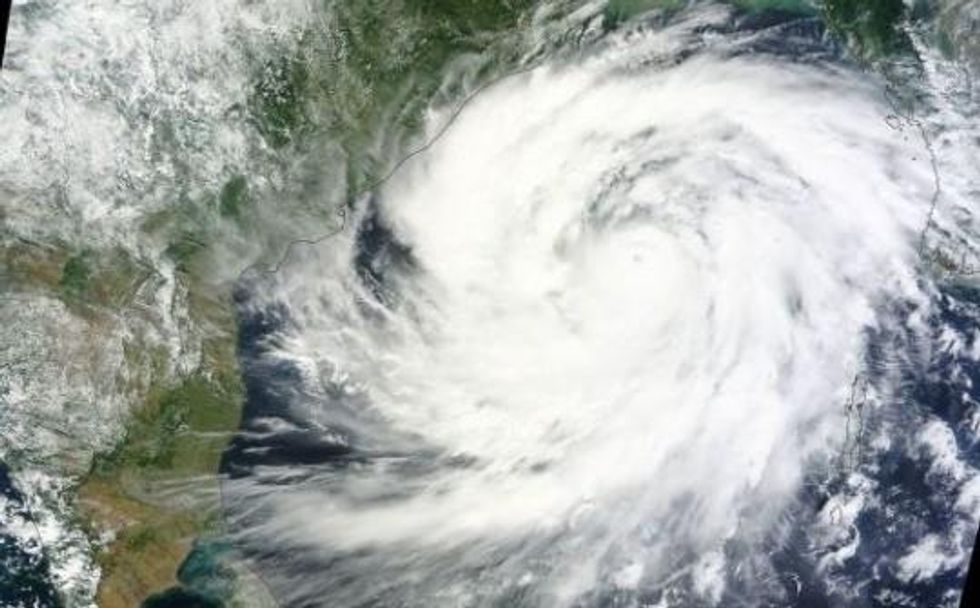
The storm had reached nearly half the size of India as it barreled towards the coast on Saturday.
_______________________
Extreme winds of up to 135 miles per hour and torrential rain had weakened as the storm headed inland into Sunday morning.
As the storm passes, news agencies are reporting up to 17 deaths so far but that number may climb, officials said, as rescue and clean up efforts continue.
Comparisons to the storm's strength and size are being made with Cyclone Orissa that left at least 10,000 people dead in India in 1999. The difference, state officials are say, lies in the evacuation of nearly 1 million people, including more than 870,000 in Orissa and more than 100,000 in neighboring Andhra Pradesh, this time around.
Reuters reports:
At least 873,000 people in Odisha and adjacent Andhra Pradesh spent the night in shelters, some of which had been built after a 1999 storm killed 10,000 in the same area. Others sought safety in schools or temples, in an exercise disaster management officials called one of India's largest evacuations.
"We saved lives by putting them in shelters in time," said Odisha's special relief commissioner, J.K. Mohapatra. [...]
Winds slowed to 90 kph (56 mph) early on Sunday and rain eased. But large swathes of Odisha, including its capital, Bhubaneswar, were without electricity for a second day after the storm tore down power cables. Officials said it was too early to assess damage accurately.
Soldiers and rescue workers in helicopters, boats and trucks fanned out across the two states, but officials sounded confident that a major disaster had been avoided.
Associated Press reports:
Mass evacuations spared India the widespread deaths many had feared from a powerful cyclone that roared ashore over the weekend, officials said Sunday, as the country sorted through the wreckage of flooded towns, tangled power lines and tens of thousands of destroyed thatch homes.
Cyclone Phailin, the strongest storm to hit India in more than a decade, destroyed hundreds of millions of dollars' worth of crops, but more than 20 hours after it made landfall in Orissa state on the country's east coast, authorities said they knew of only 17 fatalities.
The final death toll is expected to climb further as officials reach areas of the cyclone-battered coast that remain isolated by downed communication links and blocked roads, but the evacuation of nearly 1 million people appeared to have saved many lives.
"Damage to property is extensive," said Amitabh Thakur, the top police officer in the Orissa district worst-hit by the cyclone. "But few lives have been lost," he said, crediting the mass evacuations. [...]
For days before the storm hit, officials had been stockpiling emergency food supplies and setting up hundreds of shelters. The Indian military put some forces on alert, with trucks, planes and helicopters at the ready for relief operations.
The storm had reached nearly half the size of India as it barreled towards the coast on Saturday.
_______________________
Extreme winds of up to 135 miles per hour and torrential rain had weakened as the storm headed inland into Sunday morning.
As the storm passes, news agencies are reporting up to 17 deaths so far but that number may climb, officials said, as rescue and clean up efforts continue.
Comparisons to the storm's strength and size are being made with Cyclone Orissa that left at least 10,000 people dead in India in 1999. The difference, state officials are say, lies in the evacuation of nearly 1 million people, including more than 870,000 in Orissa and more than 100,000 in neighboring Andhra Pradesh, this time around.
Reuters reports:
At least 873,000 people in Odisha and adjacent Andhra Pradesh spent the night in shelters, some of which had been built after a 1999 storm killed 10,000 in the same area. Others sought safety in schools or temples, in an exercise disaster management officials called one of India's largest evacuations.
"We saved lives by putting them in shelters in time," said Odisha's special relief commissioner, J.K. Mohapatra. [...]
Winds slowed to 90 kph (56 mph) early on Sunday and rain eased. But large swathes of Odisha, including its capital, Bhubaneswar, were without electricity for a second day after the storm tore down power cables. Officials said it was too early to assess damage accurately.
Soldiers and rescue workers in helicopters, boats and trucks fanned out across the two states, but officials sounded confident that a major disaster had been avoided.
Associated Press reports:
Mass evacuations spared India the widespread deaths many had feared from a powerful cyclone that roared ashore over the weekend, officials said Sunday, as the country sorted through the wreckage of flooded towns, tangled power lines and tens of thousands of destroyed thatch homes.
Cyclone Phailin, the strongest storm to hit India in more than a decade, destroyed hundreds of millions of dollars' worth of crops, but more than 20 hours after it made landfall in Orissa state on the country's east coast, authorities said they knew of only 17 fatalities.
The final death toll is expected to climb further as officials reach areas of the cyclone-battered coast that remain isolated by downed communication links and blocked roads, but the evacuation of nearly 1 million people appeared to have saved many lives.
"Damage to property is extensive," said Amitabh Thakur, the top police officer in the Orissa district worst-hit by the cyclone. "But few lives have been lost," he said, crediting the mass evacuations. [...]
For days before the storm hit, officials had been stockpiling emergency food supplies and setting up hundreds of shelters. The Indian military put some forces on alert, with trucks, planes and helicopters at the ready for relief operations.
The storm had reached nearly half the size of India as it barreled towards the coast on Saturday.
_______________________