SUBSCRIBE TO OUR FREE NEWSLETTER
Daily news & progressive opinion—funded by the people, not the corporations—delivered straight to your inbox.
5
#000000
#FFFFFF
To donate by check, phone, or other method, see our More Ways to Give page.
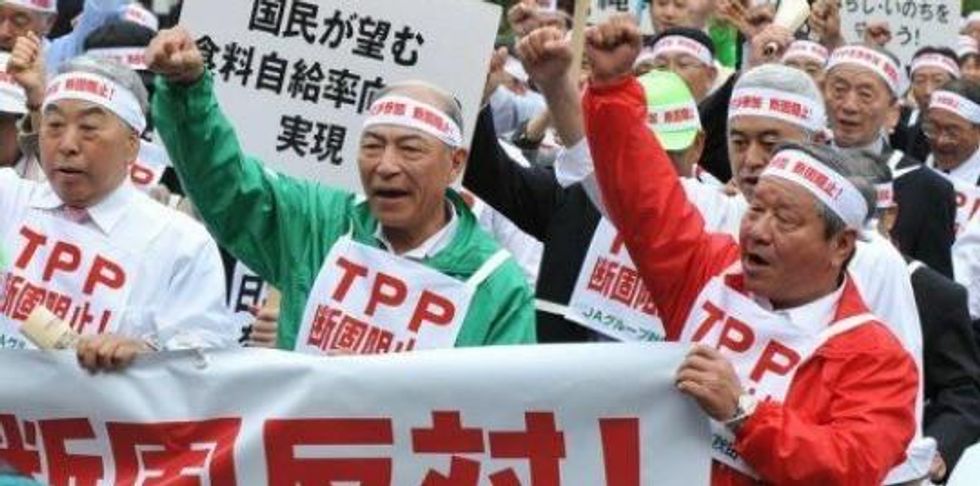
Saying the TPP will only result in "a drastic agreement that will change the way the nation deals with food," the farmers urged Japan's leaders not to back the deal or join the talks.
Roughly four thousand people joined Japan's Central Union of Agricultural Cooperatives (Ja-Zenchu) and other groups linked to the farm and fish industries to express opposition to a deal they say will compromise the integrity of their livelihoods.
Akira Banzai, head of JA-Zenchu, said at the rally that both "anxiety and anger" is "spreading around us because we have not received a sufficient explanation from the government," as to what the TPP will entail for the food industry of Japan.
The Japan Daily Press reports:
According to the head of the union Akira Banzai, joining the talks will forever change the way the nation deals with food and the industries around it, as well as threaten its safety because participation in the TPP will remove tariffs on the industry. Cheap imports will also come in to the country, endangering the country's agricultural sector.
Protesters at the rally called on Prime Minister Shinzo Abe and the Liberal Democratic Party to make good on its campaign promises to boycott the talks, despite pressure from the U.S.
According to Japanese media, Prime Minister Abe is expected to announce that Japan will participate in the negotiations at a news conference on Friday. After making the announcement, however, Japan would still have to go through a lengthy approval process before officially joining talks in early June.
In order to enter the TPP negotiations, Japan will have to seek endorsement from the United States, Australia and New Zealand, which will likely require the nation to forgo any pre-conditions--such as exemption from food tariff protections.
Mainichi reports:
Japan will unlikely enter into negotiations before June because the United States requires at least 90 days to secure congressional approval even if the administration endorses Japan's participation.
In Singapore, where the talks on the Trans-Pacific Partnership are held, participating countries shared the view that they should request Japan strictly adhere to what has been agreed on in the rounds of negotiations that have been held so far, according to the source close to the negotiations.
The source said Japan's participation was formally discussed at the meeting and some countries expressed concern that Japan has sounded out to some of the 11 participating countries if rice and other items may be exempted from tariff elimination.
The source said views were expressed at the meeting that Japan should enter into talks without setting preconditions.
_______________________
Saying the TPP will only result in "a drastic agreement that will change the way the nation deals with food," the farmers urged Japan's leaders not to back the deal or join the talks.
Roughly four thousand people joined Japan's Central Union of Agricultural Cooperatives (Ja-Zenchu) and other groups linked to the farm and fish industries to express opposition to a deal they say will compromise the integrity of their livelihoods.
Akira Banzai, head of JA-Zenchu, said at the rally that both "anxiety and anger" is "spreading around us because we have not received a sufficient explanation from the government," as to what the TPP will entail for the food industry of Japan.
The Japan Daily Press reports:
According to the head of the union Akira Banzai, joining the talks will forever change the way the nation deals with food and the industries around it, as well as threaten its safety because participation in the TPP will remove tariffs on the industry. Cheap imports will also come in to the country, endangering the country's agricultural sector.
Protesters at the rally called on Prime Minister Shinzo Abe and the Liberal Democratic Party to make good on its campaign promises to boycott the talks, despite pressure from the U.S.
According to Japanese media, Prime Minister Abe is expected to announce that Japan will participate in the negotiations at a news conference on Friday. After making the announcement, however, Japan would still have to go through a lengthy approval process before officially joining talks in early June.
In order to enter the TPP negotiations, Japan will have to seek endorsement from the United States, Australia and New Zealand, which will likely require the nation to forgo any pre-conditions--such as exemption from food tariff protections.
Mainichi reports:
Japan will unlikely enter into negotiations before June because the United States requires at least 90 days to secure congressional approval even if the administration endorses Japan's participation.
In Singapore, where the talks on the Trans-Pacific Partnership are held, participating countries shared the view that they should request Japan strictly adhere to what has been agreed on in the rounds of negotiations that have been held so far, according to the source close to the negotiations.
The source said Japan's participation was formally discussed at the meeting and some countries expressed concern that Japan has sounded out to some of the 11 participating countries if rice and other items may be exempted from tariff elimination.
The source said views were expressed at the meeting that Japan should enter into talks without setting preconditions.
_______________________
Saying the TPP will only result in "a drastic agreement that will change the way the nation deals with food," the farmers urged Japan's leaders not to back the deal or join the talks.
Roughly four thousand people joined Japan's Central Union of Agricultural Cooperatives (Ja-Zenchu) and other groups linked to the farm and fish industries to express opposition to a deal they say will compromise the integrity of their livelihoods.
Akira Banzai, head of JA-Zenchu, said at the rally that both "anxiety and anger" is "spreading around us because we have not received a sufficient explanation from the government," as to what the TPP will entail for the food industry of Japan.
The Japan Daily Press reports:
According to the head of the union Akira Banzai, joining the talks will forever change the way the nation deals with food and the industries around it, as well as threaten its safety because participation in the TPP will remove tariffs on the industry. Cheap imports will also come in to the country, endangering the country's agricultural sector.
Protesters at the rally called on Prime Minister Shinzo Abe and the Liberal Democratic Party to make good on its campaign promises to boycott the talks, despite pressure from the U.S.
According to Japanese media, Prime Minister Abe is expected to announce that Japan will participate in the negotiations at a news conference on Friday. After making the announcement, however, Japan would still have to go through a lengthy approval process before officially joining talks in early June.
In order to enter the TPP negotiations, Japan will have to seek endorsement from the United States, Australia and New Zealand, which will likely require the nation to forgo any pre-conditions--such as exemption from food tariff protections.
Mainichi reports:
Japan will unlikely enter into negotiations before June because the United States requires at least 90 days to secure congressional approval even if the administration endorses Japan's participation.
In Singapore, where the talks on the Trans-Pacific Partnership are held, participating countries shared the view that they should request Japan strictly adhere to what has been agreed on in the rounds of negotiations that have been held so far, according to the source close to the negotiations.
The source said Japan's participation was formally discussed at the meeting and some countries expressed concern that Japan has sounded out to some of the 11 participating countries if rice and other items may be exempted from tariff elimination.
The source said views were expressed at the meeting that Japan should enter into talks without setting preconditions.
_______________________