SUBSCRIBE TO OUR FREE NEWSLETTER
Daily news & progressive opinion—funded by the people, not the corporations—delivered straight to your inbox.
5
#000000
#FFFFFF
To donate by check, phone, or other method, see our More Ways to Give page.
Thousands of Chinese protesting against pollution from a huge paper factory in eastern China have taken to the streets as rising public anger over environmental threats grows.
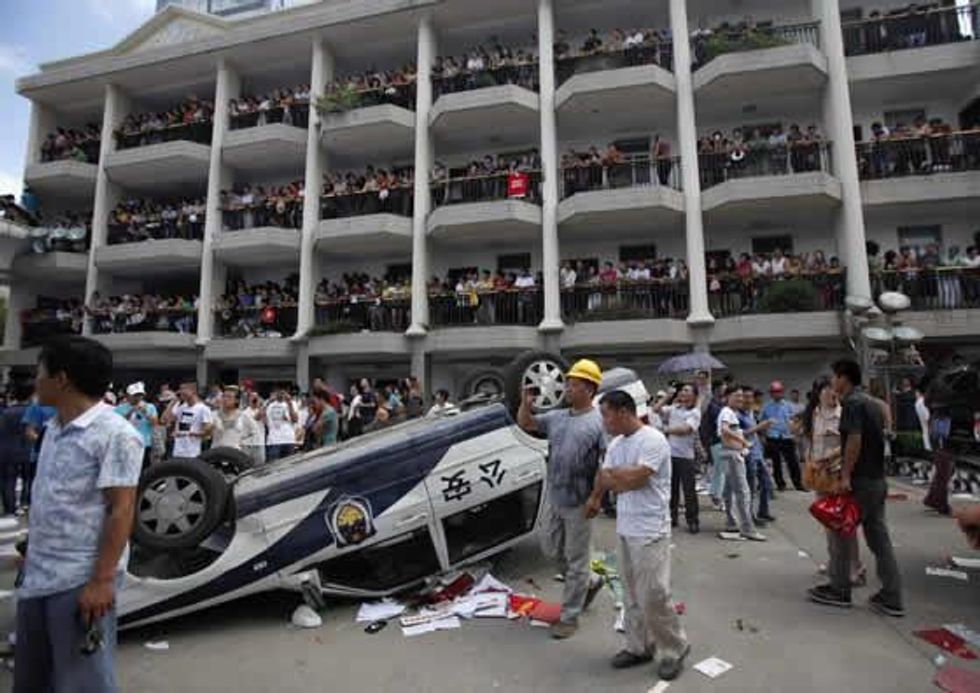
The protesters claimed victory Saturday as the Chinese officials canceled the industrial waste pipeline project after the demonstrators occupied a government office, destroyed computers, overturned cars and threw documents out the windows to loud cheers from the crowd.
The sewage pipe from the paper mill discharges in the port of Lusi, one of four fishing harbors in Qidong.
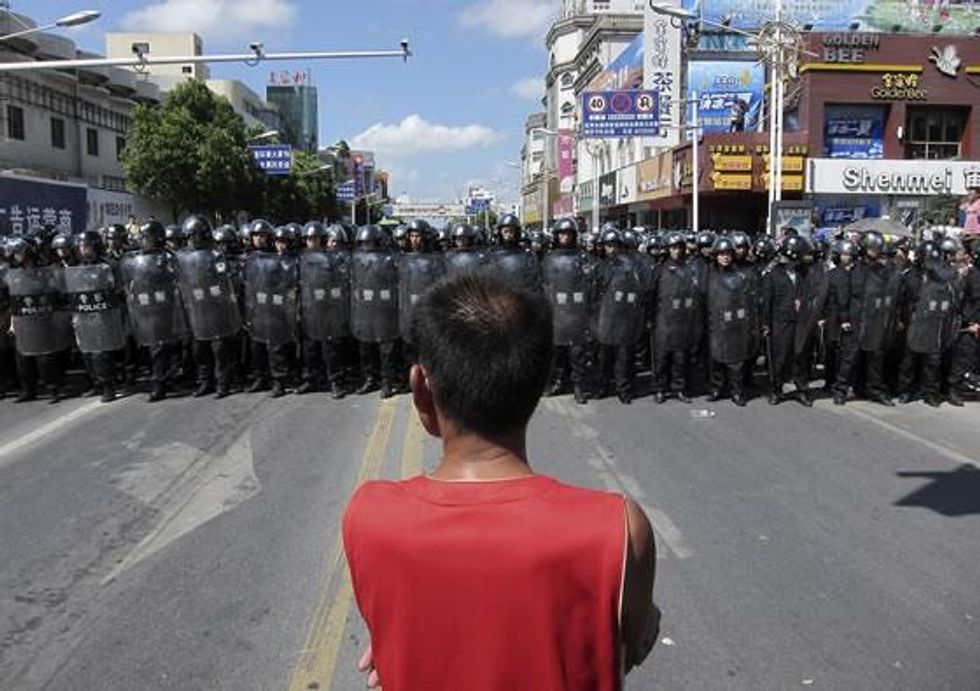
Later Saturday hundreds of police, some in riot gear, arrived in the coastal town just north of Shanghai and took up positions outside the government offices.
Protests against environmental degradation have increased in China, where three decades of rapid and unfettered industrial expansion have taken their toll.
The demonstrators had seized bottles of liquor and wine from the offices along with cartons of cigarettes, items that Chinese officials frequently receive as bribes in return for allowing polluting projects to be built.
Discharges were set to climb to 150,000 tons of sewage a day when the mill was fully operational, according to residents quoted on Friday by the state-run Global Times newspaper.
One protestor, who for safety reasons only gave her name as Qin said there were 50,000 demonstrators. A microblogger using the name Qidong Longhuisheng estimated the number at 100,000.
''There are people everywhere, on walls, cars, rooftops, in streets,'' another microblog user, writing under the name Jiaojiaotaotailang, said adding that ''the air is filled with the smell of alcohol, and there are sounds of breaking glass''.
Such protests "suggest that the middle class, whose members seemed willing to accept in the 1990s that being able to buy more things equaled having a better life, is now wondering whether one's quality of life has improved, if you have to worry about breathing the air, drinking the water, and whether the food you're eating is safe," Jeffrey Wasserstrom, of the University of California Irvine told Reuters.
Earlier this month, Shifang city in the southwestern province of Sichuan scrapped plans for a copper plant after thousands of protesters, including high school students, clashed with riot police.

Thousands of Chinese protesting against pollution from a huge paper factory in eastern China have taken to the streets as rising public anger over environmental threats grows.
The protesters claimed victory Saturday as the Chinese officials canceled the industrial waste pipeline project after the demonstrators occupied a government office, destroyed computers, overturned cars and threw documents out the windows to loud cheers from the crowd.
The sewage pipe from the paper mill discharges in the port of Lusi, one of four fishing harbors in Qidong.
Later Saturday hundreds of police, some in riot gear, arrived in the coastal town just north of Shanghai and took up positions outside the government offices.
Protests against environmental degradation have increased in China, where three decades of rapid and unfettered industrial expansion have taken their toll.
The demonstrators had seized bottles of liquor and wine from the offices along with cartons of cigarettes, items that Chinese officials frequently receive as bribes in return for allowing polluting projects to be built.
Discharges were set to climb to 150,000 tons of sewage a day when the mill was fully operational, according to residents quoted on Friday by the state-run Global Times newspaper.
One protestor, who for safety reasons only gave her name as Qin said there were 50,000 demonstrators. A microblogger using the name Qidong Longhuisheng estimated the number at 100,000.
''There are people everywhere, on walls, cars, rooftops, in streets,'' another microblog user, writing under the name Jiaojiaotaotailang, said adding that ''the air is filled with the smell of alcohol, and there are sounds of breaking glass''.
Such protests "suggest that the middle class, whose members seemed willing to accept in the 1990s that being able to buy more things equaled having a better life, is now wondering whether one's quality of life has improved, if you have to worry about breathing the air, drinking the water, and whether the food you're eating is safe," Jeffrey Wasserstrom, of the University of California Irvine told Reuters.
Earlier this month, Shifang city in the southwestern province of Sichuan scrapped plans for a copper plant after thousands of protesters, including high school students, clashed with riot police.
Thousands of Chinese protesting against pollution from a huge paper factory in eastern China have taken to the streets as rising public anger over environmental threats grows.
The protesters claimed victory Saturday as the Chinese officials canceled the industrial waste pipeline project after the demonstrators occupied a government office, destroyed computers, overturned cars and threw documents out the windows to loud cheers from the crowd.
The sewage pipe from the paper mill discharges in the port of Lusi, one of four fishing harbors in Qidong.
Later Saturday hundreds of police, some in riot gear, arrived in the coastal town just north of Shanghai and took up positions outside the government offices.
Protests against environmental degradation have increased in China, where three decades of rapid and unfettered industrial expansion have taken their toll.
The demonstrators had seized bottles of liquor and wine from the offices along with cartons of cigarettes, items that Chinese officials frequently receive as bribes in return for allowing polluting projects to be built.
Discharges were set to climb to 150,000 tons of sewage a day when the mill was fully operational, according to residents quoted on Friday by the state-run Global Times newspaper.
One protestor, who for safety reasons only gave her name as Qin said there were 50,000 demonstrators. A microblogger using the name Qidong Longhuisheng estimated the number at 100,000.
''There are people everywhere, on walls, cars, rooftops, in streets,'' another microblog user, writing under the name Jiaojiaotaotailang, said adding that ''the air is filled with the smell of alcohol, and there are sounds of breaking glass''.
Such protests "suggest that the middle class, whose members seemed willing to accept in the 1990s that being able to buy more things equaled having a better life, is now wondering whether one's quality of life has improved, if you have to worry about breathing the air, drinking the water, and whether the food you're eating is safe," Jeffrey Wasserstrom, of the University of California Irvine told Reuters.
Earlier this month, Shifang city in the southwestern province of Sichuan scrapped plans for a copper plant after thousands of protesters, including high school students, clashed with riot police.