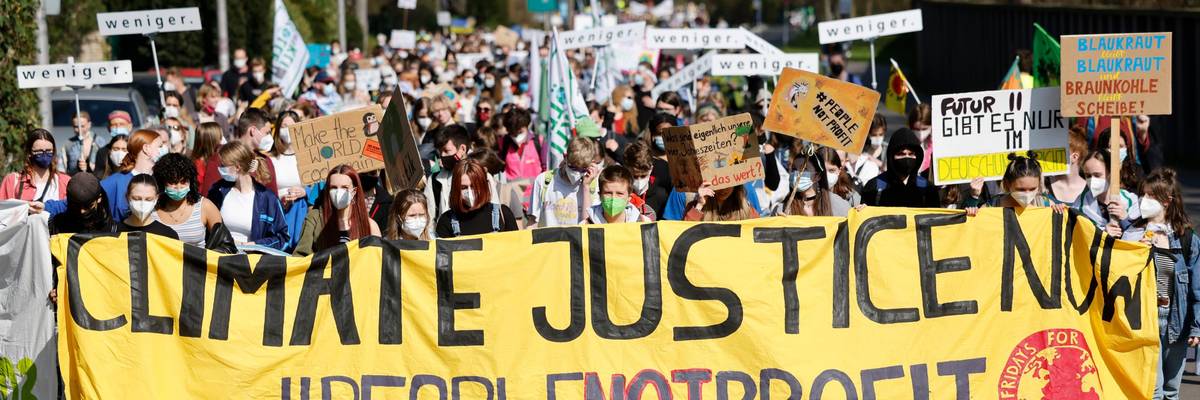
Participants in the Fridays For Future climate strike march in Cologne, Germany on March 25, 2022. (Photo: Thomas Banneyer/picture alliance via Getty Images)
How Progressives Would Handle the Current Energy, Inflation, and Climate Crises
The multiple crises are encouraging consensus on the need for public ownership and socialised management and control of energy sectors in the short and medium term.
While the climate crisis is deepening and households are falling into poverty, inflation and soaring energy bills, fossil fuel firms are enjoying their tax breaks and reporting quarterly record profits. Market analysis on energy prices predicts continuing high prices of gas for the next two years. This is not just due to the uncertainties created by the Russian occupation of Ukraine, but rather the movement of gas assets in forward markets. Forward markets create facilities used for speculative purposes, as well as for hedging, which means energy prices will continue to rise and we will continue to see phenomenal record profits by fossil fuel companies.
We are already seeing merciless floods, mega-droughts, and simultaneous crop failure in key grain-producing regions worldwide.
The Financial Times has been featuring stories of adjustments and energy saving measures being made by companies in Europe like turning down heating, which will keep facilities cold in winter. This would mean workers must continue to work in chilly workplaces and come to cold homes too. Firms are also increasingly resorting to importation of essential manufacturing materials where they are cheaper or reducing manufacturing altogether. There are reasons to worry that this could cause imminent de-industrialisation in Europe, which would lead to further losses of jobs here in the UK as well.
With the energy and food crises happening against the backdrop of the continuing Covid-19 pandemic and the ongoing war, governments are using the excuse that climate concerns are becoming less of a priority. This contrary to the reality that with geopolitical crises, the climate emergency will bring even greater disruptions. We are already seeing merciless floods, mega-droughts, and simultaneous crop failure in key grain-producing regions worldwide.
Governments are failing to keep below the 1.5C target
The recent UN environment report said there is "no credible pathway to 1.5C in place." This is not surprising. Climate justice campaigners have been saying for years that the only way to limit the worst impacts of the climate crisis is a rapid transformation of societies. Governments, especially here in the global north are failing to reduce carbon emissions year after year. Even if delivered in full, and that is a big IF, current pledges for action by 2030 at the UN climate talks would still mean a rise in global heating of about 2.5C and catastrophic extreme weather around the world. An increase of 1C to date has caused climate disasters that are already increasingly affecting lives and livelihoods, especially in developing countries.
The International Energy Agency has already said in May 2021 that the planet can no longer afford new fossil fuel development projects. A recently published study found "large consensus" across all published research that new oil and gas fields are "incompatible" with the 1.5C target.
What is frightfully different between previous global crises and the current one that we are going through is that we are also seeing the end of multilateralism and the deglobalisation process is increasingly captured by conservative forces. The national agenda, shaped by the dominant national level politics and interests that are shaping climate solutions or blockages to them, is based on unequal competition between nation states rather than cooperation between states.
How can progressive groups address the current energy crisis and climate change?
It will not be easy to solve these challenges, but there are steps and alternatives that we already know that various groups like us have been campaigning for and progressive researchers have been saying:
Energy nationalisation and socialisation to meet people's needs
The multiple crises are encouraging consensus on the need for public ownership and socialised management and control of energy sectors in the short and medium term. Energy is now considered a national security issue, opening new conflicts, and it is clear that each fossil fuel producing country asserts its rights to continue using fossil fuels. There are many cases of not just national but also municipally owned and managed energy sectors.
What we also need to understand is that embarking on energy transformation, will also be, and need to be, disruptive. The energy system is the foundation of industrialised economies, for transition to happen it needs to be overhauled for a phase-out of fossil fuels within a few decades. Huge industries like coal and oil will have to shrink or go through a period of phase-out, before they then disappear. Agriculture, transportation, manufacturing, aviation and other sectors will need to change radically to become more sustainable and resilient. That radical change will not happen without conflicts.
There is a class aspect to the questions--how, where and why fossil fuels will get left in the ground, and how, where and why the renewable energy sector gets built up and accelerated. It will be very difficult to plan a phase-out if the energy assets are not publicly owned and socially managed. At the same time, it must be ensured too that the social needs of economies relying on fossil fuels must be addressed. That inter-state question needs to be addressed, otherwise a global phase-out will not happen. There are no concrete policy proposals yet to end the market for energy prices or to bring into common ownership the energy companies, retail, distribution and wholesale operations. Here in the UK, the TUC only proposes nationalisation of retail so far.
Stop profiteering and speculative investments
The UK is the 6th richest economy in the world, yet it is a broken economy where a large number of people cannot afford basic commodities. The government energy regulator Ofgem raised the energy price cap by 80% in October taking the average gas and electricity bill to PS3549 a year. About 28 million people in 12 million homes, or 42 per cent of all households, will not be able to afford to adequately heat and power their properties from January and up to 9 million households will face fuel poverty.
Speculators bet on gas, oil and coal prices by buying futures contracts. They are gambling that prices will go up and they will be able to sell on the contracts and make a quick buck. In situations of crisis and market instability at this period, with Putin's war in Ukraine, they indeed act as war profiteers. There must be a system to deal with profiteering and speculative investments in the energy sector.
Windfall tax
The surge in fossil fuel prices has generated substantial excessive untaxed profits in the energy sector. Policymakers in many countries are now exploring policies to tax part of these profits. President Biden has also called for windfall taxes for oil companies. Windfall profits can and should be taxed using instruments targeted at economic returns. Recent proposals even from the International Monetary Fund talk about introducing a permanent tax on windfall profits from fossil fuel extraction and advise more caution about temporary and possibly poorly designed windfall profit taxes.
Fair pricing scheme for energy
It is not just households that are facing massive challenges of paying energy bills, so too are schools, hospitals, care homes, and small businesses. What is not much discussed is how domestic energy is priced in this country. The rules ensure that everyone suffers except the privatised energy companies.
The energy we get is from a mix of oil, gas, nuclear, coal, hydro and renewables. However, the wholesale price of electricity is based on marginal costing. As argued by Richard Murphy of Tax Research UK, what it means is that the wholesale energy price is set so that the most expensive producer can make a profit from the sales they make into the wholesale energy market. At the moment, this is set on gas, which is the most expensive to produce now. This doesn't make sense at all. The government puts a price guarantee on energy sectors, and it is within its remit to intervene and reduce energy costs by changing regulations.

FINAL DAY! This is urgent.
Dear Common Dreams reader, It’s been nearly 30 years since I co-founded Common Dreams with my late wife, Lina Newhouser. We had the radical notion that journalism should serve the public good, not corporate profits. It was clear to us from the outset what it would take to build such a project. No paid advertisements. No corporate sponsors. No millionaire publisher telling us what to think or do. Many people said we wouldn't last a year, but we proved those doubters wrong. Together with a tremendous team of journalists and dedicated staff, we built an independent media outlet free from the constraints of profits and corporate control. Our mission from the outset was simple. To inform. To inspire. To ignite change for the common good. Building Common Dreams was not easy. Our survival was never guaranteed. When you take on the most powerful forces—Wall Street greed, fossil fuel industry destruction, Big Tech lobbyists, and uber-rich oligarchs who have spent billions upon billions rigging the economy and democracy in their favor—the only bulwark you have is supporters who believe in your work. But here’s the urgent message from me today. It’s never been this bad out there. And it’s never been this hard to keep us going. At the very moment Common Dreams is most needed and doing some of its best and most important work, the threats we face are intensifying. Right now, with just hours left in our Spring Campaign, we're still falling short of our make-or-break goal. When everyone does the little they can afford, we are strong. But if that support retreats or dries up, so do we. Can you make a gift right now to make sure Common Dreams not only survives but thrives? There is no backup plan or rainy day fund. There is only you. —Craig Brown, Co-founder |
While the climate crisis is deepening and households are falling into poverty, inflation and soaring energy bills, fossil fuel firms are enjoying their tax breaks and reporting quarterly record profits. Market analysis on energy prices predicts continuing high prices of gas for the next two years. This is not just due to the uncertainties created by the Russian occupation of Ukraine, but rather the movement of gas assets in forward markets. Forward markets create facilities used for speculative purposes, as well as for hedging, which means energy prices will continue to rise and we will continue to see phenomenal record profits by fossil fuel companies.
We are already seeing merciless floods, mega-droughts, and simultaneous crop failure in key grain-producing regions worldwide.
The Financial Times has been featuring stories of adjustments and energy saving measures being made by companies in Europe like turning down heating, which will keep facilities cold in winter. This would mean workers must continue to work in chilly workplaces and come to cold homes too. Firms are also increasingly resorting to importation of essential manufacturing materials where they are cheaper or reducing manufacturing altogether. There are reasons to worry that this could cause imminent de-industrialisation in Europe, which would lead to further losses of jobs here in the UK as well.
With the energy and food crises happening against the backdrop of the continuing Covid-19 pandemic and the ongoing war, governments are using the excuse that climate concerns are becoming less of a priority. This contrary to the reality that with geopolitical crises, the climate emergency will bring even greater disruptions. We are already seeing merciless floods, mega-droughts, and simultaneous crop failure in key grain-producing regions worldwide.
Governments are failing to keep below the 1.5C target
The recent UN environment report said there is "no credible pathway to 1.5C in place." This is not surprising. Climate justice campaigners have been saying for years that the only way to limit the worst impacts of the climate crisis is a rapid transformation of societies. Governments, especially here in the global north are failing to reduce carbon emissions year after year. Even if delivered in full, and that is a big IF, current pledges for action by 2030 at the UN climate talks would still mean a rise in global heating of about 2.5C and catastrophic extreme weather around the world. An increase of 1C to date has caused climate disasters that are already increasingly affecting lives and livelihoods, especially in developing countries.
The International Energy Agency has already said in May 2021 that the planet can no longer afford new fossil fuel development projects. A recently published study found "large consensus" across all published research that new oil and gas fields are "incompatible" with the 1.5C target.
What is frightfully different between previous global crises and the current one that we are going through is that we are also seeing the end of multilateralism and the deglobalisation process is increasingly captured by conservative forces. The national agenda, shaped by the dominant national level politics and interests that are shaping climate solutions or blockages to them, is based on unequal competition between nation states rather than cooperation between states.
How can progressive groups address the current energy crisis and climate change?
It will not be easy to solve these challenges, but there are steps and alternatives that we already know that various groups like us have been campaigning for and progressive researchers have been saying:
Energy nationalisation and socialisation to meet people's needs
The multiple crises are encouraging consensus on the need for public ownership and socialised management and control of energy sectors in the short and medium term. Energy is now considered a national security issue, opening new conflicts, and it is clear that each fossil fuel producing country asserts its rights to continue using fossil fuels. There are many cases of not just national but also municipally owned and managed energy sectors.
What we also need to understand is that embarking on energy transformation, will also be, and need to be, disruptive. The energy system is the foundation of industrialised economies, for transition to happen it needs to be overhauled for a phase-out of fossil fuels within a few decades. Huge industries like coal and oil will have to shrink or go through a period of phase-out, before they then disappear. Agriculture, transportation, manufacturing, aviation and other sectors will need to change radically to become more sustainable and resilient. That radical change will not happen without conflicts.
There is a class aspect to the questions--how, where and why fossil fuels will get left in the ground, and how, where and why the renewable energy sector gets built up and accelerated. It will be very difficult to plan a phase-out if the energy assets are not publicly owned and socially managed. At the same time, it must be ensured too that the social needs of economies relying on fossil fuels must be addressed. That inter-state question needs to be addressed, otherwise a global phase-out will not happen. There are no concrete policy proposals yet to end the market for energy prices or to bring into common ownership the energy companies, retail, distribution and wholesale operations. Here in the UK, the TUC only proposes nationalisation of retail so far.
Stop profiteering and speculative investments
The UK is the 6th richest economy in the world, yet it is a broken economy where a large number of people cannot afford basic commodities. The government energy regulator Ofgem raised the energy price cap by 80% in October taking the average gas and electricity bill to PS3549 a year. About 28 million people in 12 million homes, or 42 per cent of all households, will not be able to afford to adequately heat and power their properties from January and up to 9 million households will face fuel poverty.
Speculators bet on gas, oil and coal prices by buying futures contracts. They are gambling that prices will go up and they will be able to sell on the contracts and make a quick buck. In situations of crisis and market instability at this period, with Putin's war in Ukraine, they indeed act as war profiteers. There must be a system to deal with profiteering and speculative investments in the energy sector.
Windfall tax
The surge in fossil fuel prices has generated substantial excessive untaxed profits in the energy sector. Policymakers in many countries are now exploring policies to tax part of these profits. President Biden has also called for windfall taxes for oil companies. Windfall profits can and should be taxed using instruments targeted at economic returns. Recent proposals even from the International Monetary Fund talk about introducing a permanent tax on windfall profits from fossil fuel extraction and advise more caution about temporary and possibly poorly designed windfall profit taxes.
Fair pricing scheme for energy
It is not just households that are facing massive challenges of paying energy bills, so too are schools, hospitals, care homes, and small businesses. What is not much discussed is how domestic energy is priced in this country. The rules ensure that everyone suffers except the privatised energy companies.
The energy we get is from a mix of oil, gas, nuclear, coal, hydro and renewables. However, the wholesale price of electricity is based on marginal costing. As argued by Richard Murphy of Tax Research UK, what it means is that the wholesale energy price is set so that the most expensive producer can make a profit from the sales they make into the wholesale energy market. At the moment, this is set on gas, which is the most expensive to produce now. This doesn't make sense at all. The government puts a price guarantee on energy sectors, and it is within its remit to intervene and reduce energy costs by changing regulations.
While the climate crisis is deepening and households are falling into poverty, inflation and soaring energy bills, fossil fuel firms are enjoying their tax breaks and reporting quarterly record profits. Market analysis on energy prices predicts continuing high prices of gas for the next two years. This is not just due to the uncertainties created by the Russian occupation of Ukraine, but rather the movement of gas assets in forward markets. Forward markets create facilities used for speculative purposes, as well as for hedging, which means energy prices will continue to rise and we will continue to see phenomenal record profits by fossil fuel companies.
We are already seeing merciless floods, mega-droughts, and simultaneous crop failure in key grain-producing regions worldwide.
The Financial Times has been featuring stories of adjustments and energy saving measures being made by companies in Europe like turning down heating, which will keep facilities cold in winter. This would mean workers must continue to work in chilly workplaces and come to cold homes too. Firms are also increasingly resorting to importation of essential manufacturing materials where they are cheaper or reducing manufacturing altogether. There are reasons to worry that this could cause imminent de-industrialisation in Europe, which would lead to further losses of jobs here in the UK as well.
With the energy and food crises happening against the backdrop of the continuing Covid-19 pandemic and the ongoing war, governments are using the excuse that climate concerns are becoming less of a priority. This contrary to the reality that with geopolitical crises, the climate emergency will bring even greater disruptions. We are already seeing merciless floods, mega-droughts, and simultaneous crop failure in key grain-producing regions worldwide.
Governments are failing to keep below the 1.5C target
The recent UN environment report said there is "no credible pathway to 1.5C in place." This is not surprising. Climate justice campaigners have been saying for years that the only way to limit the worst impacts of the climate crisis is a rapid transformation of societies. Governments, especially here in the global north are failing to reduce carbon emissions year after year. Even if delivered in full, and that is a big IF, current pledges for action by 2030 at the UN climate talks would still mean a rise in global heating of about 2.5C and catastrophic extreme weather around the world. An increase of 1C to date has caused climate disasters that are already increasingly affecting lives and livelihoods, especially in developing countries.
The International Energy Agency has already said in May 2021 that the planet can no longer afford new fossil fuel development projects. A recently published study found "large consensus" across all published research that new oil and gas fields are "incompatible" with the 1.5C target.
What is frightfully different between previous global crises and the current one that we are going through is that we are also seeing the end of multilateralism and the deglobalisation process is increasingly captured by conservative forces. The national agenda, shaped by the dominant national level politics and interests that are shaping climate solutions or blockages to them, is based on unequal competition between nation states rather than cooperation between states.
How can progressive groups address the current energy crisis and climate change?
It will not be easy to solve these challenges, but there are steps and alternatives that we already know that various groups like us have been campaigning for and progressive researchers have been saying:
Energy nationalisation and socialisation to meet people's needs
The multiple crises are encouraging consensus on the need for public ownership and socialised management and control of energy sectors in the short and medium term. Energy is now considered a national security issue, opening new conflicts, and it is clear that each fossil fuel producing country asserts its rights to continue using fossil fuels. There are many cases of not just national but also municipally owned and managed energy sectors.
What we also need to understand is that embarking on energy transformation, will also be, and need to be, disruptive. The energy system is the foundation of industrialised economies, for transition to happen it needs to be overhauled for a phase-out of fossil fuels within a few decades. Huge industries like coal and oil will have to shrink or go through a period of phase-out, before they then disappear. Agriculture, transportation, manufacturing, aviation and other sectors will need to change radically to become more sustainable and resilient. That radical change will not happen without conflicts.
There is a class aspect to the questions--how, where and why fossil fuels will get left in the ground, and how, where and why the renewable energy sector gets built up and accelerated. It will be very difficult to plan a phase-out if the energy assets are not publicly owned and socially managed. At the same time, it must be ensured too that the social needs of economies relying on fossil fuels must be addressed. That inter-state question needs to be addressed, otherwise a global phase-out will not happen. There are no concrete policy proposals yet to end the market for energy prices or to bring into common ownership the energy companies, retail, distribution and wholesale operations. Here in the UK, the TUC only proposes nationalisation of retail so far.
Stop profiteering and speculative investments
The UK is the 6th richest economy in the world, yet it is a broken economy where a large number of people cannot afford basic commodities. The government energy regulator Ofgem raised the energy price cap by 80% in October taking the average gas and electricity bill to PS3549 a year. About 28 million people in 12 million homes, or 42 per cent of all households, will not be able to afford to adequately heat and power their properties from January and up to 9 million households will face fuel poverty.
Speculators bet on gas, oil and coal prices by buying futures contracts. They are gambling that prices will go up and they will be able to sell on the contracts and make a quick buck. In situations of crisis and market instability at this period, with Putin's war in Ukraine, they indeed act as war profiteers. There must be a system to deal with profiteering and speculative investments in the energy sector.
Windfall tax
The surge in fossil fuel prices has generated substantial excessive untaxed profits in the energy sector. Policymakers in many countries are now exploring policies to tax part of these profits. President Biden has also called for windfall taxes for oil companies. Windfall profits can and should be taxed using instruments targeted at economic returns. Recent proposals even from the International Monetary Fund talk about introducing a permanent tax on windfall profits from fossil fuel extraction and advise more caution about temporary and possibly poorly designed windfall profit taxes.
Fair pricing scheme for energy
It is not just households that are facing massive challenges of paying energy bills, so too are schools, hospitals, care homes, and small businesses. What is not much discussed is how domestic energy is priced in this country. The rules ensure that everyone suffers except the privatised energy companies.
The energy we get is from a mix of oil, gas, nuclear, coal, hydro and renewables. However, the wholesale price of electricity is based on marginal costing. As argued by Richard Murphy of Tax Research UK, what it means is that the wholesale energy price is set so that the most expensive producer can make a profit from the sales they make into the wholesale energy market. At the moment, this is set on gas, which is the most expensive to produce now. This doesn't make sense at all. The government puts a price guarantee on energy sectors, and it is within its remit to intervene and reduce energy costs by changing regulations.