SUBSCRIBE TO OUR FREE NEWSLETTER
Daily news & progressive opinion—funded by the people, not the corporations—delivered straight to your inbox.
5
#000000
#FFFFFF
To donate by check, phone, or other method, see our More Ways to Give page.
Daily news & progressive opinion—funded by the people, not the corporations—delivered straight to your inbox.
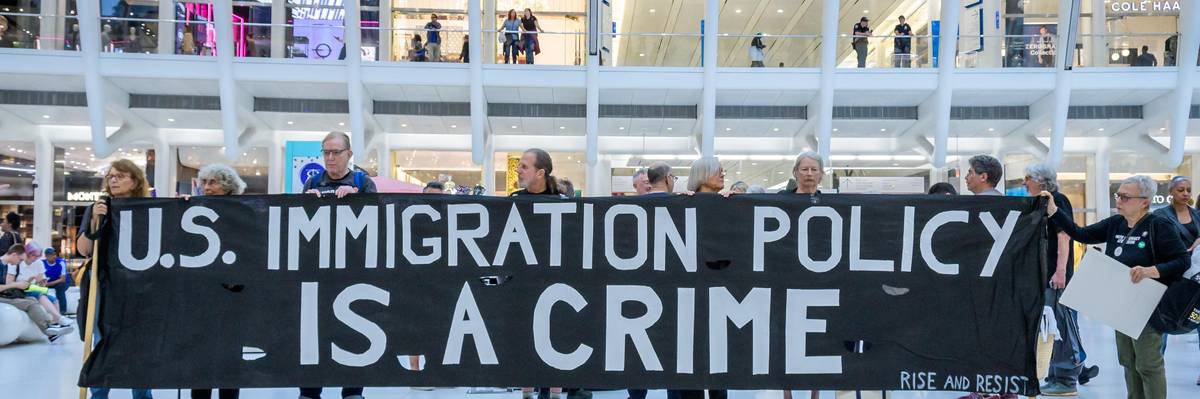
Members of the activist group Rise And Resist gathered at a silent protest inside The Oculus on September 12, 2019 holding NO RAIDS/CLOSE THE CAMPS/ABOLISH ICE banners, photographs of the children who have died in ICE custody, and photographs of the detention camps to object to Border Patrol and ICE treatment of immigrants, refugees, and asylum seekers. (Photo: Erik McGregor/LightRocket via Getty Images)
Last year, a former federal prison near Folkston, Georgia was emptied after President Biden signed an executive order phasing out the use of private prisons. So why is business now booming at the same facility for GEO Group, one of the nation's largest private prison firms? Because the administration has pulled a sneaky sleight-of-hand: Rather than fully halting the incarceration of people in such facilities, it has allowed them to simply be converted into immigration detention spaces.
Ending the use of private prisons in the criminal legal system must be paired with vigilant efforts to combat their use against immigrants.
This is an appalling reversal from the administration's earlier promises. After all, Biden came into office with bold pledges to scale back the use of for-profit incarceration of all kinds. Within days of the president's inauguration, he appeared to follow through on this promise by issuing an executive order purporting to end the use of private prisons to hold people in federal criminal custody.
However, Biden's order left at least one major loophole: It was silent on the use of private contractors to detain immigrants in civil custody. There was reason to hope a similar order barring privatized immigration detention might follow, as Biden pledged on the campaign trail to "end for-profit detention centers," as part of his immigration platform. And last April, he claimed that he would make good on this commitment within five days.
In the roughly 300 days that have passed since then, however, private detention has not ended -- it has metastasized. In many ways, immigration detention is filling the gap in the federal incarcerated population left by Biden's order. The expansion of the Folkston facility, for instance, would make it one of the largest such immigration detention facilities in the country.
The Biden administration has taken a few positive steps to address the particularly harmful forms of immigration detention, such as the confinement of asylum-seeking families. But for each step forward, there have been several steps back. In the case of family detention, for example, the sites where family units were confined haven't closed down, but merely been repurposed. One of them -- a facility in Berks County Pennsylvania, which for years held asylum-seeking mothers and children -- has now reopened as a facility for detaining single adult women.
This is part of a pattern. If a facility is emptied for a time, but never shuttered, it is almost certain to eventually be refilled by another detained population. After Louisiana took positive steps to reduce the number of incarcerated people in its parish jails, for instance, many of these facilities simply switched over to detaining immigrants. The availability of such detention sites creates a powerful incentive to find ways to fill them, regardless of the stated rationale.
Far from reducing the use of immigration detention, Biden's order on private prisons left an opening to expand it -- and the statistics bear this out. The number of people in Immigration and Customs Enforcement (ICE) custody has climbed since Biden took office. This is especially concerning in the midst of a public health crisis known to spread in detention settings. During the most recent wave of Covid-19 infections, diagnoses surged in ICE custody, causing at least 11 deaths.
Medical neglect was among the concerns that prompted Biden's original executive order barring privatized facilities in a federal criminal context. If members of the administration knew these dangers, why would they allow tens of thousands of people to remain in privatized immigration lock-ups during a pandemic?
The administration would undoubtedly claim that it's making efforts to reduce immigration detention over time. A recently-announced pilot program, for instance, would essentially confine people at home instead of in crowded detention centers.
Yet such a policy is merely detention by another name. According to the latest reporting, the contract to implement the pilot has been awarded to none other than GEO Group -- one of the nation's largest for-profit prison contractors operating immigration detention sites, including the one in Folkston.
Even under a policy that confines asylum-seekers at home instead of in traditional detention complexes, corporate actors will continue to "profit from the suffering of desperate people fleeing violence," as Biden promised to prevent in his campaign pledge to end for-profit detention centers.
Ending the use of private prisons in the criminal legal system must be paired with vigilant efforts to combat their use against immigrants. Otherwise, taking on the prison-industrial complex will be like fighting the hydra: cut off one of its heads and two more will arise.
Dear Common Dreams reader, It’s been nearly 30 years since I co-founded Common Dreams with my late wife, Lina Newhouser. We had the radical notion that journalism should serve the public good, not corporate profits. It was clear to us from the outset what it would take to build such a project. No paid advertisements. No corporate sponsors. No millionaire publisher telling us what to think or do. Many people said we wouldn't last a year, but we proved those doubters wrong. Together with a tremendous team of journalists and dedicated staff, we built an independent media outlet free from the constraints of profits and corporate control. Our mission has always been simple: To inform. To inspire. To ignite change for the common good. Building Common Dreams was not easy. Our survival was never guaranteed. When you take on the most powerful forces—Wall Street greed, fossil fuel industry destruction, Big Tech lobbyists, and uber-rich oligarchs who have spent billions upon billions rigging the economy and democracy in their favor—the only bulwark you have is supporters who believe in your work. But here’s the urgent message from me today. It's never been this bad out there. And it's never been this hard to keep us going. At the very moment Common Dreams is most needed, the threats we face are intensifying. We need your support now more than ever. We don't accept corporate advertising and never will. We don't have a paywall because we don't think people should be blocked from critical news based on their ability to pay. Everything we do is funded by the donations of readers like you. When everyone does the little they can afford, we are strong. But if that support retreats or dries up, so do we. Will you donate now to make sure Common Dreams not only survives but thrives? —Craig Brown, Co-founder |
Last year, a former federal prison near Folkston, Georgia was emptied after President Biden signed an executive order phasing out the use of private prisons. So why is business now booming at the same facility for GEO Group, one of the nation's largest private prison firms? Because the administration has pulled a sneaky sleight-of-hand: Rather than fully halting the incarceration of people in such facilities, it has allowed them to simply be converted into immigration detention spaces.
Ending the use of private prisons in the criminal legal system must be paired with vigilant efforts to combat their use against immigrants.
This is an appalling reversal from the administration's earlier promises. After all, Biden came into office with bold pledges to scale back the use of for-profit incarceration of all kinds. Within days of the president's inauguration, he appeared to follow through on this promise by issuing an executive order purporting to end the use of private prisons to hold people in federal criminal custody.
However, Biden's order left at least one major loophole: It was silent on the use of private contractors to detain immigrants in civil custody. There was reason to hope a similar order barring privatized immigration detention might follow, as Biden pledged on the campaign trail to "end for-profit detention centers," as part of his immigration platform. And last April, he claimed that he would make good on this commitment within five days.
In the roughly 300 days that have passed since then, however, private detention has not ended -- it has metastasized. In many ways, immigration detention is filling the gap in the federal incarcerated population left by Biden's order. The expansion of the Folkston facility, for instance, would make it one of the largest such immigration detention facilities in the country.
The Biden administration has taken a few positive steps to address the particularly harmful forms of immigration detention, such as the confinement of asylum-seeking families. But for each step forward, there have been several steps back. In the case of family detention, for example, the sites where family units were confined haven't closed down, but merely been repurposed. One of them -- a facility in Berks County Pennsylvania, which for years held asylum-seeking mothers and children -- has now reopened as a facility for detaining single adult women.
This is part of a pattern. If a facility is emptied for a time, but never shuttered, it is almost certain to eventually be refilled by another detained population. After Louisiana took positive steps to reduce the number of incarcerated people in its parish jails, for instance, many of these facilities simply switched over to detaining immigrants. The availability of such detention sites creates a powerful incentive to find ways to fill them, regardless of the stated rationale.
Far from reducing the use of immigration detention, Biden's order on private prisons left an opening to expand it -- and the statistics bear this out. The number of people in Immigration and Customs Enforcement (ICE) custody has climbed since Biden took office. This is especially concerning in the midst of a public health crisis known to spread in detention settings. During the most recent wave of Covid-19 infections, diagnoses surged in ICE custody, causing at least 11 deaths.
Medical neglect was among the concerns that prompted Biden's original executive order barring privatized facilities in a federal criminal context. If members of the administration knew these dangers, why would they allow tens of thousands of people to remain in privatized immigration lock-ups during a pandemic?
The administration would undoubtedly claim that it's making efforts to reduce immigration detention over time. A recently-announced pilot program, for instance, would essentially confine people at home instead of in crowded detention centers.
Yet such a policy is merely detention by another name. According to the latest reporting, the contract to implement the pilot has been awarded to none other than GEO Group -- one of the nation's largest for-profit prison contractors operating immigration detention sites, including the one in Folkston.
Even under a policy that confines asylum-seekers at home instead of in traditional detention complexes, corporate actors will continue to "profit from the suffering of desperate people fleeing violence," as Biden promised to prevent in his campaign pledge to end for-profit detention centers.
Ending the use of private prisons in the criminal legal system must be paired with vigilant efforts to combat their use against immigrants. Otherwise, taking on the prison-industrial complex will be like fighting the hydra: cut off one of its heads and two more will arise.
Last year, a former federal prison near Folkston, Georgia was emptied after President Biden signed an executive order phasing out the use of private prisons. So why is business now booming at the same facility for GEO Group, one of the nation's largest private prison firms? Because the administration has pulled a sneaky sleight-of-hand: Rather than fully halting the incarceration of people in such facilities, it has allowed them to simply be converted into immigration detention spaces.
Ending the use of private prisons in the criminal legal system must be paired with vigilant efforts to combat their use against immigrants.
This is an appalling reversal from the administration's earlier promises. After all, Biden came into office with bold pledges to scale back the use of for-profit incarceration of all kinds. Within days of the president's inauguration, he appeared to follow through on this promise by issuing an executive order purporting to end the use of private prisons to hold people in federal criminal custody.
However, Biden's order left at least one major loophole: It was silent on the use of private contractors to detain immigrants in civil custody. There was reason to hope a similar order barring privatized immigration detention might follow, as Biden pledged on the campaign trail to "end for-profit detention centers," as part of his immigration platform. And last April, he claimed that he would make good on this commitment within five days.
In the roughly 300 days that have passed since then, however, private detention has not ended -- it has metastasized. In many ways, immigration detention is filling the gap in the federal incarcerated population left by Biden's order. The expansion of the Folkston facility, for instance, would make it one of the largest such immigration detention facilities in the country.
The Biden administration has taken a few positive steps to address the particularly harmful forms of immigration detention, such as the confinement of asylum-seeking families. But for each step forward, there have been several steps back. In the case of family detention, for example, the sites where family units were confined haven't closed down, but merely been repurposed. One of them -- a facility in Berks County Pennsylvania, which for years held asylum-seeking mothers and children -- has now reopened as a facility for detaining single adult women.
This is part of a pattern. If a facility is emptied for a time, but never shuttered, it is almost certain to eventually be refilled by another detained population. After Louisiana took positive steps to reduce the number of incarcerated people in its parish jails, for instance, many of these facilities simply switched over to detaining immigrants. The availability of such detention sites creates a powerful incentive to find ways to fill them, regardless of the stated rationale.
Far from reducing the use of immigration detention, Biden's order on private prisons left an opening to expand it -- and the statistics bear this out. The number of people in Immigration and Customs Enforcement (ICE) custody has climbed since Biden took office. This is especially concerning in the midst of a public health crisis known to spread in detention settings. During the most recent wave of Covid-19 infections, diagnoses surged in ICE custody, causing at least 11 deaths.
Medical neglect was among the concerns that prompted Biden's original executive order barring privatized facilities in a federal criminal context. If members of the administration knew these dangers, why would they allow tens of thousands of people to remain in privatized immigration lock-ups during a pandemic?
The administration would undoubtedly claim that it's making efforts to reduce immigration detention over time. A recently-announced pilot program, for instance, would essentially confine people at home instead of in crowded detention centers.
Yet such a policy is merely detention by another name. According to the latest reporting, the contract to implement the pilot has been awarded to none other than GEO Group -- one of the nation's largest for-profit prison contractors operating immigration detention sites, including the one in Folkston.
Even under a policy that confines asylum-seekers at home instead of in traditional detention complexes, corporate actors will continue to "profit from the suffering of desperate people fleeing violence," as Biden promised to prevent in his campaign pledge to end for-profit detention centers.
Ending the use of private prisons in the criminal legal system must be paired with vigilant efforts to combat their use against immigrants. Otherwise, taking on the prison-industrial complex will be like fighting the hydra: cut off one of its heads and two more will arise.