SUBSCRIBE TO OUR FREE NEWSLETTER
Daily news & progressive opinion—funded by the people, not the corporations—delivered straight to your inbox.
5
#000000
#FFFFFF
To donate by check, phone, or other method, see our More Ways to Give page.
Daily news & progressive opinion—funded by the people, not the corporations—delivered straight to your inbox.
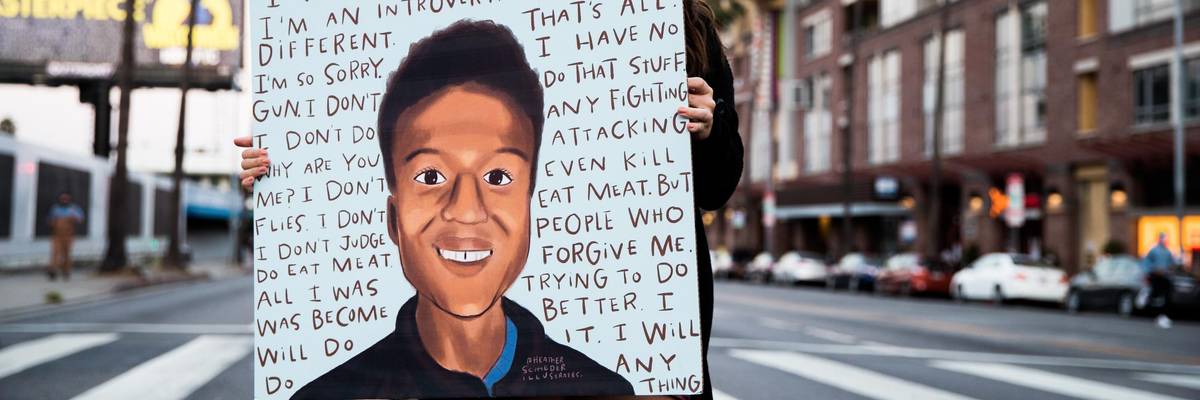
A person holds a sign at a candlelight vigil to demand justice for Elijah McClain on the one year anniversary of his death at The Laugh Factory on August 24, 2020 in West Hollywood, California. (Photo: Rich Fury/Getty Images)
"I can't breathe. I can't breathe please. I can't breathe, please." These words were recorded by the body cameras of Aurora, Colorado police as they assaulted a slight, 23-year-old African American man who was on the short walk home from his corner store after buying iced tea. It was 10:43 pm on August 24th, 2019. Aurora dispatchers had received a 911 call "describing a suspicious black male wearing a ski mask, 'acting weird.'" An officer approached McClain, saying, "Stop, I have a right to stop you since you're being suspicious." Within ten seconds officers tackle him to the ground. "My name is Elijah McClain...I'm an introvert and I'm different. [Sobbing] I'm just different, that's all."
Elijah continued, "Why were you attacking me? I don't do guns. I don't even kill flies. I don't eat meat.... I am a vegetarian. I don't judge people for anything...I respect all life."
The violent arrest continued, with two successive carotid choke holds and an "armbar hammerlock" that caused pain and injury to Elijah's shoulder. Emergency Medical Technicians arrived and, after misdiagnosing McClain with "excited delirium," injected him with a massive overdose of the sedative Ketamine. "I can't sense myself. Ow! Ah! Ow! Stop please!... I'm trying.... Please help me." Those words were the last ever uttered by Elijah McClain.
Within 18 minutes of being targeted and tackled by police, Elijah McClain, the young massage therapist and talented violinist, handcuffed and brutalized, aspirating his own vomit, suffered a cardiac arrest. After a delayed resuscitation that left him brain dead, McClain spent several days in the hospital, unconscious, on life support. He died on August 30th.
Just over two years later, long after officials in Aurora pronounced no wrongdoing by the police and paramedics, a grand jury convened by Colorado Attorney General Phil Weiser handed down a 32-count indictment. Three police officers, Randy Roedema, Nathan Woodyard and Jason Rosenblatt, and two paramedics, Jeremy Cooper and Peter Cichuniec, were charged Wednesday with manslaughter, negligent homicide, and related assaults. Rosenblatt was fired last year for replying "ha ha" to a photo of other Aurora officers mockingly reenacting the choke hold used on McClain; the other four were suspended without pay after the charges were announced.
"I'm thankful, I'm grateful that they saw what I saw," Sheneen McClain, Elijah's mother, told a Denver reporter. "He never should've been stopped, he never should've been brutalized, he never should've been handcuffed, and he never should have been given Ketamine."
The police killing of Elijah McClain gained national attention during the mass protests that erupted after George Floyd was murdered by Minneapolis Police on Memorial Day, 2020, nine months after Elijah's death. Mass marches shut down highways in Aurora, where protesters were rammed by a car and shot at. In one of the most moving images to emerge from the global protests during the summer of 2020, a violin vigil was held outside the Aurora Municipal Center, honoring Elijah McClain's memory with classical music. Elijah loved music, and played violin for stray cats at a local animal shelter. Aurora riot police attacked the vigil.
The McClain family's commitment to justice for Elijah, propelled by the sustained, mass protests, created the environment that led Colorado Governor Jared Polis to issue an executive order empowering the state Attorney General to investigate. Wednesday's indictment was the result.
Over the past two legislative sessions, State Representative Leslie Herod pushed three sweeping police accountability bills, which Gov. Polis signed into law.
"It was Sheneen's voice and her work that led to Colorado passing the largest and most impactful police accountability laws in the country," Herod said on the Democracy Now! news hour. These laws, Herod said, "called ketamine a use of force by law enforcement, ensure that we can have Special Investigations when someone dies at the hands of or at the direction of law enforcement. We banned chokeholds, and we ended qualified immunity."
Leslie Herod explained how she learned of Elijah's death, during a protest in June, 2020 that followed George Floyd's murder:
"This small, quiet woman stepped up from the crowds. I handed her the megaphone. She said, 'Why are you here for someone who died states away, but when I called you for support for my son, no one showed up?' The crowd turned to me and the emcee asked, 'Do you want us to take the microphone back?' And I said, 'No, I want to have this conversation.' I asked who her son was, and she said Elijah McClain. I knew right then that her voice needed to be centered in this conversation...So from that moment on, we worked lockstep to pass police accountability."
It's not just that movements make a difference. They make all the difference.
This country and this world are at a monumental crossroads. US voters have an opportunity to beat back the forces of fascism and confront the billionaires who are rigging the economy, our media system, and our democracy, making it increasingly impossible for ordinary people to get by. We’re not just talking about the election. We’re talking about what must be done once these fascist elements are vanquished from power. We need a bolder set of solutions than what either major party has so far been willing to offer and a working-class movement ready to fight like hell for it. Trump didn't emerge from nowhere. The conditions that fueled MAGA authoritarianism were created by decades of radical neoliberal economic policies and a corrupt political system dominated by corporate interests. They slashed taxes on the super-rich, promising that the benefits would trickle down. They said giveaways to the corporate titans would make life more affordable for the rest of us. It was all bullshit. And when a bitter, betrayed populace searches for someone to blame, right-wing demagogues have little trouble finding scapegoats. People know when they're being lied to, but you won't hear any of this from the corporate media. Only independent journalism—powered and funded by people who believe in building a better world—can deliver truly trustworthy daily news. If you share our vision, please contribute whatever you can to sustain our work. |
"I can't breathe. I can't breathe please. I can't breathe, please." These words were recorded by the body cameras of Aurora, Colorado police as they assaulted a slight, 23-year-old African American man who was on the short walk home from his corner store after buying iced tea. It was 10:43 pm on August 24th, 2019. Aurora dispatchers had received a 911 call "describing a suspicious black male wearing a ski mask, 'acting weird.'" An officer approached McClain, saying, "Stop, I have a right to stop you since you're being suspicious." Within ten seconds officers tackle him to the ground. "My name is Elijah McClain...I'm an introvert and I'm different. [Sobbing] I'm just different, that's all."
Elijah continued, "Why were you attacking me? I don't do guns. I don't even kill flies. I don't eat meat.... I am a vegetarian. I don't judge people for anything...I respect all life."
The violent arrest continued, with two successive carotid choke holds and an "armbar hammerlock" that caused pain and injury to Elijah's shoulder. Emergency Medical Technicians arrived and, after misdiagnosing McClain with "excited delirium," injected him with a massive overdose of the sedative Ketamine. "I can't sense myself. Ow! Ah! Ow! Stop please!... I'm trying.... Please help me." Those words were the last ever uttered by Elijah McClain.
Within 18 minutes of being targeted and tackled by police, Elijah McClain, the young massage therapist and talented violinist, handcuffed and brutalized, aspirating his own vomit, suffered a cardiac arrest. After a delayed resuscitation that left him brain dead, McClain spent several days in the hospital, unconscious, on life support. He died on August 30th.
Just over two years later, long after officials in Aurora pronounced no wrongdoing by the police and paramedics, a grand jury convened by Colorado Attorney General Phil Weiser handed down a 32-count indictment. Three police officers, Randy Roedema, Nathan Woodyard and Jason Rosenblatt, and two paramedics, Jeremy Cooper and Peter Cichuniec, were charged Wednesday with manslaughter, negligent homicide, and related assaults. Rosenblatt was fired last year for replying "ha ha" to a photo of other Aurora officers mockingly reenacting the choke hold used on McClain; the other four were suspended without pay after the charges were announced.
"I'm thankful, I'm grateful that they saw what I saw," Sheneen McClain, Elijah's mother, told a Denver reporter. "He never should've been stopped, he never should've been brutalized, he never should've been handcuffed, and he never should have been given Ketamine."
The police killing of Elijah McClain gained national attention during the mass protests that erupted after George Floyd was murdered by Minneapolis Police on Memorial Day, 2020, nine months after Elijah's death. Mass marches shut down highways in Aurora, where protesters were rammed by a car and shot at. In one of the most moving images to emerge from the global protests during the summer of 2020, a violin vigil was held outside the Aurora Municipal Center, honoring Elijah McClain's memory with classical music. Elijah loved music, and played violin for stray cats at a local animal shelter. Aurora riot police attacked the vigil.
The McClain family's commitment to justice for Elijah, propelled by the sustained, mass protests, created the environment that led Colorado Governor Jared Polis to issue an executive order empowering the state Attorney General to investigate. Wednesday's indictment was the result.
Over the past two legislative sessions, State Representative Leslie Herod pushed three sweeping police accountability bills, which Gov. Polis signed into law.
"It was Sheneen's voice and her work that led to Colorado passing the largest and most impactful police accountability laws in the country," Herod said on the Democracy Now! news hour. These laws, Herod said, "called ketamine a use of force by law enforcement, ensure that we can have Special Investigations when someone dies at the hands of or at the direction of law enforcement. We banned chokeholds, and we ended qualified immunity."
Leslie Herod explained how she learned of Elijah's death, during a protest in June, 2020 that followed George Floyd's murder:
"This small, quiet woman stepped up from the crowds. I handed her the megaphone. She said, 'Why are you here for someone who died states away, but when I called you for support for my son, no one showed up?' The crowd turned to me and the emcee asked, 'Do you want us to take the microphone back?' And I said, 'No, I want to have this conversation.' I asked who her son was, and she said Elijah McClain. I knew right then that her voice needed to be centered in this conversation...So from that moment on, we worked lockstep to pass police accountability."
It's not just that movements make a difference. They make all the difference.