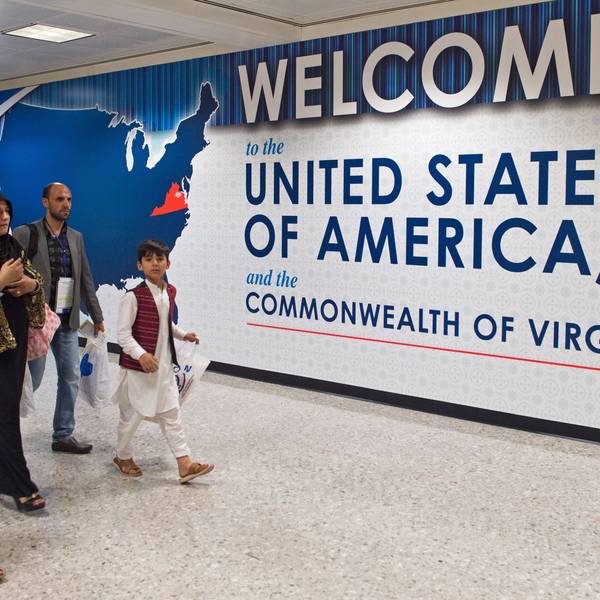

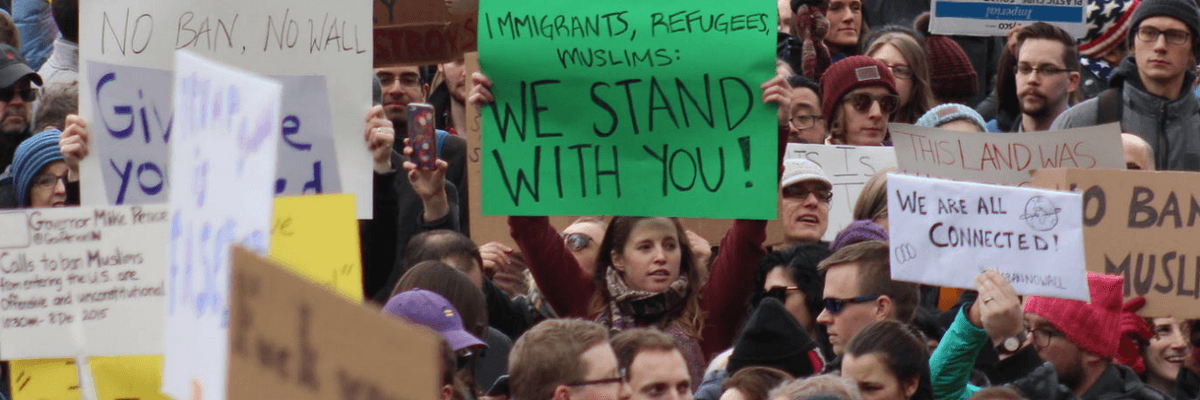
"It was delivered by thousands of people spontaneously coming together at airports across the country to declare that we will not stand for hatred and discrimination." (Photo: Ryan/flickr/cc)
The Supreme Court Ignores the Reality of President Trump's Discriminatory Muslim Ban
Trump’s consistent messages and actions paint a “harrowing picture, from which a reasonable observer would readily conclude that the Proclamation was motivated by hostility and animus toward the Muslim faith.”
The Supreme Court today rejected the challenge to President Trump's Muslim Ban. In its 5-to-4 decision, the court failed to make good on principles at the heart of our constitutional system -- including the absolute prohibition on official disfavor of a particular religion. The fight against the ban will continue, but the court's decision is devastating. History will not be kind to the court's approval of an unfounded and blatantly anti-Muslim order.
By now the story of this shameful policy is familiar. During his campaign, Trump issued a statement calling for "a total and complete shutdown of Muslims entering the United States" -- which remained on his website until well into his term in office. That was hardly a stray comment. Rather, over and over, both before and after the election, Trump expressed his animus for Islam and Muslims and tied that animus to his proposed immigration ban.
The message it relays to Muslim communities around the country and around the world is that our Constitution tolerates transparent discrimination and animus against Islam.
Just one week into office, Trump attempted to make good on the campaign promise, issuing a sweeping ban on over a hundred million Muslims without even consulting the government's national security experts. Courts rejected that first version as well as the order the administration crafted to replace it. Finally, those temporary measures were replaced by the current proclamation, which likewise bans over 150 million people -- approximately 95 percent of them Muslim. As Justice Sotomayor explained in her dissenting opinion, Trump's consistent messages and actions paint a "harrowing picture, from which a reasonable observer would readily conclude that the Proclamation was motivated by hostility and animus toward the Muslim faith."
Nonetheless, the court today rejected the constitutional challenge to the ban. Applying deference to the president despite the evidence presented, the court explained that it would "uphold the policy so long as it can reasonably be understood to result from a justification independent of unconstitutional grounds." The court then concluded based on the record in the case that the ban had "a legitimate grounding in national security concerns, quite apart from any religious hostility."
As Justice Sotomayor cogently explained, the majority could reach this conclusion only by "ignoring the facts, misconstruing our legal precedent, and turning a blind eye to the pain and suffering the Proclamation inflicts upon countless families and individuals." In this respect, as she noted, the case repeats some of the worst mistakes the court has made in the past. In particular, the parallels to Korematsu v. United States, the court's 1944 decision upholding the incarceration of Japanese-Americans, are striking.
As in that case, the court today paid lip service to the vital constitutional values at stake, but it willfully ignored the reality of the situation. The majority today repudiated Korematsu, saying it "was gravely wrong the day it was decided." But as Justice Sotomayor pointed out, then, as now, it was clear to those willing to look at the evidence that the government's policy was not about safety but prejudice:
"By blindly accepting the Government's misguided invitation to sanction a discriminatory policy motivated by animosity toward a disfavored group, all in the name of a superficial claim of national security, the Court redeploys the same dangerous logic underlying Korematsu and merely replaces one 'gravely wrong' decision with another."
Today's decision is devastating. Whatever the court may have intended, the message it relays to Muslim communities around the country and around the world is that our Constitution tolerates transparent discrimination and animus against Islam. It undermines our standing to encourage tolerance and pluralistic democracy abroad, and it reinforces the intended message that Muslims -- and immigrants, people of color, LGBT communities, and other marginalized groups -- are not welcome in Trump's America.
But this fight is not over.
Indeed, the greatest repudiation of Trump's anti-Muslim policy to date was not delivered by any court. Instead, it was delivered by thousands of people spontaneously coming together at airports across the country to declare that we will not stand for hatred and discrimination.
In that spirit, we all need to redouble our efforts to organize, protest, and push Congress to end the ban once and for all. This is a painful setback, but the struggle for a free, equal, and inclusive America will continue.
An Urgent Message From Our Co-Founder
Dear Common Dreams reader, It’s been nearly 30 years since I co-founded Common Dreams with my late wife, Lina Newhouser. We had the radical notion that journalism should serve the public good, not corporate profits. It was clear to us from the outset what it would take to build such a project. No paid advertisements. No corporate sponsors. No millionaire publisher telling us what to think or do. Many people said we wouldn't last a year, but we proved those doubters wrong. Together with a tremendous team of journalists and dedicated staff, we built an independent media outlet free from the constraints of profits and corporate control. Our mission has always been simple: To inform. To inspire. To ignite change for the common good. Building Common Dreams was not easy. Our survival was never guaranteed. When you take on the most powerful forces—Wall Street greed, fossil fuel industry destruction, Big Tech lobbyists, and uber-rich oligarchs who have spent billions upon billions rigging the economy and democracy in their favor—the only bulwark you have is supporters who believe in your work. But here’s the urgent message from me today. It's never been this bad out there. And it's never been this hard to keep us going. At the very moment Common Dreams is most needed, the threats we face are intensifying. We need your support now more than ever. We don't accept corporate advertising and never will. We don't have a paywall because we don't think people should be blocked from critical news based on their ability to pay. Everything we do is funded by the donations of readers like you. When everyone does the little they can afford, we are strong. But if that support retreats or dries up, so do we. Will you donate now to make sure Common Dreams not only survives but thrives? —Craig Brown, Co-founder |
The Supreme Court today rejected the challenge to President Trump's Muslim Ban. In its 5-to-4 decision, the court failed to make good on principles at the heart of our constitutional system -- including the absolute prohibition on official disfavor of a particular religion. The fight against the ban will continue, but the court's decision is devastating. History will not be kind to the court's approval of an unfounded and blatantly anti-Muslim order.
By now the story of this shameful policy is familiar. During his campaign, Trump issued a statement calling for "a total and complete shutdown of Muslims entering the United States" -- which remained on his website until well into his term in office. That was hardly a stray comment. Rather, over and over, both before and after the election, Trump expressed his animus for Islam and Muslims and tied that animus to his proposed immigration ban.
The message it relays to Muslim communities around the country and around the world is that our Constitution tolerates transparent discrimination and animus against Islam.
Just one week into office, Trump attempted to make good on the campaign promise, issuing a sweeping ban on over a hundred million Muslims without even consulting the government's national security experts. Courts rejected that first version as well as the order the administration crafted to replace it. Finally, those temporary measures were replaced by the current proclamation, which likewise bans over 150 million people -- approximately 95 percent of them Muslim. As Justice Sotomayor explained in her dissenting opinion, Trump's consistent messages and actions paint a "harrowing picture, from which a reasonable observer would readily conclude that the Proclamation was motivated by hostility and animus toward the Muslim faith."
Nonetheless, the court today rejected the constitutional challenge to the ban. Applying deference to the president despite the evidence presented, the court explained that it would "uphold the policy so long as it can reasonably be understood to result from a justification independent of unconstitutional grounds." The court then concluded based on the record in the case that the ban had "a legitimate grounding in national security concerns, quite apart from any religious hostility."
As Justice Sotomayor cogently explained, the majority could reach this conclusion only by "ignoring the facts, misconstruing our legal precedent, and turning a blind eye to the pain and suffering the Proclamation inflicts upon countless families and individuals." In this respect, as she noted, the case repeats some of the worst mistakes the court has made in the past. In particular, the parallels to Korematsu v. United States, the court's 1944 decision upholding the incarceration of Japanese-Americans, are striking.
As in that case, the court today paid lip service to the vital constitutional values at stake, but it willfully ignored the reality of the situation. The majority today repudiated Korematsu, saying it "was gravely wrong the day it was decided." But as Justice Sotomayor pointed out, then, as now, it was clear to those willing to look at the evidence that the government's policy was not about safety but prejudice:
"By blindly accepting the Government's misguided invitation to sanction a discriminatory policy motivated by animosity toward a disfavored group, all in the name of a superficial claim of national security, the Court redeploys the same dangerous logic underlying Korematsu and merely replaces one 'gravely wrong' decision with another."
Today's decision is devastating. Whatever the court may have intended, the message it relays to Muslim communities around the country and around the world is that our Constitution tolerates transparent discrimination and animus against Islam. It undermines our standing to encourage tolerance and pluralistic democracy abroad, and it reinforces the intended message that Muslims -- and immigrants, people of color, LGBT communities, and other marginalized groups -- are not welcome in Trump's America.
But this fight is not over.
Indeed, the greatest repudiation of Trump's anti-Muslim policy to date was not delivered by any court. Instead, it was delivered by thousands of people spontaneously coming together at airports across the country to declare that we will not stand for hatred and discrimination.
In that spirit, we all need to redouble our efforts to organize, protest, and push Congress to end the ban once and for all. This is a painful setback, but the struggle for a free, equal, and inclusive America will continue.
The Supreme Court today rejected the challenge to President Trump's Muslim Ban. In its 5-to-4 decision, the court failed to make good on principles at the heart of our constitutional system -- including the absolute prohibition on official disfavor of a particular religion. The fight against the ban will continue, but the court's decision is devastating. History will not be kind to the court's approval of an unfounded and blatantly anti-Muslim order.
By now the story of this shameful policy is familiar. During his campaign, Trump issued a statement calling for "a total and complete shutdown of Muslims entering the United States" -- which remained on his website until well into his term in office. That was hardly a stray comment. Rather, over and over, both before and after the election, Trump expressed his animus for Islam and Muslims and tied that animus to his proposed immigration ban.
The message it relays to Muslim communities around the country and around the world is that our Constitution tolerates transparent discrimination and animus against Islam.
Just one week into office, Trump attempted to make good on the campaign promise, issuing a sweeping ban on over a hundred million Muslims without even consulting the government's national security experts. Courts rejected that first version as well as the order the administration crafted to replace it. Finally, those temporary measures were replaced by the current proclamation, which likewise bans over 150 million people -- approximately 95 percent of them Muslim. As Justice Sotomayor explained in her dissenting opinion, Trump's consistent messages and actions paint a "harrowing picture, from which a reasonable observer would readily conclude that the Proclamation was motivated by hostility and animus toward the Muslim faith."
Nonetheless, the court today rejected the constitutional challenge to the ban. Applying deference to the president despite the evidence presented, the court explained that it would "uphold the policy so long as it can reasonably be understood to result from a justification independent of unconstitutional grounds." The court then concluded based on the record in the case that the ban had "a legitimate grounding in national security concerns, quite apart from any religious hostility."
As Justice Sotomayor cogently explained, the majority could reach this conclusion only by "ignoring the facts, misconstruing our legal precedent, and turning a blind eye to the pain and suffering the Proclamation inflicts upon countless families and individuals." In this respect, as she noted, the case repeats some of the worst mistakes the court has made in the past. In particular, the parallels to Korematsu v. United States, the court's 1944 decision upholding the incarceration of Japanese-Americans, are striking.
As in that case, the court today paid lip service to the vital constitutional values at stake, but it willfully ignored the reality of the situation. The majority today repudiated Korematsu, saying it "was gravely wrong the day it was decided." But as Justice Sotomayor pointed out, then, as now, it was clear to those willing to look at the evidence that the government's policy was not about safety but prejudice:
"By blindly accepting the Government's misguided invitation to sanction a discriminatory policy motivated by animosity toward a disfavored group, all in the name of a superficial claim of national security, the Court redeploys the same dangerous logic underlying Korematsu and merely replaces one 'gravely wrong' decision with another."
Today's decision is devastating. Whatever the court may have intended, the message it relays to Muslim communities around the country and around the world is that our Constitution tolerates transparent discrimination and animus against Islam. It undermines our standing to encourage tolerance and pluralistic democracy abroad, and it reinforces the intended message that Muslims -- and immigrants, people of color, LGBT communities, and other marginalized groups -- are not welcome in Trump's America.
But this fight is not over.
Indeed, the greatest repudiation of Trump's anti-Muslim policy to date was not delivered by any court. Instead, it was delivered by thousands of people spontaneously coming together at airports across the country to declare that we will not stand for hatred and discrimination.
In that spirit, we all need to redouble our efforts to organize, protest, and push Congress to end the ban once and for all. This is a painful setback, but the struggle for a free, equal, and inclusive America will continue.