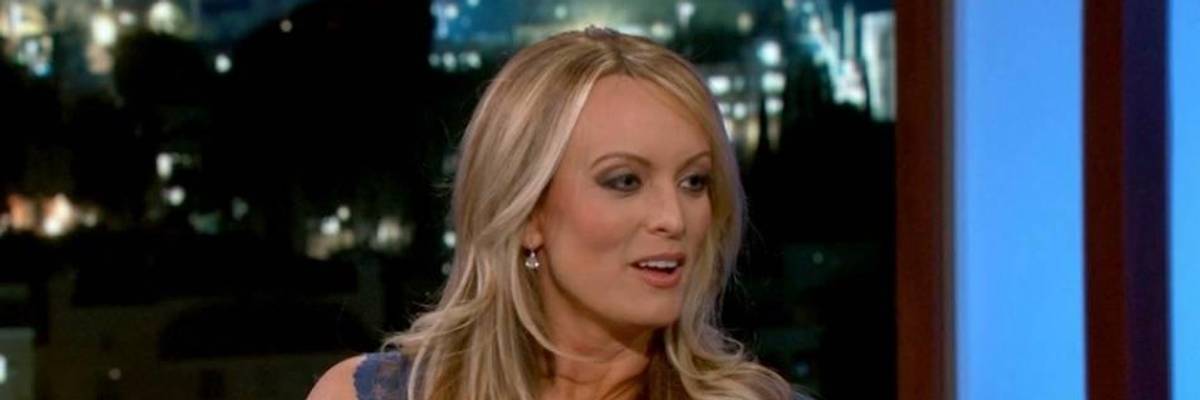
"The Daniels payment remains a reportable liability regardless of the billing arrangement." (Photo: "Jimmy Kimmel Live!"/Screenshot)
Out of Loopholes, Trump Must Disclose Stormy Daniels Debt in Next Financial Report
Trump is out of loopholes. After failing to disclose his Stormy Daniels debt to Michael Cohen, he needs to come clean in his next financial report on that debt and any others he may have left out.
President Trump has a big decision to make. Unless he requests an extension, his personal financial disclosure report is due on Tuesday. Under the Ethics in Government Act, he has to disclose all liabilities that exceeded $10,000 at any time during calendar year 2017, even if he repaid them later that year. That includes his debt to Michael Cohen for the $130,000 payment Cohen made in October 2016 to adult film star Stormy Daniels (real name Stephanie Clifford).
The question is whether Trump will disclose that debt, as well as any others he may have omitted.
The answer should be easy, but the president is in a difficult position. He left out the Daniels-related debt in the financial disclosure report he filed on June 14, 2017. Disclosing it now means acknowledging that he should have disclosed it last year. Disclosure may also lead to damaging revelations if he omitted other liabilities from any past financial disclosure reports or incurred new ones since June. As a result, the president's team may be looking for a way to justify the omission.
Rudy Giuliani, Trump's personal lawyer, seemed to be trying out a loophole when he called the payment to Daniels an "expense." He questioned the applicability of the Ethics in Government Act to the reimbursement of expenses. Even ignoring the disingenuousness of calling the payment an expense, however, there is no exception for expenses.
The law comprehensively requires disclosure of "the total liabilities owed to any creditor." The Office of Government Ethics (OGE) has explained that, "Nowhere in the statute or its legislative history can we find any indication that the terms 'liabilities' and 'creditor' were intended to be limited to cash loans or to be defined in a manner other than their ordinary usage."
Both Giuliani and his client seemed to work a related angle by characterizing the president's payments to Cohen as a "retainer." Giuliani claimed the president started making installment payments to Cohen in early 2017 in order to reimburse the Daniels payment and other items, with the understanding that Cohen could keep any excess as "profit."
In describing the billing arrangement this way, Giuliani may have hoped the president could avoid the requirement to report his debt for the Daniels payment by blurring the line between that payment and any fees for Cohen's services. (OGE once said legal fees have to be reported but, in practice, applies this requirement only when the fees are overdue.) Nevertheless, bundling the Daniels payment with Cohen's legal fees doesn't make that payment a legal fee. The Daniels payment remains a reportable liability regardless of the billing arrangement.
The search for loopholes might lead to the exception for campaign expenditures, which Trump does not have to include in his OGE financial disclosure report. But Giuliani foreclosed that option when he denied that the Daniels payment was campaign-related. If it had been campaign-related, the Trump campaign would have had a duty to report both the Cohen reimbursement and the underlying Daniels payment to the Federal Election Commission. The Trump campaign filed no such report, and a knowing failure to report that kind of campaign-related payment would be a criminal offense.
Another dead end in the search for loopholes is OGE's exception for debts owed by a business. There are several reasons why this exception doesn't fit the bill. First, the president would have to claim that making hush money payments to adult film stars relates to the operations of the Trump Organization. Second, Cohen denied that the Trump Organization reimbursed him. Third, claiming the Trump Organization paid to silence Daniels just before the election could lead to criminal prosecution under a century-old law banning corporate contributions to federal candidates, if prosecutors believed the Trump Organization was trying, even in part, to help Trump get elected and coordinated the payment with him.
Lacking a suitable loophole, Trump should cut his losses. He may already be in trouble for omitting his debt to Cohen from last year's report. If that omission was knowing and willful, the president may have violated a law that comes with civil and criminal penalties -- more than one law in fact.
There is room to wonder if the omission was knowing and willful. Giuliani inconsistently asserts that the president was unaware of the debt when he filed his June 2017 report but that he began repaying the debt months earlier. It seems implausible that the president didn't know of a debt he was repaying, all the more so when one considers the highly personal nature of the matter; the duty of attorneys to communicate with clients about settlement offers; the Trump team's shifting stories; and the degree to which it would have been unusual (maybe unethical) for Cohen to front the money without consulting his client.
Under the circumstances, the Justice Department should investigate last year's omission. For his part, Trump should avoid giving Justice another potential violation to investigate when he files his financial disclosure report Tuesday.
An Urgent Message From Our Co-Founder
Dear Common Dreams reader, It’s been nearly 30 years since I co-founded Common Dreams with my late wife, Lina Newhouser. We had the radical notion that journalism should serve the public good, not corporate profits. It was clear to us from the outset what it would take to build such a project. No paid advertisements. No corporate sponsors. No millionaire publisher telling us what to think or do. Many people said we wouldn't last a year, but we proved those doubters wrong. Together with a tremendous team of journalists and dedicated staff, we built an independent media outlet free from the constraints of profits and corporate control. Our mission has always been simple: To inform. To inspire. To ignite change for the common good. Building Common Dreams was not easy. Our survival was never guaranteed. When you take on the most powerful forces—Wall Street greed, fossil fuel industry destruction, Big Tech lobbyists, and uber-rich oligarchs who have spent billions upon billions rigging the economy and democracy in their favor—the only bulwark you have is supporters who believe in your work. But here’s the urgent message from me today. It's never been this bad out there. And it's never been this hard to keep us going. At the very moment Common Dreams is most needed, the threats we face are intensifying. We need your support now more than ever. We don't accept corporate advertising and never will. We don't have a paywall because we don't think people should be blocked from critical news based on their ability to pay. Everything we do is funded by the donations of readers like you. When everyone does the little they can afford, we are strong. But if that support retreats or dries up, so do we. Will you donate now to make sure Common Dreams not only survives but thrives? —Craig Brown, Co-founder |
President Trump has a big decision to make. Unless he requests an extension, his personal financial disclosure report is due on Tuesday. Under the Ethics in Government Act, he has to disclose all liabilities that exceeded $10,000 at any time during calendar year 2017, even if he repaid them later that year. That includes his debt to Michael Cohen for the $130,000 payment Cohen made in October 2016 to adult film star Stormy Daniels (real name Stephanie Clifford).
The question is whether Trump will disclose that debt, as well as any others he may have omitted.
The answer should be easy, but the president is in a difficult position. He left out the Daniels-related debt in the financial disclosure report he filed on June 14, 2017. Disclosing it now means acknowledging that he should have disclosed it last year. Disclosure may also lead to damaging revelations if he omitted other liabilities from any past financial disclosure reports or incurred new ones since June. As a result, the president's team may be looking for a way to justify the omission.
Rudy Giuliani, Trump's personal lawyer, seemed to be trying out a loophole when he called the payment to Daniels an "expense." He questioned the applicability of the Ethics in Government Act to the reimbursement of expenses. Even ignoring the disingenuousness of calling the payment an expense, however, there is no exception for expenses.
The law comprehensively requires disclosure of "the total liabilities owed to any creditor." The Office of Government Ethics (OGE) has explained that, "Nowhere in the statute or its legislative history can we find any indication that the terms 'liabilities' and 'creditor' were intended to be limited to cash loans or to be defined in a manner other than their ordinary usage."
Both Giuliani and his client seemed to work a related angle by characterizing the president's payments to Cohen as a "retainer." Giuliani claimed the president started making installment payments to Cohen in early 2017 in order to reimburse the Daniels payment and other items, with the understanding that Cohen could keep any excess as "profit."
In describing the billing arrangement this way, Giuliani may have hoped the president could avoid the requirement to report his debt for the Daniels payment by blurring the line between that payment and any fees for Cohen's services. (OGE once said legal fees have to be reported but, in practice, applies this requirement only when the fees are overdue.) Nevertheless, bundling the Daniels payment with Cohen's legal fees doesn't make that payment a legal fee. The Daniels payment remains a reportable liability regardless of the billing arrangement.
The search for loopholes might lead to the exception for campaign expenditures, which Trump does not have to include in his OGE financial disclosure report. But Giuliani foreclosed that option when he denied that the Daniels payment was campaign-related. If it had been campaign-related, the Trump campaign would have had a duty to report both the Cohen reimbursement and the underlying Daniels payment to the Federal Election Commission. The Trump campaign filed no such report, and a knowing failure to report that kind of campaign-related payment would be a criminal offense.
Another dead end in the search for loopholes is OGE's exception for debts owed by a business. There are several reasons why this exception doesn't fit the bill. First, the president would have to claim that making hush money payments to adult film stars relates to the operations of the Trump Organization. Second, Cohen denied that the Trump Organization reimbursed him. Third, claiming the Trump Organization paid to silence Daniels just before the election could lead to criminal prosecution under a century-old law banning corporate contributions to federal candidates, if prosecutors believed the Trump Organization was trying, even in part, to help Trump get elected and coordinated the payment with him.
Lacking a suitable loophole, Trump should cut his losses. He may already be in trouble for omitting his debt to Cohen from last year's report. If that omission was knowing and willful, the president may have violated a law that comes with civil and criminal penalties -- more than one law in fact.
There is room to wonder if the omission was knowing and willful. Giuliani inconsistently asserts that the president was unaware of the debt when he filed his June 2017 report but that he began repaying the debt months earlier. It seems implausible that the president didn't know of a debt he was repaying, all the more so when one considers the highly personal nature of the matter; the duty of attorneys to communicate with clients about settlement offers; the Trump team's shifting stories; and the degree to which it would have been unusual (maybe unethical) for Cohen to front the money without consulting his client.
Under the circumstances, the Justice Department should investigate last year's omission. For his part, Trump should avoid giving Justice another potential violation to investigate when he files his financial disclosure report Tuesday.
President Trump has a big decision to make. Unless he requests an extension, his personal financial disclosure report is due on Tuesday. Under the Ethics in Government Act, he has to disclose all liabilities that exceeded $10,000 at any time during calendar year 2017, even if he repaid them later that year. That includes his debt to Michael Cohen for the $130,000 payment Cohen made in October 2016 to adult film star Stormy Daniels (real name Stephanie Clifford).
The question is whether Trump will disclose that debt, as well as any others he may have omitted.
The answer should be easy, but the president is in a difficult position. He left out the Daniels-related debt in the financial disclosure report he filed on June 14, 2017. Disclosing it now means acknowledging that he should have disclosed it last year. Disclosure may also lead to damaging revelations if he omitted other liabilities from any past financial disclosure reports or incurred new ones since June. As a result, the president's team may be looking for a way to justify the omission.
Rudy Giuliani, Trump's personal lawyer, seemed to be trying out a loophole when he called the payment to Daniels an "expense." He questioned the applicability of the Ethics in Government Act to the reimbursement of expenses. Even ignoring the disingenuousness of calling the payment an expense, however, there is no exception for expenses.
The law comprehensively requires disclosure of "the total liabilities owed to any creditor." The Office of Government Ethics (OGE) has explained that, "Nowhere in the statute or its legislative history can we find any indication that the terms 'liabilities' and 'creditor' were intended to be limited to cash loans or to be defined in a manner other than their ordinary usage."
Both Giuliani and his client seemed to work a related angle by characterizing the president's payments to Cohen as a "retainer." Giuliani claimed the president started making installment payments to Cohen in early 2017 in order to reimburse the Daniels payment and other items, with the understanding that Cohen could keep any excess as "profit."
In describing the billing arrangement this way, Giuliani may have hoped the president could avoid the requirement to report his debt for the Daniels payment by blurring the line between that payment and any fees for Cohen's services. (OGE once said legal fees have to be reported but, in practice, applies this requirement only when the fees are overdue.) Nevertheless, bundling the Daniels payment with Cohen's legal fees doesn't make that payment a legal fee. The Daniels payment remains a reportable liability regardless of the billing arrangement.
The search for loopholes might lead to the exception for campaign expenditures, which Trump does not have to include in his OGE financial disclosure report. But Giuliani foreclosed that option when he denied that the Daniels payment was campaign-related. If it had been campaign-related, the Trump campaign would have had a duty to report both the Cohen reimbursement and the underlying Daniels payment to the Federal Election Commission. The Trump campaign filed no such report, and a knowing failure to report that kind of campaign-related payment would be a criminal offense.
Another dead end in the search for loopholes is OGE's exception for debts owed by a business. There are several reasons why this exception doesn't fit the bill. First, the president would have to claim that making hush money payments to adult film stars relates to the operations of the Trump Organization. Second, Cohen denied that the Trump Organization reimbursed him. Third, claiming the Trump Organization paid to silence Daniels just before the election could lead to criminal prosecution under a century-old law banning corporate contributions to federal candidates, if prosecutors believed the Trump Organization was trying, even in part, to help Trump get elected and coordinated the payment with him.
Lacking a suitable loophole, Trump should cut his losses. He may already be in trouble for omitting his debt to Cohen from last year's report. If that omission was knowing and willful, the president may have violated a law that comes with civil and criminal penalties -- more than one law in fact.
There is room to wonder if the omission was knowing and willful. Giuliani inconsistently asserts that the president was unaware of the debt when he filed his June 2017 report but that he began repaying the debt months earlier. It seems implausible that the president didn't know of a debt he was repaying, all the more so when one considers the highly personal nature of the matter; the duty of attorneys to communicate with clients about settlement offers; the Trump team's shifting stories; and the degree to which it would have been unusual (maybe unethical) for Cohen to front the money without consulting his client.
Under the circumstances, the Justice Department should investigate last year's omission. For his part, Trump should avoid giving Justice another potential violation to investigate when he files his financial disclosure report Tuesday.