SUBSCRIBE TO OUR FREE NEWSLETTER
Daily news & progressive opinion—funded by the people, not the corporations—delivered straight to your inbox.
5
#000000
#FFFFFF
To donate by check, phone, or other method, see our More Ways to Give page.
Daily news & progressive opinion—funded by the people, not the corporations—delivered straight to your inbox.
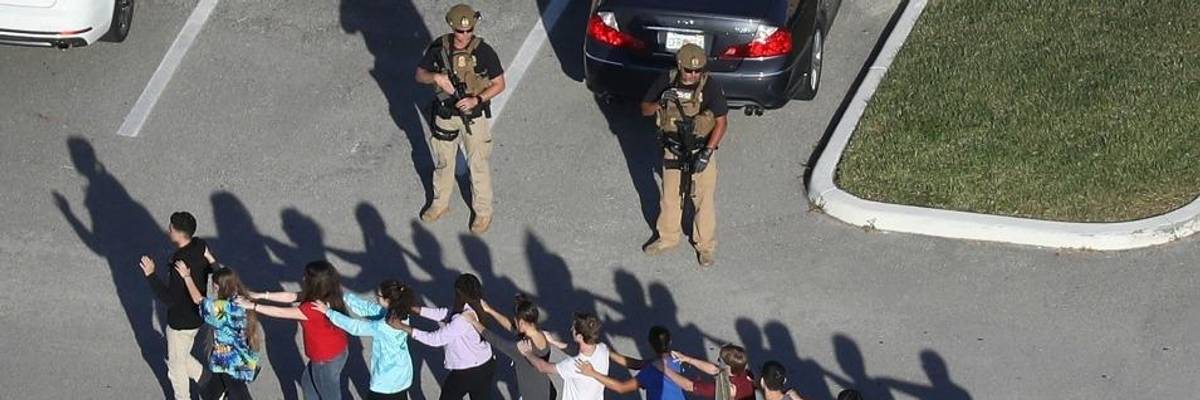
"Nothing that happens so often can be thought of as anything but routine." (Photo: Joe Raedle/Getty Images)
Nothing symbolizes the foreclosure of the future like the slaughter of a nation's young. And it's so routine now -- there have been at least eight this year at a school or college where someone was injured or killed -- that attention will quickly fade, as it does with subjects one doesn't intend to do anything about. Another word for that bitter fatalism is "defeat."
And we have been, in an important moral sense, defeated. We won't do anything about it, or can't; the fact is so well understood that we don't even need new commentaries stating as much for each shooting -- we just recycle the old ones, from the old shootings. If this is what American freedom means, if this is what the Constitution entails, if this is where prayer gets us, then it's easy to understand why millennials -- the first generation to be raised on a steady stream of schoolhouse slaughter -- barely believe in anything, democracy, American-style liberty, America's future and organized religion included.
Regular mass gun violence is a particularly American phenomenon, and it's dissolving society in a particularly American way. With every mass shooting and every utter failure of public policy to respond, the American notion of liberty looks more and more suicidal, a Faustian bargain exchanging sensible restrictions for a nihilistic, diabolical freedom. After the worst mass shooting in modern U.S. history, which happened in Las Vegas only last year, conservative pundit Bill O'Reilly articulated this grim view most clearly: "Once again, the big downside of American freedom is on gruesome display," he wrote. "This is the price of freedom." Liberty stands now in opposition to life and the pursuit of happiness; no longer do all three seem concurrently possible, and it's clear which of them we've chosen.
Faith in freedom, faith in the Constitution, and lastly, faith in God -- that, too, is compromised by these bloody rituals. There is perhaps no other social or political occasion in which the pat response to one's offer of prayers is instant righteous fury and open, bitter disbelief. It's a subgenre of public discussion of religion that is unique to mass shootings, and one can see why. Every time this happens, the same politicians offer their thoughts and prayers; every time it happens again, they offer more of the same, and never anything more. One conclusion is that they must not be praying very ardently; another is that the prayers simply aren't heard. For this shooting, the cycle has already begun. Either way, prayer itself winds up looking like a sham, and such promises sound cheaper every time.
The doubts that creep into one's mind in the shadow of extreme events usually fade: There's no use judging the ordinary by the logic of the extraordinary, after all. But day by day, it grows more and more difficult to view these murders as extraordinary. Nothing that happens so often can be thought of as anything but routine. And if these killings are mundane, then the contradictions and faults they expose at the heart of American life are better understood as general problems than specific, localized ones. The rot is in the heart of the thing, not at the margins.
And every time we rehearse again the motions that follow the destruction of young lives, millennial cynicism looks more like simple reason. It's likely the case that the killings alone would be enough to vastly damage social cohesion and public morale. But our utter inability to contend with them is far more acidic to the ideas on which our American experiment depends. This may be the way a dream ends: with a whimper, after a bang.
Dear Common Dreams reader, It’s been nearly 30 years since I co-founded Common Dreams with my late wife, Lina Newhouser. We had the radical notion that journalism should serve the public good, not corporate profits. It was clear to us from the outset what it would take to build such a project. No paid advertisements. No corporate sponsors. No millionaire publisher telling us what to think or do. Many people said we wouldn't last a year, but we proved those doubters wrong. Together with a tremendous team of journalists and dedicated staff, we built an independent media outlet free from the constraints of profits and corporate control. Our mission has always been simple: To inform. To inspire. To ignite change for the common good. Building Common Dreams was not easy. Our survival was never guaranteed. When you take on the most powerful forces—Wall Street greed, fossil fuel industry destruction, Big Tech lobbyists, and uber-rich oligarchs who have spent billions upon billions rigging the economy and democracy in their favor—the only bulwark you have is supporters who believe in your work. But here’s the urgent message from me today. It's never been this bad out there. And it's never been this hard to keep us going. At the very moment Common Dreams is most needed, the threats we face are intensifying. We need your support now more than ever. We don't accept corporate advertising and never will. We don't have a paywall because we don't think people should be blocked from critical news based on their ability to pay. Everything we do is funded by the donations of readers like you. When everyone does the little they can afford, we are strong. But if that support retreats or dries up, so do we. Will you donate now to make sure Common Dreams not only survives but thrives? —Craig Brown, Co-founder |
Nothing symbolizes the foreclosure of the future like the slaughter of a nation's young. And it's so routine now -- there have been at least eight this year at a school or college where someone was injured or killed -- that attention will quickly fade, as it does with subjects one doesn't intend to do anything about. Another word for that bitter fatalism is "defeat."
And we have been, in an important moral sense, defeated. We won't do anything about it, or can't; the fact is so well understood that we don't even need new commentaries stating as much for each shooting -- we just recycle the old ones, from the old shootings. If this is what American freedom means, if this is what the Constitution entails, if this is where prayer gets us, then it's easy to understand why millennials -- the first generation to be raised on a steady stream of schoolhouse slaughter -- barely believe in anything, democracy, American-style liberty, America's future and organized religion included.
Regular mass gun violence is a particularly American phenomenon, and it's dissolving society in a particularly American way. With every mass shooting and every utter failure of public policy to respond, the American notion of liberty looks more and more suicidal, a Faustian bargain exchanging sensible restrictions for a nihilistic, diabolical freedom. After the worst mass shooting in modern U.S. history, which happened in Las Vegas only last year, conservative pundit Bill O'Reilly articulated this grim view most clearly: "Once again, the big downside of American freedom is on gruesome display," he wrote. "This is the price of freedom." Liberty stands now in opposition to life and the pursuit of happiness; no longer do all three seem concurrently possible, and it's clear which of them we've chosen.
Faith in freedom, faith in the Constitution, and lastly, faith in God -- that, too, is compromised by these bloody rituals. There is perhaps no other social or political occasion in which the pat response to one's offer of prayers is instant righteous fury and open, bitter disbelief. It's a subgenre of public discussion of religion that is unique to mass shootings, and one can see why. Every time this happens, the same politicians offer their thoughts and prayers; every time it happens again, they offer more of the same, and never anything more. One conclusion is that they must not be praying very ardently; another is that the prayers simply aren't heard. For this shooting, the cycle has already begun. Either way, prayer itself winds up looking like a sham, and such promises sound cheaper every time.
The doubts that creep into one's mind in the shadow of extreme events usually fade: There's no use judging the ordinary by the logic of the extraordinary, after all. But day by day, it grows more and more difficult to view these murders as extraordinary. Nothing that happens so often can be thought of as anything but routine. And if these killings are mundane, then the contradictions and faults they expose at the heart of American life are better understood as general problems than specific, localized ones. The rot is in the heart of the thing, not at the margins.
And every time we rehearse again the motions that follow the destruction of young lives, millennial cynicism looks more like simple reason. It's likely the case that the killings alone would be enough to vastly damage social cohesion and public morale. But our utter inability to contend with them is far more acidic to the ideas on which our American experiment depends. This may be the way a dream ends: with a whimper, after a bang.
Nothing symbolizes the foreclosure of the future like the slaughter of a nation's young. And it's so routine now -- there have been at least eight this year at a school or college where someone was injured or killed -- that attention will quickly fade, as it does with subjects one doesn't intend to do anything about. Another word for that bitter fatalism is "defeat."
And we have been, in an important moral sense, defeated. We won't do anything about it, or can't; the fact is so well understood that we don't even need new commentaries stating as much for each shooting -- we just recycle the old ones, from the old shootings. If this is what American freedom means, if this is what the Constitution entails, if this is where prayer gets us, then it's easy to understand why millennials -- the first generation to be raised on a steady stream of schoolhouse slaughter -- barely believe in anything, democracy, American-style liberty, America's future and organized religion included.
Regular mass gun violence is a particularly American phenomenon, and it's dissolving society in a particularly American way. With every mass shooting and every utter failure of public policy to respond, the American notion of liberty looks more and more suicidal, a Faustian bargain exchanging sensible restrictions for a nihilistic, diabolical freedom. After the worst mass shooting in modern U.S. history, which happened in Las Vegas only last year, conservative pundit Bill O'Reilly articulated this grim view most clearly: "Once again, the big downside of American freedom is on gruesome display," he wrote. "This is the price of freedom." Liberty stands now in opposition to life and the pursuit of happiness; no longer do all three seem concurrently possible, and it's clear which of them we've chosen.
Faith in freedom, faith in the Constitution, and lastly, faith in God -- that, too, is compromised by these bloody rituals. There is perhaps no other social or political occasion in which the pat response to one's offer of prayers is instant righteous fury and open, bitter disbelief. It's a subgenre of public discussion of religion that is unique to mass shootings, and one can see why. Every time this happens, the same politicians offer their thoughts and prayers; every time it happens again, they offer more of the same, and never anything more. One conclusion is that they must not be praying very ardently; another is that the prayers simply aren't heard. For this shooting, the cycle has already begun. Either way, prayer itself winds up looking like a sham, and such promises sound cheaper every time.
The doubts that creep into one's mind in the shadow of extreme events usually fade: There's no use judging the ordinary by the logic of the extraordinary, after all. But day by day, it grows more and more difficult to view these murders as extraordinary. Nothing that happens so often can be thought of as anything but routine. And if these killings are mundane, then the contradictions and faults they expose at the heart of American life are better understood as general problems than specific, localized ones. The rot is in the heart of the thing, not at the margins.
And every time we rehearse again the motions that follow the destruction of young lives, millennial cynicism looks more like simple reason. It's likely the case that the killings alone would be enough to vastly damage social cohesion and public morale. But our utter inability to contend with them is far more acidic to the ideas on which our American experiment depends. This may be the way a dream ends: with a whimper, after a bang.