SUBSCRIBE TO OUR FREE NEWSLETTER
Daily news & progressive opinion—funded by the people, not the corporations—delivered straight to your inbox.
5
#000000
#FFFFFF
To donate by check, phone, or other method, see our More Ways to Give page.
Daily news & progressive opinion—funded by the people, not the corporations—delivered straight to your inbox.
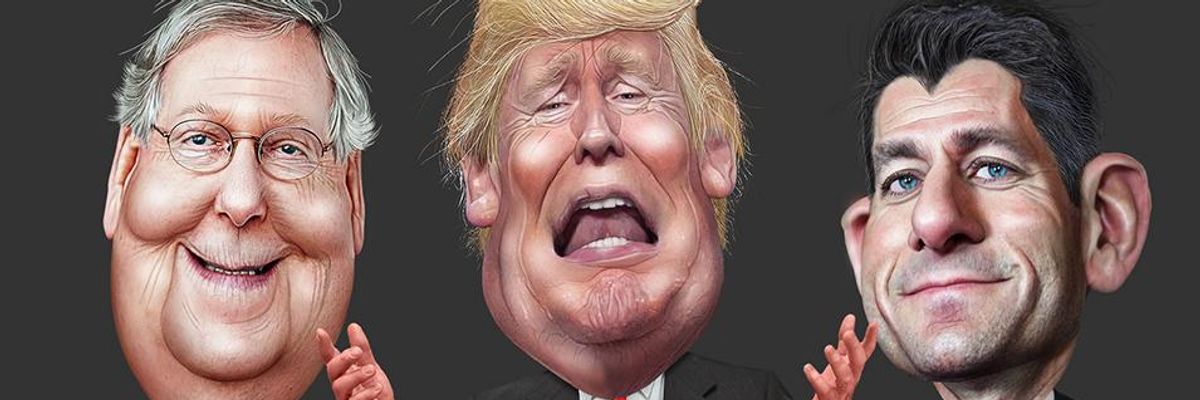
(image/cc/donkeyHotey)
In a State Journal guest column last week, Wisconsin Assembly Speaker Robin Vos couldn't heap enough praise on the Donald Trump-Paul Ryan "tax reform" legislation pending in Congress.
It got me wondering once again whether the word "reform" means what the dictionary says it does: "to put or change into an improved form or condition."
It's another example of how Republicans have been masters at framing their pet crusades with catchy but terribly misleading sound bites that a compliant media accepts as the narrative. Efforts to undermine unions are couched in a nonsensical label called "right to work." Now any attempt to weaken unions with legislation that prevents them from collecting dues to help pay for bargaining wages and benefits is called by that misleading name.
The party's succeeded in labeling estate taxes "death taxes," connoting the idea to a naive public that anyone who dies pays a tax on their sometimes-meager estate when, in fact, it applies only to estates that are nearly $12 million for a couple, a threshold that applies to a handful of deceased millionaires each year.
And then we have the "reforms." The GOP's failed attempt earlier this year to repeal Obamacare, which would have tossed some 20 million people off health care coverage by 2020, was nevertheless called "health reform," and many in the media called it just that while covering the debate. Funny, I don't think taking health coverage away from millions of people qualifies as a "change into an improved form or condition."
And now Robin Vos, Scott Walker, Scott Fitzgerald and other Wisconsin Republicans -- all former disciples of the political religion that the U.S. has too much debt -- are gleefully pushing tax "reform" that will save big corporations and wealthy Americans trillions and threatens to add significantly to that already-burdensome national debt.
As Richard Russell, that prolific letter to the editor contributor to both Madison newspapers, wrote me the other day: On the heels of the health care debacle, the real description for this tax legislation ought to be "wealth care."
Like their national counterparts, the Wisconsin legislative Republicans would have us believe that the middle class will reap huge tax savings, when in fact those savings pale compared to the $1.5 trillion giveaway to corporations whose leaders won't even say whether they'll use their tax savings for more investment and workers' wages.
And while trumpeting the doubling of the minimum deduction, they shy away from mentioning that taxpayers in states with high income taxes (that's us, Wisconsin) won't be able to deduct those taxes under their bill. Nor will students be able to deduct student loan interest. School teachers will lose the $250 annual deduction for supplies they personally buy for their classrooms.
Nor will people with chronic illnesses be able to take health care cost deductions. Gone will be the tax break for buying an electric car or investing in alternative energy for your home. Nor will folks who take a better job in another community be able to deduct moving expenses any longer.
There are dozens of provisions like this, all aimed at freeing up money from the middle class to help pay for those big cuts for the rich.
Yes, this is wealth care, not "reform."
Dear Common Dreams reader, It’s been nearly 30 years since I co-founded Common Dreams with my late wife, Lina Newhouser. We had the radical notion that journalism should serve the public good, not corporate profits. It was clear to us from the outset what it would take to build such a project. No paid advertisements. No corporate sponsors. No millionaire publisher telling us what to think or do. Many people said we wouldn't last a year, but we proved those doubters wrong. Together with a tremendous team of journalists and dedicated staff, we built an independent media outlet free from the constraints of profits and corporate control. Our mission has always been simple: To inform. To inspire. To ignite change for the common good. Building Common Dreams was not easy. Our survival was never guaranteed. When you take on the most powerful forces—Wall Street greed, fossil fuel industry destruction, Big Tech lobbyists, and uber-rich oligarchs who have spent billions upon billions rigging the economy and democracy in their favor—the only bulwark you have is supporters who believe in your work. But here’s the urgent message from me today. It's never been this bad out there. And it's never been this hard to keep us going. At the very moment Common Dreams is most needed, the threats we face are intensifying. We need your support now more than ever. We don't accept corporate advertising and never will. We don't have a paywall because we don't think people should be blocked from critical news based on their ability to pay. Everything we do is funded by the donations of readers like you. When everyone does the little they can afford, we are strong. But if that support retreats or dries up, so do we. Will you donate now to make sure Common Dreams not only survives but thrives? —Craig Brown, Co-founder |
In a State Journal guest column last week, Wisconsin Assembly Speaker Robin Vos couldn't heap enough praise on the Donald Trump-Paul Ryan "tax reform" legislation pending in Congress.
It got me wondering once again whether the word "reform" means what the dictionary says it does: "to put or change into an improved form or condition."
It's another example of how Republicans have been masters at framing their pet crusades with catchy but terribly misleading sound bites that a compliant media accepts as the narrative. Efforts to undermine unions are couched in a nonsensical label called "right to work." Now any attempt to weaken unions with legislation that prevents them from collecting dues to help pay for bargaining wages and benefits is called by that misleading name.
The party's succeeded in labeling estate taxes "death taxes," connoting the idea to a naive public that anyone who dies pays a tax on their sometimes-meager estate when, in fact, it applies only to estates that are nearly $12 million for a couple, a threshold that applies to a handful of deceased millionaires each year.
And then we have the "reforms." The GOP's failed attempt earlier this year to repeal Obamacare, which would have tossed some 20 million people off health care coverage by 2020, was nevertheless called "health reform," and many in the media called it just that while covering the debate. Funny, I don't think taking health coverage away from millions of people qualifies as a "change into an improved form or condition."
And now Robin Vos, Scott Walker, Scott Fitzgerald and other Wisconsin Republicans -- all former disciples of the political religion that the U.S. has too much debt -- are gleefully pushing tax "reform" that will save big corporations and wealthy Americans trillions and threatens to add significantly to that already-burdensome national debt.
As Richard Russell, that prolific letter to the editor contributor to both Madison newspapers, wrote me the other day: On the heels of the health care debacle, the real description for this tax legislation ought to be "wealth care."
Like their national counterparts, the Wisconsin legislative Republicans would have us believe that the middle class will reap huge tax savings, when in fact those savings pale compared to the $1.5 trillion giveaway to corporations whose leaders won't even say whether they'll use their tax savings for more investment and workers' wages.
And while trumpeting the doubling of the minimum deduction, they shy away from mentioning that taxpayers in states with high income taxes (that's us, Wisconsin) won't be able to deduct those taxes under their bill. Nor will students be able to deduct student loan interest. School teachers will lose the $250 annual deduction for supplies they personally buy for their classrooms.
Nor will people with chronic illnesses be able to take health care cost deductions. Gone will be the tax break for buying an electric car or investing in alternative energy for your home. Nor will folks who take a better job in another community be able to deduct moving expenses any longer.
There are dozens of provisions like this, all aimed at freeing up money from the middle class to help pay for those big cuts for the rich.
Yes, this is wealth care, not "reform."
In a State Journal guest column last week, Wisconsin Assembly Speaker Robin Vos couldn't heap enough praise on the Donald Trump-Paul Ryan "tax reform" legislation pending in Congress.
It got me wondering once again whether the word "reform" means what the dictionary says it does: "to put or change into an improved form or condition."
It's another example of how Republicans have been masters at framing their pet crusades with catchy but terribly misleading sound bites that a compliant media accepts as the narrative. Efforts to undermine unions are couched in a nonsensical label called "right to work." Now any attempt to weaken unions with legislation that prevents them from collecting dues to help pay for bargaining wages and benefits is called by that misleading name.
The party's succeeded in labeling estate taxes "death taxes," connoting the idea to a naive public that anyone who dies pays a tax on their sometimes-meager estate when, in fact, it applies only to estates that are nearly $12 million for a couple, a threshold that applies to a handful of deceased millionaires each year.
And then we have the "reforms." The GOP's failed attempt earlier this year to repeal Obamacare, which would have tossed some 20 million people off health care coverage by 2020, was nevertheless called "health reform," and many in the media called it just that while covering the debate. Funny, I don't think taking health coverage away from millions of people qualifies as a "change into an improved form or condition."
And now Robin Vos, Scott Walker, Scott Fitzgerald and other Wisconsin Republicans -- all former disciples of the political religion that the U.S. has too much debt -- are gleefully pushing tax "reform" that will save big corporations and wealthy Americans trillions and threatens to add significantly to that already-burdensome national debt.
As Richard Russell, that prolific letter to the editor contributor to both Madison newspapers, wrote me the other day: On the heels of the health care debacle, the real description for this tax legislation ought to be "wealth care."
Like their national counterparts, the Wisconsin legislative Republicans would have us believe that the middle class will reap huge tax savings, when in fact those savings pale compared to the $1.5 trillion giveaway to corporations whose leaders won't even say whether they'll use their tax savings for more investment and workers' wages.
And while trumpeting the doubling of the minimum deduction, they shy away from mentioning that taxpayers in states with high income taxes (that's us, Wisconsin) won't be able to deduct those taxes under their bill. Nor will students be able to deduct student loan interest. School teachers will lose the $250 annual deduction for supplies they personally buy for their classrooms.
Nor will people with chronic illnesses be able to take health care cost deductions. Gone will be the tax break for buying an electric car or investing in alternative energy for your home. Nor will folks who take a better job in another community be able to deduct moving expenses any longer.
There are dozens of provisions like this, all aimed at freeing up money from the middle class to help pay for those big cuts for the rich.
Yes, this is wealth care, not "reform."