SUBSCRIBE TO OUR FREE NEWSLETTER
Daily news & progressive opinion—funded by the people, not the corporations—delivered straight to your inbox.
5
#000000
#FFFFFF
To donate by check, phone, or other method, see our More Ways to Give page.
There's nothing new about President Obama giving speeches in which he talks about school reform in ways that have little to do with reality (see, for example, here and here), but there was something especially disconnected about the education rhetoric in his 2014 State of the
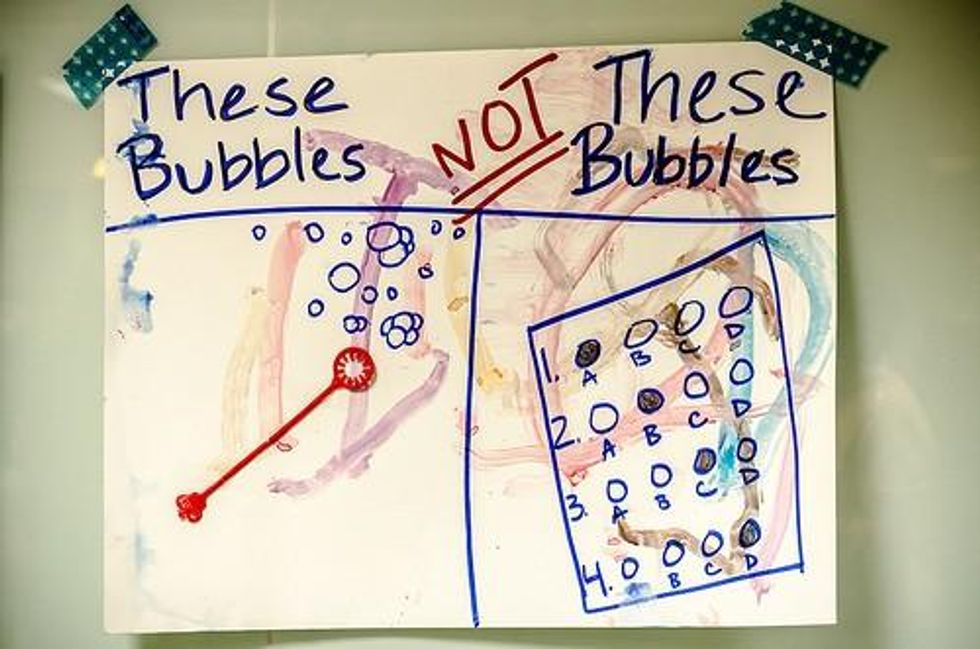
He managed to criticize standardized tests in which kids simply "fill in a bubble" without betraying any irony that it is his Education Department's policies that have led to their growth in number and importance in public schools.
He said that "research shows that one of the best investments we can make in a child's life is high-quality early education," but he failed to mention that his administration only made it a top reform priority last year when there was no chance he could persuade Congress to fund any serious early-education proposal.
He talked up his signature education program, Race to the Top, without a hint about the controversy its reform demands on states that accept federal funding has stoked for years. He said the Race has "helped states raise expectations and performance" with "the help of governors from both parties," a reference to the Common Core State Standards which he did not mention by name most likely because there is a growing revolt against the initiative in many parts of the country. Some states, in fact, are actually changing the standards and dropping the Common Core name because they don't want to be associated with it.
He did make one apparent nod to the Common Core opposition when he said "some of this change is hard," but he did not note that one of the reasons it is so hard is because the administration has promoted untenable implementation policies with timelines that states say are impossible to meet. He also said that change requires things including "more demanding parents."
He praised "the great teachers" who helped a boy named Estiven Rodriguez learn to speak English and get an education that is allowing him to go to college -- without a hint of acknowledgement that teachers around the country feel abandoned by his administration as it pushes evaluation systems that unfairly evaluate educators by student standardized test scores.
He noted that "we're shaking up our system of higher education to give parents more information, and colleges more incentives to offer better value," without noting that the administration's proposal to create ratings of colleges and universities based on criteria that may include how much money graduates make has been met with a lot of understandable opposition in the academic world.
He gave an awkward nod to Tennessee and Washington D.C. Public Schools for "making big strides in preparing students with skills for the new economy - problem solving, critical thinking, science, technology, engineering, and math" -- an apparent reference to increased scores on the National Assessment of Educational Progress. The NAEP scores don't actually measure technology and engineering, and there are big questions about whether his policies had anything to do with the rise in the scores.
(In the District, for example, while there were rises in math and reading scores on the 2013 NAEP, the school system still has the largest achievement gap among urban school systems, NAEP scores were rising well before Obama became president, and there are questions about changing demographics in the city. There also seems something contradictory about praising Tennessee for improving science and critical thinking skills when at the same time it is one of the leading states in the country in terms of numbers of public schools that teach creationism as a legitimate alternative to evolution. The Tennessee and D.C. references came straight from an op-ed that Education Secretary Arne Duncan recently had published in The Washington Post in which Duncan said: "We don't know all the reasons why students did better in Tennessee and the District in 2013 than in 2011. But it is clear that they shared a similar approach to bettering education -- taking common-sense, but politically hard, steps to help students." Actually, that isn't clear, but never mind.)
Perhaps the biggest disconnect between what Obama said and facts on the ground was this: "Change is hard .... but it's worth it -- and it's working."
Working? How? For whom?
We're all ears, Mr. President.
There's nothing new about President Obama giving speeches in which he talks about school reform in ways that have little to do with reality (see, for example, here and here), but there was something especially disconnected about the education rhetoric in his 2014 State of the
He managed to criticize standardized tests in which kids simply "fill in a bubble" without betraying any irony that it is his Education Department's policies that have led to their growth in number and importance in public schools.
He said that "research shows that one of the best investments we can make in a child's life is high-quality early education," but he failed to mention that his administration only made it a top reform priority last year when there was no chance he could persuade Congress to fund any serious early-education proposal.
He talked up his signature education program, Race to the Top, without a hint about the controversy its reform demands on states that accept federal funding has stoked for years. He said the Race has "helped states raise expectations and performance" with "the help of governors from both parties," a reference to the Common Core State Standards which he did not mention by name most likely because there is a growing revolt against the initiative in many parts of the country. Some states, in fact, are actually changing the standards and dropping the Common Core name because they don't want to be associated with it.
He did make one apparent nod to the Common Core opposition when he said "some of this change is hard," but he did not note that one of the reasons it is so hard is because the administration has promoted untenable implementation policies with timelines that states say are impossible to meet. He also said that change requires things including "more demanding parents."
He praised "the great teachers" who helped a boy named Estiven Rodriguez learn to speak English and get an education that is allowing him to go to college -- without a hint of acknowledgement that teachers around the country feel abandoned by his administration as it pushes evaluation systems that unfairly evaluate educators by student standardized test scores.
He noted that "we're shaking up our system of higher education to give parents more information, and colleges more incentives to offer better value," without noting that the administration's proposal to create ratings of colleges and universities based on criteria that may include how much money graduates make has been met with a lot of understandable opposition in the academic world.
He gave an awkward nod to Tennessee and Washington D.C. Public Schools for "making big strides in preparing students with skills for the new economy - problem solving, critical thinking, science, technology, engineering, and math" -- an apparent reference to increased scores on the National Assessment of Educational Progress. The NAEP scores don't actually measure technology and engineering, and there are big questions about whether his policies had anything to do with the rise in the scores.
(In the District, for example, while there were rises in math and reading scores on the 2013 NAEP, the school system still has the largest achievement gap among urban school systems, NAEP scores were rising well before Obama became president, and there are questions about changing demographics in the city. There also seems something contradictory about praising Tennessee for improving science and critical thinking skills when at the same time it is one of the leading states in the country in terms of numbers of public schools that teach creationism as a legitimate alternative to evolution. The Tennessee and D.C. references came straight from an op-ed that Education Secretary Arne Duncan recently had published in The Washington Post in which Duncan said: "We don't know all the reasons why students did better in Tennessee and the District in 2013 than in 2011. But it is clear that they shared a similar approach to bettering education -- taking common-sense, but politically hard, steps to help students." Actually, that isn't clear, but never mind.)
Perhaps the biggest disconnect between what Obama said and facts on the ground was this: "Change is hard .... but it's worth it -- and it's working."
Working? How? For whom?
We're all ears, Mr. President.
There's nothing new about President Obama giving speeches in which he talks about school reform in ways that have little to do with reality (see, for example, here and here), but there was something especially disconnected about the education rhetoric in his 2014 State of the
He managed to criticize standardized tests in which kids simply "fill in a bubble" without betraying any irony that it is his Education Department's policies that have led to their growth in number and importance in public schools.
He said that "research shows that one of the best investments we can make in a child's life is high-quality early education," but he failed to mention that his administration only made it a top reform priority last year when there was no chance he could persuade Congress to fund any serious early-education proposal.
He talked up his signature education program, Race to the Top, without a hint about the controversy its reform demands on states that accept federal funding has stoked for years. He said the Race has "helped states raise expectations and performance" with "the help of governors from both parties," a reference to the Common Core State Standards which he did not mention by name most likely because there is a growing revolt against the initiative in many parts of the country. Some states, in fact, are actually changing the standards and dropping the Common Core name because they don't want to be associated with it.
He did make one apparent nod to the Common Core opposition when he said "some of this change is hard," but he did not note that one of the reasons it is so hard is because the administration has promoted untenable implementation policies with timelines that states say are impossible to meet. He also said that change requires things including "more demanding parents."
He praised "the great teachers" who helped a boy named Estiven Rodriguez learn to speak English and get an education that is allowing him to go to college -- without a hint of acknowledgement that teachers around the country feel abandoned by his administration as it pushes evaluation systems that unfairly evaluate educators by student standardized test scores.
He noted that "we're shaking up our system of higher education to give parents more information, and colleges more incentives to offer better value," without noting that the administration's proposal to create ratings of colleges and universities based on criteria that may include how much money graduates make has been met with a lot of understandable opposition in the academic world.
He gave an awkward nod to Tennessee and Washington D.C. Public Schools for "making big strides in preparing students with skills for the new economy - problem solving, critical thinking, science, technology, engineering, and math" -- an apparent reference to increased scores on the National Assessment of Educational Progress. The NAEP scores don't actually measure technology and engineering, and there are big questions about whether his policies had anything to do with the rise in the scores.
(In the District, for example, while there were rises in math and reading scores on the 2013 NAEP, the school system still has the largest achievement gap among urban school systems, NAEP scores were rising well before Obama became president, and there are questions about changing demographics in the city. There also seems something contradictory about praising Tennessee for improving science and critical thinking skills when at the same time it is one of the leading states in the country in terms of numbers of public schools that teach creationism as a legitimate alternative to evolution. The Tennessee and D.C. references came straight from an op-ed that Education Secretary Arne Duncan recently had published in The Washington Post in which Duncan said: "We don't know all the reasons why students did better in Tennessee and the District in 2013 than in 2011. But it is clear that they shared a similar approach to bettering education -- taking common-sense, but politically hard, steps to help students." Actually, that isn't clear, but never mind.)
Perhaps the biggest disconnect between what Obama said and facts on the ground was this: "Change is hard .... but it's worth it -- and it's working."
Working? How? For whom?
We're all ears, Mr. President.