
The environmental justice movement, and indeed my own environmental justice activism is grounded by the experience of working with Madiba to ensure that South Africans achieve the promise of a life that was enshrined by our Constitution, a life where people live in relations of solidarity and equity with each other and in non-degrading and positive relationships with their environments.
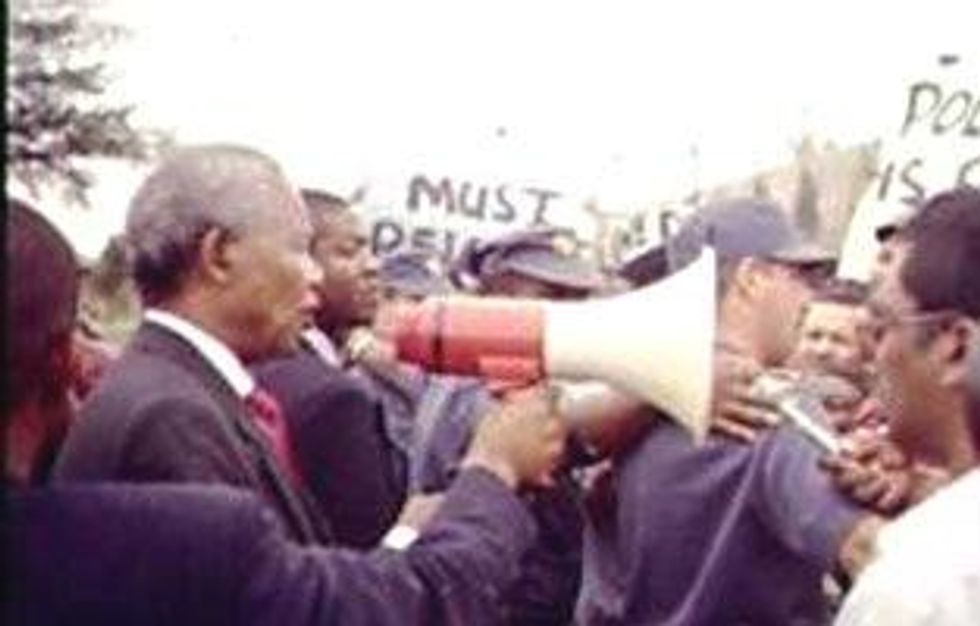
I entered university at a time of great political turmoil in the 1980s. As a young student I entered university with a very limited political awareness, but immediately was immersed in a student politic that built my personal social justice struggle, a struggle that was to be cemented in the environmental justice movement on the 25th March 1995. On that day, in a protest outside the Engen (previously Mobil) Oil Refinery, President Mandela stopped and got out of his motor vehicle and asked us: "Why are you protesting?" (see photo above). That intimate process of a powerful person willing to listen and hear people's concerns first-hand, and then act on them is an experience of ultimate humility that can only draw one closer to the ideals of democracy.
It was a time of idealism, but with a sobering dash of compromise, which Madiba reminded us of four days later on the 28th March when he met with us, representatives of the protestors at the same table with his senior cabinet Ministers and the Engen CEOs and managers, and insisted in the way only Mandela could, that Engen deals with their pollution problem. But in this he also reminded us that a good leader knows when to compromise.
Mandela, unlike any other statesperson in South Africa since, spent much time trying to understand the emerging environmental justice movement in the 1990s that brought together black and white, the rural poor and urban wealthy, the communities and the workers, the gender activists and the churches. In 1993, Mandela's hospital visit to the poisoned workers from Thor Chemicals, (who were dying from mercury poisoning because the former apartheid state had allowed for the import of toxic waste and failing recycling technology from Europe), made the worker struggle an environmental justice struggle.
The environmental justice movement has now grown globally to fight for climate and energy justice and to seek political solutions to the planetary emergency we are facing because of corporate power and greed that impacts upon communities and workers. Climate change is visibly affecting people now: people from the flood plains of Bangladesh to the toxic neighbourhoods in south Durban where oil refineries continue to dump their toxic gases together with their greenhouse gases on communities, from the growing refugees in Africa because of unprecedented drought followed by floods, to those losing their land in the corporate insatiable demand for further extraction of fossil fuels and minerals. These are the people that still need the ideals of Mandela so very much. Somewhere deep down I feel that had Madiba been active over the last decade, we would be in a different space regarding our climate change dilemma of continued stagnation and inaction. We would instead be on the inside, talking rather than walking out of what should be functional democratic spaces such as the United Nations.
Tata Madiba had a tough life, as many South Africans did in challenging the colonial and apartheid state. He was an active member of Umkhonto weSizwe and the African National Congress Youth League; he was a freedom fighter. He now is at peace, his work done in the world. His work was not only the grand politic that liberated South Africa and allowed us a forgiving peace, but it was also those he touched intimately in their local struggles throughout South Africa.
For our father Madiba, he recognised that all of us are critical in a struggle for a new South Africa. It was not only those that wielded corporate power in South Africa that were important. All South Africans were equal for Madiba. All were powerful. All were weak. All were human.
Madiba was not a saint, he was only human who made mistakes and learnt from them. He made mistakes and grew stronger from those mistakes. He was human like all of us. He was prepared to fight for a dignity that must be afforded to all. He was prepared to suffer and fight, like the very many who did and died nameless. He believed in himself being one of those that had to struggle, not one of those who by their struggle deserved a higher position.
May we never have to compromise our fight for a true and just world, for that is the compromise that Madiba would not want us to make. He would want us to continue to speak truth to power, as he always did. And may we honour his memory by holding his values and passion for justice.
Rest in peace Tata Madiba ...
The environmental justice movement, and indeed my own environmental justice activism is grounded by the experience of working with Madiba to ensure that South Africans achieve the promise of a life that was enshrined by our Constitution, a life where people live in relations of solidarity and equity with each other and in non-degrading and positive relationships with their environments.
I entered university at a time of great political turmoil in the 1980s. As a young student I entered university with a very limited political awareness, but immediately was immersed in a student politic that built my personal social justice struggle, a struggle that was to be cemented in the environmental justice movement on the 25th March 1995. On that day, in a protest outside the Engen (previously Mobil) Oil Refinery, President Mandela stopped and got out of his motor vehicle and asked us: "Why are you protesting?" (see photo above). That intimate process of a powerful person willing to listen and hear people's concerns first-hand, and then act on them is an experience of ultimate humility that can only draw one closer to the ideals of democracy.
It was a time of idealism, but with a sobering dash of compromise, which Madiba reminded us of four days later on the 28th March when he met with us, representatives of the protestors at the same table with his senior cabinet Ministers and the Engen CEOs and managers, and insisted in the way only Mandela could, that Engen deals with their pollution problem. But in this he also reminded us that a good leader knows when to compromise.
Mandela, unlike any other statesperson in South Africa since, spent much time trying to understand the emerging environmental justice movement in the 1990s that brought together black and white, the rural poor and urban wealthy, the communities and the workers, the gender activists and the churches. In 1993, Mandela's hospital visit to the poisoned workers from Thor Chemicals, (who were dying from mercury poisoning because the former apartheid state had allowed for the import of toxic waste and failing recycling technology from Europe), made the worker struggle an environmental justice struggle.
The environmental justice movement has now grown globally to fight for climate and energy justice and to seek political solutions to the planetary emergency we are facing because of corporate power and greed that impacts upon communities and workers. Climate change is visibly affecting people now: people from the flood plains of Bangladesh to the toxic neighbourhoods in south Durban where oil refineries continue to dump their toxic gases together with their greenhouse gases on communities, from the growing refugees in Africa because of unprecedented drought followed by floods, to those losing their land in the corporate insatiable demand for further extraction of fossil fuels and minerals. These are the people that still need the ideals of Mandela so very much. Somewhere deep down I feel that had Madiba been active over the last decade, we would be in a different space regarding our climate change dilemma of continued stagnation and inaction. We would instead be on the inside, talking rather than walking out of what should be functional democratic spaces such as the United Nations.
Tata Madiba had a tough life, as many South Africans did in challenging the colonial and apartheid state. He was an active member of Umkhonto weSizwe and the African National Congress Youth League; he was a freedom fighter. He now is at peace, his work done in the world. His work was not only the grand politic that liberated South Africa and allowed us a forgiving peace, but it was also those he touched intimately in their local struggles throughout South Africa.
For our father Madiba, he recognised that all of us are critical in a struggle for a new South Africa. It was not only those that wielded corporate power in South Africa that were important. All South Africans were equal for Madiba. All were powerful. All were weak. All were human.
Madiba was not a saint, he was only human who made mistakes and learnt from them. He made mistakes and grew stronger from those mistakes. He was human like all of us. He was prepared to fight for a dignity that must be afforded to all. He was prepared to suffer and fight, like the very many who did and died nameless. He believed in himself being one of those that had to struggle, not one of those who by their struggle deserved a higher position.
May we never have to compromise our fight for a true and just world, for that is the compromise that Madiba would not want us to make. He would want us to continue to speak truth to power, as he always did. And may we honour his memory by holding his values and passion for justice.
Rest in peace Tata Madiba ...
The environmental justice movement, and indeed my own environmental justice activism is grounded by the experience of working with Madiba to ensure that South Africans achieve the promise of a life that was enshrined by our Constitution, a life where people live in relations of solidarity and equity with each other and in non-degrading and positive relationships with their environments.
I entered university at a time of great political turmoil in the 1980s. As a young student I entered university with a very limited political awareness, but immediately was immersed in a student politic that built my personal social justice struggle, a struggle that was to be cemented in the environmental justice movement on the 25th March 1995. On that day, in a protest outside the Engen (previously Mobil) Oil Refinery, President Mandela stopped and got out of his motor vehicle and asked us: "Why are you protesting?" (see photo above). That intimate process of a powerful person willing to listen and hear people's concerns first-hand, and then act on them is an experience of ultimate humility that can only draw one closer to the ideals of democracy.
It was a time of idealism, but with a sobering dash of compromise, which Madiba reminded us of four days later on the 28th March when he met with us, representatives of the protestors at the same table with his senior cabinet Ministers and the Engen CEOs and managers, and insisted in the way only Mandela could, that Engen deals with their pollution problem. But in this he also reminded us that a good leader knows when to compromise.
Mandela, unlike any other statesperson in South Africa since, spent much time trying to understand the emerging environmental justice movement in the 1990s that brought together black and white, the rural poor and urban wealthy, the communities and the workers, the gender activists and the churches. In 1993, Mandela's hospital visit to the poisoned workers from Thor Chemicals, (who were dying from mercury poisoning because the former apartheid state had allowed for the import of toxic waste and failing recycling technology from Europe), made the worker struggle an environmental justice struggle.
The environmental justice movement has now grown globally to fight for climate and energy justice and to seek political solutions to the planetary emergency we are facing because of corporate power and greed that impacts upon communities and workers. Climate change is visibly affecting people now: people from the flood plains of Bangladesh to the toxic neighbourhoods in south Durban where oil refineries continue to dump their toxic gases together with their greenhouse gases on communities, from the growing refugees in Africa because of unprecedented drought followed by floods, to those losing their land in the corporate insatiable demand for further extraction of fossil fuels and minerals. These are the people that still need the ideals of Mandela so very much. Somewhere deep down I feel that had Madiba been active over the last decade, we would be in a different space regarding our climate change dilemma of continued stagnation and inaction. We would instead be on the inside, talking rather than walking out of what should be functional democratic spaces such as the United Nations.
Tata Madiba had a tough life, as many South Africans did in challenging the colonial and apartheid state. He was an active member of Umkhonto weSizwe and the African National Congress Youth League; he was a freedom fighter. He now is at peace, his work done in the world. His work was not only the grand politic that liberated South Africa and allowed us a forgiving peace, but it was also those he touched intimately in their local struggles throughout South Africa.
For our father Madiba, he recognised that all of us are critical in a struggle for a new South Africa. It was not only those that wielded corporate power in South Africa that were important. All South Africans were equal for Madiba. All were powerful. All were weak. All were human.
Madiba was not a saint, he was only human who made mistakes and learnt from them. He made mistakes and grew stronger from those mistakes. He was human like all of us. He was prepared to fight for a dignity that must be afforded to all. He was prepared to suffer and fight, like the very many who did and died nameless. He believed in himself being one of those that had to struggle, not one of those who by their struggle deserved a higher position.
May we never have to compromise our fight for a true and just world, for that is the compromise that Madiba would not want us to make. He would want us to continue to speak truth to power, as he always did. And may we honour his memory by holding his values and passion for justice.
Rest in peace Tata Madiba ...