SUBSCRIBE TO OUR FREE NEWSLETTER
Daily news & progressive opinion—funded by the people, not the corporations—delivered straight to your inbox.
5
#000000
#FFFFFF
To donate by check, phone, or other method, see our More Ways to Give page.
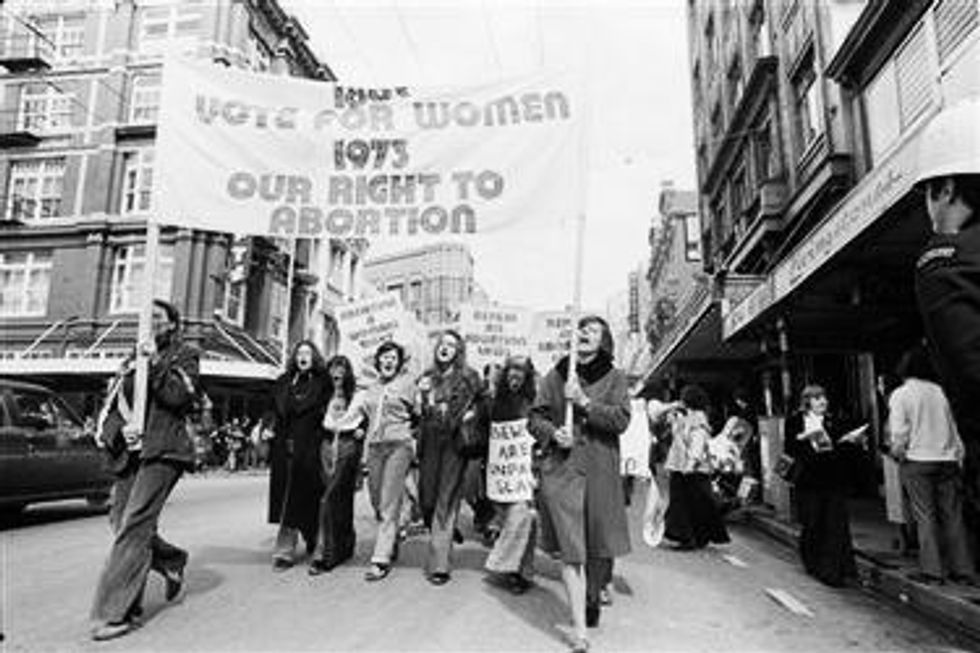
I am just about fifteen months older than Roe v. Wade, part of a generation that has come of age with the 1973 Supreme Court decision.
This is my memory of learning that some people didn't think that women should have access to safe and legal abortion.
When I was a teenager, maybe 16 or 17 years old, my friend had an appointment with her eye doctor to have her eyes dilated. I drove and went with her to the appointment since she wouldn't be able to see well afterward.
As we walked across the parking lot to the medical office building that sunny day, probably talking about where to eat lunch or go shop afterward, several adults came rushing toward us, thrusting pamphlets at us and shouting things that I don't remember. One of them shoved her hand toward me and opened it to reveal a tiny plastic fetus. Another waved a color photograph of bloody dismembered fetuses in a garbage can. They peppered us with questions. It was confusing and caught us completely off guard.
I think we stammered something like, "we're just going to the eye doctor ..." and stumbled toward the medical building. We remembered then that this office building was the one in town where the doctor who performed abortions had his office. There was only one. This was South Dakota. And it was obviously protest day. We had heard about this, I think, but had never seen or experienced it.
At the time, we were just startled and perhaps a little upset. We tried to laugh it off. We really were there for the eye doctor. But of course what the protesters saw was two teenage girls heading in to the building where abortions were performed.
They clearly didn't believe us.
They didn't trust us.
They harassed and scared us.
This happened years before I formed meaningful political views and years before I came to understand myself as a feminist and progressive activist. But I still remember it vividly.
Those protesters would be disappointed to learn that what really scared me was not their photos and brochures but their harassment. Even as a politically clueless teenage girl, I wasn't stupid. I had every right to be where I was and doing what I was. I even had a right to do what they thought I was doing. Even then I was smart enough to understand what abortion was, and to make that decision for myself.
I still am.
Since then, I have known many women who have had abortions. Most of us do. One in three American women will terminate a pregnancy at some point in her life. Anti-choice activists like those we met in the parking lot don't think that that should be a safe and legal option.
They don't believe women.
They don't trust us.
They harass and scare women who are already vulnerable and at risk.
As Roe v. Wade and I turn 40, we get closer to middle age. A little wiser and more battle-worn than we were at 16. We know more than we did then about how and why abortion must remain safe and legal.
And we know that the protesters are still in the parking lots, and in Congress, and in statehouses, and in every local community.
So even though we're a little more tired than we were as teens, we get up and keep on working to protect access to reproductive health care.
For all women.
I am just about fifteen months older than Roe v. Wade, part of a generation that has come of age with the 1973 Supreme Court decision.
This is my memory of learning that some people didn't think that women should have access to safe and legal abortion.
When I was a teenager, maybe 16 or 17 years old, my friend had an appointment with her eye doctor to have her eyes dilated. I drove and went with her to the appointment since she wouldn't be able to see well afterward.
As we walked across the parking lot to the medical office building that sunny day, probably talking about where to eat lunch or go shop afterward, several adults came rushing toward us, thrusting pamphlets at us and shouting things that I don't remember. One of them shoved her hand toward me and opened it to reveal a tiny plastic fetus. Another waved a color photograph of bloody dismembered fetuses in a garbage can. They peppered us with questions. It was confusing and caught us completely off guard.
I think we stammered something like, "we're just going to the eye doctor ..." and stumbled toward the medical building. We remembered then that this office building was the one in town where the doctor who performed abortions had his office. There was only one. This was South Dakota. And it was obviously protest day. We had heard about this, I think, but had never seen or experienced it.
At the time, we were just startled and perhaps a little upset. We tried to laugh it off. We really were there for the eye doctor. But of course what the protesters saw was two teenage girls heading in to the building where abortions were performed.
They clearly didn't believe us.
They didn't trust us.
They harassed and scared us.
This happened years before I formed meaningful political views and years before I came to understand myself as a feminist and progressive activist. But I still remember it vividly.
Those protesters would be disappointed to learn that what really scared me was not their photos and brochures but their harassment. Even as a politically clueless teenage girl, I wasn't stupid. I had every right to be where I was and doing what I was. I even had a right to do what they thought I was doing. Even then I was smart enough to understand what abortion was, and to make that decision for myself.
I still am.
Since then, I have known many women who have had abortions. Most of us do. One in three American women will terminate a pregnancy at some point in her life. Anti-choice activists like those we met in the parking lot don't think that that should be a safe and legal option.
They don't believe women.
They don't trust us.
They harass and scare women who are already vulnerable and at risk.
As Roe v. Wade and I turn 40, we get closer to middle age. A little wiser and more battle-worn than we were at 16. We know more than we did then about how and why abortion must remain safe and legal.
And we know that the protesters are still in the parking lots, and in Congress, and in statehouses, and in every local community.
So even though we're a little more tired than we were as teens, we get up and keep on working to protect access to reproductive health care.
For all women.
I am just about fifteen months older than Roe v. Wade, part of a generation that has come of age with the 1973 Supreme Court decision.
This is my memory of learning that some people didn't think that women should have access to safe and legal abortion.
When I was a teenager, maybe 16 or 17 years old, my friend had an appointment with her eye doctor to have her eyes dilated. I drove and went with her to the appointment since she wouldn't be able to see well afterward.
As we walked across the parking lot to the medical office building that sunny day, probably talking about where to eat lunch or go shop afterward, several adults came rushing toward us, thrusting pamphlets at us and shouting things that I don't remember. One of them shoved her hand toward me and opened it to reveal a tiny plastic fetus. Another waved a color photograph of bloody dismembered fetuses in a garbage can. They peppered us with questions. It was confusing and caught us completely off guard.
I think we stammered something like, "we're just going to the eye doctor ..." and stumbled toward the medical building. We remembered then that this office building was the one in town where the doctor who performed abortions had his office. There was only one. This was South Dakota. And it was obviously protest day. We had heard about this, I think, but had never seen or experienced it.
At the time, we were just startled and perhaps a little upset. We tried to laugh it off. We really were there for the eye doctor. But of course what the protesters saw was two teenage girls heading in to the building where abortions were performed.
They clearly didn't believe us.
They didn't trust us.
They harassed and scared us.
This happened years before I formed meaningful political views and years before I came to understand myself as a feminist and progressive activist. But I still remember it vividly.
Those protesters would be disappointed to learn that what really scared me was not their photos and brochures but their harassment. Even as a politically clueless teenage girl, I wasn't stupid. I had every right to be where I was and doing what I was. I even had a right to do what they thought I was doing. Even then I was smart enough to understand what abortion was, and to make that decision for myself.
I still am.
Since then, I have known many women who have had abortions. Most of us do. One in three American women will terminate a pregnancy at some point in her life. Anti-choice activists like those we met in the parking lot don't think that that should be a safe and legal option.
They don't believe women.
They don't trust us.
They harass and scare women who are already vulnerable and at risk.
As Roe v. Wade and I turn 40, we get closer to middle age. A little wiser and more battle-worn than we were at 16. We know more than we did then about how and why abortion must remain safe and legal.
And we know that the protesters are still in the parking lots, and in Congress, and in statehouses, and in every local community.
So even though we're a little more tired than we were as teens, we get up and keep on working to protect access to reproductive health care.
For all women.