When I travel across the country, I often hear from business leaders, politicians and even union members who say unions don't matter anymore.
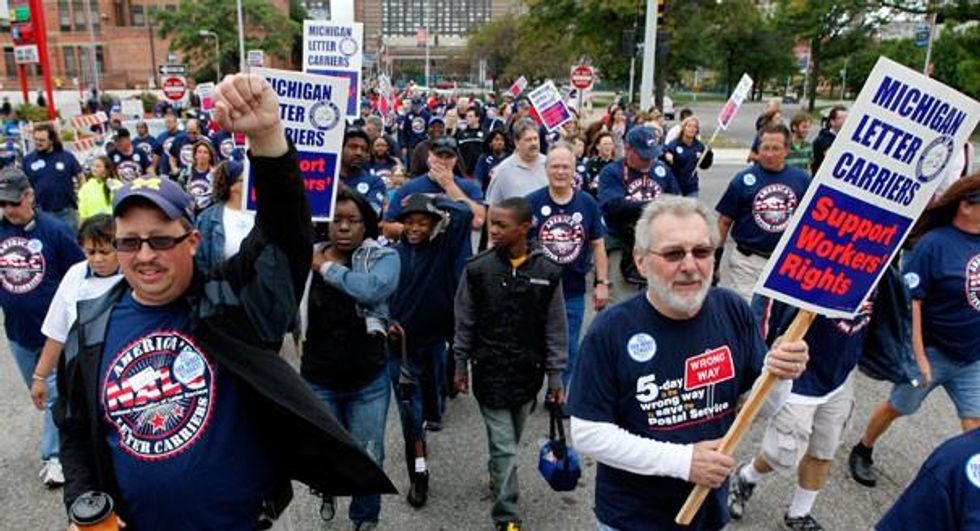
They say there was a time and place for unions -- but that has passed. They cite the fact that union membership in the U.S. stands at less than 12 percent. They cite the Wisconsin recall, the passage of right-to-work laws in Indiana and the 2012 Democratic National Convention taking place in Charlotte, N.C., a city with one of the lowest union membership rates in the country. Unions don't count, they say.
They are wrong. Unions matter today more than ever.
If we want to rebuild the American middle class, we need strong unions. It's no coincidence that the decline of the middle class began with the decline in union membership. From one-third to one-fifth of the growth in inequality can be explained by the decline of unions, according to a 2011 study in the American Sociological Review by Bruce Western of Harvard University and Jake Rosenfeld of the University of Washington.
We see the result of this decline every day. More Americans are working in low-wage jobs and are without health care and the means to save for retirement.
Union jobs can still offer workers good salaries, pensions and health care benefits that give families the economic security to send kids to college or trade schools, to invest in their communities and to have a secure retirement. This is not some socialist ideal. It is the American dream -- and unions have helped ensure that more Americans have a chance to live it.
Unions also matter if we want to retool and retrain our workforce for the global economy. Employers regularly talk about not being able to find skilled workers. New union training programs are a critical component of the answer to this problem. At their own expense, unions and union contractors provide training and apprenticeship programs that teach the latest construction and building techniques with a focus on safety.
This training allows U.S. workers compete with anyone in the world. These union training programs should be encouraged, and the workers who graduate should be put back to work rebuilding the nation's infrastructure -- and our economy.
More importantly, unions matter because who else will speak on behalf of workers? The U.S. Chamber of Commerce speaks for the interests of business, and AARP speaks for the interests of the elderly. But without unions, who would speak for workers?
If workers are to have a share in our future prosperity, they need unions to advance their issues. Otherwise, the voices of corporations, the rich and the well-connected will drown out the voices of average American workers.
For unions to remain strong, we must remain united at the ballot box. We must support each other's causes and leaders and support the common interests of organized labor -- the right to collectively bargain for wages and benefits. Union members must vote in their self-interest, not against it.
Unions matter. They mattered in the past; they matter today; and unions must remain strong if they are to matter in the future. If unions do not stand united and do not fight for the needs of working Americans, then Labor Day is meaningless. It will be just a day off in September.
That matters to me -- and it should matter to you.
When I travel across the country, I often hear from business leaders, politicians and even union members who say unions don't matter anymore.
They say there was a time and place for unions -- but that has passed. They cite the fact that union membership in the U.S. stands at less than 12 percent. They cite the Wisconsin recall, the passage of right-to-work laws in Indiana and the 2012 Democratic National Convention taking place in Charlotte, N.C., a city with one of the lowest union membership rates in the country. Unions don't count, they say.
They are wrong. Unions matter today more than ever.
If we want to rebuild the American middle class, we need strong unions. It's no coincidence that the decline of the middle class began with the decline in union membership. From one-third to one-fifth of the growth in inequality can be explained by the decline of unions, according to a 2011 study in the American Sociological Review by Bruce Western of Harvard University and Jake Rosenfeld of the University of Washington.
We see the result of this decline every day. More Americans are working in low-wage jobs and are without health care and the means to save for retirement.
Union jobs can still offer workers good salaries, pensions and health care benefits that give families the economic security to send kids to college or trade schools, to invest in their communities and to have a secure retirement. This is not some socialist ideal. It is the American dream -- and unions have helped ensure that more Americans have a chance to live it.
Unions also matter if we want to retool and retrain our workforce for the global economy. Employers regularly talk about not being able to find skilled workers. New union training programs are a critical component of the answer to this problem. At their own expense, unions and union contractors provide training and apprenticeship programs that teach the latest construction and building techniques with a focus on safety.
This training allows U.S. workers compete with anyone in the world. These union training programs should be encouraged, and the workers who graduate should be put back to work rebuilding the nation's infrastructure -- and our economy.
More importantly, unions matter because who else will speak on behalf of workers? The U.S. Chamber of Commerce speaks for the interests of business, and AARP speaks for the interests of the elderly. But without unions, who would speak for workers?
If workers are to have a share in our future prosperity, they need unions to advance their issues. Otherwise, the voices of corporations, the rich and the well-connected will drown out the voices of average American workers.
For unions to remain strong, we must remain united at the ballot box. We must support each other's causes and leaders and support the common interests of organized labor -- the right to collectively bargain for wages and benefits. Union members must vote in their self-interest, not against it.
Unions matter. They mattered in the past; they matter today; and unions must remain strong if they are to matter in the future. If unions do not stand united and do not fight for the needs of working Americans, then Labor Day is meaningless. It will be just a day off in September.
That matters to me -- and it should matter to you.
When I travel across the country, I often hear from business leaders, politicians and even union members who say unions don't matter anymore.
They say there was a time and place for unions -- but that has passed. They cite the fact that union membership in the U.S. stands at less than 12 percent. They cite the Wisconsin recall, the passage of right-to-work laws in Indiana and the 2012 Democratic National Convention taking place in Charlotte, N.C., a city with one of the lowest union membership rates in the country. Unions don't count, they say.
They are wrong. Unions matter today more than ever.
If we want to rebuild the American middle class, we need strong unions. It's no coincidence that the decline of the middle class began with the decline in union membership. From one-third to one-fifth of the growth in inequality can be explained by the decline of unions, according to a 2011 study in the American Sociological Review by Bruce Western of Harvard University and Jake Rosenfeld of the University of Washington.
We see the result of this decline every day. More Americans are working in low-wage jobs and are without health care and the means to save for retirement.
Union jobs can still offer workers good salaries, pensions and health care benefits that give families the economic security to send kids to college or trade schools, to invest in their communities and to have a secure retirement. This is not some socialist ideal. It is the American dream -- and unions have helped ensure that more Americans have a chance to live it.
Unions also matter if we want to retool and retrain our workforce for the global economy. Employers regularly talk about not being able to find skilled workers. New union training programs are a critical component of the answer to this problem. At their own expense, unions and union contractors provide training and apprenticeship programs that teach the latest construction and building techniques with a focus on safety.
This training allows U.S. workers compete with anyone in the world. These union training programs should be encouraged, and the workers who graduate should be put back to work rebuilding the nation's infrastructure -- and our economy.
More importantly, unions matter because who else will speak on behalf of workers? The U.S. Chamber of Commerce speaks for the interests of business, and AARP speaks for the interests of the elderly. But without unions, who would speak for workers?
If workers are to have a share in our future prosperity, they need unions to advance their issues. Otherwise, the voices of corporations, the rich and the well-connected will drown out the voices of average American workers.
For unions to remain strong, we must remain united at the ballot box. We must support each other's causes and leaders and support the common interests of organized labor -- the right to collectively bargain for wages and benefits. Union members must vote in their self-interest, not against it.
Unions matter. They mattered in the past; they matter today; and unions must remain strong if they are to matter in the future. If unions do not stand united and do not fight for the needs of working Americans, then Labor Day is meaningless. It will be just a day off in September.
That matters to me -- and it should matter to you.