
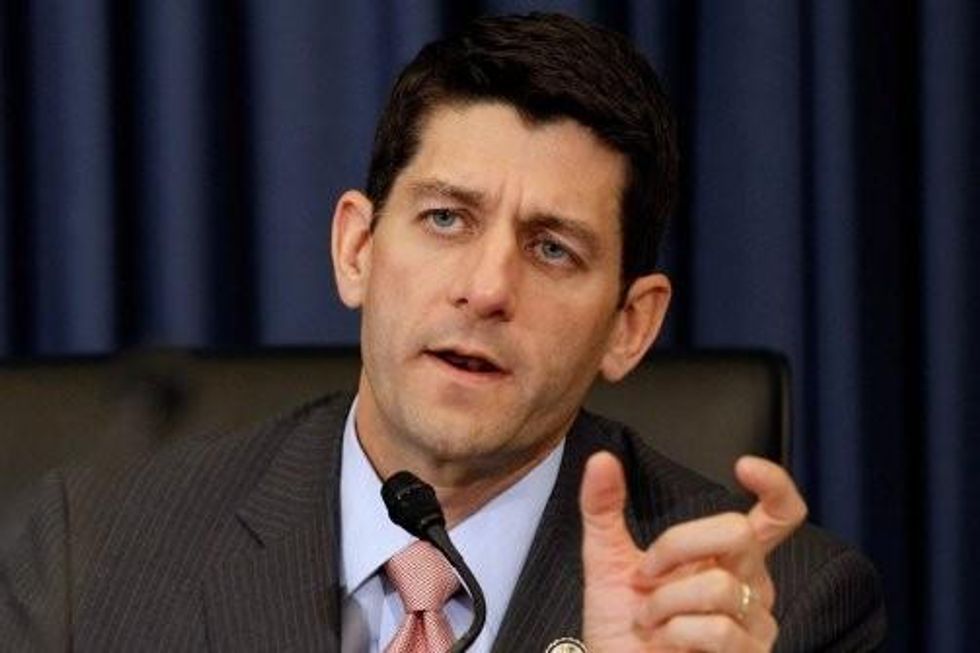
The supposedly kinder and gentler Medicare voucher proposed this year by House Budget Committee Chairman and Republican vice presidential nominee Paul Ryan (R-Wis.) is less draconian than last year's version, but still packs a wallop. The voucher shifts costs to seniors because the value of the voucher can't grow faster than half a percentage point above per capita GDP, and health care costs are projected to grow faster than that. (You can ignore the part about tying the voucher to the second-lowest-cost private plan or, if it's cheaper, fee-for-service Medicare cost growth--this is just window dressing because overall costs will exceed the "fallback" spending limits.)
The voucher will initially shift around 11 percent of costs ($700) to seniors in 2023, an amount that will grow to 45 percent ($15,700) by 2087 (all figures are in 2012 dollars and rounded to the nearest $100). You can see how this adds up by summing the annual amounts in the table below over life expectancy in retirement. Thus, for example, a 40-year-old female who expects to retire at 65 in 2037 will live to about 2058, during which she will pay roughly $82,800 more for health care.
These estimates are based on the Congressional Budget Office's analysis of Ryan's plan using CBO's "alternative fiscal scenario," which among other things incorporates adjustments similar to those made in the past to avert changes scheduled under current law, such as automatic cuts in Medicare payments to providers. Because CBO only looks at costs at the age of initial eligibility, and because costs rise as people age, these estimates may understate the amount of cost shifting. They also don't take into account the fact that Ryan would also raise the Medicare eligibility age from 65 to 67, the impact of which depends on whether you assume that most seniors can hold on to their jobs and health insurance past 65.
If someone has to pay, why not seniors? While federal, state, and local government, businesses, and households are all in trouble if we don't manage to contain health care costs--true with or without the Ryan plan--Ryan would make things a lot worse, for a number of reasons. First, it makes no sense to shift costs to seniors because they have lower incomes and higher out-of-pocket medical costs than working-age households. Second, the Ryan voucher wouldn't just shift costs, it would greatly increase them. A fragmented insurance market would hamper Medicare's ability to negotiate lower prices, raise overhead costs, and lead to cherry picking of healthier seniors by private insurance companies. An analysis by David Cutler, Topher Spiro and Maura Calsyn at the Center for American Progress estimated that these cost increases would dwarf the amount of cost shifting, so that by 2050 the total cost increase borne by seniors would more than consume their Social Security benefit.
Of course, no one can project long-term health costs with any confidence. The alternative fiscal scenario is arguably too pessimistic to describe the current outlook, since it explicitly assumes away several Affordable Care Act cost constraints after 2022 (notably the Independent Payment Advisory Board) and implicitly assumes away the excise tax on high-cost employer-sponsored plans in the ACA, which was designed to bend the cost curve, to use health wonk jargon. Though CBO projects that excess cost growth will gradually decline from 1.6 to 1 percentage points above per capita GDP in response to pressures created by rising costs, this would still lead to health programs consuming virtually all federal revenue by the end of the 75-year projection period, an unrealistic scenario by anyone's standard.
In recent budget projections, CBO has shown a hawkish tendency to dismiss revenue increases as unlikely without exhibiting the same skepticism toward spending increases. But when it comes to Ryan's plan for Medicare, an analysis based on CBO's alternative fiscal scenario probably understates the problem, at least in the medium run. In the long run, the amount of proposed cost-shifting is too extreme to seriously contemplate.
The supposedly kinder and gentler Medicare voucher proposed this year by House Budget Committee Chairman and Republican vice presidential nominee Paul Ryan (R-Wis.) is less draconian than last year's version, but still packs a wallop. The voucher shifts costs to seniors because the value of the voucher can't grow faster than half a percentage point above per capita GDP, and health care costs are projected to grow faster than that. (You can ignore the part about tying the voucher to the second-lowest-cost private plan or, if it's cheaper, fee-for-service Medicare cost growth--this is just window dressing because overall costs will exceed the "fallback" spending limits.)
The voucher will initially shift around 11 percent of costs ($700) to seniors in 2023, an amount that will grow to 45 percent ($15,700) by 2087 (all figures are in 2012 dollars and rounded to the nearest $100). You can see how this adds up by summing the annual amounts in the table below over life expectancy in retirement. Thus, for example, a 40-year-old female who expects to retire at 65 in 2037 will live to about 2058, during which she will pay roughly $82,800 more for health care.
These estimates are based on the Congressional Budget Office's analysis of Ryan's plan using CBO's "alternative fiscal scenario," which among other things incorporates adjustments similar to those made in the past to avert changes scheduled under current law, such as automatic cuts in Medicare payments to providers. Because CBO only looks at costs at the age of initial eligibility, and because costs rise as people age, these estimates may understate the amount of cost shifting. They also don't take into account the fact that Ryan would also raise the Medicare eligibility age from 65 to 67, the impact of which depends on whether you assume that most seniors can hold on to their jobs and health insurance past 65.
If someone has to pay, why not seniors? While federal, state, and local government, businesses, and households are all in trouble if we don't manage to contain health care costs--true with or without the Ryan plan--Ryan would make things a lot worse, for a number of reasons. First, it makes no sense to shift costs to seniors because they have lower incomes and higher out-of-pocket medical costs than working-age households. Second, the Ryan voucher wouldn't just shift costs, it would greatly increase them. A fragmented insurance market would hamper Medicare's ability to negotiate lower prices, raise overhead costs, and lead to cherry picking of healthier seniors by private insurance companies. An analysis by David Cutler, Topher Spiro and Maura Calsyn at the Center for American Progress estimated that these cost increases would dwarf the amount of cost shifting, so that by 2050 the total cost increase borne by seniors would more than consume their Social Security benefit.
Of course, no one can project long-term health costs with any confidence. The alternative fiscal scenario is arguably too pessimistic to describe the current outlook, since it explicitly assumes away several Affordable Care Act cost constraints after 2022 (notably the Independent Payment Advisory Board) and implicitly assumes away the excise tax on high-cost employer-sponsored plans in the ACA, which was designed to bend the cost curve, to use health wonk jargon. Though CBO projects that excess cost growth will gradually decline from 1.6 to 1 percentage points above per capita GDP in response to pressures created by rising costs, this would still lead to health programs consuming virtually all federal revenue by the end of the 75-year projection period, an unrealistic scenario by anyone's standard.
In recent budget projections, CBO has shown a hawkish tendency to dismiss revenue increases as unlikely without exhibiting the same skepticism toward spending increases. But when it comes to Ryan's plan for Medicare, an analysis based on CBO's alternative fiscal scenario probably understates the problem, at least in the medium run. In the long run, the amount of proposed cost-shifting is too extreme to seriously contemplate.
The supposedly kinder and gentler Medicare voucher proposed this year by House Budget Committee Chairman and Republican vice presidential nominee Paul Ryan (R-Wis.) is less draconian than last year's version, but still packs a wallop. The voucher shifts costs to seniors because the value of the voucher can't grow faster than half a percentage point above per capita GDP, and health care costs are projected to grow faster than that. (You can ignore the part about tying the voucher to the second-lowest-cost private plan or, if it's cheaper, fee-for-service Medicare cost growth--this is just window dressing because overall costs will exceed the "fallback" spending limits.)
The voucher will initially shift around 11 percent of costs ($700) to seniors in 2023, an amount that will grow to 45 percent ($15,700) by 2087 (all figures are in 2012 dollars and rounded to the nearest $100). You can see how this adds up by summing the annual amounts in the table below over life expectancy in retirement. Thus, for example, a 40-year-old female who expects to retire at 65 in 2037 will live to about 2058, during which she will pay roughly $82,800 more for health care.
These estimates are based on the Congressional Budget Office's analysis of Ryan's plan using CBO's "alternative fiscal scenario," which among other things incorporates adjustments similar to those made in the past to avert changes scheduled under current law, such as automatic cuts in Medicare payments to providers. Because CBO only looks at costs at the age of initial eligibility, and because costs rise as people age, these estimates may understate the amount of cost shifting. They also don't take into account the fact that Ryan would also raise the Medicare eligibility age from 65 to 67, the impact of which depends on whether you assume that most seniors can hold on to their jobs and health insurance past 65.
If someone has to pay, why not seniors? While federal, state, and local government, businesses, and households are all in trouble if we don't manage to contain health care costs--true with or without the Ryan plan--Ryan would make things a lot worse, for a number of reasons. First, it makes no sense to shift costs to seniors because they have lower incomes and higher out-of-pocket medical costs than working-age households. Second, the Ryan voucher wouldn't just shift costs, it would greatly increase them. A fragmented insurance market would hamper Medicare's ability to negotiate lower prices, raise overhead costs, and lead to cherry picking of healthier seniors by private insurance companies. An analysis by David Cutler, Topher Spiro and Maura Calsyn at the Center for American Progress estimated that these cost increases would dwarf the amount of cost shifting, so that by 2050 the total cost increase borne by seniors would more than consume their Social Security benefit.
Of course, no one can project long-term health costs with any confidence. The alternative fiscal scenario is arguably too pessimistic to describe the current outlook, since it explicitly assumes away several Affordable Care Act cost constraints after 2022 (notably the Independent Payment Advisory Board) and implicitly assumes away the excise tax on high-cost employer-sponsored plans in the ACA, which was designed to bend the cost curve, to use health wonk jargon. Though CBO projects that excess cost growth will gradually decline from 1.6 to 1 percentage points above per capita GDP in response to pressures created by rising costs, this would still lead to health programs consuming virtually all federal revenue by the end of the 75-year projection period, an unrealistic scenario by anyone's standard.
In recent budget projections, CBO has shown a hawkish tendency to dismiss revenue increases as unlikely without exhibiting the same skepticism toward spending increases. But when it comes to Ryan's plan for Medicare, an analysis based on CBO's alternative fiscal scenario probably understates the problem, at least in the medium run. In the long run, the amount of proposed cost-shifting is too extreme to seriously contemplate.