
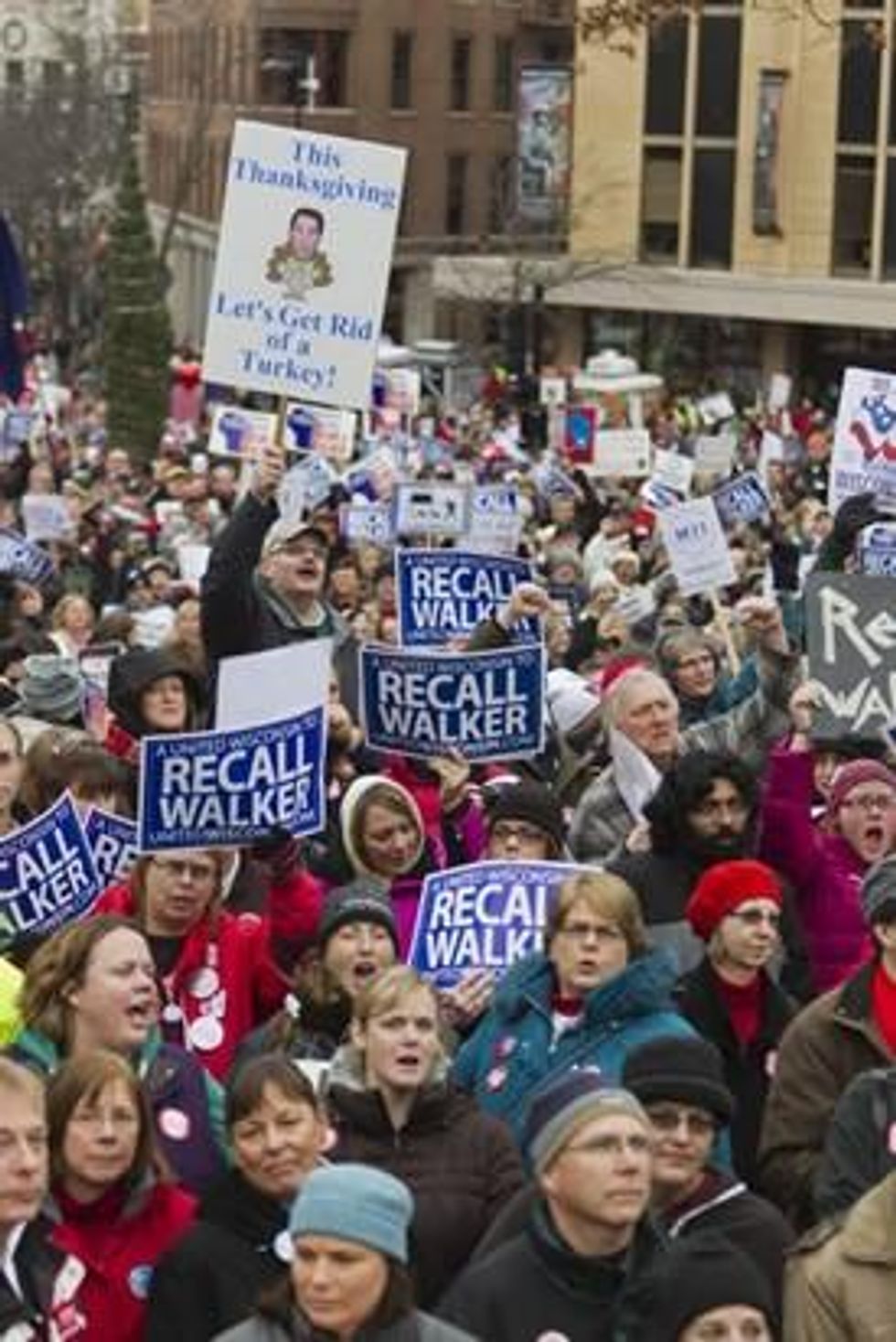
As tens of thousands of Wisconsinites rallied in Madison for a mass signing of petitions to recall anti-labor Governor Scott Walker Saturday, it was announced that the drive had collected 105,000 signatures in its first four days.
By the end of the weekend, that number will go substantially higher, say organizers of Saturday's rally, which marshalls estimated drew 40,000. (Early in the day, as the crowd was building, Capitol Police confirmed that roughly 30,000 were present and the numbers grew as units of firefighters, teachers and state, county and municipal employees poured into the Capitol Square from the edges of Madison's downtown.)
The labor, farm and community activists who organized the effort have sixty days to collect 540,000 signatures--25 percent of the electorate in the last gubernatorial election--to force the governor and Lieutenant Governor Rebecca Kleefisch to face the voters in a recall election. Organizers hope to turn in more than 700,000 signatures, in order to thwart challenges that will be posed by a multimillion-dollar effort paid for by the billionaire Koch brothers and other anti-labor zealots from across the country who have financed Walker's campaigns.
The governor and his allies have not missed any openings to try to block the recall. The Koch brothers are already paying for pro-Walker television ads put together by their Americans for Prosperity group, and the governor's campaign is spending heavily on its own ads--$300,000 since last Monday. (There are estimates that spending on Walker's behalf will exceed $50 million.) Republican legislators have moved to give the governor veto power over election rules. And the Republican Party of Wisconsin has organized a campaign to intimidate recall petitioners with a website that urges party minions to "monitor" and challenge nurses, teachers and small-business owners who seek signatures. In some cases, Walker backers have grabbed petitions and ripped them up.
But there was no evidence Saturday or Sunday that any of the governor's attempt's to protect his political career were working.
It was not just that thousands were signing recall petitions on the Capitol Square in Madison.
They were doing it in all seventy-two Wisconsin counties.
The movement to recall Governor Scott Walker and Lieutenant Governor Rebecca Kleefisch is just that: a movement. It extends across the state, to every county, to every city, village and town.
As the November 15 starting date when the movement would begin gathering petitions to recall Walker and Kleefisch approached, training sessions for petition circulators were being held in the most Republican counties of the state. More than thirty offices opened and were staffed by volunteers in communities such as Elkhorn in traditionally conservative Walworth County, where a "midnight madness" party was held last Tuesday so that petitions could be signed the minute it was possible to do so.
In the rural Lafayette County community of Darlington, local recall coordinator Kate Bausch said folks had been gearing up to recall Walker since last February, when Walker proposed to strip state, county and municipal employees and teachers of their collective bargaining rights.
The political process is sick with spin and deception. But the biggest lie of the past year has been the suggestion, peddled primarily by Walker but also by the most disingenuous of his supporters, that anger with the governor has been confined to the liberal precincts of Madison or the Democratic neighborhoods of Milwaukee.
The truth is that with his assault on collective bargaining rights, the civil service system, local democracy, school funding and public services, Walker battered every town, village, city and county in Wisconsin. And with ethical scandals that are now swirling around him--following the September FBI raid on the home of his top political appointee and the revelation that his press secretary and one of his top fund raisers had requested immunity in a "John Doe" probe of political corruption--Walker has earned the scorn even of those Wisconsinites who will never think of themselves as liberals or Democrats.
The movement to displace Walker and Kleefisch, who had served as a willing rubber-stamp for the governor, is big. The grassroots energy across the state, the size of the crowd at Saturday's rally, the number of signatures already collected: all of these confirm the historic scope and reach of the recall drive.
The movement to displace Walker and Kleefisch is broad-based. Trainings have taken place in every corner of the state. There are local committees, groups and activist circles in all of Wisconsin's seventy-two counties. The recall movement takes in Democrats, Greens, Libertarians, independents and, yes, Republicans. That's because Wisconsin's instinct for fairness is stronger than the penchant for partisanship, as state Senator Dale Schultz, R-Richland Center, confirmed when he refused to go along with efforts by Walker's legislative stooges to rig the recall process.
The response of Walker and Kleefisch partisans to Schultz's show of independence was bitter and destructive. Schultz's office in the Capitol was egged in an act of vandalism that--had it been directed at a Walker ally--would have brought cries of complaint from conservative talk-radio hosts and the Koch brothers-funded Tea Party project. But the recall movement in not prone toward that sort of whining.
Rooted as it is in the values and ideals of Wisconsin, the recall movement is genuine and determined. It has put pettiness aside and focused on the work at hand: removing a governor who has harmed the state economically, ethically and morally--and a lieutenant governor who has rejected her oath to defend the constitution and the best interests of Wisconsin.
From Kenosha in the southeast to Superior in the northwest, from the inner-city wards of Milwaukee to the crossroads towns of Marathon County, Wisconsinites are rising to the call of democracy and honest governance. They are signing petitions, circulating petitions, filing petitions and defending petitions against bogus challenges from lawyers who are paid for by the out-of-state billionaires who are funding the Walker-Kleefisch campaign. And when the petitioning is done, when the recall election is scheduled, they will mount the greatest grassroots campaign Wisconsin has seen in a century--not just to remove Walker and Kleefisch but to renew the democratic ideals of a great state that has been temporarily misled.
As tens of thousands of Wisconsinites rallied in Madison for a mass signing of petitions to recall anti-labor Governor Scott Walker Saturday, it was announced that the drive had collected 105,000 signatures in its first four days.
By the end of the weekend, that number will go substantially higher, say organizers of Saturday's rally, which marshalls estimated drew 40,000. (Early in the day, as the crowd was building, Capitol Police confirmed that roughly 30,000 were present and the numbers grew as units of firefighters, teachers and state, county and municipal employees poured into the Capitol Square from the edges of Madison's downtown.)
The labor, farm and community activists who organized the effort have sixty days to collect 540,000 signatures--25 percent of the electorate in the last gubernatorial election--to force the governor and Lieutenant Governor Rebecca Kleefisch to face the voters in a recall election. Organizers hope to turn in more than 700,000 signatures, in order to thwart challenges that will be posed by a multimillion-dollar effort paid for by the billionaire Koch brothers and other anti-labor zealots from across the country who have financed Walker's campaigns.
The governor and his allies have not missed any openings to try to block the recall. The Koch brothers are already paying for pro-Walker television ads put together by their Americans for Prosperity group, and the governor's campaign is spending heavily on its own ads--$300,000 since last Monday. (There are estimates that spending on Walker's behalf will exceed $50 million.) Republican legislators have moved to give the governor veto power over election rules. And the Republican Party of Wisconsin has organized a campaign to intimidate recall petitioners with a website that urges party minions to "monitor" and challenge nurses, teachers and small-business owners who seek signatures. In some cases, Walker backers have grabbed petitions and ripped them up.
But there was no evidence Saturday or Sunday that any of the governor's attempt's to protect his political career were working.
It was not just that thousands were signing recall petitions on the Capitol Square in Madison.
They were doing it in all seventy-two Wisconsin counties.
The movement to recall Governor Scott Walker and Lieutenant Governor Rebecca Kleefisch is just that: a movement. It extends across the state, to every county, to every city, village and town.
As the November 15 starting date when the movement would begin gathering petitions to recall Walker and Kleefisch approached, training sessions for petition circulators were being held in the most Republican counties of the state. More than thirty offices opened and were staffed by volunteers in communities such as Elkhorn in traditionally conservative Walworth County, where a "midnight madness" party was held last Tuesday so that petitions could be signed the minute it was possible to do so.
In the rural Lafayette County community of Darlington, local recall coordinator Kate Bausch said folks had been gearing up to recall Walker since last February, when Walker proposed to strip state, county and municipal employees and teachers of their collective bargaining rights.
The political process is sick with spin and deception. But the biggest lie of the past year has been the suggestion, peddled primarily by Walker but also by the most disingenuous of his supporters, that anger with the governor has been confined to the liberal precincts of Madison or the Democratic neighborhoods of Milwaukee.
The truth is that with his assault on collective bargaining rights, the civil service system, local democracy, school funding and public services, Walker battered every town, village, city and county in Wisconsin. And with ethical scandals that are now swirling around him--following the September FBI raid on the home of his top political appointee and the revelation that his press secretary and one of his top fund raisers had requested immunity in a "John Doe" probe of political corruption--Walker has earned the scorn even of those Wisconsinites who will never think of themselves as liberals or Democrats.
The movement to displace Walker and Kleefisch, who had served as a willing rubber-stamp for the governor, is big. The grassroots energy across the state, the size of the crowd at Saturday's rally, the number of signatures already collected: all of these confirm the historic scope and reach of the recall drive.
The movement to displace Walker and Kleefisch is broad-based. Trainings have taken place in every corner of the state. There are local committees, groups and activist circles in all of Wisconsin's seventy-two counties. The recall movement takes in Democrats, Greens, Libertarians, independents and, yes, Republicans. That's because Wisconsin's instinct for fairness is stronger than the penchant for partisanship, as state Senator Dale Schultz, R-Richland Center, confirmed when he refused to go along with efforts by Walker's legislative stooges to rig the recall process.
The response of Walker and Kleefisch partisans to Schultz's show of independence was bitter and destructive. Schultz's office in the Capitol was egged in an act of vandalism that--had it been directed at a Walker ally--would have brought cries of complaint from conservative talk-radio hosts and the Koch brothers-funded Tea Party project. But the recall movement in not prone toward that sort of whining.
Rooted as it is in the values and ideals of Wisconsin, the recall movement is genuine and determined. It has put pettiness aside and focused on the work at hand: removing a governor who has harmed the state economically, ethically and morally--and a lieutenant governor who has rejected her oath to defend the constitution and the best interests of Wisconsin.
From Kenosha in the southeast to Superior in the northwest, from the inner-city wards of Milwaukee to the crossroads towns of Marathon County, Wisconsinites are rising to the call of democracy and honest governance. They are signing petitions, circulating petitions, filing petitions and defending petitions against bogus challenges from lawyers who are paid for by the out-of-state billionaires who are funding the Walker-Kleefisch campaign. And when the petitioning is done, when the recall election is scheduled, they will mount the greatest grassroots campaign Wisconsin has seen in a century--not just to remove Walker and Kleefisch but to renew the democratic ideals of a great state that has been temporarily misled.
As tens of thousands of Wisconsinites rallied in Madison for a mass signing of petitions to recall anti-labor Governor Scott Walker Saturday, it was announced that the drive had collected 105,000 signatures in its first four days.
By the end of the weekend, that number will go substantially higher, say organizers of Saturday's rally, which marshalls estimated drew 40,000. (Early in the day, as the crowd was building, Capitol Police confirmed that roughly 30,000 were present and the numbers grew as units of firefighters, teachers and state, county and municipal employees poured into the Capitol Square from the edges of Madison's downtown.)
The labor, farm and community activists who organized the effort have sixty days to collect 540,000 signatures--25 percent of the electorate in the last gubernatorial election--to force the governor and Lieutenant Governor Rebecca Kleefisch to face the voters in a recall election. Organizers hope to turn in more than 700,000 signatures, in order to thwart challenges that will be posed by a multimillion-dollar effort paid for by the billionaire Koch brothers and other anti-labor zealots from across the country who have financed Walker's campaigns.
The governor and his allies have not missed any openings to try to block the recall. The Koch brothers are already paying for pro-Walker television ads put together by their Americans for Prosperity group, and the governor's campaign is spending heavily on its own ads--$300,000 since last Monday. (There are estimates that spending on Walker's behalf will exceed $50 million.) Republican legislators have moved to give the governor veto power over election rules. And the Republican Party of Wisconsin has organized a campaign to intimidate recall petitioners with a website that urges party minions to "monitor" and challenge nurses, teachers and small-business owners who seek signatures. In some cases, Walker backers have grabbed petitions and ripped them up.
But there was no evidence Saturday or Sunday that any of the governor's attempt's to protect his political career were working.
It was not just that thousands were signing recall petitions on the Capitol Square in Madison.
They were doing it in all seventy-two Wisconsin counties.
The movement to recall Governor Scott Walker and Lieutenant Governor Rebecca Kleefisch is just that: a movement. It extends across the state, to every county, to every city, village and town.
As the November 15 starting date when the movement would begin gathering petitions to recall Walker and Kleefisch approached, training sessions for petition circulators were being held in the most Republican counties of the state. More than thirty offices opened and were staffed by volunteers in communities such as Elkhorn in traditionally conservative Walworth County, where a "midnight madness" party was held last Tuesday so that petitions could be signed the minute it was possible to do so.
In the rural Lafayette County community of Darlington, local recall coordinator Kate Bausch said folks had been gearing up to recall Walker since last February, when Walker proposed to strip state, county and municipal employees and teachers of their collective bargaining rights.
The political process is sick with spin and deception. But the biggest lie of the past year has been the suggestion, peddled primarily by Walker but also by the most disingenuous of his supporters, that anger with the governor has been confined to the liberal precincts of Madison or the Democratic neighborhoods of Milwaukee.
The truth is that with his assault on collective bargaining rights, the civil service system, local democracy, school funding and public services, Walker battered every town, village, city and county in Wisconsin. And with ethical scandals that are now swirling around him--following the September FBI raid on the home of his top political appointee and the revelation that his press secretary and one of his top fund raisers had requested immunity in a "John Doe" probe of political corruption--Walker has earned the scorn even of those Wisconsinites who will never think of themselves as liberals or Democrats.
The movement to displace Walker and Kleefisch, who had served as a willing rubber-stamp for the governor, is big. The grassroots energy across the state, the size of the crowd at Saturday's rally, the number of signatures already collected: all of these confirm the historic scope and reach of the recall drive.
The movement to displace Walker and Kleefisch is broad-based. Trainings have taken place in every corner of the state. There are local committees, groups and activist circles in all of Wisconsin's seventy-two counties. The recall movement takes in Democrats, Greens, Libertarians, independents and, yes, Republicans. That's because Wisconsin's instinct for fairness is stronger than the penchant for partisanship, as state Senator Dale Schultz, R-Richland Center, confirmed when he refused to go along with efforts by Walker's legislative stooges to rig the recall process.
The response of Walker and Kleefisch partisans to Schultz's show of independence was bitter and destructive. Schultz's office in the Capitol was egged in an act of vandalism that--had it been directed at a Walker ally--would have brought cries of complaint from conservative talk-radio hosts and the Koch brothers-funded Tea Party project. But the recall movement in not prone toward that sort of whining.
Rooted as it is in the values and ideals of Wisconsin, the recall movement is genuine and determined. It has put pettiness aside and focused on the work at hand: removing a governor who has harmed the state economically, ethically and morally--and a lieutenant governor who has rejected her oath to defend the constitution and the best interests of Wisconsin.
From Kenosha in the southeast to Superior in the northwest, from the inner-city wards of Milwaukee to the crossroads towns of Marathon County, Wisconsinites are rising to the call of democracy and honest governance. They are signing petitions, circulating petitions, filing petitions and defending petitions against bogus challenges from lawyers who are paid for by the out-of-state billionaires who are funding the Walker-Kleefisch campaign. And when the petitioning is done, when the recall election is scheduled, they will mount the greatest grassroots campaign Wisconsin has seen in a century--not just to remove Walker and Kleefisch but to renew the democratic ideals of a great state that has been temporarily misled.