

Between 1979 and 2007, the income share of the top 1% of U.S. households (by income rank) more than doubled, to over 17% of total U.S. income. Meanwhile, the income share of the bottom 80% dropped from 57% to 48% of total income. "We are the 99%," the rallying cry of the #OccupyWallStreet movement, does a good job at calling attention to the dramatic increase of incomes for those at the very top--and the stagnation of incomes for the majority.
This way of looking at income distribution, however, does not explicitly focus on the different sources of people's incomes. Most people get nearly all of their incomes--wages and salaries, as well as employment benefits--by working for someone else. A few people, on the other hand, get much of their income not from work but from ownership of property--profits from a business, dividends from stock, interest income from bonds, rents on land or structures, and so on. People with large property incomes may also draw large salaries or bonuses, especially from managerial jobs. Executive pay, though treated in official government statistics as labor income, derives from control over business firms and really should be counted as property income.
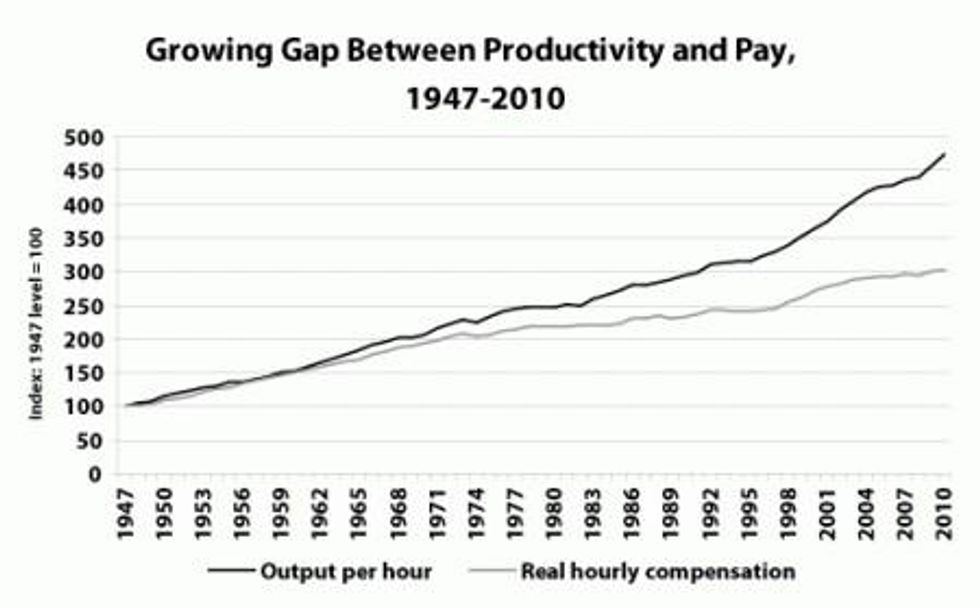
Over the last forty years, the distribution of income in the United States has tilted in favor of capitalists (including business owners, stock- and bondholders, and corporate executives) and against workers. Between the 1940s and 1960s, U.S. workers' hourly output ("average labor productivity") and workers' real hourly compensation both grew at about 3% per year, so the distribution of income between workers and capitalists changed relatively little. (If the size of a pie doubles, and the size of your slice also doubles, your share of the pie does not change.) Since the 1970s, productivity has kept growing at over 2% per year. Average hourly compensation, however, has stagnated--growing only about 1% per year (see figure below). As the gap between what workers produce and what they get paid has increased, workers' share of total income has fallen, and capitalists' share has increased. Since income from property is overwhelmingly concentrated at the top of the income scale, this has helped fuel the rising income share of "the 1%."
The spectacular rise in some types of income--like bank profits or executive compensation--has provoked widespread outrage. Lower financial profits or CEO pay, however, will not reverse the trend toward greater inequality if the result is only to swell, say, profits for nonfinancial corporations or dividends for wealthy shareholders. Focusing too much on one or another kind of property income distracts from the fact that the overall property-income share has been growing at workers' expense.
Workers and employers--whether they like it or not, recognize it or not, prepare for it or not--are locked in a class struggle. Employers in the United States and other countries, over the last few decades, have recognized that they were in a war and prepared for it. They have been fighting and winning. Workers will only regain what they have lost if they can rebuild their collective fighting strength. In the era of globalized capitalism, this means not only building up labor movements in individual countries, but also creating practical solidarity between workers around the world.
A labor resurgence could end workers' decades-long losing streak at the hands of employers and help reverse the tide of rising inequality. Ultimately, though, this struggle should be about more than just getting a better deal. It should be--and can be--about the possibility of building a new kind of society. The monstrous inequalities of capitalism are plain to see. The need for an appealing alternative--a vision of a cooperative, democratic, and egalitarian way of life--is equally stark.
Between 1979 and 2007, the income share of the top 1% of U.S. households (by income rank) more than doubled, to over 17% of total U.S. income. Meanwhile, the income share of the bottom 80% dropped from 57% to 48% of total income. "We are the 99%," the rallying cry of the #OccupyWallStreet movement, does a good job at calling attention to the dramatic increase of incomes for those at the very top--and the stagnation of incomes for the majority.
This way of looking at income distribution, however, does not explicitly focus on the different sources of people's incomes. Most people get nearly all of their incomes--wages and salaries, as well as employment benefits--by working for someone else. A few people, on the other hand, get much of their income not from work but from ownership of property--profits from a business, dividends from stock, interest income from bonds, rents on land or structures, and so on. People with large property incomes may also draw large salaries or bonuses, especially from managerial jobs. Executive pay, though treated in official government statistics as labor income, derives from control over business firms and really should be counted as property income.
Over the last forty years, the distribution of income in the United States has tilted in favor of capitalists (including business owners, stock- and bondholders, and corporate executives) and against workers. Between the 1940s and 1960s, U.S. workers' hourly output ("average labor productivity") and workers' real hourly compensation both grew at about 3% per year, so the distribution of income between workers and capitalists changed relatively little. (If the size of a pie doubles, and the size of your slice also doubles, your share of the pie does not change.) Since the 1970s, productivity has kept growing at over 2% per year. Average hourly compensation, however, has stagnated--growing only about 1% per year (see figure below). As the gap between what workers produce and what they get paid has increased, workers' share of total income has fallen, and capitalists' share has increased. Since income from property is overwhelmingly concentrated at the top of the income scale, this has helped fuel the rising income share of "the 1%."
The spectacular rise in some types of income--like bank profits or executive compensation--has provoked widespread outrage. Lower financial profits or CEO pay, however, will not reverse the trend toward greater inequality if the result is only to swell, say, profits for nonfinancial corporations or dividends for wealthy shareholders. Focusing too much on one or another kind of property income distracts from the fact that the overall property-income share has been growing at workers' expense.
Workers and employers--whether they like it or not, recognize it or not, prepare for it or not--are locked in a class struggle. Employers in the United States and other countries, over the last few decades, have recognized that they were in a war and prepared for it. They have been fighting and winning. Workers will only regain what they have lost if they can rebuild their collective fighting strength. In the era of globalized capitalism, this means not only building up labor movements in individual countries, but also creating practical solidarity between workers around the world.
A labor resurgence could end workers' decades-long losing streak at the hands of employers and help reverse the tide of rising inequality. Ultimately, though, this struggle should be about more than just getting a better deal. It should be--and can be--about the possibility of building a new kind of society. The monstrous inequalities of capitalism are plain to see. The need for an appealing alternative--a vision of a cooperative, democratic, and egalitarian way of life--is equally stark.
Between 1979 and 2007, the income share of the top 1% of U.S. households (by income rank) more than doubled, to over 17% of total U.S. income. Meanwhile, the income share of the bottom 80% dropped from 57% to 48% of total income. "We are the 99%," the rallying cry of the #OccupyWallStreet movement, does a good job at calling attention to the dramatic increase of incomes for those at the very top--and the stagnation of incomes for the majority.
This way of looking at income distribution, however, does not explicitly focus on the different sources of people's incomes. Most people get nearly all of their incomes--wages and salaries, as well as employment benefits--by working for someone else. A few people, on the other hand, get much of their income not from work but from ownership of property--profits from a business, dividends from stock, interest income from bonds, rents on land or structures, and so on. People with large property incomes may also draw large salaries or bonuses, especially from managerial jobs. Executive pay, though treated in official government statistics as labor income, derives from control over business firms and really should be counted as property income.
Over the last forty years, the distribution of income in the United States has tilted in favor of capitalists (including business owners, stock- and bondholders, and corporate executives) and against workers. Between the 1940s and 1960s, U.S. workers' hourly output ("average labor productivity") and workers' real hourly compensation both grew at about 3% per year, so the distribution of income between workers and capitalists changed relatively little. (If the size of a pie doubles, and the size of your slice also doubles, your share of the pie does not change.) Since the 1970s, productivity has kept growing at over 2% per year. Average hourly compensation, however, has stagnated--growing only about 1% per year (see figure below). As the gap between what workers produce and what they get paid has increased, workers' share of total income has fallen, and capitalists' share has increased. Since income from property is overwhelmingly concentrated at the top of the income scale, this has helped fuel the rising income share of "the 1%."
The spectacular rise in some types of income--like bank profits or executive compensation--has provoked widespread outrage. Lower financial profits or CEO pay, however, will not reverse the trend toward greater inequality if the result is only to swell, say, profits for nonfinancial corporations or dividends for wealthy shareholders. Focusing too much on one or another kind of property income distracts from the fact that the overall property-income share has been growing at workers' expense.
Workers and employers--whether they like it or not, recognize it or not, prepare for it or not--are locked in a class struggle. Employers in the United States and other countries, over the last few decades, have recognized that they were in a war and prepared for it. They have been fighting and winning. Workers will only regain what they have lost if they can rebuild their collective fighting strength. In the era of globalized capitalism, this means not only building up labor movements in individual countries, but also creating practical solidarity between workers around the world.
A labor resurgence could end workers' decades-long losing streak at the hands of employers and help reverse the tide of rising inequality. Ultimately, though, this struggle should be about more than just getting a better deal. It should be--and can be--about the possibility of building a new kind of society. The monstrous inequalities of capitalism are plain to see. The need for an appealing alternative--a vision of a cooperative, democratic, and egalitarian way of life--is equally stark.