SUBSCRIBE TO OUR FREE NEWSLETTER
Daily news & progressive opinion—funded by the people, not the corporations—delivered straight to your inbox.
5
#000000
#FFFFFF
To donate by check, phone, or other method, see our More Ways to Give page.
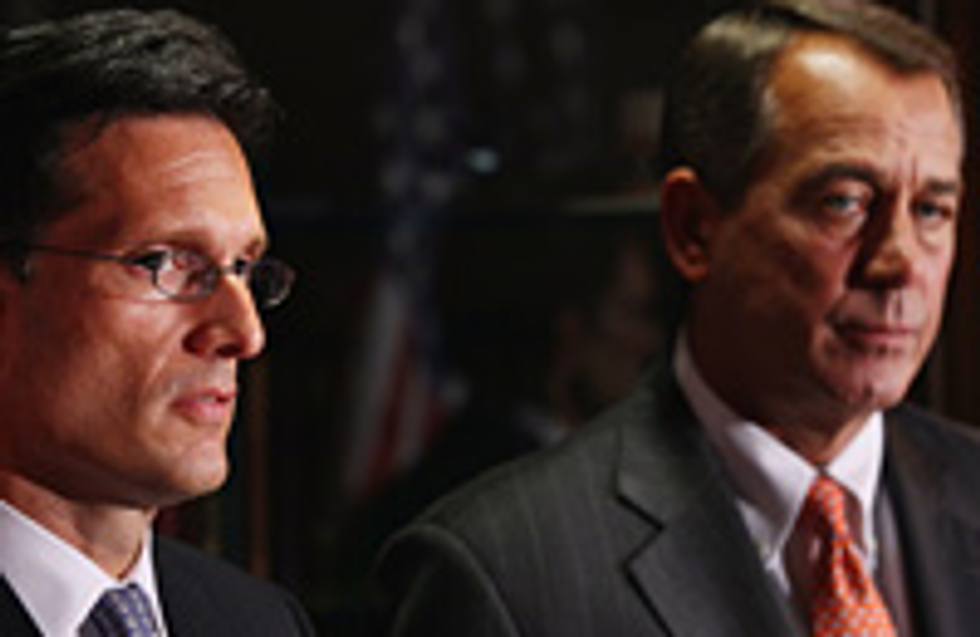
John Boehner said Tuesday the Republicans got "90 percent of what we wanted" from the budget deal. So presumably he and his colleagues are willing to take responsibility for some 450 points of today's mammoth 513-point drop in the Dow Jones Industrial Average.
I'm being a bit facetious - but only a bit. It's always dangerous to read too much into one day's move in the stock market.
Yet the stock sell-off - not just today's, but that of the last days - cannot be easily dismissed. It marks Wall Street's largest losing streak since 2008.
Republicans repeatedly assured the nation that once the debt-limit deal was done - capping spending, cutting the budget deficit, and getting "90 percent" of what they wanted -- the economy would bounce back.
Just the opposite seems to be happening.
Call it the Republican's double-dip recession.
Wall Street investors aren't ideologues. They don't obsess about budget deficits ten years from now, or the size of the government. One day doesn't make a trend, but a giant sell-off like this is motivated by hard, cold realities.
Here are the two hard, cold realities investors are most worried about:
First, the economy looks like it's dead in the water. The Commerce Department reports almost no growth in the first half of the year. And job growth is just about at a standstill. Far fewer jobs were generated in May and June than necessary just to keep up with the growth in the potential labor force - meaning the employment picture is actually worsening. Investors fear tomorrow's (Friday's) jobs report for July will show more of the same.
Secondly, investors now know the federal government's hands are tied. The original stimulus is over; the Fed's "quantitative easing" is over.
This week's deal over the debt ceiling cinches it. The market is now on its own -- without enough rocket power get out of the continuing gravitational pull of the Great Recession.
Now that the deal is done, Obama and the Democrats will have a much harder time passing anything close to the stimulus necessary to breach the gap between what consumers (who are 70 percent of the economy) are willing to spend and what the economy can produce at or near full-employment.
Not incidentally, the Commerce Department's revised data for what happened to the economy in 2008 and 2009 shows the drop to have been far greater than had been supposed. The economy plunged 8.9 percent in the fourth quarter of 2008 - the steepest quarterly decline in more than half a century. And in 2009 household buying declined almost 2 percent (compared with a previous estimate of 1.2 percent). That's the biggest contraction in almost sixty years.
This means the original stimulus should have been much larger in order to offset the drop. With cash-starved state and local governments simultaneously scaling back their own spending, the federal stimulus needed to be even bigger.
So much for Republican claims that the original stimulus "didn't work." Of course it didn't, given the size of the slide.
It was never a debt crisis. The debt crisis was manufactured. It's been a jobs, wages, and growth crisis all along. And that reality has finally caught up with us.
Now that we're slouching toward a double-dip recession, the only hope is voters will tell their members of Congress - who are now on recess back home - to stop obsessing about future budget deficits and get to work on the real crisis of unemployment, falling wages, and no growth.
We need a bold jobs bill to restart the economy. Eliminate payroll taxes on the first $20,000 of income for two years. Recreate the WPA and the Civilian Conservation Corps. The federal government should lend money to cash-strapped states and local governments. Give employers tax credits for net new jobs. Amend the bankruptcy laws to allow distressed homeowners to declare bankruptcy on their primary residence. Extend unemployment insurance. Provide partial unemployment benefits to people who have lost part-time jobs. Start an infrastructure bank.
And more.
The jobs bill should be number one on the nation's agenda. It should have been all along.
John Boehner said Tuesday the Republicans got "90 percent of what we wanted" from the budget deal. So presumably he and his colleagues are willing to take responsibility for some 450 points of today's mammoth 513-point drop in the Dow Jones Industrial Average.
I'm being a bit facetious - but only a bit. It's always dangerous to read too much into one day's move in the stock market.
Yet the stock sell-off - not just today's, but that of the last days - cannot be easily dismissed. It marks Wall Street's largest losing streak since 2008.
Republicans repeatedly assured the nation that once the debt-limit deal was done - capping spending, cutting the budget deficit, and getting "90 percent" of what they wanted -- the economy would bounce back.
Just the opposite seems to be happening.
Call it the Republican's double-dip recession.
Wall Street investors aren't ideologues. They don't obsess about budget deficits ten years from now, or the size of the government. One day doesn't make a trend, but a giant sell-off like this is motivated by hard, cold realities.
Here are the two hard, cold realities investors are most worried about:
First, the economy looks like it's dead in the water. The Commerce Department reports almost no growth in the first half of the year. And job growth is just about at a standstill. Far fewer jobs were generated in May and June than necessary just to keep up with the growth in the potential labor force - meaning the employment picture is actually worsening. Investors fear tomorrow's (Friday's) jobs report for July will show more of the same.
Secondly, investors now know the federal government's hands are tied. The original stimulus is over; the Fed's "quantitative easing" is over.
This week's deal over the debt ceiling cinches it. The market is now on its own -- without enough rocket power get out of the continuing gravitational pull of the Great Recession.
Now that the deal is done, Obama and the Democrats will have a much harder time passing anything close to the stimulus necessary to breach the gap between what consumers (who are 70 percent of the economy) are willing to spend and what the economy can produce at or near full-employment.
Not incidentally, the Commerce Department's revised data for what happened to the economy in 2008 and 2009 shows the drop to have been far greater than had been supposed. The economy plunged 8.9 percent in the fourth quarter of 2008 - the steepest quarterly decline in more than half a century. And in 2009 household buying declined almost 2 percent (compared with a previous estimate of 1.2 percent). That's the biggest contraction in almost sixty years.
This means the original stimulus should have been much larger in order to offset the drop. With cash-starved state and local governments simultaneously scaling back their own spending, the federal stimulus needed to be even bigger.
So much for Republican claims that the original stimulus "didn't work." Of course it didn't, given the size of the slide.
It was never a debt crisis. The debt crisis was manufactured. It's been a jobs, wages, and growth crisis all along. And that reality has finally caught up with us.
Now that we're slouching toward a double-dip recession, the only hope is voters will tell their members of Congress - who are now on recess back home - to stop obsessing about future budget deficits and get to work on the real crisis of unemployment, falling wages, and no growth.
We need a bold jobs bill to restart the economy. Eliminate payroll taxes on the first $20,000 of income for two years. Recreate the WPA and the Civilian Conservation Corps. The federal government should lend money to cash-strapped states and local governments. Give employers tax credits for net new jobs. Amend the bankruptcy laws to allow distressed homeowners to declare bankruptcy on their primary residence. Extend unemployment insurance. Provide partial unemployment benefits to people who have lost part-time jobs. Start an infrastructure bank.
And more.
The jobs bill should be number one on the nation's agenda. It should have been all along.
John Boehner said Tuesday the Republicans got "90 percent of what we wanted" from the budget deal. So presumably he and his colleagues are willing to take responsibility for some 450 points of today's mammoth 513-point drop in the Dow Jones Industrial Average.
I'm being a bit facetious - but only a bit. It's always dangerous to read too much into one day's move in the stock market.
Yet the stock sell-off - not just today's, but that of the last days - cannot be easily dismissed. It marks Wall Street's largest losing streak since 2008.
Republicans repeatedly assured the nation that once the debt-limit deal was done - capping spending, cutting the budget deficit, and getting "90 percent" of what they wanted -- the economy would bounce back.
Just the opposite seems to be happening.
Call it the Republican's double-dip recession.
Wall Street investors aren't ideologues. They don't obsess about budget deficits ten years from now, or the size of the government. One day doesn't make a trend, but a giant sell-off like this is motivated by hard, cold realities.
Here are the two hard, cold realities investors are most worried about:
First, the economy looks like it's dead in the water. The Commerce Department reports almost no growth in the first half of the year. And job growth is just about at a standstill. Far fewer jobs were generated in May and June than necessary just to keep up with the growth in the potential labor force - meaning the employment picture is actually worsening. Investors fear tomorrow's (Friday's) jobs report for July will show more of the same.
Secondly, investors now know the federal government's hands are tied. The original stimulus is over; the Fed's "quantitative easing" is over.
This week's deal over the debt ceiling cinches it. The market is now on its own -- without enough rocket power get out of the continuing gravitational pull of the Great Recession.
Now that the deal is done, Obama and the Democrats will have a much harder time passing anything close to the stimulus necessary to breach the gap between what consumers (who are 70 percent of the economy) are willing to spend and what the economy can produce at or near full-employment.
Not incidentally, the Commerce Department's revised data for what happened to the economy in 2008 and 2009 shows the drop to have been far greater than had been supposed. The economy plunged 8.9 percent in the fourth quarter of 2008 - the steepest quarterly decline in more than half a century. And in 2009 household buying declined almost 2 percent (compared with a previous estimate of 1.2 percent). That's the biggest contraction in almost sixty years.
This means the original stimulus should have been much larger in order to offset the drop. With cash-starved state and local governments simultaneously scaling back their own spending, the federal stimulus needed to be even bigger.
So much for Republican claims that the original stimulus "didn't work." Of course it didn't, given the size of the slide.
It was never a debt crisis. The debt crisis was manufactured. It's been a jobs, wages, and growth crisis all along. And that reality has finally caught up with us.
Now that we're slouching toward a double-dip recession, the only hope is voters will tell their members of Congress - who are now on recess back home - to stop obsessing about future budget deficits and get to work on the real crisis of unemployment, falling wages, and no growth.
We need a bold jobs bill to restart the economy. Eliminate payroll taxes on the first $20,000 of income for two years. Recreate the WPA and the Civilian Conservation Corps. The federal government should lend money to cash-strapped states and local governments. Give employers tax credits for net new jobs. Amend the bankruptcy laws to allow distressed homeowners to declare bankruptcy on their primary residence. Extend unemployment insurance. Provide partial unemployment benefits to people who have lost part-time jobs. Start an infrastructure bank.
And more.
The jobs bill should be number one on the nation's agenda. It should have been all along.